August 8, 2026
The Hidden Architecture of the Glencore Sydney Listing and Rio Tinto Merger Calculus
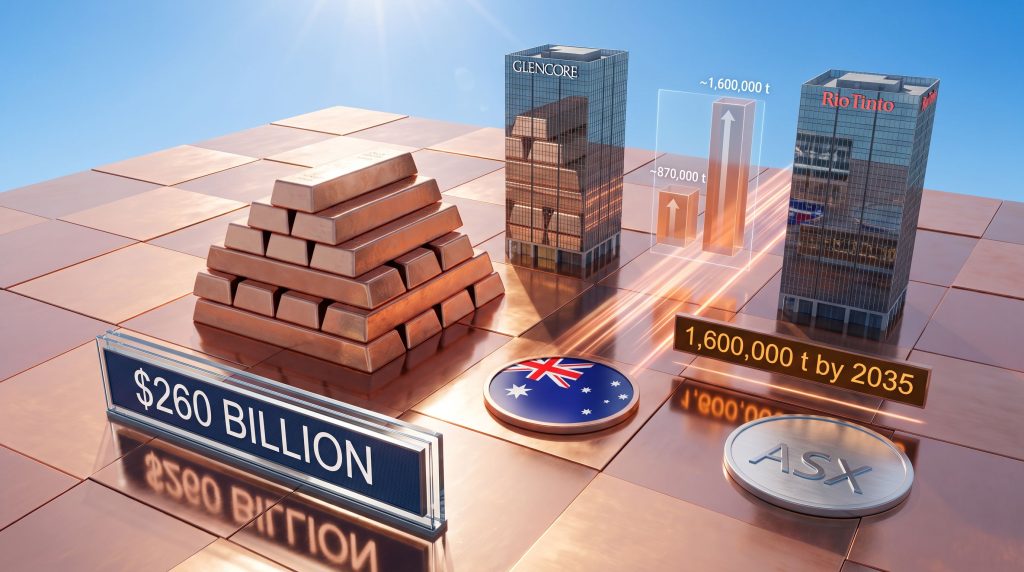
When two of the world's largest mining groups come within reach of a $260 billion merger and then step back, the question investors should be asking is not whether the deal is dead. It is where the pieces are being repositioned for the next move. The Glencore Sydney listing and Rio Tinto merger calculus reveals how capital markets rarely act in isolation from corporate strategy, and a secondary listing that costs almost nothing to execute but delivers substantial strategic optionality deserves far closer examination than a routine exchange announcement would suggest.
When big ASX news breaks, our subscribers know first
What a Secondary Listing Actually Does, and Does Not, Do
The mechanics of a secondary listing are frequently misunderstood by retail investors. Unlike a primary IPO, a secondary listing on the Australian Securities Exchange (ASX) involves no new share issuance, no dilution of existing shareholders, and no fresh capital flowing into the listing company. It is, at its operational core, a profile exercise. The shares that trade are already in existence. The exchange simply becomes an additional venue where those shares can be bought and sold.
Glencore's planned ASX admission, targeting approximately October 2026, fits this structure precisely. The company is not raising money in Sydney. It is raising its hand.
What This Achieves Structurally
What this achieves, however, is structurally significant:
- ASX-listed securities become eligible for inclusion in domestic index funds and superannuation mandates that require locally listed exposure
- Institutional Australian investors who are restricted from holding foreign-listed equities gain access to Glencore's share register
- The company enters the daily analytical framework of Australia's mining-sector research community
- Brand recognition builds among retail investors who follow the ASX resources sector
For a company of Glencore's scale, valued at approximately $87 billion, the cost of achieving all of this through a secondary listing is negligible. The strategic asymmetry, furthermore, is considerable.
Australia's Mining Capital Pool: Deeper Than Most Global Investors Appreciate
One of the less-appreciated dimensions of the Glencore Sydney listing and Rio Tinto merger dynamic is the sheer depth of Australia's mining-sector capital infrastructure. The country's compulsory superannuation system, which mandates employer contributions into retirement savings funds, has created one of the largest pools of institutionally managed capital relative to GDP anywhere in the world.
Critically, Australian superannuation funds have historically maintained structurally elevated allocations to resources equities. This is not simply cultural preference. It reflects the genuine weight of mining in Australia's economic output, its export revenue, and its equity market composition. Resources companies have represented a disproportionately large share of ASX market sectors for decades.
The domestic copper investment landscape, however, has contracted meaningfully through successive rounds of M&A activity. Several standalone copper-focused listings have been absorbed into larger groups or delisted entirely, leaving Australian institutional investors with fewer domestic vehicles through which to express copper conviction. Glencore's arrival would consequently fill a meaningful gap in that landscape.
The exchange itself characterised Glencore's listing choice as a source of institutional delight, a reaction that signals how significant the addition of an $87 billion diversified miner and commodities trading group would be for the ASX's resources ecosystem.
The $260 Billion Collapse: Understanding What Actually Went Wrong
To understand why the Glencore Sydney listing carries strategic weight beyond investor relations, it is necessary to understand what the failed Rio Tinto merger actually represented and why it fell apart. Both Rio Tinto and Glencore released formal statements confirming the end of merger discussions.
The proposed combination would have been the largest transaction in mining history, uniting two fundamentally different business models under a single corporate structure. Rio Tinto operates primarily as a pure-mining group, deriving value from asset quality, scale, and capital discipline. Glencore, by contrast, operates as both a mining company and a commodities trading house, with its marketing division generating returns that are structurally different in nature and risk profile from production-based earnings.
| Breakdown Factor | Detail |
|---|---|
| Valuation Disagreement | Rio's board determined proposed terms failed to deliver sufficient shareholder value |
| Business Model Divergence | Trading-dominant model versus pure-mining model created integration complexity |
| Portfolio Alignment | Combining coal, copper, iron ore, aluminium, and cobalt assets required complex rationalisation |
| Antitrust Exposure | A $260 billion combination would have faced extensive global regulatory scrutiny |
| Governance Conflict | Shareholder value frameworks differed materially between the two organisations |
Talks collapsed in February 2026. Rio Tinto publicly confirmed it no longer intended to pursue any form of business combination with Glencore. That public withdrawal triggered a mechanism under the UK Takeover Code that most market participants have since paid insufficient attention to. The Rio delisting impact on investor sentiment across the ASX resources sector was, furthermore, immediate and broadly felt.
The UK Takeover Code Standstill: The Regulatory Clock Everyone Should Be Watching
Under the UK Takeover Code, when a potential acquirer formally withdraws from merger discussions, a standstill period is automatically triggered. During this window, the withdrawing party is prohibited from making a new formal bid for the target company, with limited exceptions.
Rio Tinto's February 2026 withdrawal initiated a six-month standstill period, which places its expiry around August 2026. The Glencore ASX listing was announced against this backdrop, with a target completion date of approximately October 2026.
The Sequence That Markets Are Watching
The sequencing is precise:
- February 2026: Rio Tinto formally withdraws from merger discussions
- February to August 2026: UK Takeover Code standstill period in effect
- Around August 2026: Standstill period expires, formal approaches become legally permissible again
- October 2026 (target): Glencore's ASX listing completes, embedding the company within Australia's institutional investor ecosystem
The regulatory standstill mechanism exists to protect target shareholders from serial bidding fatigue. But it also functions as a defined countdown, one that sophisticated market participants track with considerable attention.
Analysts at both Jefferies and RBC Capital Markets have independently flagged the M&A optionality embedded in this sequence. Jefferies noted that an ASX listing could make it easier for Glencore to pursue large-scale M&A with Australian-listed companies. RBC Capital Markets analysts observed that the listing appeared designed to raise Glencore's profile among Australian investors, which would be particularly relevant if the two companies decided to revisit a potential merger.
When two independent research houses arrive at the same M&A interpretation from the same corporate action, the market is pricing a non-trivial probability of renewed deal activity, regardless of what management communications suggest. Australian mining M&A patterns, moreover, suggest that Australian mining M&A activity of this scale typically reshapes sector dynamics for years afterward.
What Management Says, and What the Market Hears
CEO Gary Nagle has been consistent in his public framing: the company's strategic priority is organic copper growth, not M&A, and a secondary ASX listing would make no substantive difference to any potential future discussions with Rio Tinto. Australia, in his framing, simply offers access to a highly sophisticated investor base that is well-suited to understanding Glencore's long-term copper thesis.
This is standard corporate communications discipline during sensitive pre-deal periods. What matters analytically is not the message but the structure being built underneath it.
The shareholder base alignment dynamic is the most analytically underappreciated element of the entire situation. If major Australian superannuation funds accumulate positions in both Rio Tinto, which is already ASX-listed, and Glencore following its Sydney listing, those shared institutional investors would hold direct financial exposure to both sides of any potential future merger negotiation.
Shared institutional shareholders in large-cap mining M&A have historically functioned as informal facilitators. Their financial interest in value-accretive outcomes reduces adversarial tension between bidder and target shareholder registers, creates natural back-channels for constructive negotiation, and can accelerate the timeline from first approach to agreed terms.
The next major ASX story will hit our subscribers first
Copper's Role: The Industrial Thesis That Makes the Listing Commercially Coherent
Regardless of the M&A subtext, Glencore's copper growth ambition provides a standalone commercial rationale for the ASX listing that would hold even if the Rio Tinto merger question never resurfaced. The ongoing copper supply crunch has, in addition, significantly strengthened the investment case for large-scale copper producers.
| Glencore Copper Production Metrics | Figure |
|---|---|
| Current Annual Output | ~870,000 tonnes |
| 2035 Production Target | ~1,600,000 tonnes |
| Required Growth | More than 83% over approximately 10 years |
| Key Demand Driver | Electrification infrastructure, EV networks, grid-scale renewables |
Copper's structural demand profile has strengthened materially over the past decade. As the primary conductor metal for electrical systems, it sits at the centre of every major electrification trend, from EV charging infrastructure to grid-scale battery storage and renewable energy transmission. Supply-side constraints, including declining ore grades at many of the world's largest copper mines, deepening mine depths, and extended permitting timelines for new discoveries, have created a supply-demand dynamic that many analysts expect to persist through the 2030s.
Australian superannuation funds, which have demonstrated strong and sustained appetite for copper-exposed equities, represent the ideal long-duration capital for a company pursuing an 83% production increase over a decade-long horizon. These investors are not seeking short-term trading returns. They are seeking structural exposure to energy transition minerals, held through a globally credible operator.
Glencore's copper portfolio spans multiple continents, including significant operations in South America and Africa, giving the company both geographic diversification and exposure to some of the world's most resource-endowed copper belts.
Three Scenarios for What Comes Next
Scenario A: Standalone ASX Listing, No Renewed Merger
The listing completes in October 2026, Glencore builds its Australian investor base, and the Rio Tinto question remains dormant. This is the officially stated outcome. It is also the least interesting from a capital markets perspective.
Scenario B: Targeted Asset Combination or Joint Venture
Rather than pursuing a full corporate merger, the two companies explore a more surgical combination focused on copper and battery minerals assets. This would sidestep the valuation complexity and antitrust exposure that derailed the full merger while still delivering meaningful synergies. Geographies like South America and Africa, where both companies hold significant positions, would be logical candidates for structured collaboration.
Scenario C: Renewed Full Merger Attempt Post-Standstill
With the standstill expiring around August 2026 and the ASX listing completing shortly after, the conditions exist for a renewed formal approach. Whether it proceeds would depend on copper price trajectory, iron ore market conditions, and the willingness of Rio Tinto's board to revisit terms that previously failed their shareholder value threshold.
None of these pathways are confirmed or under active negotiation based on publicly available information. They represent the analytical range of outcomes that the market is assigning probability to based on the structural signals available.
What the Glencore Sydney Listing and Rio Tinto Merger Mean for the ASX Resources Sector
The broader implication for Australia's equity market is straightforward but significant. The ASX resources sector has thinned through consolidation over the past decade. Large-cap copper and diversified mining listings have been absorbed, restructured, or delisted at a rate that has outpaced the arrival of new major entrants.
Glencore's arrival would represent one of the most consequential additions to the ASX resources index in recent memory. For domestic investors, it creates a new large-cap copper vehicle with global scale, a proven trading operation, and a production growth trajectory directly aligned with the energy transition. For the exchange itself, it signals that the ASX remains a credible venue for globally significant mining companies, even as resource sector consolidation continues to reshape the competitive landscape.
The Glencore Sydney listing and Rio Tinto merger question may ultimately resolve in ways that surprise both bulls and sceptics. However, the structural positioning underway, the regulatory countdown, the investor base alignment, and the copper growth narrative are not accidental. They are the architecture of a company ensuring it has maximum optionality when the clock runs out.
This article is for informational purposes only and does not constitute financial advice. Forward-looking statements, scenario modelling, and analyst commentary referenced herein involve inherent uncertainty. Readers should conduct independent research and seek professional advice before making investment decisions.
Want to Stay Ahead of Major ASX Mining Discoveries Before the Broader Market?
Discovery Alert's proprietary Discovery IQ model delivers real-time alerts on significant ASX mineral discoveries, instantly converting complex commodities data across more than 30 sectors into clear, actionable insights for both short-term traders and long-term investors. Explore how historic discoveries have generated substantial returns on Discovery Alert's dedicated discoveries page, and begin your 14-day free trial today to secure a genuine market-leading advantage.