May 22, 2026
The Aluminium Bottleneck That No One Talks About
The global aluminium industry has a processing problem that raw material statistics alone cannot reveal. Bauxite, the reddish ore from which aluminium ultimately derives, is abundant across multiple continents. Yet the critical bottleneck sits one step downstream: alumina refining. Converting bauxite into aluminium oxide, the intermediate feedstock that smelters require, demands enormous quantities of energy, caustic chemicals, and specialised infrastructure. Whoever controls this mid-stream conversion stage exercises significant leverage over the entire aluminium value chain, regardless of who digs the ore from the ground.
That structural reality explains, more than any single policy or trade agreement, why the Chalco alumina project in Guinea represents a genuinely consequential development in global metals markets, not simply another overseas mining announcement.
When big ASX news breaks, our subscribers know first
Guinea's Bauxite Geology: Why This West African Nation Holds Extraordinary Leverage
The Lateritic Advantage That Sets Guinea Apart
Most casual observers understand that Guinea sits atop massive bauxite reserves. What receives far less attention is why those deposits are particularly valuable from a processing standpoint. Guinea's bauxite formations are the product of deep lateritic weathering acting on ancient basement rocks of the West African Craton over tens of millions of years. This geological process has concentrated aluminium oxide content to levels typically ranging between 52% and 62%, while simultaneously leaching away many of the impurities that complicate refinery operations.
Silica content, one of the most problematic impurities in bauxite processing, typically sits at just 2-4% in Guinea's deposits. By comparison, many Australian bauxite deposits carry silica levels of 5-12%. This distinction matters enormously for refinery economics: elevated reactive silica consumes caustic soda during the Bayer process, directly inflating operating costs and reducing recovery yields. Guinea's mineralogy, in this sense, delivers a structural cost advantage before a single tonne of ore has been processed.
The Boffa region, where the Chalco alumina project in Guinea is anchored, sits within this high-grade bauxite corridor. Chalco secured mining rights to the Boffa North and South deposits through a mining agreement signed in 2018, establishing an operational foundation well before the alumina refinery concept reached board-level consideration. Furthermore, global bauxite production trends increasingly point toward Guinea as a preferred source owing to this superior ore quality.
From Raw Ore Exporter to Industrial Processor: Guinea's Policy Shift
For decades, Guinea exported the vast majority of its bauxite in raw form, effectively subsidising alumina refining industries in China, Australia, and elsewhere while capturing only modest revenues relative to the deposits' underlying value. Guinean authorities have progressively moved to correct this arrangement by conditioning sustained bauxite access on commitments to build in-country processing infrastructure.
This policy posture reflects a structural shift seen across multiple resource-rich African nations, where governments have grown increasingly sophisticated in their understanding of commodity value chains and less willing to accept pure extraction relationships. The pressure to refine bauxite domestically into alumina before export has reshaped how operators structure long-term concession agreements, effectively making in-country value addition a prerequisite for mining access rather than an optional add-on.
Guinea's government has been actively requiring mining companies to commit to in-country alumina refinery development as a condition of sustained bauxite access, a regulatory dynamic that directly shaped the structure and timing of Chalco's investment commitment.
What the Chalco Alumina Project in Guinea Actually Involves
Project Specifications and the Bayer Process Foundation
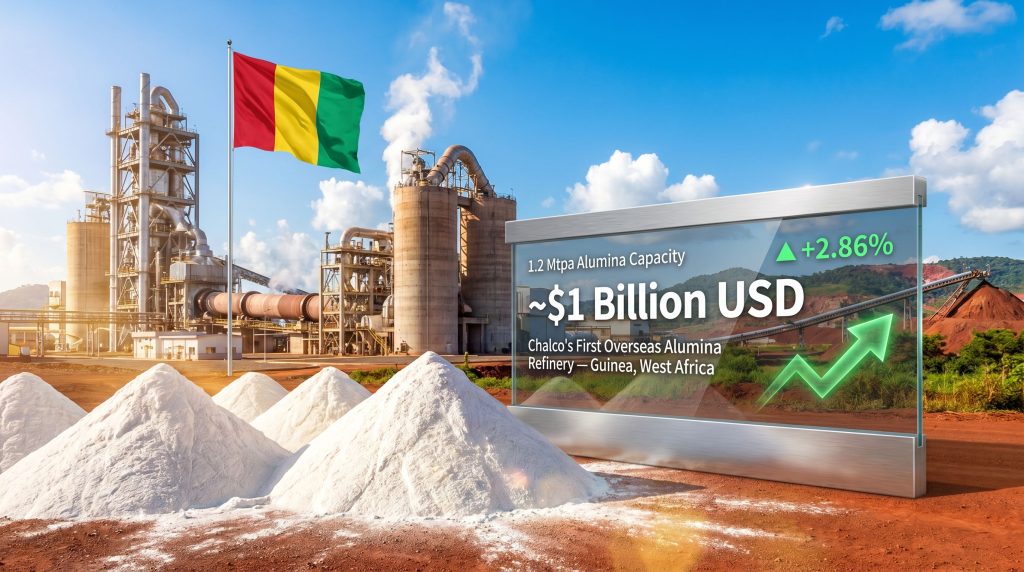
The Chalco alumina project in Guinea centres on a greenfield alumina refinery with a nameplate capacity of 1.2 million tonnes per year, representing the Aluminium Corporation of China's first overseas alumina processing facility. Total capital expenditure is estimated at approximately $1 billion USD, placing it among the most significant Chinese mining infrastructure commitments in West Africa in recent years.
Understanding what that capital must deliver requires appreciating the technical complexity of alumina refining. The dominant industrial method, the Bayer process, converts bauxite into alumina through a sequence of digestion, clarification, precipitation, and calcination steps. Each stage demands substantial inputs:
- Caustic soda (sodium hydroxide) consumed at rates of roughly 0.5 to 1.0 tonnes per tonne of alumina produced, depending on ore silica content
- Continuous energy supply, with modern facilities typically consuming 12 to 15 gigajoules per tonne of alumina
- Significant water resources for process liquor management and cooling systems
- Specialised containment infrastructure for red mud residue, generated at approximately 1.5 tonnes per tonne of alumina produced
Guinea's low-silica bauxite substantially reduces caustic soda consumption compared to processing higher-silica ores, which is one reason the economics of refining closer to Guinea's deposits are compelling. The conversion ratio for high-grade Guinean bauxite typically sits at the more favourable end of the 4-5 tonne range required to produce 2 tonnes of alumina, which in turn yields approximately 1 tonne of aluminium metal in downstream smelting.
| Project Parameter | Detail |
|---|---|
| Annual Alumina Capacity | 1.2 million tonnes per year |
| Total Estimated Investment | ~$1 billion USD |
| Project Location | Guinea, West Africa (Boffa region) |
| Project Type | Greenfield alumina refinery |
| Strategic Classification | First overseas alumina project for Chalco |
| Board Approval Date | June 26, 2025 |
| Public Disclosure Date | May 22, 2026 |
| Agreement Type | Amended and restated mining agreement |
Why Board Approval Preceded Public Disclosure by Nearly a Year
One of the more technically interesting aspects of this announcement is the gap between internal decision-making and external disclosure. Chalco's board formally approved the investment in June 2025, yet the company deferred public announcement until May 2026 under applicable regulatory provisions. The stated rationale was that premature disclosure could have adversely affected ongoing negotiations and project momentum.
This deferred disclosure mechanism is a recognised instrument under certain exchange listing rules, allowing companies to temporarily withhold material information when early release could jeopardise commercial outcomes. It is not unusual in the context of complex multi-jurisdictional agreements, particularly those involving sovereign government counterparties where negotiating leverage is sensitive. Three Chalco subsidiaries subsequently formalised the arrangement by signing an amended and restated mining agreement with the Guinean government, though this agreement remains subject to Chalco shareholder ratification and Guinean government agency approvals before capital deployment can proceed.
How This Investment Extends China's Aluminium Supply Chain Logic
The Domestic Constraint Driving Overseas Refining Strategy
China accounts for the majority of global aluminium smelting capacity, yet its domestic bauxite reserves are increasingly constrained in both quality and volume. The country has become structurally dependent on imported ore, with Guinea, Australia, and Indonesia representing the primary sources. This dependency has historically applied at the raw material level, but strategic planners within China's state-owned enterprise system have recognised a more sophisticated vulnerability: dependence on third-party refining services introduces additional price exposure and supply uncertainty into an already complex chain.
China's domestic environmental policy has compounded this issue. Tightening regulations under the country's broader carbon reduction commitments have increased the cost and political difficulty of operating energy-intensive bauxite processing facilities within Chinese borders. Consequently, provinces that historically hosted significant alumina refining capacity have faced output constraints, creating pressure to establish processing infrastructure in jurisdictions with different regulatory environments and direct access to high-quality ore.
Vertical Integration as the Defining Strategic Logic
By controlling the complete sequence from bauxite extraction at Boffa through to alumina refining at the new facility, Chalco positions itself to insulate its operations from third-party processing costs, capacity bottlenecks, and spot market price volatility. This vertically integrated model is not novel in the broader mining industry, where major aluminium mining companies like Rio Tinto and Norsk Hydro have long demonstrated the competitive durability of controlling multiple stages of the value chain.
What is significant here is the scale and geography of the commitment: a $1 billion investment establishing refining capacity in a resource-rich African nation represents a qualitative evolution in how Chinese state-linked enterprises approach overseas resource strategy.
The comparison to China's rare earth sector is instructive. Over the past decade, Chinese producers systematically transitioned from exporting rare earth oxides to dominating downstream magnet manufacturing, capturing substantially greater economic value per tonne of material processed. A parallel logic now appears to be informing Chalco's aluminium strategy: rather than simply securing bauxite supply and shipping it to Chinese refineries, establishing controlled processing capacity at the source creates a more defensible and economically superior position.
The GAC Partnership and Kamsar's Infrastructure Significance
Why the Guinea Alumina Corporation Collaboration Changes the Risk Profile
The Chalco alumina project in Guinea does not exist in isolation. According to recent industry reporting, the Guinea Alumina Corporation, which developed a 12-million-tonne-per-year greenfield bauxite mine and export facility at Kamsar with first ore delivered in 2019, has entered into a collaboration agreement with Chalco to jointly develop alumina refining capacity in Guinea. This partnership builds on an earlier memorandum of understanding and reflects a convergence of two major bauxite operators around shared downstream processing objectives.
The strategic significance of the Kamsar infrastructure cannot be overstated. Developing an alumina refinery in a West African context requires not just processing plant construction but an entire supporting ecosystem: reliable port access for alumina exports, power supply solutions, caustic soda import logistics, and water management systems. GAC's established Kamsar export infrastructure addresses several of these requirements simultaneously, reducing both capital expenditure requirements and the timeline uncertainty associated with building logistics infrastructure from scratch in a developing market context.
This infrastructure convergence materially de-risks the project's capital case by reducing the proportion of the budget devoted to enabling infrastructure versus productive processing capacity.
Market Signals and Investor Implications
What Aluminium Futures Are Telling the Market
Aluminium futures were trading at approximately $3,314 per tonne at the time the Chalco Guinea project was publicly disclosed. At that price level, the economics of a 1.2 million tonne per year alumina refinery, with alumina typically trading at roughly 15-20% of aluminium metal prices, suggest a facility generating substantial annual revenue once operational. Against a $1 billion capital commitment, the implied payback metrics are commercially credible under base-case aluminium demand assumptions.
The long-dated nature of this investment, however, means its returns are fundamentally a bet on structural aluminium demand over a multi-decade horizon rather than current spot prices. That demand trajectory is broadly supported by the energy transition's material requirements: electric vehicle bodies rely heavily on lightweight aluminium alloys, grid infrastructure requires aluminium conductors, and solar panel mounting systems consume significant volumes of aluminium extrusions. These end-use pathways create a demand floor that many commodity analysts regard as structurally durable regardless of near-term price cycles. In addition, China's industrial demand for processed metals continues to underpin long-term investment theses across the sector.
How Markets Interpreted the Announcement
Chalco's shares rose 2.86% on the day the Guinea alumina project entered public disclosure. In the context of a $1 billion capital commitment that remains subject to shareholder and regulatory approvals, this market response is meaningfully positive. It suggests institutional investors interpreted the investment as a credible long-term value creation strategy rather than an overreach into unfamiliar territory.
The market's constructive response to a multi-year, multi-jurisdictional capital commitment reflects growing investor recognition that vertically integrated resource strategies, particularly those securing mid-stream processing capabilities, offer more defensible returns than pure extraction-focused models.
The positive price action also signals something about investor psychology around China's overseas resource investments more broadly. Where such commitments were once viewed with scepticism regarding execution risk, the market appears increasingly willing to price in the strategic optionality they create, particularly when they are built on existing operational foundations like Chalco's established Boffa bauxite platform.
The next major ASX story will hit our subscribers first
Risk Factors That Could Reshape the Timeline
The Approval Conditions That Still Need Resolution
Several material conditions must be satisfied before the Chalco alumina project in Guinea advances to active construction. Chalco shareholder approval represents the first formal gate, requiring the company to present the investment case to its investor base and secure ratification of the amended mining agreement. Given the positive market response to the announcement, shareholder approval appears probable but is not guaranteed. Concurrently, relevant Guinean government agencies must provide regulatory clearances that formalise the project's legal operating framework within the country.
Until both conditions are satisfied, the project remains in a conditional status, and capital deployment timelines are subject to change based on the pace of regulatory processing across two distinct jurisdictions with different institutional processes and political dynamics.
Guinea's Political Environment and Operational Context
Guinea has experienced significant political transitions in recent years, including a military-led government change that altered how mining agreements are negotiated, enforced, and occasionally renegotiated. Investors and operators in Guinea's mining sector must factor in the possibility that policy frameworks governing foreign investment could evolve, creating either additional obligations such as expanded local content requirements or, in more adverse scenarios, pressure to renegotiate existing concession terms.
This is not a theoretical risk. Several African resource jurisdictions have moved to capture greater value from existing mining agreements after commodity price increases, and Guinea's government has demonstrated a willingness to use its regulatory position to advance domestic industrialisation objectives. Operators with strong in-country relationships and demonstrated commitments to local value creation, as Chalco's alumina refinery represents, are generally better positioned to navigate this environment than pure extraction operators.
Infrastructure Requirements Beyond the Refinery Itself
Building a 1.2 million tonne per year alumina refinery in Guinea requires substantially more than the processing plant. Reliable power supply at the scale required for continuous alumina production, estimated at roughly 300-350 megawatts of continuous capacity for a facility of this size, represents a non-trivial challenge in West Africa's power infrastructure environment. Caustic soda import logistics, water management for process liquor systems, and specialised containment for red mud residue all add complexity and cost that will likely consume a significant portion of the $1 billion capital budget.
These infrastructure requirements are real constraints that have historically caused greenfield alumina refinery projects in developing markets to experience cost overruns and commissioning delays. Chalco's experience with its Boffa bauxite operation provides some operational familiarity with Guinea's infrastructure environment, but the complexity of refinery development substantially exceeds that of a mining and export operation. For comparison, the Alcoa alumina joint venture approach in similar resource contexts highlights how major operators structure risk-sharing arrangements to manage these infrastructure challenges.
Frequently Asked Questions
What is alumina and why does controlling it matter strategically?
Alumina, or aluminium oxide, is the intermediate product refined from bauxite before being electrolytically reduced into aluminium metal at smelting facilities. The conversion economics are significant: roughly 4-5 tonnes of bauxite yield approximately 2 tonnes of alumina, which in turn produces around 1 tonne of aluminium metal. Each conversion step adds substantial value, meaning whoever controls alumina refining capacity controls a critical economic bottleneck. Companies that refine their own alumina rather than purchasing it on spot markets insulate themselves from mid-stream price volatility and third-party capacity constraints.
How does the new refinery differ strategically from the existing Boffa bauxite operation?
The Boffa operation extracts and exports raw bauxite ore, primarily to China. The alumina refinery project converts that bauxite within Guinea into alumina before export, capturing a substantially higher value per tonne of material processed. Alumina commands a price premium that makes in-country processing economically attractive for the operator while simultaneously generating local employment and industrial activity that Guinea's government has been actively pursuing as a policy objective.
When might the refinery begin commercial production?
No formal construction timeline or commissioning date has been publicly confirmed as of the project's disclosure in May 2026. With shareholder approval and Guinean regulatory clearance still outstanding, a definitive production start date remains unavailable. Greenfield alumina refinery construction in complex logistics environments typically requires 3-5 years from financial close to first production, suggesting the facility is unlikely to produce alumina before the late 2020s at the earliest, assuming approvals and construction proceed without material delays.
What does this project mean for global alumina trade flows?
A new 1.2 million tonne per year alumina source in West Africa would represent a meaningful addition to global supply, which has historically been concentrated among Australian, Brazilian, and Chinese producers. A Guinean alumina source could introduce additional pricing competition and supply diversity into the market while potentially positioning Guinea as a platform for further downstream alumina development across the region over the coming decade. However, aluminium tariff impacts in major consuming nations could influence how quickly new supply from Guinea is absorbed into existing trade patterns.
Africa's Broader Trajectory in Global Aluminium Supply Chains
The Value-Add Mandate Reshaping Resource Relationships
Guinea's push for in-country alumina refining is part of a structural reorientation visible across resource-rich Africa. Nations including the Democratic Republic of Congo, Zimbabwe, and South Africa have all pursued value-add mandates requiring foreign operators to move beyond pure extraction relationships toward in-country processing, manufacturing, or fabrication. This pattern reflects a growing sophistication among African governments in understanding how commodity value chains function and where economic leverage is most effectively exercised.
The trajectory points toward a future where raw material exports from Africa become increasingly conditional on downstream investment commitments, gradually shifting the continent's position in global commodity hierarchies from supplier of unprocessed ore toward provider of higher-value intermediary and refined products.
The Speculative Dimension: Could Guinea Become a Global Alumina Swing Supplier?
Looking further ahead, a scenario exists in which Guinea develops multiple alumina refineries over the next decade, drawing on its vast and high-quality bauxite reserves to establish itself as a genuine swing supplier capable of influencing global alumina pricing dynamics. This remains speculative, contingent on sustained foreign investment commitments, stable political conditions, and infrastructure development that would take years to materialise.
However, the logic is not implausible. Guinea holds sufficient bauxite reserves to support multiple world-scale alumina refineries operating simultaneously for decades. As Bloomberg reported at the time of announcement, if the Chalco alumina project in Guinea succeeds operationally and commercially, it creates a proof-of-concept that could attract further investment from other global operators seeking to replicate the vertically integrated model in a high-grade bauxite jurisdiction.
Should Guinea develop multiple alumina refineries over the coming decade, drawing on its vast bauxite reserves and established port infrastructure, the country could emerge as a genuine pricing force in global alumina markets, introducing competitive pressure currently absent from a supply landscape dominated by a small number of major producers.
Key Takeaways
- The Chalco alumina project in Guinea involves a $1 billion greenfield refinery with 1.2 million tonnes per year of alumina capacity, representing the company's first overseas alumina processing facility.
- Guinea's bauxite is geologically exceptional, with aluminium oxide content of 52-62% and silica levels of just 2-4%, significantly improving Bayer process economics compared to many competing ore sources.
- The refinery is built on Chalco's existing Boffa bauxite platform established since 2018, making this a vertically integrated downstream extension rather than a standalone venture.
- Shareholder approval and Guinean regulatory clearance remain outstanding conditions before active capital deployment can proceed, maintaining timeline uncertainty.
- Aluminium futures at approximately $3,314 per tonne at the time of disclosure support the long-term economic case, with structural demand from energy transition applications providing a credible demand floor.
- Chalco shares rose 2.86% on the announcement day, reflecting investor confidence in the vertically integrated strategic rationale.
- Infrastructure requirements including 300-350 megawatts of continuous power capacity, caustic soda logistics, and red mud containment represent material execution challenges in the West African context.
- The GAC collaboration, anchored by the established Kamsar export facility, meaningfully reduces logistics infrastructure risk and capital expenditure requirements for the refinery project.
Disclaimer: This article contains forward-looking analysis and scenario-based commentary that involves assumptions about future commodity prices, regulatory outcomes, and project execution timelines. Such forecasts are inherently uncertain and should not be construed as financial advice. Readers should conduct independent research and consult qualified advisers before making investment decisions. All financial data referenced reflects publicly available information at the time of the Chalco disclosure in May 2026.
Want To Stay Ahead of Major Mineral Discoveries Before the Broader Market?
Discovery Alert's proprietary Discovery IQ model delivers real-time alerts on significant ASX mineral discoveries, translating complex resource data into actionable investment insights for both short-term traders and long-term investors. Explore the historic returns major discoveries have generated and begin your 14-day free trial today to secure a genuine market-leading edge.