May 21, 2026
Revolutionary advances in membrane technology are transforming how mining operations approach metal extraction, with silicon-based filtration systems emerging as the cornerstone of next-generation processing capabilities. Traditional mining has long relied on chemical-intensive separation processes that consume substantial energy and generate significant waste streams, but breakthrough developments in electrochemical extraction are creating pathways toward entirely chemical free metal recovery operations.
What Is Chemical-Free Metal Recovery and Why Does It Matter?
Defining Chemical-Free Extraction Processes
Chemical free metal recovery represents a fundamental departure from conventional mining practices, utilising electricity-driven processes instead of chemical reagents for metal separation and purification. The core technologies driving this transformation include silicon-based membrane filtration, direct electrochemical extraction, and advanced plasma reduction methods that operate without traditional chemical inputs.
These systems process mining streams through nanoscale porous structures that perform selective separation at the molecular level. Unlike conventional approaches requiring extensive chemical addition and subsequent neutralisation, chemical-free technologies apply electrical energy to drive both filtration pumps and electrochemical reactions. The membrane materials themselves—engineered through precise chemical etching of silicon substrates—create the separation functionality without ongoing chemical consumption.
The environmental advantages extend beyond eliminating chemical waste production. Mining operations utilising chemical free metal recovery can process acid mine drainage, pregnant leach solutions, and raffinate streams whilst simultaneously achieving water remediation objectives. This dual-purpose functionality addresses both resource recovery and environmental liability management through a single technological platform.
The Economic Case for Eliminating Chemical Reagents
Industrial separations globally consume between 10-15% of total energy production, representing a massive opportunity for process optimisation through electricity-based alternatives. Chemical-free recovery systems reduce operational complexity by eliminating chemical procurement, storage, handling, and disposal requirements that traditionally burden mining operations with ongoing costs and regulatory compliance challenges.
The regulatory advantages prove particularly compelling for mining companies navigating increasingly stringent environmental oversight. Rather than adding regulatory burden, chemical-free technologies actually ease compliance requirements by eliminating hazardous chemical handling protocols, reducing waste generation, and supporting environmental remediation objectives. This regulatory simplification creates competitive advantages when operations interface with environmental protection agencies.
Long-term operational savings emerge through streamlined mining waste solutions and reduced infrastructure requirements. Traditional chemical processing demands extensive neutralisation facilities, chemical storage systems, and specialised waste treatment capabilities. Chemical-free alternatives operate with simplified infrastructure focused on electrical systems and mechanical processing components.
When big ASX news breaks, our subscribers know first
How Do Modern Chemical-Free Recovery Technologies Work?
Silicon-Based Membrane Filtration Systems
The foundation of chemical-free recovery lies in advanced silicon membrane engineering that creates nanoscale pore structures through controlled chemical etching processes. These flat silicon sheets undergo precise modification to develop molecular-scale pores from surface to substrate, creating membrane structures with exceptional durability and selectivity characteristics.
The manufacturing process represents a significant advancement in scalable membrane production. Traditional membrane technologies often suffer from durability limitations in harsh mining environments, but silicon-based systems demonstrate resilience in extreme conditions including pH levels ranging from 0 to 14, high total dissolved solids concentrations, and the presence of suspended particles that typically degrade conventional filtration materials.
Processing mechanisms operate through pressurisation of feed streams—including heap leach solutions, pregnant leach solutions, raffinate, acid mine drainage, and tailings pond water—through the nanoporous membrane structure. The material properties of the silicon substrate perform the separation work without chemical additives, using electrical energy exclusively for pump operation and pressure maintenance.
Electrochemical Metal Extraction Processes
Direct electrochemical extraction applies voltage to silicon-based electrodes capable of operating in extremely harsh chemical environments without neutralisation requirements. These systems process feed streams with pH levels as low as 0, including sulfuric acid, hydrochloric acid, and nitric acid-based solutions that would destroy conventional extraction equipment.
The electrochemical conversion process utilises electrons to transform metallic ions—such as copper 2+ ions—directly into metallic copper through electrowinning-style reactions. Recovered metals adhere to electrode surfaces and undergo mechanical removal for collection, allowing electrodes to return to processing streams for continued operation.
Hardware versatility represents a significant operational advantage, with identical systems capable of processing multiple metal types without modification. The same electrochemical extraction equipment effectively recovers copper, cobalt, nickel, gold, silver, platinum, palladium, and even iridium, providing mining operations with flexible processing capabilities that adapt to varying ore compositions and market demands.
Hydrogen Plasma Smelting Reduction (HPSR)
Plasma-based reduction technologies offer single-step metal oxide processing that eliminates traditional smelting requirements whilst achieving superior energy efficiency compared to conventional thermal processes. Hydrogen plasma systems operate at precisely controlled temperatures and atmospheric conditions to reduce metal oxides directly to pure metals or targeted alloy compositions.
The energy efficiency improvements stem from focused plasma application that delivers reduction energy directly to target materials rather than heating entire furnace volumes. This precision reduces overall energy consumption whilst enabling processing of materials that prove challenging for conventional smelting operations.
Direct alloy production capabilities allow these systems to create specific metal compositions in single processing steps, eliminating the multi-stage refining typically required to achieve desired alloy specifications for end-use applications.
What Metals Can Be Recovered Using Chemical-Free Methods?
Primary Target Metals and Recovery Rates
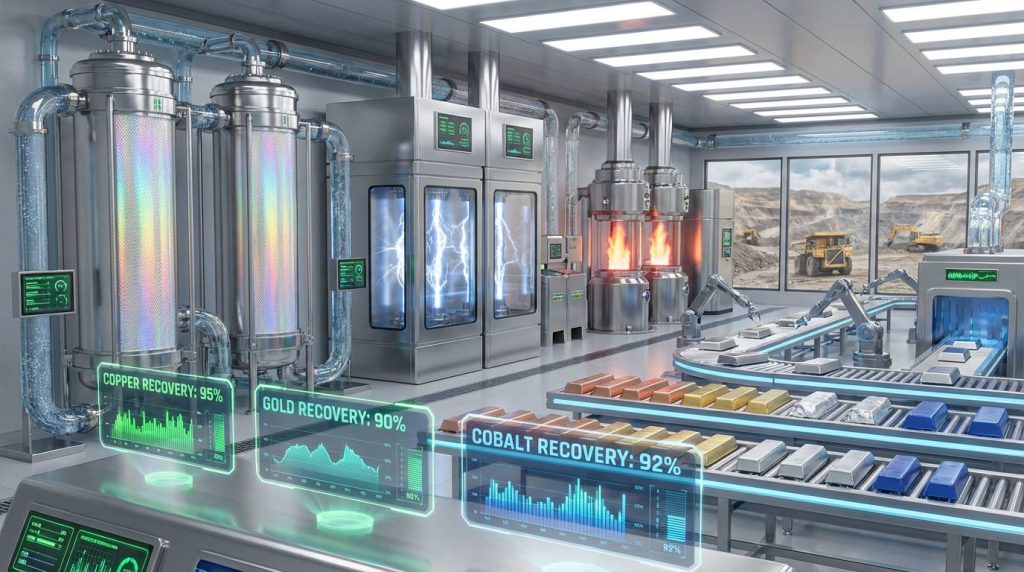
Chemical-free recovery technologies demonstrate exceptional versatility across the critical metals spectrum, with particular strength in processing copper, cobalt, nickel, and precious metals. Real-world testing with mining partners has achieved recovery yields exceeding 90% with purity levels reaching 99% or higher for most target metals.
Chemical-Free Recovery Performance by Metal
| Metal | Primary Applications | Supply Chain Considerations |
|---|---|---|
| Copper | Electrical infrastructure, data centers, energy grid | Growing demand from AI revolution and electrification |
| Cobalt | Battery manufacturing, aerospace alloys | Supply chain vulnerabilities from DRC sourcing |
| Nickel | Stainless steel, battery cathodes | Critical component in lithium-ion battery chemistry |
| Gold, Silver | Electronics, investment products | Value appreciation driving recovery economics |
| Platinum Group | Catalytic converters, hydrogen production | Industrial catalysts for petrochemical processing |
Copper recovery holds particular significance given the metal's central role in energy transition infrastructure and emerging applications in data center construction driven by AI in mining operations. The United States data center market represents a rapidly expanding copper consumption category that creates additional demand pressure on existing supply chains.
Battery metals including cobalt and nickel present strategic recovery opportunities given supply chain vulnerabilities associated with geographic concentration of primary production. Cobalt sourcing from the Democratic Republic of Congo involves social and environmental concerns that make domestic recovery from waste streams particularly attractive for Western battery manufacturers seeking supply chain security.
Rare Earth Element Concentration Capabilities
Chemical-free technologies excel at pre-concentrating dilute rare earth streams rather than achieving final purification to high-purity oxide products. Real-world testing with acid mine drainage samples demonstrated successful concentration of rare earth elements from 1-5 parts per million to 20-30 parts per million concentration levels.
This pre-concentration capability creates significant value by improving the economics of downstream processing at specialised rare earth refineries. By delivering feedstock with 5-10 times higher concentration than raw waste streams, chemical-free recovery systems enable existing rare earth processing facilities to achieve dramatically improved efficiency and reduced processing costs.
The strategic implications extend beyond economics to national security considerations, as concentrated rare earth streams from domestic waste sources reduce dependence on foreign supply chains for these critical materials used in defence applications, renewable energy systems, and advanced manufacturing.
Which Industries Benefit Most from Chemical-Free Recovery?
Battery Recycling and Critical Mineral Recovery
Lithium-ion battery recycling represents a natural application for chemical free metal recovery given the acidic leach solutions typically generated when batteries undergo grinding and dissolution processing. These feed streams contain high concentrations of lithium, cobalt, and nickel—the three most critical components of conventional battery chemistry.
The technology addresses battery recycling challenges by processing complex acidic streams without neutralisation requirements whilst achieving simultaneous recovery of multiple valuable metals from single feed streams. This multi-metal recovery capability maximises resource extraction from battery waste whilst minimising processing steps and associated costs.
Closed-loop manufacturing opportunities emerge as automotive and electronics manufacturers seek to establish circular supply chains for critical battery materials. Chemical-free recovery enables on-site processing of battery manufacturing waste and end-of-life products, reducing transportation costs and supply chain complexity whilst ensuring material quality standards.
Mining Waste Stream Remediation
Acid mine drainage presents both environmental liability and resource recovery opportunity, as these naturally occurring acidic solutions continuously dissolve valuable metals from waste rock formations. Rainwater, snowmelt, and groundwater percolating through ground waste rock creates self-acidifying streams that require ongoing management throughout mine operational life and in perpetuity after closure.
These waste streams represent "low-hanging fruit" for chemical-free recovery implementation, as they constitute existing operational liabilities requiring active management regardless of resource recovery activities. Processing acid mine drainage through chemical-free systems achieves dual objectives: environmental remediation and valuable metal recovery from a single operation.
Tailings pond processing addresses both resource recovery and environmental risk reduction, as these facilities contain accumulated metals and represent long-term environmental liabilities. Chemical-free recovery systems can process tailings pond water whilst reducing environmental exposure and capturing stranded value from decades of mining operations.
Primary Mining Operation Integration
Integration with existing mining operations offers multiple processing stream opportunities, including heap leach solutions, pregnant leach solutions, and raffinate streams that currently undergo limited processing before disposal or recycling. Chemical-free systems can insert into existing processing workflows to capture additional metals without disrupting established operations.
The mobile deployment advantage proves particularly valuable for mining operations lacking fixed processing infrastructure. Rather than constructing billion-dollar solvent extraction/electrowinning facilities or multi-billion-dollar smelters, chemical-free systems can deploy with approximately $100 million in equipment investment whilst achieving significant resource recovery capabilities.
Infrastructure limitations in regions like the United States—which currently operates only two smelters—make mobile chemical-free processing attractive for distributed mining operations that otherwise must ship concentrate ore internationally for processing, frequently to China for smelting operations.
What Are the Main Technical Challenges in Scaling Chemical-Free Recovery?
Engineering Scale-Up Requirements
Scale progression represents perhaps the most significant technical challenge facing chemical-free recovery commercialisation, with required throughput increases of 100x factors occurring every one to two years during technology development. Laboratory operations processing 10-100 litres per day must advance through pilot scale systems handling 1,000 litres per day (approximately 1 ton per day throughput) toward commercial scale requirements of thousands of tons per day for waste applications.
The scaling timeline creates fundamental misalignment between startup development cycles and mining industry innovation patterns. Technology companies operate on 2-3 year fundraising and development cycles, whilst mining operations require 5-10 year technology validation and implementation timelines due to operational complexity and risk management requirements.
Commercial scale deployment demands modular system design that enables rapid expansion without complete infrastructure replacement. This modularity requirement influences fundamental engineering decisions regarding membrane configuration, electrochemical system architecture, and supporting equipment specifications.
Real-World Conditions vs. Laboratory Performance
Mining operations present inherently complex feed streams containing suspended solids, silt, algae, ultra-high total dissolved solids concentrations, and other contaminants that challenge separation technologies optimised for controlled laboratory conditions. These "real-world" materials prove difficult to simulate in laboratory environments, requiring extensive testing with actual mining samples to validate performance claims.
Consistency between synthetic laboratory testing and real-world sample processing represents a critical validation milestone that determines commercial viability. Recent extensive testing with hundreds of litres of real mining samples has demonstrated minimal performance variation between synthetic and real-world conditions in almost all applications, indicating robust technology performance under operational conditions.
Fouling management presents ongoing operational challenges as suspended materials and biological growth can impact membrane performance over extended operating periods. Chemical-free recovery systems demonstrate exceptional resilience to these contaminants compared to conventional separation technologies, but operational protocols must account for periodic cleaning and maintenance requirements.
Capital Investment and Infrastructure Requirements
Mobile processing unit deployment strategies offer significant advantages over fixed infrastructure investments, particularly for waste stream processing applications where material locations may shift over time. The mobile approach enables processing equipment to move between waste sites, optimising utilisation rates and reducing per-ton processing costs.
Traditional infrastructure replacement economics favour chemical-free technologies in regions lacking established processing facilities, as the capital requirements for new smelters or solvent extraction plants often exceed $1-2 billion compared to approximately $100 million for equivalent chemical-free processing capability.
Payback period analysis varies significantly based on application type, with waste stream processing generally offering faster returns due to combined environmental liability reduction and resource recovery value. Primary ore processing applications require longer validation periods but offer larger-scale revenue opportunities once commercial deployment occurs.
How Do Chemical-Free Technologies Compare to Traditional Methods?
Process Efficiency and Environmental Impact
Energy consumption patterns differ markedly between chemical and chemical-free approaches, with traditional thermal processes requiring substantial energy for heating operations whilst electrical alternatives focus energy consumption on pumping, pressurisation, and electrochemical reactions. This energy application difference typically results in 15-20% reduction in total energy consumption whilst enabling more precise process control.
Traditional vs. Chemical-Free Methods Comparison
| Factor | Traditional Chemical | Chemical-Free | Key Advantages |
|---|---|---|---|
| Energy Source | Thermal/Chemical | Electrical | Better controllability |
| Waste Production | High chemical waste | Minimal waste | 90%+ reduction |
| Infrastructure | Complex processing | Simplified systems | Lower complexity |
| Process Steps | Multiple stages | Single/dual stage | Streamlined operations |
| Environmental Permits | Extensive requirements | Reduced permitting | Faster deployment |
Chemical waste reduction represents the most significant environmental advantage, with chemical-free processes eliminating the need for 100+ tons per day of chemical inputs like lime that traditional operations require. This elimination extends to neutralisation chemicals, solvent exchange reagents, and associated waste treatment requirements.
Water usage optimisation occurs through membrane processing that enables acid recycling and water recovery for reuse within mining operations. Through metal recovery technologies, sulfuric acid, hydrochloric acid, and other processing acids can be recovered through membrane separation and returned to heap leach or other processing applications, reducing both chemical purchases and waste generation.
Regulatory and Safety Advantages
Environmental permitting complexity decreases substantially when chemical handling requirements are eliminated from mining operations. Traditional chemical processing requires extensive safety protocols, emergency response procedures, and environmental monitoring systems that chemical-free alternatives can avoid entirely.
Worker safety improvements result from eliminating hazardous chemical exposure risks whilst reducing the complexity of safety training requirements. Chemical-free operations focus safety protocols on electrical systems and mechanical equipment rather than chemical handling and emergency response procedures.
Regulatory compliance benefits extend to operational flexibility, as chemical-free systems can often receive approval for waste treatment applications that simultaneously achieve environmental remediation objectives. This dual-purpose capability creates regulatory advantages when mining companies interface with environmental protection agencies seeking waste reduction and site remediation.
The next major ASX story will hit our subscribers first
What Economic Opportunities Exist in Waste Stream Recovery?
Mining Waste as Untapped Resource Reserves
A landmark study published in Science journal demonstrates that mining waste within the United States contains sufficient critical minerals to satisfy almost all domestic demand for these materials. This finding suggests similar potential exists in other major mining regions including Chile and Australia, representing massive stranded value in existing waste accumulations.
The challenge lies in selective extraction capabilities—having "billions of needles in an incomprehensible amount of hay" according to industry analysis. Technologies capable of processing complex waste streams to extract valuable materials efficiently can unlock this stranded resource value whilst addressing environmental liabilities associated with waste storage and management.
Waste stream composition varies dramatically between liquid accumulations in tailings ponds and acid mine drainage versus solid waste rock piles accumulated over decades of mining operations. Each waste type requires different processing approaches, but chemical-free technologies can address both through membrane processing of liquid streams and electrochemical extraction from leached solid materials.
Remining Economics and Market Dynamics
Historical grade decline creates compelling remining economics as average copper ore grades have declined by 50% over the past 30 years whilst waste rock piles from 50-100 years of extraction now contain higher copper concentrations than current primary mining ore. This fundamental reversal makes previously discarded waste more valuable than current mining targets.
Infrastructure availability influences remining viability, as many historical mining sites lack the solvent extraction/electrowinning facilities or smelter access required for traditional processing. Chemical-free recovery systems can process leached waste rock through mobile equipment without requiring fixed processing infrastructure investments.
Geographic distribution of waste resources enables distributed processing strategies rather than centralised facility development. Mobile chemical-free processing units can move between waste sites to optimise equipment utilisation whilst avoiding the transportation costs associated with shipping waste materials to centralised processing facilities.
Revenue Stream Diversification for Mining Operations
Multi-metal recovery capabilities enable mining operations to extract additional value from processing streams that traditionally focus on single primary commodities. A single waste stream might yield copper, cobalt, nickel, precious metals, and concentrated rare earths through sequential processing steps using identical hardware platforms.
Environmental liability reduction provides additional economic value beyond direct metal recovery, as processing acid mine drainage and tailings pond contents addresses long-term environmental management costs that mining companies must bear throughout operational life and post-closure periods.
Market timing flexibility emerges from the ability to process waste streams when metal prices favour specific commodities whilst maintaining processing capability for other metals when market conditions change. This flexibility contrasts with fixed processing facilities optimised for specific metal recovery that cannot adapt to changing market dynamics.
Which Regions Show Greatest Potential for Chemical-Free Recovery Implementation?
Geographic Distribution of Opportunities
North American mining regions present substantial waste processing opportunities given decades of accumulated tailings, waste rock piles, and ongoing acid mine drainage generation across major copper, gold, and rare earth mining districts. The geographic distribution of these waste resources enables regional processing strategies that minimise transportation costs whilst maximising resource recovery efficiency.
Australian mining operations offer similar waste stream processing potential, particularly in copper and gold producing regions where acid mine drainage and tailings pond management represent ongoing operational and environmental challenges. The established mining infrastructure and regulatory frameworks in Australia support technology deployment for both environmental remediation and resource recovery objectives.
South American brine processing applications initially drove chemical-free technology development for lithium recovery, but the technology's versatility enables expansion into copper waste processing in major mining regions of Chile and Peru where extensive waste accumulations exist from decades of production operations.
Regulatory Environment and Government Support
Critical mineral supply chain security initiatives at national levels create policy support for domestic resource recovery technologies that reduce dependence on foreign supply chains. Government funding programmes through agencies like the U.S. National Science Foundation, Department of Energy, and equivalent organisations in other countries provide development support for technologies addressing strategic mineral recovery.
Environmental remediation funding programmes offer additional support mechanisms for technologies that achieve dual objectives of waste treatment and resource recovery. These programmes recognise the value proposition of addressing environmental liabilities whilst simultaneously extracting economic value from waste materials.
Technology development incentives including non-dilutive funding through fellowship programmes and research grants enable technology companies to advance development without diluting equity ownership. These support mechanisms prove particularly valuable during early-stage technology validation and pilot deployment phases.
What Does the Future Hold for Chemical-Free Metal Recovery?
Technology Development Roadmap
Next-generation membrane materials continue advancing through improved silicon processing techniques that enhance durability and selectivity whilst reducing manufacturing costs. Research focus areas include pore structure optimisation, surface chemistry modification, and scaling manufacturing processes to support commercial deployment requirements.
Artificial intelligence integration offers optimisation opportunities for process control systems that can adjust operational parameters in real-time based on feed stream composition changes and recovery efficiency targets. Machine learning algorithms can optimise voltage application, pressure settings, and flow rates to maximise metal recovery whilst minimising energy consumption.
Autonomous mobile processing unit deployment represents a significant advancement in operational efficiency, enabling processing equipment to move between waste sites with minimal human intervention whilst maintaining optimal processing performance through automated systems integration.
Market Adoption Timeline and Barriers
Early adopter mining company partnerships currently focus on pilot-scale demonstrations that validate technology performance under real-world operating conditions. These partnerships provide crucial validation data whilst enabling mining companies to evaluate technology integration with existing operations.
The cultural adaptation challenge requires mining industry acceptance of new technologies that differ substantially from established processing approaches. Mining operations prioritise safety and operational reliability, making thorough validation and risk mitigation essential for technology adoption.
Scaling timeline pressures create tension between startup development cycles and data-driven mining strategies implementation requirements. Successful commercialisation requires balancing rapid technology advancement with comprehensive risk management and validation procedures that mining companies require.
Integration with Sustainable Mining Practices
In-situ recovery processes benefit from chemical-free processing capabilities that enable targeted extraction without surface disruption. These approaches inject lixiviant solutions underground and recover metal-bearing solutions through chemical-free processing systems, minimising environmental impact whilst maximising resource recovery efficiency.
Surgical mining techniques enabled by improved exploration technologies can target specific ore bodies with minimal waste generation, but still produce concentrated solutions that require efficient processing. Chemical-free recovery systems support these precision mining approaches through mobile processing capabilities that can deploy rapidly to targeted extraction sites.
Ecosystem disruption minimisation becomes achievable through processing approaches that eliminate chemical waste generation whilst enabling more selective extraction techniques. The combination of precision extraction and chemical-free processing creates pathways toward mining operations with dramatically reduced environmental impact compared to conventional approaches.
Furthermore, the integration of mining decarbonisation benefits becomes increasingly apparent as operators seek to reduce their carbon footprint whilst maintaining profitability. This technological advancement in metal recycling solutions demonstrates the industry's commitment to sustainable practices.
Conclusion: The Transformation of Metal Recovery Operations
Key Takeaways for Mining Industry Stakeholders
Chemical-free metal recovery represents more than incremental improvement in processing efficiency—it fundamentally transforms the economics and environmental impact of metal extraction operations. Mining companies can achieve competitive advantages through simplified operations that eliminate chemical handling requirements whilst accessing previously uneconomic waste resources that now represent significant value creation opportunities.
Environmental stewardship through technology adoption creates positive regulatory relationships and social licence advantages that prove increasingly important as environmental oversight intensifies globally. Chemical-free recovery enables mining companies to position themselves as environmental solution providers rather than solely extraction operations.
The economic benefits extend beyond direct processing cost reductions to include simplified infrastructure requirements, reduced regulatory compliance costs, and access to waste stream revenue sources that traditional operations cannot efficiently process. These combined advantages create compelling business cases for technology adoption across multiple mining industry segments.
Implementation Considerations for Mining Companies
Pilot project planning requires careful risk management and staged deployment approaches that enable thorough technology validation without disrupting existing operations. Successful implementation involves close collaboration between technology providers and mining operators to ensure safety protocols, performance validation, and integration planning meet operational requirements.
Partnership strategies with technology developers should focus on shared risk and reward structures that align incentives for successful commercial deployment. Mining companies bring operational expertise and site access whilst technology companies provide innovation and processing capabilities.
Timeline expectations for commercial deployment must account for both technology scaling requirements and mining industry validation processes. Realistic planning acknowledges 5-10 year development cycles whilst identifying interim applications that provide early value creation and risk reduction for both technology providers and mining operators.
The future of chemical free metal recovery lies in its ability to transform mining operations from purely extractive activities into integrated resource recovery and environmental remediation systems that create value whilst minimising environmental impact through revolutionary processing technologies.
Ready to Capitalise on Revolutionary Mining Technologies?
Discovery Alert's proprietary Discovery IQ model instantly identifies ASX companies developing breakthrough technologies like chemical-free metal recovery, delivering real-time alerts when these transformative innovations reach the market. Begin your 30-day free trial today and position yourself ahead of the curve when the next mining technology revolution creates substantial market opportunities.