May 16, 2026
Understanding Chemical Processing Capabilities in Critical Material Value Chains
Modern industrial competitiveness increasingly depends on sophisticated chemical processing networks that transform raw mineral concentrates into precision-engineered materials. These midstream processing in mineral supply chains operations represent the crucial link between extraction and manufacturing, where specialised facilities convert basic feedstocks into the high-purity compounds required for advanced technologies.
Chemical refinement facilities typically require $500 million to $2 billion in capital investment, reflecting the complex infrastructure needed for multi-stage purification processes. Unlike traditional commodity mining operations, these facilities must maintain exacting quality standards whilst managing diverse feedstock streams from primary mines, recycling operations, and industrial waste recovery programmes.
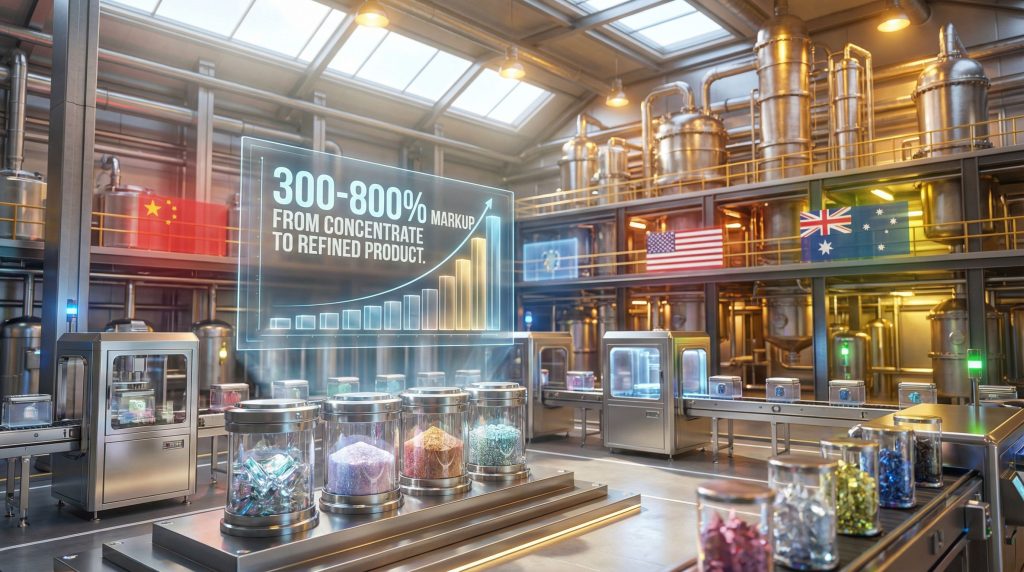
The economic multiplier effect of value-added processing creates substantial revenue premiums over basic concentrates. Processing operations can generate 300-800% markup from raw concentrates to refined products, whilst supporting 5-15 indirect jobs for each direct processing position through supply chain integration and technical services.
Chemical Refinement Technologies and Industrial Applications
Hydrometallurgical processing forms the backbone of modern critical material production through sequential leaching, precipitation, and crystallisation steps. These water-based chemical processes enable precise control over product purity levels, achieving specifications of 99.9% or higher for semiconductor and aerospace applications.
Pyrometallurgical methods complement hydrometallurgical approaches through high-temperature processing including smelting, roasting, and electrolytic refining. These thermal processes excel at handling complex ore compositions and achieving rapid throughput for bulk material production.
Advanced separation techniques enable recovery of trace elements and by-products that would otherwise represent waste streams. Secondary mineral extraction from primary processing operations can recover valuable materials like scandium from titanium processing or gallium from aluminium refining, creating additional revenue streams whilst improving overall resource efficiency.
Quality control systems in midstream processing in mineral supply chains must meet stringent customer specifications across diverse applications:
-
Semiconductor applications: Parts-per-billion contamination limits for critical impurities
-
Battery manufacturing: Precise particle size distributions and moisture content specifications
-
Aerospace components: Certified material properties and traceability documentation
-
Medical devices: Biocompatibility testing and regulatory compliance verification
When big ASX news breaks, our subscribers know first
Strategic Control Points in Global Material Supply Networks
Geographic concentration of processing capacity creates significant strategic vulnerabilities in critical material supply chains. China currently controls dominant market positions across multiple material categories, leveraging decades of coordinated industrial policy and investment in chemical processing infrastructure.
| Material Category | Chinese Processing Share | Strategic Vulnerability Level |
|---|---|---|
| Rare Earth Separation | 85-90% global capacity | Critical dependency |
| Lithium Chemical Conversion | 60-65% global capacity | High strategic risk |
| Cobalt Refinement Operations | 70-75% global capacity | Supply chain concern |
| Graphite Purification | 90%+ global capacity | Near-monopoly control |
Note: These figures represent approximate capacity shares and may vary based on measurement methodology and recent capacity additions.
Western governments have responded with substantial investment commitments to rebuild domestic processing capabilities. Furthermore, the United States has allocated approximately $3.1 billion through various critical materials initiatives focusing on domestic processing infrastructure. European Union policies under the Raw Materials Act establish capacity targets for 2030, emphasising strategic autonomy in critical material supply chains.
Australia's critical minerals strategy emphasises processing hub development to capture greater value from the country's substantial mineral endowments. These regional initiatives reflect recognition that critical materials processing provides greater strategic leverage than primary mining assets alone.
Supply Chain Resilience Versus Cost Optimisation
Friend-shoring initiatives among allied nations aim to distribute processing capacity across trusted partners whilst maintaining economic viability. These arrangements require balancing higher costs associated with smaller-scale, geographically dispersed facilities against supply security benefits.
Economic security considerations now influence industrial policy frameworks as governments recognise that over-reliance on concentrated processing capacity creates systemic vulnerabilities. In addition, strategic stockpiling requirements and supply chain resilience metrics increasingly guide investment decisions in critical material processing infrastructure.
Investment Dynamics and Market Structure Analysis
However, midstream processing in mineral supply chains operates under fundamentally different financial models compared to traditional commodity extraction. Processing facilities require 15-25 year payback periods for greenfield developments, with technology risk premiums adding 200-400 basis points above conventional mining projects.
Operational leverage in processing operations creates sensitivity to capacity utilisation rates. Fixed cost structures mean that facilities must maintain high throughput to achieve acceptable returns, making long-term offtake agreements critical for project financing.
Demand-Pull Business Models for Specialty Materials
Critical materials processing diverges from traditional commodity markets through customer-specific product development and long-term supply relationships. Rather than price-taking behaviour in spot markets, specialty materials producers engage in collaborative product development with manufacturing partners.
Customer co-investment structures increasingly characterise specialty materials projects, where downstream manufacturers provide capital commitments in exchange for guaranteed supply agreements. These arrangements share development risks whilst securing demand certainty for processing operations.
Feedstock diversification strategies reduce supply security risks through multi-source procurement from mining operations, recycling streams, and industrial waste recovery. Consequently, inventory management becomes critical for processing facilities dependent on concentrated supply sources or materials subject to export restrictions.
Technology Development and Competitive Positioning
Process innovation drives competitive advantage in midstream processing through cost reduction and product quality improvements. Automation integration optimises labour costs whilst maintaining consistency in product specifications required by advanced manufacturing applications.
Environmental sustainability transformation initiatives increasingly influence processing technology selection as manufacturers seek materials with reduced carbon footprints. Moreover, decarbonisation benefits from low-carbon aluminium production demonstrate how processing location and energy sources affect market positioning for specialty materials.
Technical Requirements for Advanced Manufacturing Integration
Semiconductor manufacturing imposes exceptional purity requirements on processed materials, with contamination limits measured in parts-per-billion for key impurities. Ultra-high purity chemicals and gases require specialised handling and storage systems to maintain specifications throughout the supply chain.
Just-in-time delivery requirements in chip fabrication create additional complexity for processing operations, which must balance inventory costs against supply chain responsiveness. Analytical techniques including X-ray diffraction and inductively coupled plasma mass spectrometry verify product specifications before shipment.
Electric Vehicle Battery Material Processing
A battery-grade lithium refinery requires precise control over chemical form, with lithium hydroxide preferred for high-energy-density applications whilst lithium carbonate serves conventional battery chemistries. Particle size distribution and moisture content specifications affect battery performance and manufacturing yields.
Cathode material processing involves multi-step chemical synthesis to create layered oxide structures with controlled stoichiometry. Processing facilities must manage hazardous materials whilst achieving consistent product quality across large-scale production runs.
Anode material preparation encompasses both synthetic graphite production through high-temperature treatment and natural graphite purification through chemical and thermal processes. Battery manufacturers require detailed traceability documentation for all material inputs to ensure performance consistency.
Renewable Energy Component Manufacturing
Permanent magnet production for wind turbines and electric motors requires rare earth separation to individual high-purity oxides, followed by alloy formation and powder metallurgy processing. Magnetic properties depend critically on chemical composition and microstructure control during processing.
Solar panel metallisation requires silver paste formulations with controlled particle size and electrical properties. Processing operations must maintain low oxygen content and prevent contamination during powder handling and storage operations.
Energy storage system materials encompass diverse chemistries requiring specialised processing approaches for each technology platform. Flow battery electrolytes, solid-state battery ceramics, and advanced capacitor materials each demand unique chemical processing capabilities.
Regional Processing Hub Development and Market Entry Strategies
Greenfield processing facility development requires careful site selection considering proximity to feedstock sources, energy availability, and skilled labour pools. Environmental permitting timelines can extend 3-5 years for complex chemical processing operations, requiring early stakeholder engagement.
Technology licensing agreements provide access to proven processing methods whilst proprietary process development offers potential competitive advantages. Companies must balance development risks against intellectual property ownership and differentiation opportunities.
Strategic Partnership Models and Investment Structures
Mining company vertical integration strategies aim to capture midstream processing margins whilst securing customer relationships. These investments require substantial capital commitments and technical expertise beyond traditional extraction operations.
Manufacturing company backward integration initiatives seek supply security for critical materials through processing facility ownership or long-term partnerships. These arrangements reduce supply chain risks whilst potentially lowering material costs through elimination of intermediary margins.
Government co-investment structures provide risk-sharing mechanisms for strategically important processing developments. For instance, public-private partnerships can accelerate capacity development whilst sharing commercial risks between public and private sector participants.
Cluster Economics and Infrastructure Optimisation
Regional processing clusters enable shared infrastructure including utilities, waste treatment systems, and logistics networks. Specialised service providers locate near processing hubs to support maintenance, analytical services, and technical expertise requirements.
Transportation cost optimisation favours processing locations with access to multiple transportation modes including rail, pipeline, and marine shipping. Material handling systems must accommodate diverse feedstock types whilst maintaining segregation for quality control.
Workforce development programmes create technical expertise concentrations supporting multiple processing operations. Training partnerships with educational institutions develop specialised skills in chemical processing, materials science, and quality control systems.
Circular Economy Integration and Resource Security
Urban mining operations extract critical materials from electronic waste streams, creating alternative feedstocks for processing facilities. Recovery rates vary significantly by material type, with precious metals achieving higher yields than rare earth elements from electronic components.
Industrial symbiosis arrangements convert waste streams from primary processing into feedstocks for secondary material recovery. Furthermore, the battery recycling process demonstrates how tailings reprocessing can recover previously uneconomic materials as market conditions and technology capabilities evolve.
Lifecycle optimisation approaches consider material recyclability during product design phases, facilitating closed-loop systems that reduce primary material requirements. Design for recyclability guidelines help ensure end-of-life material recovery whilst maintaining product performance requirements.
National Economic Strategy and Trade Balance Implications
Import substitution through domestic processing capacity reduces trade deficits whilst capturing value-added manufacturing revenues. Countries with substantial mineral endowments can transform resource advantages into sustainable economic development through midstream processing in mineral supply chains investments.
Export diversification beyond raw materials creates more stable revenue streams less subject to commodity price volatility. Processed materials command premium pricing and develop customer relationships that support long-term business development.
Enhanced negotiating positions in international trade result from controlling critical processing capabilities rather than solely raw material supplies. Processing capacity provides leverage in supply chain discussions and reduces vulnerability to export restrictions.
Innovation ecosystem development around processing hubs generates research and development spillovers into related industries. Patent development and intellectual property creation contribute to technological leadership in advanced materials processing.
The next major ASX story will hit our subscribers first
Operational Excellence and Competitive Advantage Development
Process optimisation focuses on maximising recovery rates from input materials whilst minimising energy consumption per unit of output. Advanced process control systems monitor chemical parameters in real-time to maintain optimal operating conditions.
Energy efficiency improvements reduce processing costs per unit output whilst supporting environmental sustainability objectives. Heat integration systems recover thermal energy from high-temperature processes to support lower-temperature unit operations.
Waste minimisation strategies reduce environmental compliance costs whilst recovering valuable by-products from process streams. Zero liquid discharge systems eliminate wastewater whilst concentrating dissolved materials for potential recovery.
Market Intelligence and Customer Relationship Management
Demand forecasting capabilities enable processing operations to anticipate specification changes and volume requirements from manufacturing customers. Market intelligence systems track technological developments that may affect material specifications or create new application opportunities.
Price discovery mechanisms in specialty materials markets depend on customer relationships rather than commodity exchange trading. Long-term supply agreements provide revenue stability whilst enabling investment in capacity expansion and process improvements.
Quality assurance systems maintain customer certification standards through statistical process control and comprehensive documentation systems. Traceability requirements enable rapid response to quality issues whilst supporting continuous improvement initiatives.
Technology development programmes support continuous improvement in processing efficiency and product quality. However, direct lithium extraction automation integration reduces labour costs whilst improving consistency in product specifications required by advanced manufacturing applications.
Disclaimer: This analysis includes forward-looking assessments of market conditions and technology developments that involve inherent uncertainties. Investment decisions should consider multiple factors including regulatory changes, technological developments, and market dynamics that may affect processing facility economics and strategic positioning.
For additional research on critical materials and value chain development, readers may explore resources from organisations such as the Canadian Critical Minerals and Materials Alliance and related educational institutions focused on mineral processing and advanced materials research.
Ready to capitalise on critical materials processing opportunities?
Discovery Alert's proprietary Discovery IQ model delivers real-time notifications on significant ASX mineral discoveries across critical materials sectors, instantly empowering subscribers to identify actionable investment opportunities ahead of the broader market. Understand why historic discoveries can generate substantial returns by visiting Discovery Alert's dedicated discoveries page, showcasing exceptional market outcomes from major mineral finds.