August 21, 2026
India's Battery Mineral Ambitions Are Being Built on Ancient Rock
Some of the most consequential geological decisions shaping India's energy future are being made not in boardrooms in Mumbai or Delhi, but across the ancient Archaean terrains of central India. The Bastar Craton, one of the oldest basement rock formations on the subcontinent, holds within its Precambrian geology the structural signatures of lithium pegmatites, rare earth-bearing carbonatites, and polymetallic sulphide systems. For decades, this geological richness went largely untested at depth. That is changing rapidly, and the pace of Chhattisgarh critical mineral exploration projects approved for 2026-27 reflects just how urgently India needs to close the gap between its clean energy ambitions and its domestic resource base.
When big ASX news breaks, our subscribers know first
The Supply Chain Vulnerability That Is Driving Exploration Urgency
India currently imports the overwhelming majority of its critical mineral requirements. Lithium arrives predominantly from Australia and South America. Graphite, the anode material underpinning every lithium-ion battery manufactured today, is sourced almost entirely from China, which controls roughly 65 to 70 percent of global natural graphite supply. Rare earth element processing is similarly concentrated, with China accounting for approximately 85 to 90 percent of global refining capacity according to data published by the International Energy Agency.
For a country targeting 500 gigawatts of renewable energy capacity by 2030 and pushing aggressively toward electric vehicle adoption, this import dependency represents a structural vulnerability. The surging critical minerals demand driven by the global energy transition has cascaded into state-level exploration mandates that are now reshaping geological programming budgets and institutional priorities across Chhattisgarh, Rajasthan, Jharkhand, and Odisha.
Chhattisgarh stands apart from other Indian states not simply because of the volume of its exploration activity, but because of the unusual diversity of critical mineral systems present within a single state boundary, spanning battery minerals, rare earths, platinum group elements, and technology metals simultaneously.
Furthermore, India's strategic exposure extends well beyond lithium. The battery raw materials market is tightening globally, and domestically sourced alternatives are becoming a national security priority as much as an economic one.
What the 26th SGPB Meeting Actually Approved
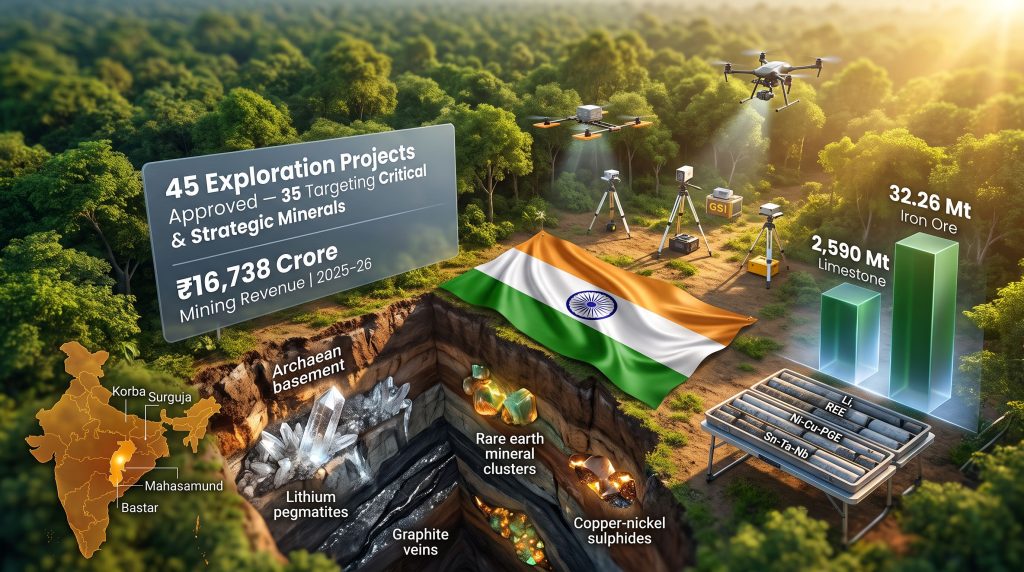
The 26th meeting of the State Geological Programming Board, chaired by Mineral Resources Department Secretary P Dayanand, formalised 45 mineral exploration projects for the 2026-27 financial year. The breakdown reveals a deliberate prioritisation of strategic commodities over conventional bulk minerals.
| Project Category | Number of Projects | Key Minerals Targeted |
|---|---|---|
| Critical and Strategic Minerals | 35 | Lithium, REE, tin-tantalum-niobium, graphite |
| Deep-Seated Mineral Deposits | 4 | Subsurface metallic systems requiring advanced geophysics |
| Bulk Mineral Exploration | 6 | Iron ore, limestone, bauxite |
| Total Approved Projects | 45 | Multi-commodity across Bastar and central Chhattisgarh |
The Geological Survey of India's Raipur unit was assigned responsibility for 25 of the 45 projects, making it the primary field execution agency for the programme. Attendance at the board meeting extended across a broad institutional coalition, including the Indian Bureau of Mines, Atomic Minerals Directorate, Mineral Exploration and Consultancy Limited (MECL), NMDC, MOIL, Hindustan Copper Ltd, Central Institute of Mining and Fuel Research, Central Ground Water Board, CMPDI, and the Chhattisgarh Mineral Development Corporation.
The involvement of the Atomic Minerals Directorate is particularly notable and rarely discussed in mainstream coverage. Its participation signals that uranium and thorium prospectivity is being evaluated alongside battery and technology metals within the same geological programming framework, a scope that extends Chhattisgarh's strategic mineral mandate well beyond what the headline lithium and graphite narrative suggests.
Why Tin-Tantalum-Niobium Deserves More Attention Than It Gets
Among the minerals listed in Chhattisgarh's approved exploration portfolio, tin-tantalum-niobium tends to attract the least public attention despite representing some of the highest per-tonne value among technology metals. Tantalum is essential for capacitors in smartphones, laptops, and aerospace electronics. Niobium is a critical alloying element in high-strength steel used in automotive manufacturing and infrastructure construction. Both are listed on India's official critical minerals inventory.
The Bastar region's geological architecture, characterised by granitic and pegmatitic intrusions into ancient basement rock, creates the same structural conditions that host tantalum-niobium mineralisation in comparable cratons globally, including the Pilbara in Western Australia and the Congo Basin in central Africa. This geological analogy, while speculative in terms of grade and scale until drilling confirms otherwise, provides a rationale for why SGPB has included these metals within the priority exploration programme.
A Dual-Track Exploration System
Operating in parallel with the SGPB pipeline, the Directorate of Geology and Mining separately finalised 11 exploration proposals for 2026-27. This dual-track architecture creates a layered exploration system within the state, with each stream operating under different institutional mandates and timelines.
| Mineral Block Type | Number of Proposals |
|---|---|
| Graphite | 1 |
| Limestone | 2 |
| Iron Ore | 4 |
| Glauconite | 2 |
| REE and Rare Metals | 1 |
| Bauxite and Aluminous Laterite | 1 |
| Total | 11 |
The inclusion of glauconite in this list is worth examining. Glauconite is an iron-potassium phyllosilicate mineral found in marine sedimentary sequences and has gained renewed interest globally as a slow-release fertiliser input and as a potassium source for agricultural applications. Its presence in Chhattisgarh's geological programming signals that the state is looking beyond conventional mineral categories to capture value from sedimentary sequences that may have been overlooked during previous survey cycles.
Four exploration projects approved in the prior financial year are continuing into 2026-27, and nine projects under the National Programme for Exploration and Augmentation (NPEA) remain operational. This continuity framework reduces the risk of knowledge loss between survey cycles and allows GSI geologists to build progressively richer datasets across multi-year field programmes.
What the 2025-26 Results Tell Us About Programme Quality
Last year's exploration activity delivered quantifiable outcomes that validate the multi-year programming methodology being applied across the state.
- 2,590 million tonnes of limestone resources confirmed through 2025-26 exploration activity
- 32.26 million tonnes of iron ore resources added to the state's known mineral inventory
- Mining royalty and related sector revenue reached approximately ₹16,738 crore during 2025-26
These are not trivial numbers. The limestone tonnage alone represents a resource base capable of supporting decades of cement production, and the iron ore additions reinforce Chhattisgarh's standing as a bulk mineral powerhouse even as its critical mineral exploration ambitions grow. The ₹16,738 crore in revenue demonstrates that the sector already generates substantial fiscal returns before any critical mineral auction pipeline has been fully activated. Successful lithium, REE, or PGE block auctions could meaningfully diversify that revenue base beyond its current coal and iron ore dependency.
Southern Bastar: Why Geologists Are Looking Deeper
The Bastar Craton occupies a special position in Indian geological literature. As one of the continent's Archaean basement terrains, it shares characteristics with some of the world's most mineralised ancient shields. Lithium-bearing pegmatite swarms, REE-enriched carbonatite intrusions, and base metal sulphide systems have all been documented or hypothesised within its boundaries based on surface geochemistry and regional structural mapping.
Despite this prospectivity, southern Bastar has historically been under-explored relative to its geological potential. The reasons are structural rather than geological: dense forest cover, limited road infrastructure, tribal habitation zones subject to Free, Prior, and Informed Consent (FPIC) requirements under the Forest Rights Act, and the logistical challenges of operating in one of India's most ecologically complex terrains.
The SGPB explicitly called for accelerated exploration timelines in this corridor and mandated greater deployment of advanced geophysical technologies, including airborne electromagnetics, gravity surveys, and deep seismic profiling, to assess mineralisation at depths beyond the reach of conventional field mapping. The transfer of mineral resource maps covering five districts from GSI to the Mineral Resources Department at the 26th meeting represents a critical data handover that accelerates the path from geological survey to auction-ready block delineation.
Drone-assisted geological surveying is emerging as a particularly important tool in forested exploration terrain, reducing the need for physical access while generating high-resolution topographic and spectral data that can be integrated directly into digital mineral resource mapping platforms.
The next major ASX story will hit our subscribers first
Private and PSU Drilling Activity Adds Commercial Credibility
Government-led geological programming creates the knowledge base, but it is private and public sector enterprise drilling that converts prospectivity into investable resource estimates. On this front, Chhattisgarh is seeing meaningful early-stage activity.
Deccan Gold Mines has commenced drilling operations at the Bhalukona nickel-copper-PGE block in Mahasamund district. The target mineral suite, which includes nickel, copper, platinum, and palladium, places Bhalukona within a commodity category of extremely high strategic value. Platinum group elements are essential for hydrogen fuel cell catalysts, autocatalytic converters, and advanced electronics, and India currently has no domestic PGE production of significance.
The involvement of NMDC, MOIL, and Hindustan Copper Ltd at SGPB meetings further signals that public sector mining enterprises are aligning their forward exploration programmes with the state's critical mineral priorities, creating a convergence between government geological survey work and commercial development pipelines.
District-by-District Exploration Priorities
| District or Region | Primary Minerals Under Exploration |
|---|---|
| Bastar (South) | Lithium, REE, tin-tantalum-niobium, graphite |
| Korba | Lithium, coal-adjacent critical minerals |
| Mahasamund | Nickel, copper, platinum group elements |
| Sukma | Lithium, base metals |
| Balrampur | REE, bauxite, strategic minerals |
| Surguja | Uranium, gold, base metals |
| Surajpur | Uranium exploration proposals |
The geographic spread of this activity is itself strategically significant. Chhattisgarh is not concentrating exploration in a single mineralised corridor but building a multi-district, multi-commodity programme that reduces the risk of the entire pipeline being dependent on the success of any single geological system.
Comparing Chhattisgarh Against India's Other Critical Mineral States
| State | Critical Mineral Focus | Notable Minerals | Exploration Maturity |
|---|---|---|---|
| Chhattisgarh | High | Lithium, REE, graphite, PGE, nickel | Rapidly advancing |
| Rajasthan | High | Lithium, potash, REE | Early to mid stage |
| Jharkhand | Moderate | Nickel, PGE, graphite | Early stage |
| Odisha | Moderate | Nickel, chromite, REE | Established bulk minerals |
| Andhra Pradesh | Moderate | REE beach sands, lithium | Early stage |
What distinguishes Chhattisgarh within this comparison is the simultaneous advancement across multiple commodity classes. In addition, the strength of its rare earth supply chains prospectivity within the state adds another layer of strategic differentiation that other states have not yet replicated at the same scale.
Environmental and Social Governance: The Structural Constraint
Any realistic assessment of Chhattisgarh's critical mineral exploration trajectory must account for the environmental and social governance challenges embedded within the programme's most prospective geography. Southern Bastar overlaps substantially with ecologically sensitive forest zones and areas inhabited by Scheduled Tribe communities with legal rights over forest land under the Forest Rights Act 2006.
FPIC requirements, forest clearance processes, and biodiversity impact assessments are not merely procedural hurdles. They represent substantive legal and ethical frameworks that can extend exploration timelines by years in forested tribal districts. The state's ability to accelerate exploration in southern Bastar will depend as much on its community engagement quality and regulatory compliance rigour as on the technical capabilities of its geological teams.
The Outlook: From Prospecting to Pre-Development
The trajectory of Chhattisgarh critical mineral exploration projects across the near and medium term depends on several converging factors coming together in sequence.
Near-term milestones through 2028:
- Completion of GSI field programmes across the 25 SGPB-assigned projects
- Utilisation of transferred district mineral resource maps to gazette auction-ready critical mineral blocks
- Maiden resource estimates from Bhalukona PGE-nickel-copper drilling programme
- Lithium block auction outcomes across Korba and Bastar corridors
Medium-term development scenarios through 2030:
- Transition of confirmed REE and lithium resources from exploration toward pre-feasibility assessment
- Potential establishment of mineral processing infrastructure within Bastar to capture downstream economic value
- Integration of Chhattisgarh's critical mineral output into national battery supply chain frameworks
- Expanded foreign and domestic investment in exploration joint ventures as resource delineation matures
Furthermore, broader geopolitical dynamics are accelerating this timeline. India's lithium investments at the international level are growing, but domestic sourcing remains the more strategically resilient long-term answer. However, India's lithium supply strategy will ultimately require both international partnerships and domestic discoveries to function at the scale the energy transition demands.
If exploration programmes deliver resource confirmations at meaningful scale across lithium, REE, and PGE systems, Chhattisgarh could emerge as India's most consequential domestic source of battery-grade and technology-grade minerals by the early 2030s, a shift that would materially reshape the country's critical mineral import dependency profile.
Disclaimer: This article contains forward-looking statements, projections, and analysis based on publicly available information and geological assessments. Mineral exploration is inherently uncertain, and exploration-stage results do not guarantee the establishment of economically viable resources or reserves. Readers should conduct independent research before making any investment or commercial decisions related to the mining and minerals sector.
Frequently Asked Questions
How many critical mineral projects has Chhattisgarh approved for 2026-27?
Chhattisgarh approved 45 mineral exploration projects for 2026-27, with 35 specifically targeting critical and strategic minerals including lithium, graphite, rare earth elements, and tin-tantalum-niobium. The ongoing NITs for critical minerals published by India's Ministry of Mines provides further context on the national tendering framework supporting these programmes.
Which region is the highest-priority exploration corridor?
Southern Bastar has been identified by the SGPB as the most critical exploration corridor, with accelerated timelines and advanced geophysical technology deployment mandated for the 2026-27 programme.
What was the state's mining revenue in 2025-26?
Chhattisgarh generated approximately ₹16,738 crore in mining royalty and related revenue during 2025-26, according to figures presented at the 26th SGPB meeting.
What resources were confirmed in 2025-26?
Exploration during 2025-26 established 2,590 million tonnes of limestone and 32.26 million tonnes of iron ore in confirmed resource additions across the state.
Is private sector drilling underway in Chhattisgarh?
Yes. Deccan Gold Mines has commenced drilling at the Bhalukona nickel-copper-PGE block in Mahasamund district, targeting nickel, copper, platinum, and palladium, all minerals classified on India's critical mineral list. The Chhattisgarh critical mineral exploration projects pipeline is consequently drawing growing interest from both domestic and international investors monitoring early-stage resource delineation across the Bastar corridor.
Want to Catch the Next Major Critical Mineral Discovery Before the Market Does?
Discovery Alert's proprietary Discovery IQ model scans ASX announcements in real time, instantly identifying significant mineral discoveries across lithium, rare earths, and platinum group elements — the very commodities driving India's battery mineral ambitions and reshaping global supply chains. Explore how historic mineral discoveries have delivered exceptional returns and begin your 14-day free trial today to position yourself ahead of the market.