August 7, 2026
Chile's Strategic Position in Global Copper Investment Flows
The global copper market stands at a critical inflection point where supply chain security intersects with unprecedented demand from emerging technologies. While electric vehicle manufacturing and artificial intelligence infrastructure drive consumption patterns, mining operators face declining ore grades and escalating operational complexities across established production regions. Strategic resource development within stable jurisdictions has become paramount for multinational corporations seeking to maintain competitive positioning through the energy transition period. Furthermore, the Freeport McMoRan Chile copper expansion represents a pivotal development in addressing these supply chain challenges.
When big ASX news breaks, our subscribers know first
Regulatory Framework Modernisation Under Current Administration
Chile's mining regulatory environment has undergone significant restructuring aimed at accelerating project approvals while maintaining environmental standards. The current administration's focus on streamlined permitting processes represents a strategic pivot toward attracting foreign direct investment in mining infrastructure. Minister Daniel Mas has articulated the government's position that expedited environmental approvals could generate over 20,000 jobs while unlocking billions in capital commitments.
This regulatory modernisation comes at a time when Freeport McMoRan Chile copper expansion projects require complex approval pathways spanning multiple years. The company's $7.5 billion El Abra expansion exemplifies how major operators are positioning themselves within Chile's evolving regulatory landscape. Environmental impact assessments for such projects must navigate both technical requirements and community engagement protocols, creating a multi-layered approval process.
Historical permitting timelines in Chile have typically extended 3-5 years for mega-projects, but the government's stated commitment to acceleration suggests potential timeline compression. However, the actual implementation of faster approvals remains under evaluation as projects like El Abra progress through the regulatory pipeline. In addition, mineral exploration for copper activities have benefited from these regulatory improvements.
Infrastructure Capabilities Supporting Large-Scale Operations
Chile's mining regions benefit from established infrastructure networks that support copper production expansion. The country's desalination capacity has expanded significantly over the past decade, addressing water scarcity challenges that constrain mining operations in arid northern regions. Major copper projects increasingly integrate desalination facilities directly into their operational planning, ensuring water supply security for processing activities.
Port infrastructure along Chile's coast provides established export pathways for copper concentrate and cathode products. The nation's logistics networks, including rail and trucking capacity, have evolved to support high-volume mineral transport from inland mining sites to coastal facilities. These infrastructure advantages reduce capital requirements for new projects compared to greenfield developments in less established regions.
Power generation capacity in northern Chile has expanded through renewable energy developments, providing mining operations with access to cleaner electricity sources. Grid stability improvements support energy-intensive copper processing operations while addressing environmental considerations increasingly important to international investors and regulatory bodies.
Supply Chain Implications of Multi-Billion Dollar Copper Developments
Production Scale Analysis: From Current Output to Expansion Targets
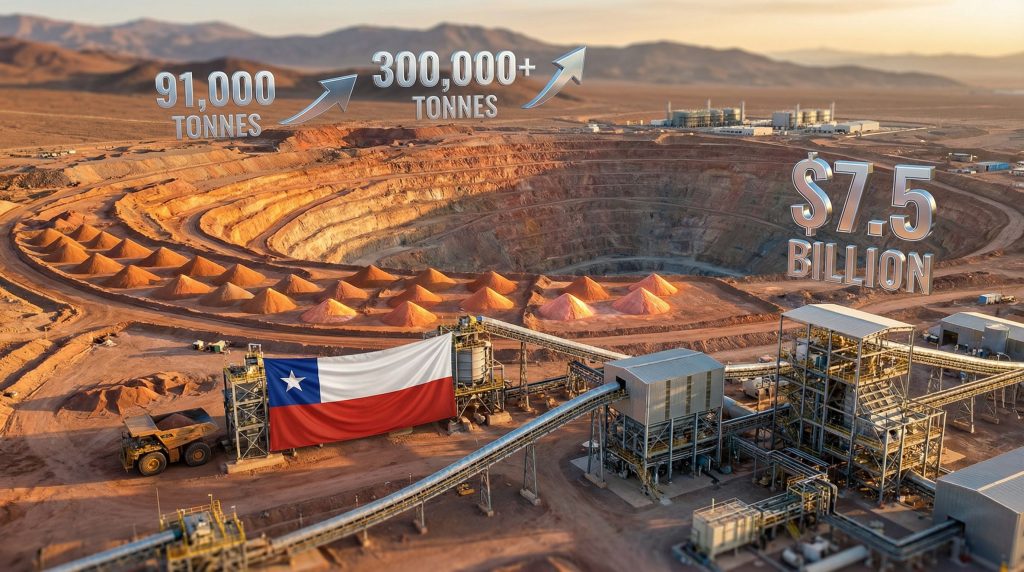
The El Abra expansion project demonstrates the scale transformation possible within existing mining operations. Current production of 91,000 tonnes annually represents a baseline that the proposed expansion would increase by over 300,000 tonnes, potentially reaching total output exceeding 390,000 tonnes per year.
| Production Metrics | Current Operations | Post-Expansion Projection |
|---|---|---|
| Annual Copper Output | 91,000 tonnes | 390,000+ tonnes |
| Investment Required | N/A | $7.5 billion |
| Construction Timeline | N/A | 2029-2033 |
| Production Commencement | Current | 2033+ |
This production increase occurs within a global context where copper demand continues outpacing supply additions. Electric vehicle manufacturing requires approximately 80 kilograms of copper per vehicle, while traditional internal combustion engines utilise roughly 25 kilograms. As EV adoption accelerates, copper intensity per vehicle increases substantially.
Artificial intelligence data centres represent another demand driver requiring significant copper content for cooling systems, power distribution, and connectivity infrastructure. A typical hyperscale data centre contains hundreds of tonnes of copper across various applications, creating sustained demand growth as digital infrastructure expands globally. Consequently, copper prices record highs have become a significant consideration for investors.
Market Positioning Within Supply Deficit Scenarios
Global copper supply deficits have emerged as a structural challenge facing the industry through 2030 and beyond. Major mining companies face declining ore grades at existing operations, requiring increased processing volumes to maintain output levels. New mine development timelines often span 7-10 years from discovery through production, creating supply response delays.
The Freeport McMoRan Chile copper expansion project addresses this supply challenge through capacity expansion at an established operation rather than greenfield development. This approach reduces timeline risk while leveraging existing infrastructure and operational expertise. Moreover, the global copper supply forecast indicates continued tightening of market conditions.
Chile's position as the world's largest copper producer provides advantages in terms of geological knowledge, regulatory familiarity, and established supply chains. The country produces approximately 28% of global copper output, making expansion projects within Chile strategically significant for global supply stability.
Investment Structure Analysis: Joint Venture Economics at Scale
Partnership Framework Between International Capital and State Resources
The 51%-49% ownership structure between Freeport and state-owned Codelco represents a strategic risk-sharing arrangement common in Chilean mining developments. Freeport's majority stake provides operational control while Codelco's participation ensures state involvement in resource development decisions.
This partnership structure distributes capital requirements between private international investment and Chilean state resources. The $7.5 billion investment commitment represents one of the largest mining expansions currently planned in South America, requiring sophisticated financing arrangements and risk management protocols.
Joint venture agreements typically include provisions for capital contribution timing, operational control distribution, and profit-sharing mechanisms. The specific terms governing the El Abra expansion remain subject to final investment decision processes and regulatory approvals.
Economic Modelling and Price Sensitivity Considerations
Copper price volatility creates significant economic modelling challenges for long-term investment decisions. Current copper prices above $4.00 per pound provide favourable economics for expansion projects, but price forecasting over 10-15 year project lifecycles involves substantial uncertainty.
Operating cost projections for the expanded El Abra operations must account for:
- Energy costs for concentrator plant operations and desalination facilities
- Labour expenses in Chile's mining regions
- Transportation costs for concentrate movement to ports
- Maintenance requirements for new processing equipment
- Environmental compliance costs throughout the operational period
Return on investment calculations for the $7.5 billion commitment depend critically on copper price assumptions, production ramp-up timelines, and operational efficiency achievements. The project's economics benefit from existing infrastructure at El Abra, reducing total capital requirements compared to greenfield alternatives. Furthermore, effective copper investment strategies consider these economic factors.
Environmental Approval Pathways for Mega-Scale Mining Projects
Impact Assessment Requirements and Timeline Management
Environmental impact assessment submission for the El Abra expansion is scheduled for the first half of 2026, initiating a comprehensive review process spanning multiple regulatory bodies. Chilean environmental law requires detailed analysis of water usage, tailings storage, air quality impacts, and community effects.
The project includes several major infrastructure components requiring individual environmental review:
- New concentrator plant with expanded processing capacity
- Desalination facility for water supply security
- Additional tailings storage areas with enhanced containment systems
- Transportation infrastructure connecting new facilities
Regulatory approval timelines typically extend 36-48 months for projects of this scale, involving public consultation periods, technical review processes, and conditional approval negotiations. The government's stated commitment to permitting acceleration may reduce these timelines, though actual implementation remains under evaluation.
Water Management Through Desalination Integration
Water scarcity in Chile's northern mining regions necessitates innovative supply solutions for expanded operations. The El Abra expansion includes dedicated desalination capacity to support increased processing requirements while reducing pressure on regional freshwater resources.
Desalination technology for mining applications has advanced significantly, with modern facilities achieving energy efficiency improvements and reduced environmental impacts. Integration of renewable energy sources with desalination operations addresses both water supply and environmental sustainability objectives. However, Freeport plans to boost El Abra copper output through these enhanced water management systems.
Critical Infrastructure Timeline:
- Environmental impact submission: H1 2026
- Regulatory review and approval: 2026-2029
- Construction phase implementation: 2029-2033
- Production ramp-up commencement: 2033+
Tailings management represents another critical environmental component requiring extensive regulatory review. The expansion's additional tailings storage facilities must meet evolving safety standards while providing long-term containment security.
Competitive Landscape Evolution in Chilean Copper Development
Benchmarking Against Regional Mega-Projects
The El Abra expansion competes for capital, regulatory attention, and skilled labour with other major Chilean copper projects. Collahuasi's proposed $8 billion concentrator development represents a comparable investment scale, creating competitive dynamics within Chile's mining sector.
Project timing provides strategic advantages for early movers in Chile's regulatory modernisation period. Companies achieving environmental approvals under the current administration's streamlined processes may benefit from faster project implementation compared to later entrants.
Technology integration differentiates modern copper projects from older operations. The El Abra expansion incorporates advanced concentrator plant designs, automated processing systems, and digital monitoring capabilities that improve operational efficiency and environmental performance.
Strategic Positioning Advantages Through Existing Operations
Freeport's established presence at El Abra provides significant advantages over greenfield development alternatives. Existing infrastructure, regulatory relationships, and operational expertise reduce project risks while accelerating development timelines.
The expansion leverages existing permits, environmental approvals, and community relationships established through decades of operation. This foundation enables focus on incremental expansion approvals rather than comprehensive permitting for entirely new operations.
Supply chain relationships, skilled labour availability, and logistical arrangements already in place at El Abra create operational synergies that improve project economics compared to standalone developments.
The next major ASX story will hit our subscribers first
Global Energy Transition Demand Drivers
Copper Requirements Across Emerging Technology Sectors
Electric vehicle manufacturing represents the most significant copper demand growth driver through 2035. Battery electric vehicles require substantially more copper than conventional vehicles, with demand increasing further for commercial vehicles, buses, and heavy equipment electrification.
Renewable energy infrastructure development creates sustained copper demand through:
- Wind turbine generators requiring high-grade copper windings
- Solar panel mounting systems and electrical connections
- Grid infrastructure modernisation for renewable energy integration
- Energy storage systems supporting grid stability
Data centre expansion driven by artificial intelligence applications represents an emerging demand category with significant copper intensity. These facilities require extensive copper content for power distribution, cooling systems, and connectivity infrastructure.
Supply Chain Security Considerations for Strategic Metals
Geographic concentration of copper production creates supply chain vulnerabilities that expansion projects in stable jurisdictions help address. Chile's established mining sector, political stability, and regulatory framework provide security advantages compared to production in less stable regions.
Strategic metal stockpiling by major economies reflects growing awareness of supply chain risks in critical materials. Copper's role in defence applications, infrastructure development, and energy transition technologies makes supply security a national security consideration for major consumers.
Trade relationship stability between producing and consuming nations affects long-term supply agreements and investment decisions. Chile's established trade relationships provide advantages for copper exports compared to regions with complex geopolitical relationships.
Risk Assessment Framework for Large-Scale Mining Investments
Market Volatility and Economic Cycle Impacts
Copper price forecasting over project lifecycles involves substantial uncertainty due to economic cycle impacts, demand fluctuations, and supply response timing. The El Abra expansion's $7.5 billion commitment requires robust economic modelling across various price scenarios.
Historical copper price volatility demonstrates the importance of hedging strategies for long-term projects. Price swings between $2.00 and $5.00 per pound over economic cycles create significant cash flow variations that affect project returns and financing requirements.
Economic recession impacts on copper demand create downside risks for expansion projects with long construction timelines. However, economic recovery periods typically generate strong copper demand as industrial activity rebounds and infrastructure investment increases.
Operational and Regulatory Challenge Management
Construction cost inflation represents a significant risk for major mining projects, particularly during periods of high commodity prices when contractor availability becomes constrained. The 2029-2033 construction timeline for El Abra expansion faces potential cost escalation risks.
Permitting timeline uncertainty creates project scheduling risks despite government commitments to acceleration. Regulatory review processes may extend beyond projected timelines due to technical complexities, public consultation requirements, or environmental considerations.
Environmental compliance evolution presents ongoing operational risks as regulations tighten and community expectations increase. Mining operations must adapt to changing requirements while maintaining operational efficiency and cost competitiveness.
Frequently Asked Questions About Major Copper Expansions
When will the expanded operations begin producing copper?
The El Abra expansion timeline projects production commencement in 2033, following environmental approval processes expected to conclude by 2029 and subsequent construction activities spanning 2029-2033. This timeline depends on regulatory approval success and construction execution without major delays.
How does this project compare to other Chilean copper investments?
The $7.5 billion El Abra expansion represents one of Chile's largest mining investments, comparable to Collahuasi's proposed $8 billion concentrator project. The scale positions it among the most significant copper capacity additions planned globally, with production increases exceeding 300,000 tonnes annually.
What environmental safeguards are required for the expansion?
Environmental requirements include comprehensive impact assessments for water usage, tailings storage, air quality, and community effects. The project must incorporate desalination facilities to reduce freshwater consumption and implement advanced tailings management systems meeting current safety standards.
How will this affect global copper pricing dynamics?
The expansion's 300,000+ tonne annual production increase represents approximately 1.5% of global copper supply, potentially providing moderate downward pressure on prices if demand growth moderates. However, growing EV and renewable energy demand may absorb additional supply without significant price impacts.
Investment Portfolio Implications for Mining Sector Exposure
Portfolio Diversification Through Mega-Project Participation
Large-scale mining projects provide investors with exposure to commodity price appreciation while benefiting from operational scale economies. The El Abra expansion offers geographic diversification within established mining jurisdictions and exposure to copper demand growth drivers.
Risk-adjusted return projections for mega-projects require careful consideration of construction risks, operational execution challenges, and commodity price volatility. Diversification across multiple projects and development stages can reduce concentration risks while maintaining commodity exposure.
Timeline diversification becomes important for mining investments, as projects at different development stages provide varying risk-return profiles. Early-stage projects offer higher potential returns but greater execution risks, while established operations provide more predictable cash flows.
Long-Term Value Creation Opportunities
Asset appreciation potential for successful mining expansions extends beyond immediate production increases to include reserve base enhancement, infrastructure value, and operational capability development. The Freeport McMoRan Chile copper expansion creates long-term value through enhanced production capacity and extended operational life.
Dividend yield sustainability depends on operational cash flow generation and capital allocation strategies. Successful project execution can support increased dividend payments while funding future growth opportunities within established mining operations.
Strategic acquisition opportunities may emerge as the copper industry consolidates around high-quality assets in stable jurisdictions. Projects like El Abra's expansion enhance asset quality and attractiveness for potential strategic transactions.
This analysis is based on publicly available information and industry research. Mining investments involve substantial risks including commodity price volatility, regulatory changes, and operational challenges. Investors should conduct thorough due diligence and consider professional advice before making investment decisions.
Exploring Opportunities in Small-Cap Copper Companies?
Discovery Alert's proprietary Discovery IQ model delivers real-time alerts on significant copper discoveries, instantly empowering subscribers to identify actionable opportunities ahead of the broader market. Begin your 14-day free trial today and secure your market-leading advantage.