May 10, 2026
Understanding Chile's Copper Production Landscape in 2025
The global copper market operates within a complex web of geological constraints, technological limitations, and economic pressures that extend far beyond simple supply-demand dynamics. Mining companies worldwide face the persistent challenge of declining ore grades while simultaneously confronting rising operational costs and increasing safety regulations. This convergence of factors creates a unique environment where even marginal production improvements carry significant strategic implications for both individual operators and entire national economies.
Chile's position as the world's dominant copper producer rests upon geological advantages accumulated over millions of years, yet these natural endowments now face systematic depletion after decades of intensive extraction. The nation's copper deposits, concentrated primarily in the Atacama Desert region, represent approximately 27% of global copper production, making Chile's mining performance a critical variable in international commodity markets.
When big ASX news breaks, our subscribers know first
Global Copper Market Context and Chile's Strategic Position
Chile's copper industry generated approximately 4.5 million metric tons in 2024, establishing the country as the world's leading copper producer by a substantial margin. This production volume represents more than one-quarter of global refined copper output, which reached approximately 22 million metric tons annually according to International Copper Study Group data.
The concentration of global copper production within Chilean borders creates both advantages and vulnerabilities for international supply chains. Industrial consumers of copper ranging from electrical equipment manufacturers to renewable energy infrastructure developers maintain heightened sensitivity to Chilean production variations, as disruptions can trigger rapid price adjustments across global commodity markets.
Chilean copper deposits benefit from favourable geological conditions including high-grade porphyry systems and established mining infrastructure spanning multiple decades of development. However, these same advantages now face systematic erosion as ore grades decline and operational complexity increases across major production centres. Furthermore, mineral exploration for copper has become increasingly challenging as easily accessible deposits are exhausted.
Codelco's Role as the World's Largest Copper Producer
Codelco operates as Chile's state-owned mining enterprise, established through nationalisation legislation in 1976 that consolidated foreign-owned copper assets under government control. The company maintains 100% state ownership while operating with autonomous management authority, creating a unique governance structure within the global mining industry.
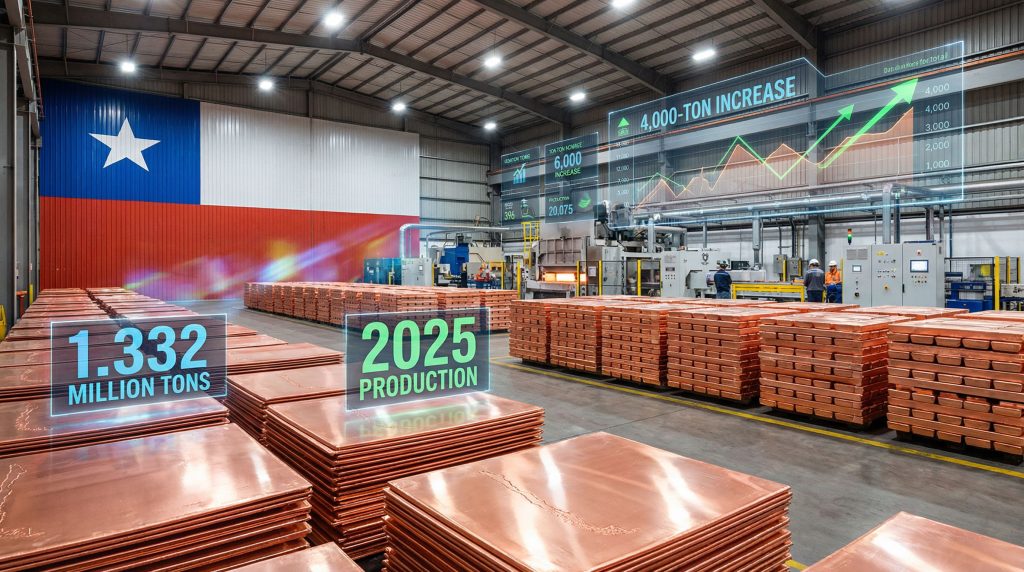
Codelco copper production 2025 reached 1.332 million tons, representing approximately 29.6% of Chile's total copper output and 6.1% of global refined copper production. This market position establishes Codelco as the single largest copper producer worldwide, though the company's production has remained relatively stable rather than experiencing significant growth over recent years.
The company operates six major mining divisions across Chile: Andina, Chuquicamata, El Salvador, El Teniente, Ministro Hales, and Radomiro Tomic. These operations span diverse geographical and geological environments, from high-altitude Andean deposits exceeding 4,500 metres elevation to lower-altitude open-pit operations in desert regions.
Key Performance Metrics Defining Production Success
| Metric | 2025 Performance | 2024 Comparison |
|---|---|---|
| Total Production | 1.332 million tons | 1.328 million tons |
| Year-over-Year Growth | +4,000 tons | +0.30% |
| Global Market Share | 6.1% | ~6.0% |
| Chilean Market Share | 29.6% | ~29.5% |
Production efficiency metrics for copper mining extend beyond simple tonnage figures to encompass ore grade management, processing recovery rates, and operational safety performance. Codelco's ability to maintain production levels despite declining ore grades demonstrates operational competency while highlighting the fundamental geological constraints affecting Chilean copper mining.
The company's production stability becomes particularly significant when considering the industry-wide trend toward declining ore grades. Chilean average copper ore grades have fallen from 1.4% copper content in 1990 to approximately 0.8-0.9% by 2024, requiring substantially increased ore processing volumes to maintain equivalent copper output levels.
What Drove Codelco's 2025 Production Performance?
Codelco copper production 2025 reflected successful operational management amid significant structural and operational challenges. The modest 4,000-ton increase over 2024 levels represented stabilisation rather than expansion, indicating management's focus on maintaining production consistency within existing asset constraints.
Chairman Máximo Pacheco characterised the results as delivering good news to the country through slightly better production than 2024, emphasising incremental improvement over dramatic growth. This messaging reflects realistic acknowledgment of the operational environment facing Chilean copper mining operations.
Quarterly Production Analysis and Trend Identification
Codelco Quarterly Production Breakdown 2025
| Period | Production Volume | Notable Characteristics |
|---|---|---|
| Q1-Q2 Combined | 689,000 tons | Strong first-half performance |
| Q3 | 248,000 tons | Operational challenges impact |
| October | 111,000 tons | Sequential decline patterns |
The first half of 2025 demonstrated Codelco's production capacity under optimal conditions, with 689,000 tons representing a solid foundation for annual targets. However, third-quarter performance revealed the impact of operational disruptions and the July El Teniente incident on production continuity.
October's 111,000-ton output illustrated the company's recovery efforts following major operational setbacks, though production levels remained below optimal capacity. The sequential patterns through 2025 highlighted Codelco's vulnerability to individual mine disruptions given the concentrated nature of its production base.
Mine-Specific Contribution Analysis
Top-Performing Operations by Output Gains
| Operation | Year-over-Year Change | Strategic Significance |
|---|---|---|
| Ministro Hales | +31,000 tons | Largest single improvement |
| El Teniente | +24,000 tons | Pre-incident performance |
| Rajo Inca | +17,000 tons | Successful ramp-up |
| Chuquicamata Underground | Structural impact | Long-term transformation |
Ministro Hales delivered the strongest individual performance improvement, contributing 31,000 additional tons compared to 2024 levels. This achievement demonstrated successful operational optimisation within existing infrastructure constraints, providing a model for performance enhancement across other divisions.
El Teniente's 24,000-ton improvement occurred primarily before the July rock burst incident that claimed six workers' lives and disrupted subsequent production. The mine's performance illustrated both its production potential and the vulnerability created by concentrated operations in challenging geological conditions.
The Rajo Inca operation contributed 17,000 tons through successful ramp-up activities, representing expansion of existing mining areas rather than entirely new development. This incremental expansion approach reflects Codelco's capital-efficient strategy for production enhancement.
Operational Efficiency Metrics and Benchmarking
Codelco's operational efficiency faced persistent headwinds from declining ore grades across multiple divisions. The company processed larger volumes of lower-grade ore to maintain copper output levels, creating pressure on milling capacity and increasing per-unit production costs.
Processing recovery rates remained within typical ranges of 85-92% for porphyry copper ores, though lower ore grades complicated flotation chemistry and threatened recovery efficiency. Metallurgical performance became increasingly critical as ore grade degradation accelerated across Chilean deposits.
Water management emerged as a critical operational constraint, with copper mining consuming approximately 65% of Chile's industrial water usage. Codelco's operations required enhanced water recycling systems to maintain production levels while addressing environmental compliance requirements.
How Do Production Challenges Impact Long-Term Strategy?
The structural challenges affecting Codelco copper production 2025 performance extend beyond short-term operational issues to fundamental geological and economic constraints that will shape the company's strategic direction for decades. Ore grade degradation, infrastructure aging, and safety requirements create compounding pressures that demand comprehensive strategic responses.
Management's acknowledgment of production struggles due to lower ore grades and operational issues reflects a broader industry reality affecting copper mining operations worldwide. These challenges require systematic approaches combining technological advancement, infrastructure investment, and operational methodology improvements.
Ore Grade Degradation Patterns Across Chilean Deposits
Chilean copper deposits have experienced systematic ore grade decline over multiple decades of intensive extraction. Average ore grades fell from 1.4% copper content in 1990 to approximately 0.8-0.9% by 2024, representing a 36-43% reduction in ore quality across the national mining sector.
This degradation pattern affects all major Chilean copper operations, though individual mines experience varying rates of decline based on geological characteristics and extraction methodologies. Codelco's operations face similar constraints, with each division adapting to progressively lower ore grades through processing optimisation and infrastructure modification.
The economic implications of ore grade decline are substantial. Each 0.1% reduction in copper content requires approximately 12.5% additional ore processing volume to maintain constant copper output, creating exponential cost pressures as grades continue declining.
Infrastructure Modernisation Requirements
Codelco's infrastructure base, developed for historical ore grades of 1.0-1.2% copper content, requires substantial modification to accommodate current grades of 0.8-0.9%. Processing facilities designed for higher-grade ore lack the capacity to handle increased volumes necessary for maintaining production levels.
Modernisation requirements include:
- Expanded milling capacity for lower-grade ore processing
- Enhanced flotation circuits optimised for complex ore mineralogy
- Upgraded water treatment and recycling systems
- Advanced tailings management infrastructure
- Improved material handling systems for increased throughput
The company's smelting capacity of approximately 1.5 million metric tons of concentrate annually provides adequate processing capability for current production levels, though infrastructure bottlenecks exist in upstream concentration processes.
Safety Protocol Evolution Following El Teniente Incident
The July 2025 El Teniente rock burst incident resulted in six fatalities and significant production disruption, highlighting safety challenges in deep underground mining operations. El Teniente operates at depths exceeding 2,000 metres, creating elevated geological stress conditions that contribute to rock burst risk.
"The July 2025 El Teniente rock burst incident resulted in six fatalities and estimated production losses of 33,000-48,000 tons, highlighting the critical intersection between worker safety and operational continuity in deep underground mining environments."
Rock burst incidents occur when accumulated stress in rock formations suddenly releases, causing violent fracturing and potential ground collapse. Deep underground mining operations face elevated risk due to increased geological pressure at depth and complex rock stress interactions.
Enhanced safety protocols typically include seismic monitoring systems for stress detection, modified pillar design and support systems, improved evacuation procedures, and comprehensive worker training programs. The implementation of these measures requires significant capital investment while potentially impacting production efficiency.
The next major ASX story will hit our subscribers first
What Does the 1.332 Million Ton Figure Mean for Global Markets?
Codelco copper production 2025 of 1.332 million tons carries implications extending far beyond Chilean borders, influencing global copper supply dynamics, price discovery mechanisms, and industrial supply chain planning across multiple sectors. The figure represents both achievement and constraint within the context of growing global copper demand.
The stability implied by Codelco's production maintenance amid operational challenges provides market confidence in Chilean copper supply reliability. However, the modest growth rate raises questions about Chile's capacity to meet expanding global copper requirements driven by electrification and renewable energy infrastructure development.
Supply Chain Implications for Copper-Dependent Industries
Global copper-dependent industries monitor Chilean production performance closely due to the country's dominant market position. Electrical equipment manufacturers, renewable energy developers, and construction companies maintain supply chain strategies accounting for Chilean production variability.
Codelco's production stability provides industrial consumers with predictable supply availability, though limited growth potential creates pressure for alternative supply source development. The global copper investment outlook reflects these supply chain considerations as companies seek diversified sourcing strategies.
Industries particularly sensitive to Chilean copper supply include:
- Electric vehicle manufacturing (wiring harnesses, charging infrastructure)
- Wind and solar power generation (transmission systems, generators)
- Building construction (electrical systems, plumbing applications)
- Telecommunications infrastructure (cables, network equipment)
Price Discovery Mechanisms and Market Response
Copper prices reflect supply-demand balance across global markets, with Chilean production levels influencing pricing dynamics through supply availability expectations. Codelco's 2025 copper production hits 1.332 million tons affects market sentiment regarding copper supply security and future availability.
The modest production increase relative to growing global demand supports price stability at elevated levels. Market participants interpret limited Chilean production growth as supply constraint validation, supporting higher copper prices across international commodity exchanges.
Price discovery mechanisms incorporate multiple factors beyond immediate production levels, including inventory management, forward contracting, and speculation activity. Codelco's production performance provides fundamental supply data that influences these pricing dynamics.
Comparative Analysis Against International Producers
Global Copper Production Context 2025
| Producer | Annual Production | Market Share | Geographic Base |
|---|---|---|---|
| Codelco | 1.332 million tons | 6.1% | Chile |
| Freeport-McMoRan | ~1.1 million tons | 5.0% | Multiple countries |
| BHP | ~800,000 tons | 3.6% | Australia, Chile |
| Southern Copper | ~950,000 tons | 4.3% | Peru, Mexico |
Codelco maintains its position as the world's largest individual copper producer, though the margin over competitors has narrowed as other producers expanded capacity. In addition, Argentinian copper projects have begun attracting international attention as companies seek geographic diversification.
The competitive landscape reflects geographic diversification strategies among major producers, with companies developing operations across multiple continents to reduce country-specific risk exposure. Codelco's concentration in Chilean operations creates both operational efficiency and geographic risk concentration.
Why Did Codelco Revise Production Guidance Downward?
Codelco's November 2025 production guidance revision from 1.34-1.37 million tons to 1.31-1.34 million tons reflected management's recognition of operational constraints that emerged throughout the production year. The revision demonstrated responsible guidance management while acknowledging challenges beyond management control.
The company's actual production of 1.332 million tons fell within the revised guidance range, tracking at the upper boundary and validating management's revised projections. This outcome demonstrated effective operational management within acknowledged constraints rather than systematic underperformance.
November 2025 Forecast Adjustment Analysis
Production Guidance Evolution
| Guidance Period | Production Range | Midpoint | Actual Outcome |
|---|---|---|---|
| Original 2025 | 1.34-1.37 million tons | 1.355 million tons | Below range |
| Revised November | 1.31-1.34 million tons | 1.325 million tons | Within range |
| Final 2025 | 1.332 million tons | Actual | Upper boundary |
The guidance revision represented approximately 10,000-20,000 metric ton production shortfall versus original projections. This adjustment magnitude indicates significant operational challenges rather than minor production optimisation issues.
Management's decision to revise guidance in November rather than maintaining optimistic projections demonstrated transparent communication with stakeholders and realistic assessment of operational capabilities under existing constraints.
Risk Factor Assessment and Mitigation Strategies
The guidance revision incorporated multiple risk factors that materialised during 2025 operations:
- El Teniente incident impact: Production disruption from July rock burst
- Ore grade degradation acceleration: Faster than anticipated grade decline
- Equipment reliability issues: Aging infrastructure maintenance requirements
- Water availability constraints: Seasonal variation in water access
- Labour productivity challenges: Safety protocol implementation effects
Risk mitigation strategies implemented during 2025 included enhanced preventive maintenance programmes, accelerated equipment replacement schedules, and improved operational contingency planning. Furthermore, AI in mining operations has begun playing a role in predictive maintenance and operational optimisation across the industry.
Investor Communication Protocols During Guidance Changes
Codelco's guidance revision process followed established protocols for state-owned enterprise communication, with updates provided through official channels and media engagement. Chairman Máximo Pacheco's radio appearances provided public updates on production performance and strategic direction.
Transparent communication during guidance revisions maintains credibility with stakeholders while managing expectations regarding production capability under challenging operational conditions. The approach builds long-term confidence through realistic projection setting.
How Does 2025 Performance Position Codelco for 2030 Targets?
Codelco copper production 2025 baseline of 1.332 million tons establishes the foundation for achieving significantly higher production targets by 2030. The company aims to reach 1.7 million tons of annual copper production within five years, representing a 368,000-ton increase or 28% growth from current levels.
This ambitious target requires systematic transformation of operational capabilities, infrastructure expansion, and technology integration across all mining divisions. The 2030 objective reflects both opportunity and challenge within Chilean copper mining development.
Pathway Analysis to 1.7 Million Ton Annual Capacity
Achieving 1.7 million tons by 2030 requires annual production growth averaging approximately 73,600 tons, substantially higher than the 4,000-ton increase achieved in 2025. This acceleration demands fundamental changes to production methodology and asset base expansion.
Production Growth Requirements
| Year | Target Production | Required Growth | Cumulative Increase |
|---|---|---|---|
| 2025 | 1.332 million tons | Baseline | 0 tons |
| 2027 | 1.480 million tons | +74,000 tons/year | +148,000 tons |
| 2030 | 1.700 million tons | +73,300 tons/year | +368,000 tons |
The pathway requires consistent annual growth rates significantly exceeding 2025 performance, indicating the need for substantial operational transformation and capital investment deployment.
Capital Investment Requirements and Timeline
Reaching 1.7 million tons annual capacity necessitates major capital expenditure across multiple categories:
Infrastructure Development Priorities:
- Mining equipment expansion and replacement
- Processing facility capacity enhancement
- Underground mine development and access systems
- Tailings management facility construction
- Water treatment and recycling system installation
- Power generation and transmission infrastructure
Capital requirements likely exceed $5-7 billion over the five-year period, based on typical mining industry investment ratios for production capacity expansion of this magnitude. Funding sources include government budget allocation, internal cash flow generation, and potential international financing arrangements.
Technology Integration and Automation Roadmap
Codelco's 2030 targets require advanced technology implementation to overcome operational constraints limiting current production levels. Automation technologies offer potential solutions for labour productivity enhancement and operational consistency improvement.
Priority Technology Applications:
- Automated mining equipment for underground operations
- Artificial intelligence-based ore sorting systems
- Advanced process control for flotation optimisation
- Predictive maintenance systems for equipment reliability
- Integrated mine planning and scheduling software
- Remote monitoring and control systems
Technology integration timelines must align with infrastructure development schedules to ensure coordinated capability enhancement across operational systems.
What Operational Innovations Are Driving Future Growth?
Codelco's pursuit of 1.7 million tons by 2030 relies heavily on operational innovations that address fundamental constraints affecting current production levels. These innovations focus on maximising extraction efficiency from declining ore grades while maintaining operational safety and environmental compliance.
The company's innovation strategy encompasses underground mining methodology advancement, processing technology optimisation, and integrated resource management systems. Success depends on effective technology deployment coordinated with infrastructure development and workforce capability enhancement.
Underground Mining Technology Advancement
Codelco's underground operations, particularly at El Teniente and the new Chuquicamata Underground project, represent critical components of production expansion strategy. Advanced underground mining technologies offer potential solutions for accessing ore bodies unsuitable for open-pit extraction.
Underground Innovation Priorities:
- Block caving optimisation for maximum ore recovery
- Automated material handling systems for improved safety
- Advanced rock mechanics monitoring for stability management
- High-capacity underground transportation systems
- Integrated ventilation and cooling systems for deep operations
The Chuquicamata Underground project exemplifies Codelco's underground mining evolution, transitioning from open-pit to underground extraction as surface ore becomes economically unviable. This transformation provides a model for similar transitions at other divisions.
Processing Efficiency Improvements
Processing efficiency optimisation becomes increasingly critical as ore grades decline and processing volumes increase. Codelco's concentrator operations require technological enhancement to maintain copper recovery rates while processing larger tonnages of lower-grade ore.
Processing Technology Initiatives:
- Advanced flotation cell design for improved separation
- Sensor-based ore sorting for grade enhancement
- Artificial intelligence process optimisation systems
- Enhanced grinding efficiency through mill optimisation
- Improved reagent management for flotation chemistry
Metallurgical recovery improvements of 1-2 percentage points could substantially increase copper output without requiring additional ore processing, providing cost-effective production enhancement.
Environmental Sustainability Integration
Environmental sustainability requirements increasingly influence operational design decisions, with water management and tailings storage representing critical constraints for production expansion. Codelco's sustainability initiatives aim to reduce environmental impact while supporting production growth objectives.
Sustainable operation technologies include water recycling systems achieving 85-90% reuse rates, renewable energy integration for power generation, and advanced tailings treatment for environmental risk reduction.
How Do Geopolitical Factors Influence Production Planning?
Codelco's production planning occurs within a complex geopolitical environment where Chilean government policy, international trade relationships, and strategic resource considerations intersect to influence operational decisions. The company's state ownership creates direct linkages between national economic policy and mining strategy.
Government revenue dependency on copper exports establishes alignment between national fiscal requirements and Codelco's production performance, though this relationship also creates pressure for short-term revenue maximisation that may conflict with long-term strategic development.
Chilean Government Policy Framework
The Chilean government maintains copper industry oversight through multiple regulatory agencies and policy mechanisms that directly impact Codelco's operational planning. Environmental regulations, labour policies, and taxation structures influence production economics and strategic decision-making.
Government Policy Influences:
- Environmental permitting requirements for expansion projects
- Labour law compliance and worker safety regulations
- Corporate tax rates and royalty payment structures
- Foreign investment policies affecting technology partnerships
- Water rights allocation and environmental protection requirements
Codelco's state ownership provides advantages in regulatory coordination while creating accountability for national economic contribution through employment generation and export revenue production.
International Trade Relationship Management
Chile's copper exports serve global markets with China representing the largest single destination for Chilean copper products. Trade relationship stability directly impacts Codelco's market access and pricing realisation for production output.
International trade considerations affecting production planning include currency exchange rate fluctuations, trade agreement provisions, and geopolitical tensions between major copper-consuming nations. Consequently, Codelco maintains operational stability through market diversification strategies to reduce dependency on individual trading partners.
Strategic Resource Allocation Considerations
Chile's copper resources represent national strategic assets with implications extending beyond immediate commercial value. Government decision-making regarding resource extraction rates balances current economic benefits against long-term resource conservation and strategic value preservation.
Strategic considerations include reserve conservation for future generations, technological development investment for enhanced recovery, and international cooperation on sustainable mining practices.
What Investment Opportunities Emerge from Production Data?
Codelco's 2025 production performance and 2030 targets create multiple investment opportunity categories spanning technology development, infrastructure construction, and supply chain integration. The company's capital requirements and operational challenges generate market opportunities for both domestic and international investors.
Investment opportunities extend beyond direct mining operations to encompass supporting industries including equipment manufacturing, technology development, and specialised services. The scale of Codelco's operations creates substantial economic multiplier effects throughout Chilean and international business networks.
Copper Market Fundamentals and Demand Projections
Global copper demand growth driven by electrification trends, renewable energy development, and infrastructure expansion creates favourable market conditions for Chilean copper production investment. Electric vehicle adoption and grid modernisation require substantial copper consumption increases over the next decade.
Demand Growth Drivers:
- Electric vehicle manufacturing expansion
- Renewable energy infrastructure development
- Grid modernisation and energy storage systems
- Building electrification and heat pump adoption
- Industrial automation and robotics deployment
Conservative projections estimate global copper demand growth of 2-3% annually through 2030, creating market conditions supporting Chilean production expansion investment. Furthermore, the US copper production overview indicates that diversified production sources will be essential to meet growing demand.
Infrastructure Development Requirements
Codelco's production expansion requires substantial infrastructure development creating investment opportunities across multiple sectors. Transportation, power generation, water management, and telecommunications infrastructure require enhancement to support increased mining operations.
Infrastructure Investment Themes:
| Category | Investment Requirement | Market Opportunity |
|---|---|---|
| Transportation | Rail and port capacity expansion | Logistics and shipping companies |
| Power Generation | Renewable energy systems | Solar and wind development |
| Water Management | Treatment and recycling facilities | Environmental technology providers |
| Telecommunications | Remote monitoring systems | Technology integration services |
Infrastructure development creates long-term investment opportunities with stable returns supported by essential service provision to mining operations.
Technology Partnership Potential
Codelco's technology advancement requirements create partnership opportunities for companies developing mining automation, processing optimisation, and environmental management systems. The company's scale provides attractive market validation for technology developers.
Technology partnership areas include artificial intelligence applications for process optimisation, robotics development for automated mining operations, and environmental monitoring systems for regulatory compliance.
Frequently Asked Questions About Codelco's 2025 Performance
Codelco's 2025 production results generated significant interest from industry observers, investors, and policy makers seeking to understand the implications of modest growth within challenging operational conditions. Key questions focus on comparative performance, growth constraints, and future reporting schedules.
How does the 4,000-ton increase compare to industry standards?
The 4,000-ton increase represents 0.30% year-over-year growth, significantly below typical industry expansion rates of 3-5% annually for major mining operations. However, this comparison must consider Codelco's operational constraints including declining ore grades and infrastructure limitations.
Industry peer comparison reveals mixed performance among global copper producers, with some achieving higher growth rates through new mine development while others face similar challenges from aging assets and geological constraints.
What factors contributed to the modest production growth?
Multiple factors limited Codelco's production growth in 2025:
- Ore grade degradation: Declining copper content in processed ore
- El Teniente incident: Production disruption from July rock burst
- Infrastructure constraints: Milling capacity limitations for increased throughput
- Water availability: Seasonal and regulatory constraints on water usage
- Equipment reliability: Aging infrastructure requiring increased maintenance
These factors created compound effects limiting production expansion despite operational optimisation efforts across mining divisions.
When will Codelco release official full-year confirmation?
Codelco typically releases official annual production figures through quarterly and annual reporting schedules aligned with Chilean state enterprise requirements. The 1.332 million ton figure reported through Chilean media sources awaits official company confirmation through formal reporting channels.
Investors and industry observers monitor official releases through Codelco's corporate communications and Chilean regulatory filings for comprehensive production analysis including divisional breakdowns and operational performance metrics.
Disclaimer: This analysis contains forward-looking projections and market interpretations that involve inherent uncertainty. Copper market conditions, production capabilities, and operational performance may vary significantly from projections discussed. Investment decisions should incorporate comprehensive due diligence and professional financial advice. Production figures and market data reflect information available as of publication date and may be subject to revision.
Ready to Capitalise on Major Copper Discoveries?
Discovery Alert's proprietary Discovery IQ model delivers real-time alerts on significant ASX mineral discoveries, instantly empowering investors to identify actionable opportunities ahead of the broader market. Understand why major mineral discoveries can lead to substantial market returns by exploring Discovery Alert's dedicated discoveries page, showcasing historic examples of exceptional outcomes, and begin your 30-day free trial today to position yourself ahead of the market.