May 21, 2026
Chilean mining companies are increasingly embracing copper production using seawater in Chile as traditional freshwater sources become scarce and regulatory frameworks evolve toward sustainability mandates. The transformation of copper mining across remote desert landscapes represents one of the most significant operational shifts in modern resource extraction. Traditional water sourcing methodologies face unprecedented pressure as groundwater reserves decline and regulatory frameworks evolve toward sustainability mandates. Understanding the engineering systems that enable alternative water utilisation reveals fundamental changes in how mining operations approach resource security and long-term viability.
Understanding Chile's Water Crisis in Mining Operations
Chile's northern mining corridor faces acute freshwater constraints that fundamentally reshape operational planning. The Atacama Desert, spanning over 105,000 square kilometres, receives less than 1mm of annual precipitation in some areas, creating conditions where traditional water sourcing becomes economically and environmentally unsustainable.
Quantifying the Atacama Desert's Freshwater Scarcity Challenge
The region's hydrological profile presents stark challenges for industrial operations. Aquifer depletion rates exceed natural recharge by significant margins, with some underground water sources showing declining levels of 1-3 metres annually. This creates a cascading effect where mining operations must compete with agricultural and municipal users for increasingly scarce freshwater resources.
Mining facilities in the northern provinces of Antofagasta and Tarapacá consume substantial water volumes. Traditional operations require 0.7 to 1.2 cubic metres of water per ton of copper produced. The cumulative effect across multiple large-scale operations creates regional water stress that threatens both current production and expansion plans.
Furthermore, the copper production forecast indicates growing demand that will intensify these water security challenges. Mining companies must therefore develop innovative solutions to maintain production levels whilst addressing environmental concerns.
Mining Water Consumption Patterns Across Different Ore Types
Processing requirements vary significantly based on geological characteristics and extraction methodologies:
- Sulfide ore flotation: Requires 1.0-1.5 m³ per ton processed
- Oxide heap leaching: Consumes 0.8-1.2 m³ per ton of ore
- SX-EW operations: Demand 0.5-0.9 m³ per ton of cathode produced
- Concentration processes: Utilise 2.0-3.5 m³ per ton of concentrate
These consumption patterns create operational constraints when freshwater availability becomes limited. Consequently, operations must either reduce throughput or invest in alternative water sourcing technologies. Advanced waste management solutions are becoming essential for optimising water recovery and recycling processes.
Regional Distribution of Water-Stressed Mining Operations
Geographic analysis reveals concentrated water stress across key mining districts. The Antofagasta region hosts over 60% of Chile's copper production capacity, yet possesses minimal renewable freshwater resources. Mining operations in this area increasingly rely on groundwater extraction from depths exceeding 200 metres, with associated pumping costs and sustainability concerns.
The Atacama region presents similar challenges, where lithium and copper operations compete for limited water resources. Environmental regulations increasingly restrict freshwater extraction permits, creating regulatory risk for operations dependent on traditional sourcing methods.
When big ASX news breaks, our subscribers know first
What Are the Core Technologies Behind Seawater-Based Copper Production?
Technological integration enables copper production using seawater in Chile through three primary approaches: desalination for freshwater equivalent production, direct seawater utilisation in processing circuits, and hybrid systems combining both methodologies. Each approach presents distinct engineering requirements and economic considerations.
Desalination Systems for Mining Applications
Industrial desalination for mining applications operates at scales significantly larger than municipal systems. Reverse osmosis facilities designed for copper operations typically process 500-2000 litres per second, requiring substantial energy inputs and specialised equipment designed for continuous operation.
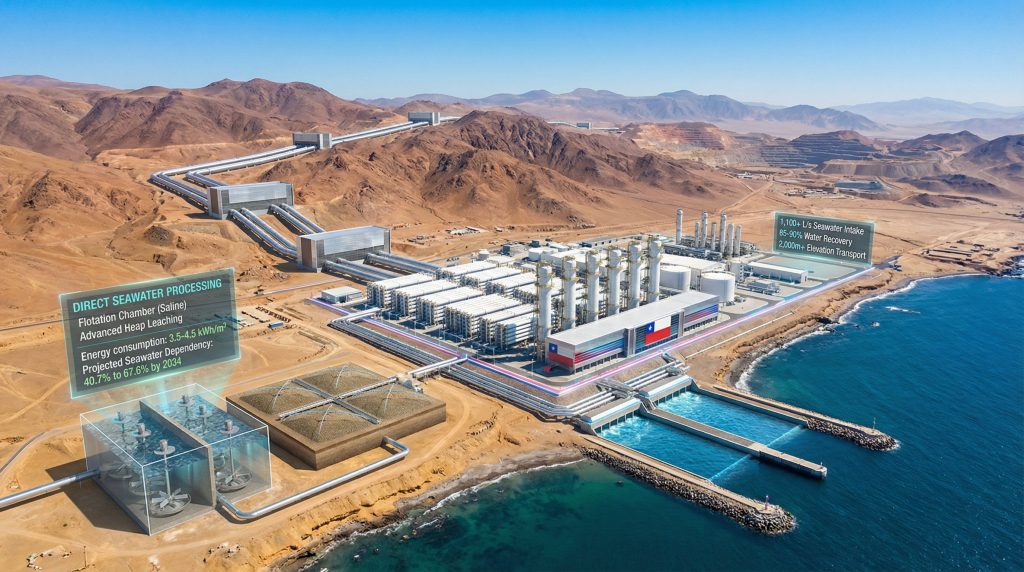
Energy consumption represents the primary operational cost, with modern reverse osmosis systems consuming approximately 3.5-4.5 kWh per cubic metre of produced freshwater. This energy requirement creates direct correlations between electricity costs and water production economics. However, renewable energy solutions are increasingly integrated to reduce operational costs and environmental impact.
| System Component | Capacity Range | Energy Consumption | Capital Cost Factor |
|---|---|---|---|
| RO Membranes | 1000-5000 m³/day | 3.2-4.1 kWh/m³ | 35-40% of total CapEx |
| High Pressure Pumps | 50-200 bar | 2.8-3.4 kWh/m³ | 15-20% of total CapEx |
| Energy Recovery Systems | 85-95% efficiency | 0.3-0.7 kWh/m³ saved | 10-15% of total CapEx |
Direct Seawater Processing Technologies
Direct utilisation of seawater in mineral processing circuits eliminates desalination requirements but demands significant process modifications. Flotation chemistry requires adaptation to saline conditions, with collectors, frothers, and pH modifiers selected for compatibility with elevated ionic strength environments.
Corrosion management becomes critical in direct seawater applications. Equipment selection must account for accelerated corrosion rates, with stainless steel grades 316L or higher typically required for process pipelines and vessels. Protective coatings and cathodic protection systems extend equipment life but increase maintenance complexity.
Flotation performance in seawater environments can achieve recovery rates within 2-5% of freshwater equivalents when proper reagent schemes are implemented. However, reagent consumption typically increases by 15-25% due to ionic interference effects and increased solution conductivity. AI mining innovations are helping optimise these processes through real-time monitoring and adjustment systems.
Water Transport and Distribution Networks
Infrastructure requirements for seawater transport to inland mining operations present significant engineering challenges. Pipeline systems must overcome elevation differences exceeding 2,000 metres while maintaining flow rates sufficient for continuous operations.
Pumping station design requires:
- Multiple boost stations spaced at 15-25 kilometre intervals
- Pressure ratings of 40-60 bar for elevation gain requirements
- Corrosion-resistant materials throughout the pipeline system
- Redundant pumping capacity to ensure operational continuity
Storage and distribution systems at mining sites require specialised design to prevent seawater degradation and biological growth. Covered reservoirs with circulation systems maintain water quality during temporary storage periods.
How Do Production Economics Change with Seawater Integration?
Economic analysis of seawater integration reveals complex trade-offs between capital expenditure, operational costs, and production capacity optimisation. Initial infrastructure investments are substantial, but long-term operational benefits often justify the capital deployment for large-scale operations.
Capital Expenditure Analysis
Infrastructure investment requirements vary significantly based on operation size, distance from coast, and technological approach selected. Desalination facilities represent 40-60% of total seawater infrastructure costs, with pipeline construction comprising 25-35% of capital requirements.
Investment breakdown by operation size:
- Large operations (>100,000 tpa copper): $200-400 million total infrastructure
- Medium operations (30,000-100,000 tpa): $80-200 million total investment
- Small operations (<30,000 tpa): $30-80 million infrastructure costs
Financing models increasingly incorporate sustainability metrics and ESG considerations. Development banks and institutional investors provide favourable terms for water security projects. Risk-sharing mechanisms between mining companies and infrastructure developers reduce individual company exposure whilst enabling large-scale implementation.
For investors considering exposure to this sector, comprehensive investing guide 2025 resources provide valuable insights into project evaluation criteria and risk assessment frameworks.
Operational Cost Implications
Energy consumption dominates operational costs for seawater-based copper production systems. Electricity requirements for desalination, pumping, and specialised processing equipment create direct correlations between power costs and water production economics.
Annual operational cost components:
- Energy costs: $0.15-0.25 per m³ processed (varies by electricity pricing)
- Maintenance and consumables: $0.05-0.12 per m³ processed
- Labour and administration: $0.02-0.05 per m³ processed
- Membrane replacement: $0.03-0.08 per m³ (amortised over membrane life)
Equipment maintenance requirements increase substantially in seawater environments. Corrosion monitoring, protective coating maintenance, and component replacement schedules require specialised expertise and higher inventory levels for critical spare parts.
Production Capacity Enhancement Metrics
Water security enables production optimisation that was previously constrained by freshwater availability. Operations can maintain consistent throughput during drought periods and pursue expansion projects without additional freshwater permitting constraints.
Quantified production benefits include:
Capacity utilisation improvements: 5-15% higher annual throughput due to water availability certainty
Processing flexibility: Ability to process lower-grade ores previously considered uneconomic due to water constraints
Expansion potential: Reduced regulatory risk for future capacity increases
Which Mining Operations Lead Chile's Seawater Transition?
Several mining operations have established themselves as pioneers in seawater integration, developing operational expertise and demonstrating commercial viability. These facilities provide practical examples of different technological approaches and implementation strategies.
Large-Scale Integrated Operations
BHP's Spence operation represents one of the most comprehensive seawater integration projects in Chilean copper mining. The facility operates a desalination plant with capacity exceeding 1,000 litres per second, connected via pipeline infrastructure spanning over 150 kilometres from the Pacific coast to the mining site.
The Spence implementation demonstrates several key operational principles:
- Redundant water sourcing combining desalinated seawater with limited groundwater backup
- Process optimisation for saline water compatibility across all processing circuits
- Environmental integration with marine ecosystem monitoring and brine disposal management
Antofagasta Minerals has committed to achieving 90% seawater or recirculated water utilisation across its Chilean operations before 2030. This commitment encompasses multiple facilities and represents one of the industry's most comprehensive water security strategies, as reported by BNamericas.
Mid-Scale Adaptation Strategies
Medium-sized operations face different economic constraints when implementing seawater systems. Shared infrastructure models and phased implementation approaches enable these operations to achieve water security whilst managing capital requirements.
Retrofit approaches for existing facilities typically involve:
- Gradual replacement of freshwater sources with seawater alternatives
- Process circuit modifications implemented during scheduled maintenance periods
- Equipment upgrades prioritised based on corrosion risk and replacement schedules
Regional cooperation models enable multiple operations to share pipeline infrastructure and desalination facilities. This reduces per-operation capital requirements whilst achieving economies of scale in construction and operation.
Emerging Project Implementations
New mining developments increasingly incorporate seawater systems from initial design phases. This approach eliminates retrofit costs and enables optimal integration of water systems with processing infrastructure.
Greenfield projects benefit from:
- Integrated design optimising equipment selection for seawater compatibility
- Simplified permitting avoiding freshwater extraction environmental assessments
- Operational efficiency achieved through purpose-built infrastructure rather than retrofit adaptations
What Engineering Challenges Define Seawater Mining Operations?
Technical challenges associated with seawater utilisation in copper mining extend beyond simple water quality management. Corrosion, process chemistry modifications, and environmental compliance create interconnected engineering requirements that demand specialised expertise and comprehensive solutions.
Equipment Corrosion and Material Selection
Seawater's corrosive properties accelerate equipment degradation compared to freshwater operations. Chloride concentrations exceeding 19,000 ppm create conditions where standard carbon steel components experience rapid failure, necessitating upgraded materials and protective systems.
Material selection criteria for seawater environments:
- Stainless steel 316L minimum for process piping and vessels
- Super-duplex alloys for high-stress components and pumping systems
- Specialised coatings providing 10-15 year protection cycles for large structures
- Cathodic protection systems for buried pipelines and storage facilities
Maintenance scheduling requires adaptation to accelerated wear patterns. Inspection frequencies typically increase by 50-100% compared to freshwater operations, with predictive maintenance technologies essential for avoiding unplanned shutdowns.
Process Chemistry Modifications
Flotation chemistry undergoes significant modification when transitioning from freshwater to seawater environments. Ion concentrations affect reagent effectiveness, requiring reformulated collector packages and modified dosing strategies.
Critical process adjustments include:
- pH control systems adapted for seawater's buffering capacity
- Collector selection optimised for high ionic strength conditions
- Frother modifications maintaining flotation kinetics in saline solutions
- Recovery optimisation through particle size and residence time adjustments
Metallurgical testing programmes must validate process performance under seawater conditions before full-scale implementation. Laboratory testing protocols require modification to accurately simulate industrial seawater processing environments.
Environmental Engineering Considerations
Brine disposal from desalination operations requires comprehensive environmental management systems. Concentrated seawater discharge contains elevated salinity levels and trace concentrations of process chemicals that require treatment before ocean discharge.
Environmental compliance frameworks address:
- Marine ecosystem monitoring to assess discharge impact on local species
- Brine discharge optimisation to minimise environmental effects through dilution and timing
- Chemical treatment systems removing process contaminants before discharge
- Long-term monitoring programmes tracking cumulative environmental effects
Regulatory approval processes typically require extensive environmental impact assessments and ongoing monitoring commitments that extend throughout operational life cycles.
How Does Water Efficiency Technology Maximise Seawater Utilisation?
Advanced water management technologies enable mining operations to maximise the utility of processed seawater whilst minimising overall consumption. These systems combine traditional process engineering with digital monitoring and optimisation algorithms.
Recirculation and Reuse Systems
Closed-loop water processing achieves substantial efficiency improvements by recycling process water through multiple utilisation cycles. Modern recirculation systems achieve 85-90% water recovery rates through advanced separation and treatment technologies.
System components enabling high recovery rates:
- Thickener optimisation maximising water extraction from tailings streams
- Filtration systems recovering process water from concentrate streams
- Water treatment modules removing accumulated contaminants during recirculation
- Quality monitoring systems ensuring process water specifications throughout recycling cycles
AI-driven monitoring systems optimise recirculation performance by analysing water quality parameters in real-time and adjusting treatment processes automatically. These systems reduce manual oversight requirements whilst maintaining optimal process conditions.
Advanced Processing Techniques
Process modifications enable substantial reductions in water consumption whilst maintaining metallurgical performance. Coarser flotation approaches reduce water requirements by 20% through modified particle size distributions and improved separation efficiency.
Dry tailings systems represent perhaps the most significant water conservation technology, eliminating traditional tailings pond water consumption. These systems achieve water consumption reductions of 50% or more by extracting moisture from tailings through mechanical filtration and thermal processes.
Water efficiency improvements by technology:
| Technology | Water Reduction | Implementation Complexity | Capital Requirement |
|---|---|---|---|
| Coarse Flotation | 15-25% | Moderate | Low-Medium |
| Dry Tailings | 45-60% | High | High |
| Paste Thickening | 30-40% | Moderate | Medium |
| Ore Sorting | 10-20% | Low-Moderate | Medium |
Smart Water Management Integration
Digital monitoring systems provide real-time visibility into water consumption patterns across all process areas. Sensor networks track flow rates, quality parameters, and system performance metrics, enabling optimisation algorithms to minimise consumption whilst maintaining process targets.
Predictive maintenance applications utilise water system data to forecast equipment failures and optimise replacement schedules. These systems reduce unplanned downtime whilst extending equipment life through optimised operating conditions.
Automated optimisation algorithms adjust water distribution, recycling rates, and treatment processes based on current operational conditions and metallurgical requirements. This automation reduces manual intervention whilst achieving consistent efficiency improvements.
The next major ASX story will hit our subscribers first
What Investment Patterns Drive Seawater Infrastructure Development?
Investment in seawater infrastructure reflects changing risk perceptions around water security and regulatory compliance. Traditional project financing models evolve to accommodate longer payback periods and sustainability-focused investment criteria.
Public-Private Partnership Models
Government support for water security initiatives creates opportunities for risk-sharing between public and private sectors. These partnerships typically involve public sector provision of basic infrastructure whilst private mining companies invest in operation-specific facilities and equipment.
Risk-sharing arrangements commonly address:
- Regulatory approval processes with government agencies providing permitting support
- Environmental compliance through shared monitoring and reporting obligations
- Infrastructure maintenance combining public and private resource commitments
- Technology development through joint research and demonstration projects
Regulatory incentives increasingly favour sustainable water sourcing approaches, with expedited permitting processes and reduced regulatory fees for seawater-based projects compared to freshwater extraction proposals.
International Financing Structures
Development banks and international financial institutions provide specialised financing for water security projects in mining regions. These institutions typically offer favourable terms for projects demonstrating clear environmental and social benefits.
ESG-driven investment criteria increasingly influence capital allocation decisions. Institutional investors prioritise projects with demonstrated sustainability benefits, creating financing advantages for seawater infrastructure compared to traditional freshwater extraction approaches.
Corporate sustainability commitments drive internal capital allocation toward water security projects, even when traditional financial metrics might not justify immediate investment. Mining companies increasingly view water security as essential for long-term operational viability rather than optional efficiency improvements.
Technology Development Funding
Research and development investment in seawater processing technologies accelerates as commercial demand increases. Venture capital firms focus on mining water technology startups developing specialised equipment, monitoring systems, and process optimisation solutions.
Corporate innovation programmes enable established mining companies to evaluate and implement emerging technologies through partnerships with technology developers. These programmes reduce implementation risk whilst accelerating technology adoption across multiple operations.
Technology development priorities include:
- Energy efficiency improvements reducing operational costs for desalination and processing
- Corrosion resistance advances extending equipment life in seawater environments
- Process optimisation algorithms maximising water utilisation efficiency
- Environmental monitoring systems ensuring compliance with discharge regulations
How Will Seawater Integration Scale Across Chile's Copper Sector?
Industry-wide adoption of seawater technologies follows predictable patterns based on operational scale, geographic location, and regulatory pressure. Large operations lead implementation due to economies of scale, whilst smaller operations follow as technology costs decrease and shared infrastructure becomes available.
Industry-Wide Adoption Timeline
Seawater dependency across Chile's copper sector shows accelerating growth patterns. Current analysis suggests seawater will supply approximately 67.6% of total mining water needs by 2034, representing a significant increase from 40.7% in 2024, as highlighted by Mining.com. This transition reflects both new project development and retrofit of existing operations.
Regional implementation priorities follow logical patterns:
- Coastal proximity operations implementing seawater systems first due to reduced infrastructure costs
- Large-scale producers justifying capital expenditure through economies of scale
- Water-stressed regions facing regulatory pressure for alternative sourcing approaches
- New developments incorporating seawater systems during initial construction phases
Technology standardisation across operations enables cost reductions through shared expertise and equipment specifications. Industry collaboration on technical standards accelerates implementation whilst reducing individual company risk exposure.
Production Capacity Implications
Total water consumption across Chile's copper sector is projected to increase from 18.5 m³/s to 20.6 m³/s by 2034, reflecting both increased production and new project development. This growth occurs despite efficiency improvements as overall copper output expands to meet global demand.
Water security through seawater integration enables production optimisation previously constrained by freshwater availability. Operations can maintain consistent throughput during drought conditions whilst pursuing expansion projects without freshwater permitting limitations.
Production benefits from water security include:
- Capacity utilisation improvements through elimination of water-constrained production periods
- Ore grade flexibility enabling processing of previously uneconomic lower-grade materials
- Expansion capability without additional freshwater extraction environmental constraints
- Operational reliability through diversified water sourcing reducing single-point-of-failure risks
Competitive Advantages in Global Markets
Water security provides Chilean copper producers with operational advantages compared to competitors in water-stressed regions. Reliable water availability enables consistent production scheduling whilst reducing operational risk from drought or regulatory restrictions.
Cost competitiveness improves over time as seawater infrastructure capital costs are amortised whilst freshwater extraction costs increase due to scarcity and regulatory compliance requirements. Long-term projections suggest seawater-based operations achieve lower unit water costs than freshwater alternatives within 7-10 years of initial implementation.
Sustainability credentials in international markets increasingly influence purchasing decisions and financing availability. Copper producers demonstrating responsible water management gain advantages in ESG-focused procurement processes and capital markets.
What Lessons Can Other Mining Regions Learn from Chile's Approach?
Chile's experience with seawater integration provides valuable insights for other mining regions facing similar water scarcity challenges. Technology transfer opportunities exist for regions with comparable geological conditions and water availability constraints.
Technology Transfer Opportunities
Mining regions with similar water scarcity challenges can adapt Chilean seawater technologies with modifications for local conditions. Peru's coastal copper operations face comparable challenges and geographic conditions, enabling direct technology transfer with minimal adaptation requirements.
Applicable regions include:
- Australian mining operations in water-stressed areas of Western Australia and South Australia
- African copper belt regions with limited freshwater availability and coastal access
- Middle Eastern mining developments in arid regions with seawater accessibility
- Southwestern United States copper operations facing groundwater depletion issues
Adaptation requirements vary based on local geological conditions, environmental regulations, and existing infrastructure. However, core technologies and implementation approaches translate effectively across similar operating environments.
Policy Framework Development
Regulatory approaches supporting seawater integration require coordination between mining, environmental, and water resource agencies. Chile's experience demonstrates the importance of integrated policy frameworks that address permitting, environmental compliance, and infrastructure development simultaneously.
Environmental permitting processes must accommodate marine ecosystem considerations whilst enabling efficient project approval timelines. Successful frameworks balance environmental protection with industrial development needs through science-based assessment criteria and stakeholder engagement processes.
International cooperation models facilitate technology transfer and knowledge sharing between mining regions. Government-to-government agreements can address regulatory harmonisation and technical standard development whilst reducing implementation barriers.
Investment Strategy Replication
Financing models developed for Chilean seawater projects provide templates for similar implementations in other jurisdictions. Public-private partnerships, development bank participation, and ESG-focused investment approaches can be adapted for different regulatory and economic environments.
Risk assessment frameworks must account for local conditions including regulatory stability, environmental requirements, and infrastructure availability. However, core risk categories and mitigation strategies translate effectively across different mining regions.
Investment success factors include:
- Long-term government policy support providing regulatory certainty for infrastructure investment
- Technical expertise development through education and training programmes
- Environmental compliance frameworks ensuring sustainable implementation
- Financial incentive structures supporting initial capital deployment and operational efficiency improvements
Disclaimer: This analysis contains forward-looking projections and technical assessments that involve inherent uncertainties. Investment decisions should be based on comprehensive due diligence and professional consultation. Water consumption figures and implementation timelines may vary based on actual operational conditions and regulatory developments.
Ready to Capitalise on Chile's Water Innovation Revolution?
Discovery Alert's proprietary Discovery IQ model delivers instant notifications on significant ASX mineral discoveries, including breakthrough technologies transforming global mining operations like Chile's seawater integration innovations. Stay ahead of market movements by exploring historical discoveries that have generated exceptional returns, and begin your 14-day free trial today to position yourself at the forefront of mining investment opportunities.