May 20, 2026
When Regulatory Friction Meets a Critical Copper Asset
The global mining industry is undergoing a quiet but profound transformation in how environmental governance intersects with large-scale resource extraction. Across Latin America, the legal architecture surrounding indigenous rights, marine ecology, and freshwater scarcity has matured rapidly over the past decade. This has created a regulatory environment that can challenge even the most meticulously planned mining projects. The May 2026 ruling by Chile's Second Environmental Tribunal — in which the Chilean tribunal rejects Collahuasi development plan — is a precise illustration of this shift in action.
Understanding what this ruling actually means, what it does not mean, and what it signals for one of the world's premier copper assets requires careful analysis across multiple dimensions: legal, operational, hydrological, and market-oriented.
When big ASX news breaks, our subscribers know first
Chile's Environmental Tribunal System and Why It Holds Real Power
The Architecture of Environmental Oversight
Chile's environmental tribunal system was established under Law No. 20,417, which created specialised courts staffed by judges with expertise in environmental matters. This legislative reform represented a significant departure from the previous model where general courts handled environmental disputes, often without the technical grounding necessary to assess complex ecological or community impact questions.
The Second Environmental Tribunal exercises jurisdiction over environmental cases in the Tarapacá and Antofagasta regions, precisely the corridor where Chile's most productive copper mines are concentrated. Its authority extends to reviewing contested Resoluciones de Calificación Ambiental — the formal environmental authorisations issued by the Environmental Assessment Service, known as the SEA.
The SEA functions as the primary permitting body for large-scale mining infrastructure in Chile. When the SEA grants an RCA following an environmental impact assessment process, that decision can subsequently be challenged before an environmental tribunal. Critically, the tribunal's power to set aside an RCA does not automatically equate to a prohibition on the project. Rather, it creates a binding obligation on the SEA to re-examine the specific elements the tribunal has identified as deficient, leaving the broader authorisation intact unless otherwise determined.
This distinction matters enormously for investors and analysts. A remand to the SEA for targeted re-examination is a procedural correction mechanism, not a veto over the project's existence.
For multinational mining operators working within Latin American regulatory environments, the predictability and legal rigour of Chile's tribunal system is generally considered more manageable than the regulatory unpredictability seen in some neighbouring jurisdictions. Chile's framework operates within a stable democratic rule-of-law context, meaning tribunal decisions, while consequential, follow established procedural pathways.
The C20+ Project: What Was Being Built and Why It Matters
Desalination as Operational Necessity, Not Optional Infrastructure
The C20+ project, formally titled the Infrastructure Development and Production Capacity Improvement initiative, was designed to expand Collahuasi's operational capabilities while addressing one of the mine's most fundamental long-term vulnerabilities: water supply.
The centrepiece of C20+ is a seawater desalination plant. At the time of the May 2026 ruling, construction of that facility was reported to be nearly complete, meaning that years of capital investment and engineering work had already been deployed before the authorisation was set aside.
To understand why this matters so profoundly, it is essential to understand the geography. Collahuasi operates in the Atacama Desert region of northern Chile, one of the most arid environments on the planet. Average annual rainfall in the Atacama can be less than one millimetre in some areas, and aquifer systems in the region face increasing stress from both extraction demands and the compounding effects of climatic shifts. Freshwater is not merely scarce in this environment; it is existentially finite at the volumes required by large-scale copper processing operations.
Desalination has emerged across the broader Chilean mining industry as the structural solution to this constraint. By drawing seawater from the Pacific coast, treating it to the quality required for industrial use, and pumping it to elevation at mine sites, operators can decouple their water requirements from increasingly depleted continental sources. The capital intensity of this approach is substantial, but so is its strategic necessity.
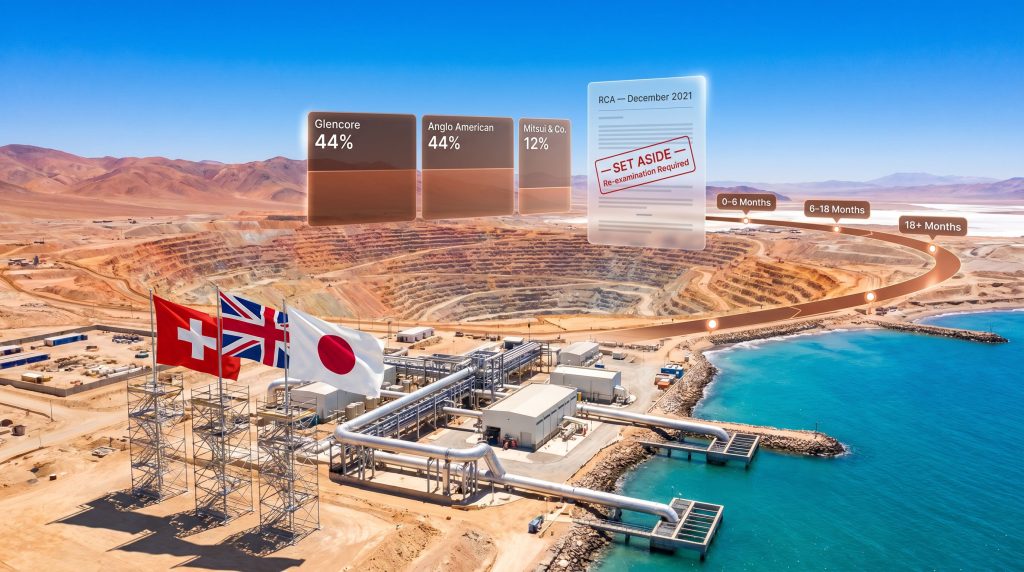
The original RCA authorising C20+ was granted by the SEA in December 2021 following what Collahuasi described as a comprehensive assessment process that included the indigenous consultation process defined by the competent authority. That authorisation was subsequently upheld by the Ministers Committee in August 2023, clearing two significant institutional hurdles before the tribunal challenge emerged. (Engineering & Mining Journal, May 2026)
Who Owns Collahuasi and Why the Ruling Resonates Globally
Ownership Structure and Its Governance Implications
| Stakeholder | Ownership Stake | Headquarters |
|---|---|---|
| Glencore | 44% | Baar, Switzerland |
| Anglo American | 44% | London, United Kingdom |
| Mitsui & Co. Consortium | 12% | Tokyo, Japan |
Collahuasi operates as one of the world's largest copper-producing mines by annual output, and its geographic position in northern Chile places it within one of the planet's most significant copper-bearing geological corridors. The mine's reserve base and production capacity make it a strategically irreplaceable asset within the global copper supply chain. Furthermore, understanding the broader Chile copper outlook helps contextualise just how consequential any disruption to Collahuasi's operations could be.
The ownership structure carries specific governance implications for how the C20+ regulatory situation will be managed. Collahuasi is independently managed, meaning neither Glencore nor Anglo American exercises unilateral control over the mine's operational or regulatory responses. Both companies must coordinate their positions through Collahuasi's own management and governance frameworks, which adds a layer of institutional complexity to the response process.
Both Anglo American and Glencore provided statements confirming the same key position: the tribunal's ruling is limited to two specific aspects, and neither company currently expects any immediate production impact based on the information available and subject to the existence of alternative water sources. (Engineering & Mining Journal, May 2026)
The financial materiality of Collahuasi to both parent companies' copper portfolios is significant. For Glencore, copper represents one of its core commodity segments in the context of energy transition metals demand. For Anglo American, Collahuasi contributes meaningfully to its copper production base, which the company has repeatedly emphasised as a long-term strategic priority. Regulatory friction at an asset of this scale introduces execution risk even when immediate production continuity is maintained.
The Two Grounds for the Ruling: Narrow but Consequential
What the Tribunal Actually Found
The ruling was deliberately targeted. Rather than a wholesale rejection of the C20+ project's environmental authorisation, the Chilean tribunal rejects Collahuasi development plan on two discrete grounds:
-
Inadequate analysis of impacts on a specific local community — raising questions about whether the indigenous consultation process met the depth and quality required under Chilean law
-
Insufficient assessment of effects on the marine environment — directly relevant given that the desalination facility draws and discharges seawater, creating potential ecological interactions with coastal and marine ecosystems
These two objections are not peripheral concerns. They sit at the intersection of Chile's most legally active regulatory frontiers: indigenous rights law shaped by the country's ratification of ILO Convention 169, and environmental protection frameworks governing coastal ecosystems that are increasingly subject to legal challenge.
ILO Convention 169 requires that governments ensure free, prior, and informed consent processes with indigenous peoples before approving projects that may affect their territories, livelihoods, or cultural heritage. When a tribunal identifies the analysis of community impacts as deficient, it signals that the original consultation or impact assessment process may not have satisfied these obligations to the standard the tribunal considers legally sufficient.
What the Ruling Does Not Do
Equally important is what the ruling does not represent:
- It is not a shutdown order or an immediate operational halt
- It does not nullify the entire permitting history of the C20+ project
- It does not prohibit the eventual commissioning of the desalination plant
- It returns specific elements of the environmental review to the SEA for targeted re-examination, not a full restart of the assessment process
The distinction between a procedural remand and a full permit revocation is not merely semantic. For mining companies and their investors, understanding this difference is the difference between a timeline disruption and an asset impairment.
Immediate Operational Consequences: What Changes Now?
Production Continuity Through Alternative Water Sources
In the near term, Collahuasi's copper production is not expected to be disrupted. Both Glencore and Anglo American have confirmed this position, with the critical qualifier being the continued availability of alternative water sources. (Engineering & Mining Journal, May 2026)
The mine's access to alternative water supply arrangements provides an operational buffer during the period in which Collahuasi seeks formal clarification from the tribunal on the precise scope of the ruling and pursues re-examination through the SEA process. This buffer is meaningful in the short term but has structural limits in a region defined by hydrological scarcity.
The longer the SEA re-examination and potential supplementary consultation process extends, the greater the risk that the absence of the desalination plant's operational capacity begins to constrain production growth planning. The C20+ project was designed to support capacity improvements, and its desalination component was intended to underpin those improvements with a sustainable, long-term water supply model.
Timeline Risk by Phase
| Timeframe | Operational Status | Key Risk Factor |
|---|---|---|
| 0 to 6 months | No production impact; alternative water sources active | Clarity on tribunal ruling scope |
| 6 to 18 months | SEA re-examination underway; potential consultation expansion | Duration of regulatory process |
| 18 months plus | Revised RCA issued or further challenged | Long-term water strategy confirmation or restructure |
Note: Timeline scenarios are speculative projections based on comparable regulatory processes and publicly available information. Actual outcomes will depend on regulatory and legal developments.
The next major ASX story will hit our subscribers first
The Broader Chilean Regulatory Landscape: A Pattern Taking Shape
Heightened Scrutiny Across Multiple Fronts
The Collahuasi tribunal ruling does not exist in isolation. It reflects a pattern of intensifying regulatory and legal scrutiny directed at large mining projects in Chile, particularly those involving indigenous community territories and coastal ecological systems. In addition, Chile's copper supply gap makes this regulatory friction especially consequential for global markets that depend on uninterrupted output from the region.
Chile's ratification of ILO Convention 169 created binding obligations around free, prior, and informed consent that have progressively become more operationally significant. Indigenous communities are developing greater legal capacity and awareness of their rights within environmental permitting processes. Fishing communities and coastal stakeholder groups have similarly emerged as increasingly organised legal actors in Chilean environmental proceedings, particularly where coastal infrastructure such as desalination plants is involved.
| Mine or Project | Type of Regulatory Challenge | Status |
|---|---|---|
| Collahuasi C20+ | RCA set aside on community and marine impact grounds | Under re-examination (2026) |
| Codelco Expansions | Water use and community consultation disputes | Ongoing negotiations |
| Escondida Water Supply | Desalination and marine discharge scrutiny | Resolved with design modifications |
Note: Table reflects publicly reported regulatory patterns. Specific outcomes remain subject to ongoing developments.
Precedent-Setting Potential
The tribunal's reasoning in the Collahuasi case, once published in full, has the potential to be cited in future permit challenges against comparable projects. The intersection of desalination infrastructure, indigenous consultation adequacy, and marine environmental assessment is emerging as a defining legal frontier in Chilean mining regulation.
For companies planning coastal water infrastructure across the Atacama and Antofagasta regions, the signal from this ruling is clear: the bar for demonstrating thoroughness in both community consultation and marine impact assessment is rising. Projects that meet the administrative minimum may still face tribunal scrutiny if the depth of analysis does not satisfy the evidentiary standards the courts apply.
This has a practical planning implication. Mining companies increasingly need to engage with indigenous consultation not as a procedural checkbox but as a substantive, documented dialogue that can withstand legal examination years after the initial authorisation process concludes. Consequently, Codelco's copper strategy offers a useful parallel study in how major Chilean producers are adapting their regulatory engagement models under this evolving environment.
What Happens Next: The Regulatory Pathway Forward
Six Steps to Resolution
-
Tribunal clarification: Collahuasi formally requests clarification from the Second Environmental Tribunal on the precise scope and implications of the ruling, including which elements of the original RCA require re-examination
-
SEA re-examination scope determination: The SEA assesses which specific components of the December 2021 authorisation need to be revisited, informed by the tribunal's stated grounds
-
Supplementary consultation assessment: If the indigenous consultation process is determined to have been insufficient, a new or expanded consultation process may be required under Chilean law before the SEA can issue a revised authorisation
-
Marine impact reassessment: Updated or expanded coastal and marine environmental studies may be required to satisfy the tribunal's concerns regarding the desalination plant's interactions with the marine environment
-
Revised authorisation: Following the re-examination process, the SEA issues an updated or amended RCA that addresses the tribunal's identified deficiencies
-
Potential further legal challenge: Affected communities, environmental organisations, or other interested parties retain the legal right to challenge any revised authorisation through the tribunal system
Collahuasi has indicated it will continue working in coordination with relevant authorities and stakeholders, acting within the legal framework, to determine the appropriate next steps. (Engineering & Mining Journal, May 2026)
Water Security as the Strategic Fault Line for Chilean Copper Mining
The Structural Constraint Facing an Entire Industry
Northern Chile's Atacama and Tarapacá regions are confronting an accelerating freshwater crisis driven by the combination of intensive industrial extraction and long-term climatic aridification. Aquifer systems that once provided operational flexibility to major mining operations are under increasing pressure, with depletion rates outpacing natural recharge cycles.
This structural reality has transformed desalination from a premium alternative into an operational prerequisite for large-scale copper mines seeking long-term production continuity. The capital requirements are substantial. Pumping seawater to elevation at mine sites thousands of metres above sea level requires significant energy infrastructure investment alongside the desalination facilities themselves. Yet the economics are increasingly compelling when weighed against the alternative: the gradual depletion of groundwater access and the regulatory exposure that comes with competing for scarce continental water resources.
The regulatory complexity now associated with coastal desalination infrastructure, as illustrated by the Collahuasi ruling, is reshaping how miners approach long-term water strategy from the earliest stages of project planning. Community consultation, marine impact assessment, and coastal stakeholder engagement are no longer late-stage considerations to be addressed during permitting. They are foundational planning elements that require substantive investment from project inception.
Copper Demand Versus Regulatory Friction
Global copper demand forecasts tied to energy transition infrastructure — including electric vehicle battery systems, electrical grid expansion, and renewable energy generation assets — are placing significant strategic premium on large, long-life copper assets. The broader copper supply crunch already facing global markets means that regulatory delays at tier-one assets like Collahuasi carry outsized consequences for future supply trajectories.
Regulatory friction of the kind demonstrated by this tribunal ruling does not eliminate that strategic value. However, it does introduce meaningful compression of near-term production growth optionality and elevates the permitting risk premium that sophisticated investors must apply when modelling future output scenarios from Chilean operations.
The Chilean tribunal rejects Collahuasi development plan is a permitting setback, not an asset impairment. However, it illustrates with precision the growing regulatory complexity of operating world-class copper mines in jurisdictions where indigenous rights law, environmental tribunals, and water scarcity intersect simultaneously.
This complexity is not temporary. It reflects structural changes in Chile's legal and social environment that are unlikely to reverse. Mining companies that treat regulatory engagement as a cost centre rather than a strategic capability are likely to face repeated versions of the friction now visible at Collahuasi. Furthermore, the future of copper mining will increasingly hinge on how effectively operators navigate precisely these kinds of intersecting legal and environmental pressures.
Frequently Asked Questions
What exactly did Chile's Second Environmental Tribunal rule in May 2026?
The tribunal set aside the environmental authorisation that the SEA had granted in December 2021 for Collahuasi's C20+ infrastructure and capacity expansion project. The ruling was confined to two areas: the adequacy of the analysis of impacts on a specific local community, and the assessment of effects on the marine environment. It was not a full project prohibition.
Will Collahuasi's copper production be affected immediately?
No. Both Glencore and Anglo American have confirmed that no immediate production impact is expected, as alternative water sources remain available while the regulatory situation is resolved.
Is the desalination plant still being completed?
The facility was reported to be nearly complete at the time of the ruling. Whether its commissioning is affected will depend on the outcome of the SEA's re-examination process and any revised authorisation that follows.
What is an RCA and why does it matter?
An RCA, or Resolución de Calificación Ambiental, is the formal environmental authorisation issued by Chile's SEA following an environmental impact assessment. It is the primary legal instrument permitting large-scale infrastructure development. Without a valid RCA, projects cannot legally proceed under Chilean environmental law.
How does indigenous consultation factor into this ruling?
Chilean environmental law, reinforced by the country's ratification of ILO Convention 169, requires that projects affecting indigenous communities undergo a formal consultation process. The tribunal identified the analysis of impacts on a specific local community as one of the two areas requiring further review, raising questions about whether the original consultation or impact assessment met applicable legal standards.
Could this ruling affect other mining projects in Chile?
Potentially, yes. The ruling reinforces the legal standing of environmental tribunals to scrutinise indigenous consultation processes and marine impact assessments in detail. Future projects involving coastal desalination infrastructure or operations near indigenous communities may face heightened evidentiary requirements based on the reasoning applied in this case.
Key Takeaways: What the Collahuasi Ruling Signals
-
The ruling is a procedural and regulatory setback, not an operational shutdown. Production continuity is maintained through alternative water sources in the near term
-
The two grounds for the ruling — community impact analysis and marine environmental assessment — reflect the dual pressure points now shaping the regulatory environment for mining-water infrastructure across Latin America
-
Collahuasi's trilateral ownership structure across Glencore, Anglo American, and the Mitsui-led Japanese consortium means the regulatory response will require carefully coordinated stakeholder management across multiple corporate governance frameworks
-
The case illustrates the growing legal sophistication of indigenous and coastal community groups in challenging mining permits through Chile's environmental tribunal system, a trend that is accelerating rather than moderating
-
For global copper markets, the ruling adds a risk premium to Chilean production growth timelines at precisely the moment when energy transition demand forecasts are most aggressively pricing in future copper requirements
-
The fact that the Chilean tribunal rejects Collahuasi development plan understates the nuance: what has actually occurred is a targeted procedural intervention that preserves a path to resolution, rather than a terminal outcome for the project
This article draws on reporting published by Engineering & Mining Journal on May 20, 2026. The timeline projections and regulatory pathway scenarios presented here are analytical frameworks based on publicly available information and comparable regulatory precedents. They should not be construed as legal advice or financial guidance. Investors should conduct independent due diligence and consult qualified advisers before making decisions based on regulatory developments affecting listed companies.
Want to Stay Ahead of Major Copper and Mineral Discoveries on the ASX?
Discovery Alert's proprietary Discovery IQ model delivers real-time alerts the moment significant mineral discoveries are announced on the ASX, turning complex data across more than 30 commodities into clear, actionable insights for both traders and long-term investors — explore Discovery Alert's discoveries page to see how historic finds have generated substantial returns, and begin your 14-day free trial today to secure your market-leading edge.