May 20, 2026
The Underground Imperative: Why Deep Mining Demands a New Knowledge Architecture
The economics of copper extraction are undergoing a quiet but irreversible transformation. For decades, the dominant model relied on vast open-pit operations, where economies of scale, relatively predictable geology, and accessible ore bodies kept production costs manageable. That era is drawing to a close. As surface-accessible copper reserves diminish and pits approach the physical and financial limits of viability, the global industry is being forced underground, into environments that are geologically volatile, thermally extreme, and operationally unforgiving.
This is not a gradual shift. It is a structural discontinuity, one that exposes a fundamental gap between the knowledge frameworks that built the modern copper industry and the capabilities required to sustain it through the next half-century. The Institute of Complex Mining in Chile represents one of the most significant institutional responses to that gap anywhere in the world.
When big ASX news breaks, our subscribers know first
Why Chile's Open-Pit Era Is Reaching Its Limits
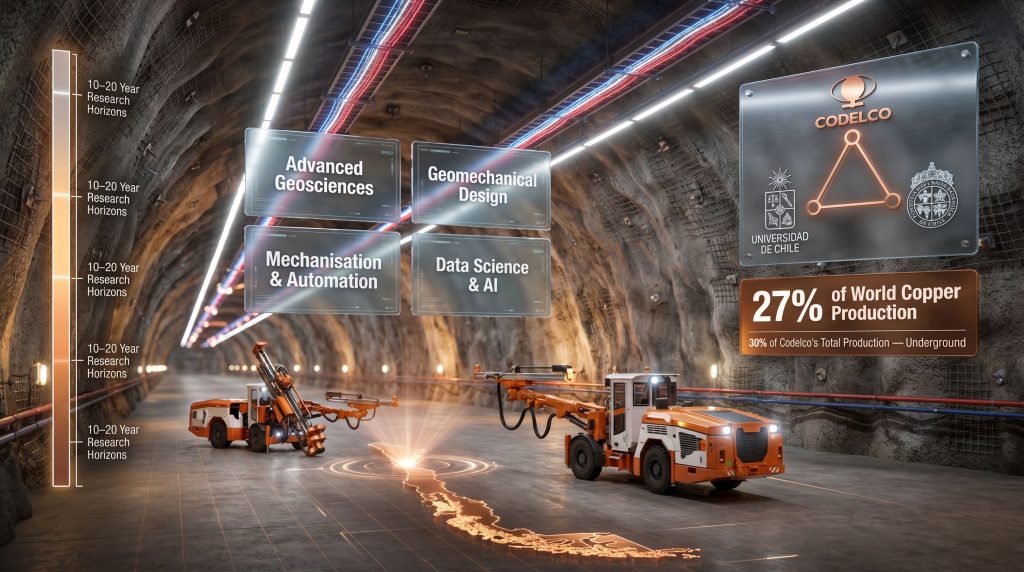
Chile currently accounts for roughly 27% of global copper production, a dominance built largely on massive open-pit operations across the Atacama and surrounding regions. Mines such as Escondida, Chuquicamata, and El Teniente have defined the global copper supply curve for generations. However, the geological reality underpinning those operations is shifting in ways that cannot be reversed through incremental engineering improvements.
Surface deposits are progressively depleting. As pit walls extend deeper and ore grades decline at shallower elevations, the strip ratios required to access economically viable material increase dramatically. At a certain depth threshold, the cost of moving waste rock to reach ore renders open-pit extraction commercially indefensible. That threshold is being reached across multiple major Chilean operations simultaneously, intensifying concerns around the copper supply crunch that analysts have been monitoring closely.
Underground mining currently represents just over 30% of Codelco's total production, but that proportion is projected to grow substantially over the coming decades as flagship operations transition to block-cave and sublevel-caving methods. The challenge is that these methods introduce complexity categories that simply do not exist in surface mining:
- Rock stress and induced seismicity at depths exceeding 1,000 metres, where in-situ stress fields can trigger rockbursts with little warning
- Ventilation and thermal management in confined underground networks, where heat from both geothermal gradients and machinery creates life-safety hazards
- Geomechanical unpredictability, where fault intersections, varying rock mass quality, and dynamic stress redistribution make ground behaviour difficult to model with conventional tools
- Real-time operational decision-making in environments where communications, sensor networks, and autonomous systems must function reliably under physical and electronic stress
Conventional mining engineering frameworks were designed around visible geology and accessible working environments. Underground block-cave mining at depth requires a fundamentally different epistemology, one that treats the rock mass as a dynamic, responsive system rather than a static material to be removed.
What the Institute of Complex Mining Actually Is
The Institute of Complex Mining (ICM) was formalised through a Memorandum of Understanding signed by three institutions: Codelco, the world's largest state-owned copper producer; Universidad de Chile (UCH), the country's oldest and most research-intensive public university; and Pontificia Universidad Católica de Chile (PUC), one of Latin America's leading technical and scientific institutions.
What distinguishes the ICM from both corporate R&D divisions and conventional academic research centres is its governance architecture. The institute operates as an autonomous scientific-industrial entity with its own board of directors and professional governance structures, deliberately insulated from the short-term commercial pressures that constrain internal corporate research and the publication-cycle incentives that shape academic output.
The following comparison illustrates how the ICM's design differs from conventional research models:
| Feature | Institute of Complex Mining | Corporate R&D Division | University Research Centre |
|---|---|---|---|
| Governance | Independent board | Internal management | Academic faculty |
| Project horizon | 10 to 20 years | 1 to 5 years | 3 to 7 years |
| Funding model | Multi-party industrial + academic | Single company | Grants + industry contracts |
| Commercial mandate | Technology spin-off creation | Direct product development | Publication-focused |
| Operational independence | High | Low | Medium |
The 10 to 20-year research horizon is not an arbitrary figure. It reflects the actual lead times required for deep mining technology to progress from laboratory validation through prototype testing, pilot-scale deployment, and finally commercial integration into operating mines. Any institution operating on shorter cycles will systematically underinvest in the foundational research that makes transformative technology possible.
The Four Research Pillars of the ICM
The institute's research agenda is organised around four strategic domains, each targeting a distinct category of failure in deep underground mining operations.
Advanced Geosciences
At the most fundamental level, underground mining fails when operators do not adequately understand what is inside the rock mass before, during, and after extraction. Advanced geosciences research within the ICM focuses on developing predictive geological models that integrate remote sensing technologies, borehole geophysics, and computational simulation to reduce subsurface uncertainty.
This is not merely academic cartography. In block-cave mining, the caving geometry, fragmentation behaviour, and dilution characteristics of a rock mass are determined by its geological architecture at scales ranging from mineralogical to structural. Errors in geological interpretation at the design stage compound into production shortfalls, safety incidents, and capital overruns years later.
Geomechanical Design for Deep Environments
Rock mechanics at depth behaves in ways that challenge classical engineering assumptions. As confining pressures increase, brittle failure mechanisms give way to more complex elasto-plastic and viscous behaviour. Induced seismicity, a direct consequence of stress redistribution caused by excavation, poses both immediate safety risks and long-term structural integrity challenges.
The ICM's geomechanical pillar targets next-generation support system design, dynamic hazard response protocols, and stope geometry optimisation for high-stress environments. The objective is to bridge the gap between theoretical geomechanics, which has advanced considerably in academic literature, and practical engineering decisions made at the production face.
Mechanisation and Automation in High-Risk Zones
In areas where seismic activity, ground instability, or atmospheric conditions make human presence genuinely dangerous, the only sustainable operating model involves remotely operated or autonomous equipment. The ICM's approach to mining automation trends encompasses tele-remote drilling platforms, autonomous load-haul-dump vehicles in confined underground geometries, and robotic systems for inspection and support installation in hazard zones.
Critically, the institute embeds safety-by-design principles from the earliest stages of mechanisation research, rather than retrofitting safety considerations onto systems developed primarily for productivity.
Data Science and Artificial Intelligence Applied to Operations
The fourth pillar addresses the integration challenge that undermines most digitisation efforts in mining: vast quantities of sensor data exist, but the analytical infrastructure to convert that data into actionable operational intelligence is either absent or inadequate.
The ICM's data science programme targets several interconnected capabilities:
- Development of digital twin frameworks that replicate underground mine environments in real-time simulation
- Predictive maintenance modelling using machine learning to anticipate equipment failures before they cause production interruptions
- AI-assisted geotechnical risk prediction that synthesises seismic monitoring, displacement data, and geological mapping to identify hazard precursors
- Ore grade estimation tools that reduce sampling uncertainty and improve production planning accuracy
These four pillars are not parallel but interdependent. Geoscience feeds geomechanical design. Geomechanical understanding determines where automation is required. Automation generates data streams that AI systems process into operational insight. The research architecture reflects a systems-level understanding of how deep mining actually works.
Where the ICM Fits Within Chile's Mining Innovation Ecosystem
Chile already possesses a layered institutional framework for mining governance and industrial development. Codelco functions simultaneously as a commercial producer and a national strategic asset. ENAMI supports small and medium-scale operators through processing and financing services. Sernageomin governs geological surveying, safety regulation, and mine closure standards. CORFO drives broader industrial innovation including technology commercialisation programmes.
Each of these bodies addresses specific functions within the mining economy, but none was designed to execute long-duration, deep-technology research for large-scale complex mining. The ICM fills that institutional white space. Furthermore, knowledge-intensive mining services have long been identified as a strategic growth area for Chile's broader economic development, making the ICM's mandate all the more relevant.
Internationally, Chile's model can be compared against established mining research institutions:
| Country | Key Institution | Model Type | Primary Focus |
|---|---|---|---|
| Chile | Institute of Complex Mining | Tripartite (state miner + 2 universities) | Deep underground copper mining |
| Australia | JKMRC | University + industry consortium | Comminution and processing |
| Canada | CEMI | Multi-industry + government | Deep mining, hard rock |
| Finland | GTK Geological Survey | Government-led | Critical minerals, geosciences |
| USA | NIOSH Mining Program | Federal government | Safety and health |
The tripartite structure of the ICM, combining state industrial capacity with complementary academic strengths, is relatively unusual at this scale. UCH brings depth in applied geosciences and engineering. PUC contributes strength in computational sciences, data systems, and interdisciplinary research methodology. Together they provide the ICM with academic capabilities that no single institution would possess independently.
Codelco's Transition Challenge and Why Research Timelines Matter
Codelco production recovery is already underway, with operations including El Teniente, Chuquicamata Underground, and the Andina expansion project representing some of the most technically complex underground mine developments in history. Each requires continuous advancement in engineering practice simply to maintain production levels as the operating environment deepens and becomes more geologically demanding.
The alignment between the ICM's 10 to 20-year research mandate and the actual capital deployment cycle of major underground mines is deliberate and significant. Large-scale underground mine developments typically require 10 to 15 years from feasibility study through construction to full production ramp-up. Research initiated today under the ICM framework will directly inform the engineering decisions governing mines that will not reach peak output until the 2030s and 2040s.
This temporal alignment is rare in industrial research partnerships, where commercial pressures typically truncate project timelines well before foundational insights can be fully developed and validated.
The ICM also carries an explicit mandate to generate technology-based businesses and spin-off companies, positioning Chile not merely as a copper producer but as a potential exporter of deep-mining intellectual property. If that mandate is realised, the institute's outputs could reach mining operations in Peru, Australia, Canada, and Central Africa, extending Chilean mining influence from raw commodity supply into the higher-value domain of knowledge and technology provision.
The next major ASX story will hit our subscribers first
The Global Dimension: A Knowledge Deficit With Macroeconomic Consequences
The challenges the ICM is designed to address are not unique to Chile. Mining operations worldwide are confronting the same geological reality: the shallow, high-grade deposits that underpinned twentieth-century production are increasingly exhausted, and the industry's future lies in deeper, more complex, lower-grade ore bodies that demand capabilities the current knowledge base cannot reliably provide.
This convergence has macroeconomic consequences that extend well beyond the mining sector. Copper demand is projected to increase substantially through the 2030s, driven by the material intensity of renewable energy infrastructure, grid expansion, and electric vehicle manufacturing. The International Energy Agency and various commodity research bodies have consistently identified copper as one of the minerals most exposed to potential supply shortfalls under high-electrification scenarios.
The ability of Chilean operations, which represent more than a quarter of global copper output, to successfully navigate the open-pit-to-underground transition will have a direct bearing on whether that demand can be met. Consequently, the Chile copper outlook is increasingly tied to how effectively institutions like the ICM can accelerate that transition. Research conducted through the ICM therefore carries macroeconomic significance that extends well beyond Codelco's balance sheet or Chile's national production targets.
A less commonly discussed dimension of this challenge is the knowledge accumulation problem in deep mining. Unlike surface mining, where operational knowledge can be relatively rapidly transferred across projects and geographies, underground block-cave mining at depth generates highly site-specific insights that are difficult to generalise. The ICM's long-horizon research model is partly a response to this characteristic: building durable, transferable knowledge requires sustained engagement with specific geological and operational environments over timescales that short-cycle research cannot accommodate.
In addition, the Australia-Chile mining collaboration framework highlights how international partnerships are increasingly viewed as essential to closing the deep-mining knowledge gap, further reinforcing the ICM's role as a conduit for global research exchange.
The Institute of Complex Mining is not simply responding to a Chilean industry challenge. It is constructing an institutional foundation for knowledge that the entire global copper industry will eventually need, and currently lacks.
What This Means for the Future of Copper Supply
Several interconnected implications flow from the ICM's establishment for anyone tracking the copper supply chain over a multi-decade horizon.
Production continuity is the primary near-term driver. Without successful technological advancement in underground mining methods, Codelco faces genuine production continuity risk as its surface operations reach their limits. The ICM addresses this risk directly through applied research with explicit industrial mandates.
The spin-off pathway creates optionality. If the ICM successfully develops exportable technology platforms, Chile gains a second vector of value creation in the global mining economy, supplementing commodity revenue with intellectual property income. This has been achieved by Australian and Canadian mining research institutions at smaller scales, but never by a Latin American mining economy at this level of ambition.
The knowledge gap is wider than the industry publicly acknowledges. Conversations within the technical mining community consistently surface the same concern: the generation of engineers and geoscientists who built the current underground operations are approaching retirement, and the systems they used to manage complexity were partially tacit and insufficiently codified. The ICM's institutional design, with its independent governance and long-duration mandates, creates a structure capable of capturing and formalising that knowledge before it dissipates.
For the global copper market, the establishment of the Institute of Complex Mining in Chile represents something more significant than a single institutional announcement. It is an acknowledgment, by one of the industry's most consequential players, that the knowledge foundations required for the next generation of copper production do not yet fully exist, and that building them will require decades of sustained, independent, scientifically rigorous effort.
Disclaimer: This article contains forward-looking analysis regarding mining production, technological development, and commodity demand projections. Such projections involve inherent uncertainty and should not be construed as investment advice. Readers should conduct independent research before making any investment or business decisions related to the mining sector or companies mentioned herein.
Want to Track the Next Major Copper Discovery Before the Broader Market Catches On?
Discovery Alert's proprietary Discovery IQ model delivers real-time alerts on significant ASX mineral discoveries — instantly translating complex geological data into actionable investment insights for both short-term traders and long-term investors. Explore historic discoveries and their extraordinary returns, then begin your 14-day free trial today to position yourself ahead of the next major find.