
July 17, 2026
Inside the Central African Copperbelt: How Bulk-Tonnage Deposits Are Reshaping Copper Supply Fundamentals
The Central African Copperbelt has historically produced more copper per square kilometre of prospective ground than almost any other geological province on Earth. Stretching across Zambia and the Democratic Republic of Congo, the belt hosts some of the highest-grade and largest-tonnage sediment-hosted copper deposits ever discovered. Yet despite this legacy, a substantial portion of the region's mineralised systems remain either underexplored or only partially defined. It is within this context that the latest Mumbezhi copper project resource estimate takes on its full significance, not simply as a project-level update, but as a window into how the next generation of Zambian copper supply is being assembled, deposit by deposit, drilling campaign by drilling campaign.
When big ASX news breaks, our subscribers know first
Three Deposits, One Rapidly Expanding Resource Inventory
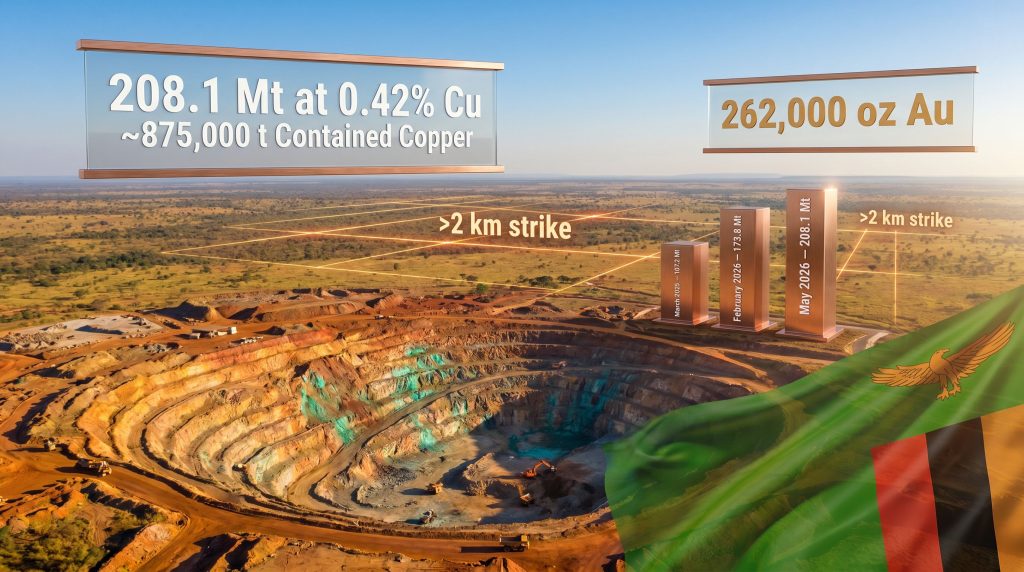
Prospect Resources Ltd., the ASX-listed explorer advancing the Mumbezhi project in north-west Zambia, released an updated Mineral Resource Estimate (MRE) in May 2026 that collectively covers three separate deposits: Nyungu Central, Kabikupa, and the newly defined West Mwombezhi. The aggregate figure stands at 208.1 million tonnes (Mt) grading 0.42% copper, or 0.49% copper equivalent (CuEq) when gold and cobalt by-products are factored in, using a 0.2% copper cut-off grade. Total contained copper is now approaching 900,000 tonnes, with 262,000 ounces of contained gold also formally captured within the resource inventory.
To appreciate the velocity of this resource growth, the progression across all three MRE milestones tells its own story:
| MRE Milestone | Total Tonnage | Head Grade (Cu) | Contained Cu | Key Changes |
|---|---|---|---|---|
| Maiden MRE (March 2025) | 107.2 Mt | 0.50% Cu | ~515 kt | Nyungu Central + Kabikupa only |
| Updated MRE (February 2026) | 173.8 Mt | 0.44% Cu | ~772 kt | Indicated classification upgrade |
| Latest MRE (May 2026) | 208.1 Mt | 0.42% Cu (0.49% CuEq) | ~875–900 kt | West Mwombezhi added, gold formalised |
From March 2025 to May 2026, total resource tonnage has grown by approximately 94% in just over 14 months. The accompanying decline in average copper grade from 0.50% to 0.42% is a textbook pattern in bulk-tonnage deposit development: as exploration expands outward from high-grade core zones into peripheral mineralisation, grade dilution is expected and normal. What matters for project economics is the net growth in contained metal, and on that measure, Mumbezhi's trajectory is compelling. Furthermore, understanding the broader global copper production trends helps contextualise why deposits of this scale are attracting significant attention.
Understanding CuEq: Why the 0.49% Figure Matters More Than It First Appears
Copper equivalent grade is a standardised metric used to express the total economic value of a multi-commodity resource in a single copper-referenced number. At Mumbezhi, the gap between the 0.42% Cu grade and the 0.49% CuEq grade reflects the real economic contribution of gold and cobalt mineralisation. In practical terms, this means that every tonne of ore processed at Mumbezhi carries value beyond copper alone, a distinction that becomes financially significant when modelling production costs and revenue streams at scale.
West Mwombezhi: What a Shallow, Tabular Deposit Means for Open-Pit Economics
The most structurally significant addition to the May 2026 MRE is the maiden Inferred resource at West Mwombezhi, a deposit located approximately 13 kilometres north of Nyungu Central. Its geometry is described as shallow and tabular, a classification that carries important practical implications for mine planning.
In open-pit mining, deposit geometry directly influences the strip ratio, which is the volume of waste material that must be moved for every tonne of ore extracted. Shallow, flat-lying (tabular) mineralisation typically supports lower strip ratios compared to steeply dipping or deeply buried deposits, translating directly into lower pre-production capital requirements and reduced unit operating costs. West Mwombezhi contributes 115,000 tonnes of contained copper to the project's resource inventory, and its spatial separation from the main Nyungu cluster demonstrates that Mumbezhi's mineralised system is not confined to a single geological locus but extends across a genuinely regional footprint.
The discovery of a shallow, tabular deposit 13 km from the primary resource cluster is not simply an incremental resource addition. It signals that the broader land package hosts multiple mineralised centres, each with the potential to evolve into independently economic resources under the right drilling programmes.
The Gold Reassaying Programme: A Strategic Inflection Point
Perhaps the least widely understood development within the May 2026 MRE is the formal incorporation of gold into the Nyungu Central resource model, driven by a systematic gold reassaying programme applied to existing drill core. The project now holds 262,000 ounces of contained gold, a figure that was not previously captured in the resource inventory because gold had not been routinely assayed during earlier drilling phases.
This distinction matters for several reasons:
- Gold was present in the deposit all along but was invisible to the resource model due to analytical gaps in the original assay programme
- The decision to routinely assay for gold in all future drilling means the gold resource base will grow incrementally with each successive MRE update, independently of any new gold-specific discovery
- At current gold spot prices (which have traded at historically elevated levels through 2025 and into 2026), 262,000 ounces represents a materially valuable by-product credit that was simply not being counted before
This reassaying-driven resource upgrade is a relatively uncommon but highly instructive scenario in exploration geology. It demonstrates that the economic value of a deposit can be substantially understated when multi-commodity analysis is not applied from the outset. Consequently, the Zambia copper growth forecast for projects like Mumbezhi looks increasingly compelling as these hidden values are unlocked.
JORC Resource Classification and What It Signals About Development Readiness
Not all mineral resources carry equal weight in the mine development process. Under the JORC Code 2012, which is the standard governing Australian-listed mining companies, resources are classified according to geological confidence:
- Measured Resources: Highest confidence, sufficient for detailed engineering and bankable feasibility studies
- Indicated Resources: Sufficient for mine planning and preliminary economic studies, with reasonable assumptions about continuity
- Inferred Resources: Lowest confidence, based on limited data, and cannot form the primary basis for feasibility-level work
As of the February 2026 MRE, more than 40% of the Mumbezhi resource was classified as Indicated, a threshold that enables the project to move toward Scoping Study or Preliminary Feasibility Study level analysis. The May 2026 update introduces additional Inferred tonnes via West Mwombezhi, which will require further drilling to upgrade before they can support development-stage economic modelling. The pathway from Inferred to Indicated through targeted infill drilling is the primary technical de-risking mechanism in exploration-stage copper projects and the standard precondition for attracting project finance at scale.
The Exploration Target: Conceptual Scale vs. Defined Resource
One of the more nuanced aspects of the Mumbezhi story is the relationship between the current defined resource and the project's broader exploration target range:
| Metric | Current MRE (May 2026) | Exploration Target |
|---|---|---|
| Tonnage | 208.1 Mt | 420 to 1,050 Mt |
| Grade (Cu) | 0.42% Cu | 0.4% to 0.6% Cu |
| JORC Status | Compliant Mineral Resource | Conceptual estimate only |
Important disclaimer: An Exploration Target is not a Mineral Resource under the JORC Code. It is a geological conceptualisation of potential mineralisation that requires systematic drilling to confirm or refute. Investors and analysts should not treat exploration targets as equivalent in status or reliability to defined resources.
The target range of 420 to 1,050 Mt is roughly two to five times the size of the current defined resource. The wide range reflects the early-stage nature of regional target definition across a large and geologically active land package. In the Central African Copperbelt context, exploration targets of this scale are not uncommon for projects that have yet to fully test their strike and depth extents.
The next major ASX story will hit our subscribers first
First Quantum Minerals' Involvement: Reading Institutional Signals
First Quantum Minerals, one of the world's largest copper producers and the operator of the Kansanshi and Sentinel mines in Zambia, has committed approximately A$15.2 million toward Mumbezhi's exploration programme. In the exploration finance landscape, the identity of a project's financial backers is often as analytically informative as the resource numbers themselves. Indeed, majors backing juniors has become an increasingly prominent feature of the current copper investment cycle.
First Quantum brings not only capital but deep institutional knowledge of Zambian copper geology, processing infrastructure, and regulatory environment. Its financial participation in Mumbezhi does not guarantee project success, but it does represent a third-party assessment by an operator with exceptional regional context that the project's geological fundamentals are worth backing at a meaningful financial scale. For further context on this partnership, mining-technology.com has reported extensively on the significance of First Quantum's involvement.
Phase 3 Drilling: The Regional Targets That Could Change the Scale Conversation
The Phase 3 2026 drilling programme, now underway, targets both deposit extensions and entirely new mineralised systems across the Mumbezhi land package. The programme structure reflects a deliberate sequencing of risk:
- Immediate priority: Up-dip extensions of Nyungu Central at shallower depths to the south, targeting geometry that would improve open-pit economics
- Secondary priority: Testing the broader Nyungu Hub concept, including Nyungu West and a key electromagnetic (EM) conductor northeast of Nyungu South
- Regional scout drilling: Chipimpa and Sharamba EM conductor targets
Are the Regional Targets Worth Watching?
The Chipimpa and Sharamba targets deserve particular analytical attention:
| Target | Strike Length | Conductivity Profile |
|---|---|---|
| Chipimpa | Over 2 km | High, similar to Nyungu Central |
| Sharamba | Over 2 km | High, similar to Nyungu Central |
Both targets exceed 2 kilometres in strike length and display EM signatures comparable in scale, shape, and conductivity to the Nyungu Central deposit, which has already yielded a multi-hundred-kiloton copper resource. In exploration geology, the EM conductivity method is particularly effective for detecting the sulphide-hosted copper mineralisation typical of the Central African Copperbelt. A strong EM anomaly that mirrors the geometry of a known producing deposit is considered a high-priority drill target precisely because the geophysical comparability reduces the geological uncertainty before a single hole is drilled.
If either regional target converts to a defined resource through Phase 3 drilling, the scale of the Mumbezhi project would increase materially, potentially transforming it from a large development project into a district-scale copper system.
By-Product Economics: Gold and Cobalt as Cost Curve Levers
The concept of by-product credits is central to how copper projects are evaluated on the global cost curve. The C1 cash cost is the industry-standard measure of copper production cost, expressed in USD per pound of copper produced. By-product revenues from co-produced metals, when subtracted from gross operating costs, lower the net C1 figure and improve a project's competitive position relative to single-commodity copper operations.
At Mumbezhi, the presence of 262,000 ounces of contained gold and formally classified cobalt mineralisation at Nyungu Central creates a structural mechanism to drive net production costs downward. Projects with meaningful gold and cobalt credits have historically achieved sub-median positions on global copper cost curves even at moderate copper grades, because the by-product revenue effectively subsidises the copper production economics. However, understanding the copper price growth drivers at a macro level is equally important for assessing how these economics will evolve. As gold prices remain elevated and cobalt maintains relevance in battery supply chains, this multi-commodity revenue profile is an increasingly important differentiator for emerging copper projects.
What 208.1 Million Tonnes Could Translate to at Mine Scale
While no feasibility study has been completed at Mumbezhi and no production decision has been made, the resource scale permits illustrative scenario modelling. At a hypothetical throughput rate of 10 to 15 million tonnes per annum, a 208.1 Mt resource base would support a mine life of approximately 14 to 20 years, broadly consistent with the scale required to justify major capital investment in processing infrastructure, power supply, and logistics.
The combination of shallow, tabular geometry at West Mwombezhi and near-surface mineralisation at Nyungu Central provides a structural basis for open-pit extraction scenarios, which typically carry lower upfront capital intensity than underground mining alternatives. In addition, the ongoing copper supply crunch at a global level only strengthens the strategic case for advancing the Mumbezhi copper project resource estimate toward development-readiness. These are illustrative observations only and should not be construed as company guidance or feasibility-level projections.
Frequently Asked Questions: Mumbezhi Copper Project Resource Estimate
What is the total Mumbezhi copper project resource estimate as of May 2026?
The May 2026 MRE totals 208.1 Mt at 0.42% Cu (0.49% CuEq) across Nyungu Central, Kabikupa, and West Mwombezhi, with contained copper approaching 900,000 tonnes and 262,000 ounces of contained gold.
What cut-off grade applies to the Mumbezhi MRE?
A 0.2% copper cut-off grade is applied, which is standard for bulk-tonnage open-pittable copper deposits in the Central African Copperbelt.
How does the May 2026 MRE differ from the February 2026 update?
The February 2026 MRE reported 173.8 Mt at 0.44% Cu. The May 2026 update adds the maiden West Mwombezhi Inferred resource and incorporates gold and cobalt formally into the Nyungu Central estimate, lifting total tonnage to 208.1 Mt.
Are the deposits open for further resource growth?
All three deposits, Nyungu Central, Kabikupa, and West Mwombezhi, are reported as remaining open along strike and down-dip, meaning current resource boundaries do not represent geological limits.
What is the Mumbezhi Exploration Target?
The updated Exploration Target is 420 to 1,050 Mt grading 0.4% to 0.6% Cu. This is a conceptual range only and does not constitute a JORC-compliant Mineral Resource Estimate.
Disclaimer: This article contains forward-looking statements and illustrative scenarios based on publicly available information. It does not constitute financial or investment advice. Resource estimates and exploration targets are subject to revision as additional data is collected. Readers should conduct their own due diligence and consult a licensed financial adviser before making investment decisions.
Want to Be First When the Next Major Copper Discovery Hits the ASX?
Discovery Alert's proprietary Discovery IQ model delivers real-time alerts on significant ASX mineral discoveries — turning complex geological data into actionable investment insights the moment they're announced. Explore historic discoveries and the returns they generated, then start your 14-day free trial at Discovery Alert to position yourself ahead of the broader market.