
August 3, 2026
The Hidden Fragility Inside Chile's Most Impressive Economic Number
Resource-dependent economies occupy a peculiar position in global markets. When their dominant commodity surges, headline growth figures can mask structural weaknesses that only become visible during the inevitable correction. Chile economic activity mining rebound offers a compelling lens through which to examine both the promise and the peril of copper-led growth, and its June 2026 economic performance sits at the centre of this dynamic more than almost any other nation.
When big ASX news breaks, our subscribers know first
Understanding Chile's IMACEC: The Economic Barometer Behind the Headlines
Before dissecting what June's data actually means, it is worth understanding the instrument being used to measure it. The IMACEC, or Indicador Mensual de Actividad Económica, is a monthly economic activity index published by the Central Bank of Chile. It functions as the primary near-term proxy for gross domestic product, capturing roughly 90% of Chile's total productive economic activity across mining, manufacturing, trade, and services.
Why the IMACEC Matters Beyond Chile's Borders
Because official GDP figures are released quarterly with a lag, the IMACEC provides investors, policymakers, and analysts with the most timely available signal about economic momentum. Monthly IMACEC readings regularly move currency markets, influence central bank rate expectations, and shape portfolio positioning among Latin America-focused fund managers. When the Central Bank of Chile releases this figure, the interpretation ripples outward well beyond Santiago.
The index is not a perfect instrument. It is subject to revision, and its composition means that an outsized move in a single sector, particularly mining, can dramatically skew the headline reading in ways that do not reflect broader economic health. Understanding this limitation is essential for reading June's result correctly.
Chile's June 2026 Economic Turnaround: What the Numbers Actually Reveal
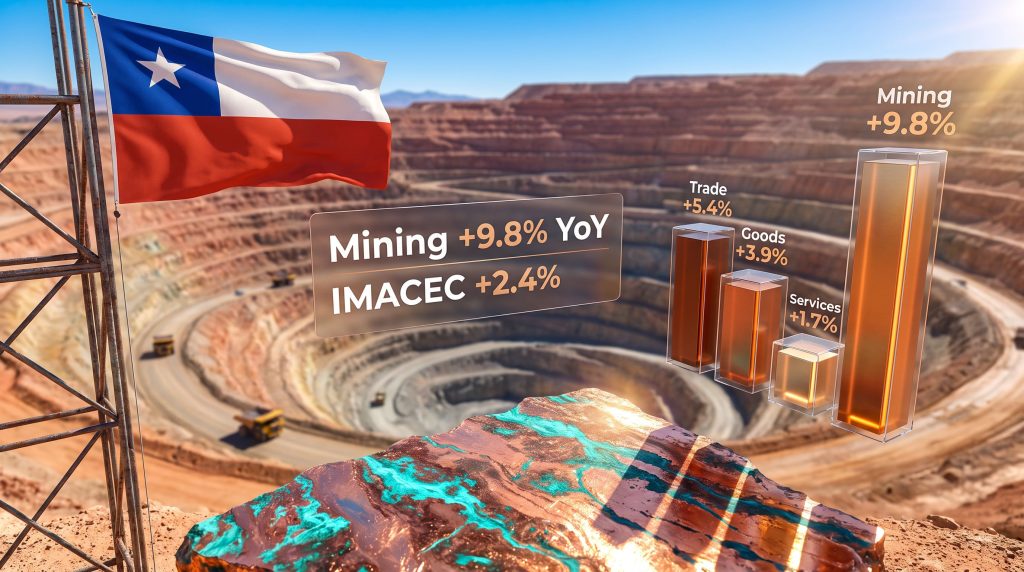
June 2026 delivered a 2.4% year-on-year expansion in the IMACEC, exceeding the 1.5% consensus forecast compiled by Reuters from a poll of economists. More significantly, it ended a streak of five consecutive year-on-year contractions, marking the first positive monthly reading in six months and representing a meaningful inflection point in Chile's economic narrative.
The sector-by-sector breakdown tells the fuller story:
| Sector | Year-on-Year Change |
|---|---|
| Mining | +9.8% |
| Trade | +5.4% |
| Goods Production | +3.9% |
| Services | +1.7% |
Mining was unambiguously the engine of the result. The 3.9% goods production expansion was itself driven primarily by mining output, meaning copper effectively appears twice in any honest reading of the data. The beat versus consensus carries analytical weight in its own right: in an environment where economists were braced for modest improvement, the scale of the outperformance signals that the mining recovery was sharper and more synchronised than anticipated.
Chile's Finance Minister had flagged in early July 2026 that June would very probably register positive growth and that this momentum was expected to continue. That assessment proved accurate, lending credibility to forward guidance from fiscal authorities and reducing some of the uncertainty that had weighed on market confidence.
Why Copper Is the Cornerstone of Chile's Economic Recovery
Chile holds a structural position in global copper markets that no other nation comes close to matching. As the world's largest copper producer, the country accounts for roughly a quarter of global mine supply, and the metal constitutes the dominant share of its export revenues. Furthermore, the Chile copper supply gap relative to global demand underscores just how pivotal this nation's output decisions are to world markets.
How Copper Output Drives the Headline IMACEC
Copper production rose 5.1% year-on-year in June 2026, reversing a pattern of sharp prior-year declines that had weighed heavily on headline IMACEC readings. This recovery was not simply a function of improved operational efficiency at existing mines. It also reflected the statistical base effect created by those prior declines, meaning the year-on-year comparison was, in part, measuring against an unusually weak reference period.
Key Insight: When mining accounts for the majority of goods production growth, as it did in June 2026, the Chilean economy's headline performance becomes highly sensitive to a single commodity's output cycle. This concentration creates both opportunity and acute vulnerability that investors in Chilean assets must continuously monitor.
The structural relationship between copper output and Chile's export revenues is deeply embedded. Higher production volumes, when combined with elevated spot prices, amplify fiscal receipts through royalties and corporate taxes paid by mining operators. This creates a secondary stimulus effect on public expenditure capacity that is often underappreciated in surface-level GDP commentary.
What is less commonly discussed is the quality dimension of copper production. Chile's major deposits, including the giant porphyry copper systems of the Atacama and surrounding regions, are mature orebodies where grades have been declining over multi-decade timeframes. Lower head grades mean that maintaining or growing production volumes requires processing larger tonnages of ore, increasing energy and water consumption per unit of output. This structural challenge sits beneath the headline production growth numbers and represents a persistent cost pressure for Chilean operators independent of commodity price cycles.
A Volatile Recovery: Reading Chile's Economic Data Across 2025–2026
The June 2026 result did not emerge from a smoothly improving trajectory. Chile's economic path over the preceding fourteen months has been characterised by sharp swings that reflect the volatility inherent in a mining-concentrated economy.
| Period | IMACEC Growth (YoY) | Mining Growth (YoY) | Notable Driver |
|---|---|---|---|
| April 2025 | +2.5% | Strong positive | Mining offset weak manufacturing |
| May 2025 | +3.2% | +10.3% | Missed broader forecasts despite mining strength |
| June 2025 | +3.1% | Temporary contraction | Non-mining sectors sustained overall growth |
| Q2 2025 | +2.9% | +3.3% | Rebound after Q1 2025 contraction |
| April 2026 | -1.2% | Decline | Copper output weakness dragged headline figure |
| June 2026 | +2.4% | +9.8% | Mining-led recovery, beat consensus |
The April 2026 contraction of 1.2% is particularly instructive. It demonstrates with precision how rapidly a mining slowdown can overwhelm positive contributions from other sectors. When copper output falters, even a functioning trade and services sector cannot generate sufficient momentum to prevent a negative headline reading. This asymmetry is a defining feature of Chile's economic architecture.
Investment in mining projects during periods of weaker consumer activity has historically served as a partial stabilising force, sustaining capital goods demand and employment in regions where alternative employers are scarce. However, the cyclicality of major project commitments means this stabilising effect is uneven and cannot be relied upon as a consistent buffer.
What Economists Are Saying About the Sustainability of Chile's Recovery
The consensus view among Latin America-focused macroeconomic analysts is that Chile's recovery is real but structurally conditional. Gradual strengthening through the second half of 2026 is the central scenario, with mining and exports identified as the primary growth drivers.
Three conditions are consistently cited as necessary for continued expansion:
- Sustained elevated copper prices on global spot and futures markets
- Continued growth in Chilean mining production volumes across major operations
- Favourable terms of trade driven by robust commodity demand from Chile's principal import partners, particularly China
Pantheon Macroeconomics has noted that elevated copper prices, stronger mining production, and exceptionally favourable terms of trade should continue to support growth, with mining and exports expected to remain the principal drivers of recovery through the remainder of 2026. This assessment, while constructive, implicitly acknowledges the fragility of the outlook: all three supporting conditions are externally determined and outside Chilean policy control.
Analyst Perspective: Elevated copper demand tied to the global energy transition provides a structural demand floor that distinguishes Chile's current recovery from prior commodity cycles. However, supply-side execution risk at individual mine level, including grade decline, water scarcity in the Atacama region, and labour relations, remains a persistent variable that no macroeconomic forecast can fully price.
The risk scenario is clearly illustrated by the April 2026 IMACEC contraction. Any reversal in copper prices, whether driven by China commodity demand weakness, accelerated substitution of copper in specific applications, or a global growth slowdown, could return the headline index to negative territory with limited warning.
The next major ASX story will hit our subscribers first
How Chile's Mining Dependence Compares to Global Resource Economy Peers
Chile is not alone in navigating the complexity of single-commodity economic concentration, but the scale of its copper exposure is distinctive even among major resource economies. The structural comparison reveals a recurring pattern:
- Accelerated upside during commodity price booms, as foreign exchange earnings, fiscal revenues, and investment inflows amplify domestic demand
- Amplified downside during supply or price shocks, as export revenue compression triggers fiscal constraint and investment withdrawal simultaneously
- Persistent investment crowding effects, where mining sector returns attract capital that might otherwise develop manufacturing or technology industries
OECD analysis of Chilean growth patterns has consistently highlighted the role of mining investment in sustaining activity even when consumer-facing sectors underperform. However, the same analysis points to the limitations of this model over longer time horizons, particularly as Chile's workforce seeks economic opportunities that resource extraction alone cannot provide at scale.
The energy transition demand for copper introduces a dimension that separates the current cycle from previous booms. Copper is a non-substitutable input in electric vehicle drivetrains, grid-scale transmission infrastructure, and renewable energy generation systems. Estimates from the International Energy Agency and other bodies project that energy transition requirements could absorb a significant share of incremental global copper supply over the coming two decades, creating a demand profile with longer duration than traditional industrial cycles.
For Chile, this represents a structural tailwind of genuine significance, though one that also risks intensifying the country's existing concentration rather than encouraging diversification.
Trade and Services: Are Non-Mining Sectors Beginning to Contribute?
June 2026 offered tentative evidence that the recovery may be broadening. Trade sector growth of 5.4% year-on-year was a meaningful secondary contributor to the headline figure, while services expansion of 1.7% was modest but directionally positive. If sustained, broader sectoral participation would signal a maturation of Chile's Chile economic activity mining rebound beyond pure mining dependence.
However, caution is warranted before treating a single month's non-mining data as confirmation of structural change. The volatility observed across 2025 and 2026 demonstrates that non-mining sector performance can shift significantly from month to month. Sustained contribution of trade and services to headline growth requires conditions — including real wage growth, credit availability, and consumer confidence — that remain unevenly distributed across Chile's economy.
For trade and services to become reliable growth anchors independent of commodity cycles, several structural conditions would need to be met: sustained productivity improvements in services industries, deepening of domestic capital markets, and diversification of Chile's export base beyond primary commodities. These are medium-to-long-term ambitions rather than near-term realities.
What Chile's Economic Rebound Means for Copper Markets and Global Supply Chains
Chile's output recovery carries supply-side implications that extend well beyond its own borders. As the dominant global producer, Chilean production volumes directly influence copper price formation on the London Metal Exchange and Chicago Mercantile Exchange. Furthermore, the copper price outlook for 2025 and beyond is closely tied to Chile's ability to sustain and grow its production profile.
When Chilean output contracts, global markets tighten and prices respond. When production recovers sharply, as the 5.1% June 2026 increase demonstrates, it provides a visible supply signal that commodity traders and industrial buyers incorporate into their positioning.
The downstream implications are substantial:
- Electric vehicle manufacturers dependent on copper wiring and motor components track Chilean output as a supply chain risk variable
- Grid infrastructure developers require predictable copper availability for long-dated project planning
- Industrial machinery producers incorporate copper price expectations into capital allocation decisions quarters in advance
For Europe, North America, and Asian manufacturing economies working to accelerate energy transition infrastructure, the stability and growth of Chilean copper supply is not a peripheral concern but a strategic input into national industrial planning. In addition, the copper supply crunch emerging across global markets means Chile's output trajectory carries consequences that extend far beyond its own fiscal position.
Key Risks That Could Derail Chile's Economic Momentum
Understanding the upside of June's result requires equal attention to the risks that could rapidly reverse it:
- Commodity price reversal: A sustained decline in copper prices would compress export revenues and undermine the investment incentives that sustain production growth
- Production disruption risk: Labour disputes at major operations, geological challenges in ageing orebodies, or regulatory changes affecting water usage in the Atacama could quickly reverse output gains
- Grade decline pressure: As copper ore grades at mature Chilean porphyry deposits continue to fall, maintaining production volumes requires processing greater tonnages, raising costs and energy consumption in ways that eventually constrain margins
- Single-sector concentration: The April 2026 IMACEC contraction of 1.2% demonstrates precisely how rapidly a mining slowdown overwhelms positive contributions from other sectors
- China demand vulnerability: Chile's terms of trade are heavily influenced by the economic trajectory of China, which accounts for the majority of global refined copper consumption
- Domestic policy uncertainty: Regulatory and fiscal policy settings affecting mining investment approvals, water rights, and royalty structures remain medium-term variables that influence long-dated capital commitment decisions
According to BNP Paribas economic research, Chile's economy remains fundamentally dependent on its mining sector, a structural reality that no single month of positive data can meaningfully alter.
This article contains forward-looking analysis and macroeconomic projections that involve inherent uncertainty. Readers should not construe any of the content above as financial or investment advice. Economic forecasts, analyst views, and commodity market projections are subject to material revision as conditions evolve.
FAQ: Chile Economic Activity and the Mining Rebound
What is the IMACEC index?
The IMACEC is a monthly economic activity index published by the Central Bank of Chile. It functions as the primary near-term GDP proxy, capturing approximately 90% of Chile's total productive economic activity across all major sectors.
Why did Chile's economy contract for five consecutive months before June 2026?
The contraction period reflected a combination of weaker copper production volumes, softer global commodity demand, and subdued performance in consumer-facing sectors. Mining output declines were the dominant driver of negative readings during that stretch.
How significant was the June 2026 IMACEC result?
The 2.4% year-on-year expansion was notably above the 1.5% consensus forecast and ended the longest run of consecutive contractions in recent years, making it a genuine inflection point for market and policy confidence.
Is Chile's economic recovery sustainable?
Analysts project gradual strengthening through the second half of 2026, supported by copper prices, production growth, and favourable trade conditions. The recovery remains structurally dependent on mining performance, which introduces ongoing volatility risk that a single positive monthly reading cannot resolve.
What role does copper play in Chile's economy?
Copper is Chile's dominant export commodity and the primary engine of its mining sector. As the world's largest copper producer, the Chile economic activity mining rebound is closely tied to global copper demand, pricing dynamics, and production efficiency at its major mining operations. The OECD economic outlook for Chile further reinforces how deeply the country's medium-term growth prospects depend on sustained commodity sector performance.
Want to Know Which ASX Copper and Mining Stocks Could Deliver the Next Major Discovery?
Chile's copper rebound highlights just how transformative mineral discoveries can be for markets — and Discovery Alert's proprietary Discovery IQ model delivers real-time alerts the moment significant ASX mineral discoveries are announced, turning complex geological data into actionable investment insights. Explore historic returns from major mineral discoveries to understand the scale of opportunity, then start your 14-day free trial at Discovery Alert to position yourself ahead of the market.