August 3, 2026
Why Infrastructure Ownership Is Rewriting the Rules of Copper M&A in Australia
Across the global mining landscape, a quiet but powerful shift is underway. The companies that own processing infrastructure are increasingly dictating the terms of consolidation, rather than simply responding to it. In copper-rich jurisdictions like Queensland, Australia, this dynamic has become particularly acute. Processing capacity is finite, capital-intensive to build, and extraordinarily difficult to permit. For junior and mid-tier copper explorers sitting on high-quality resources but lacking the means to process them independently, the strategic calculus is straightforward: find a partner who already has the plant, or risk being stranded.
It is precisely this infrastructure scarcity premium that frames the Austral acquisition of Hammer Metals, one of the more consequential consolidation moves to emerge from the ASX copper sector in 2026. Furthermore, understanding this deal requires looking beyond its headline numbers to the structural forces reshaping Queensland's copper landscape.
When big ASX news breaks, our subscribers know first
The Strategic Logic Driving Queensland Copper Consolidation
Queensland has quietly cemented its position as one of Australia's most active copper M&A corridors. The state hosts a combination of established processing infrastructure, underexplored tenement packages, and a geological setting that favours polymetallic copper systems. These characteristics, combined with growing global copper supply crunch driven by electrification and grid expansion, have made Queensland copper assets increasingly contested.
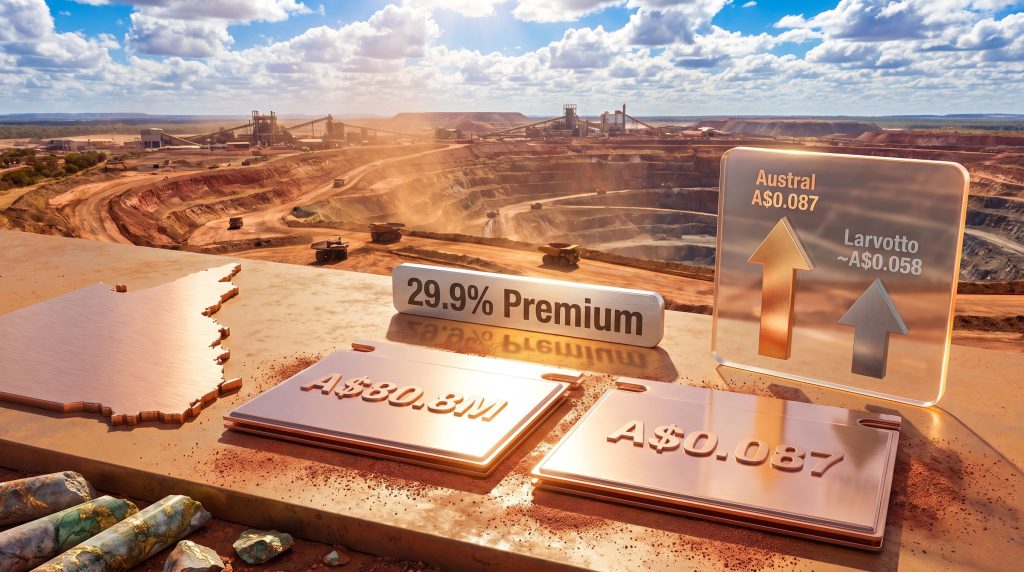
Austral Resources Australia's binding proposal to acquire Hammer Metals via a scheme of arrangement reflects this broader competitive dynamic. The transaction implies a total equity value of approximately A$80.8 million, equivalent to A$0.087 per Hammer share. This consideration is structured across two components:
- A$0.080 per share in new Austral scrip
- A$0.007 per share in a demerged entity (SpinCo) holding Hammer's Western Australian gold assets
| Parameter | Detail |
|---|---|
| Implied Offer Price | A$0.087 per Hammer share |
| Total Implied Equity Value | ~A$80.8 million |
| Scrip Component | A$0.080 in new Austral shares |
| SpinCo Component | A$0.007 in demerged WA gold assets |
| Working Capital Facility | Up to A$5 million (conditional) |
| Premium to Larvotto Offer | ~29.9% above Larvotto's implied A$0.058/share |
The strategic rationale is anchored in operational complementarity. Hammer's flagship Kalman deposit, a copper, gold, molybdenum, and rhenium resource in Queensland, has been identified as a natural ore feed candidate for Austral's existing Rocklands sulphide processing facility. Bringing these two assets under a single corporate structure eliminates reliance on third-party toll processing, a cost and logistical burden that has historically constrained the economics of smaller Queensland copper operations.
Competing Bids and the Larvotto Matching Right Window
The Austral proposal did not emerge into a vacuum. Hammer Metals was already party to a binding scheme implementation deed with Larvotto Resources, structured on a ratio of one new Larvotto share for every 22 Hammer shares held. At the time Austral's proposal was announced, Larvotto's implied offer value sat at approximately A$0.058 per Hammer share.
Hammer's board of directors reviewed both positions and determined the Austral proposal to represent a superior offer. Under Australian M&A conventions, this triggered a formal matching right period, giving Larvotto until August 10 to table a proposal that is equivalent to or better than Austral's implied value. If Larvotto declines or fails to respond within that window, the path towards formalising the Austral transaction opens considerably.
| Metric | Austral Proposal | Larvotto Proposal |
|---|---|---|
| Implied Price Per Share | A$0.087 | ~A$0.058 |
| Deal Structure | Scheme of Arrangement | Scheme of Arrangement |
| Consideration Type | Scrip + SpinCo demerger | All-scrip (1:22 ratio) |
| Working Capital Facility | Up to A$5 million | Existing facility terms |
| Board Recommendation | Determined superior | Original binding deed |
| Binding Status at Announcement | Conditional binding proposal | Binding SID in place |
Understanding How a Scheme of Arrangement Works
For investors unfamiliar with Australian corporate law, a scheme of arrangement is a court-supervised acquisition mechanism under the Corporations Act 2001 (Cth). Unlike a traditional off-market takeover bid, a scheme requires the target's board to actively recommend the transaction to shareholders. Approval thresholds are deliberately demanding:
- At least 75% of votes cast by value must be in favour
- More than 50% of shareholders by number (headcount test) must approve
- The Federal Court of Australia must sanction the scheme
Schemes are widely preferred in friendly ASX mining deals because they are efficient once approved, delivering 100% ownership to the acquirer in a single transaction. However, they are also more condition-heavy in their early stages, which is a relevant nuance in this situation.
Despite being described as a binding proposal at the time of announcement, Austral's offer remained conditional across several key dimensions, including due diligence completion, execution of a formal scheme implementation deed, Hammer board recommendation, and the passage of the Larvotto matching right window without a superior counter-proposal.
The Kalman Deposit: Why Hammer's Resource Base Commands Attention
Not all copper assets are equal, and the Kalman deposit illustrates why geological complexity can translate directly into strategic value. Kalman is a polymetallic system carrying copper, gold, molybdenum, and rhenium. The presence of molybdenum and rhenium alongside copper and gold is geologically significant and commercially noteworthy.
Rhenium is among the rarest naturally occurring elements, and global primary supply is almost entirely a byproduct of molybdenum processing, which is itself predominantly a byproduct of porphyry copper mining. Primary rhenium production is minuscule on a global scale. The fact that Kalman's resource carries rhenium content positions it within a very narrow category of copper-molybdenum-rhenium systems globally, and adds a layer of byproduct revenue optionality that conventional copper deposits simply do not offer.
Molybdenum itself serves as a critical hardening agent in high-strength steel alloys, with demand closely tied to infrastructure construction, aerospace manufacturing, and energy sector applications. For Austral, acquiring a resource with this kind of byproduct diversity adds resilience to the combined group's revenue profile across commodity cycles.
The alignment between Kalman's sulphide ore characteristics and Austral's Rocklands processing circuit is another dimension worth examining carefully. Sulphide copper ores require flotation-based processing technology, which Rocklands is equipped to handle. This technical fit means Austral is not acquiring a resource that would demand incremental capital expenditure on new processing infrastructure. The plant already exists. The ore simply needs to flow through it.
Austral's Dual-Facility Processing Architecture
What makes Austral an unusual asset among ASX copper companies is the breadth of its processing capability. Most operators of comparable scale own a single processing stream. Austral operates two:
| Facility | Location | Ore Type Processed |
|---|---|---|
| Mount Kelly | Queensland | Oxide copper ores |
| Rocklands | Queensland | Sulphide copper ores |
This dual-stream configuration is strategically significant. Oxide and sulphide copper ores require fundamentally different processing approaches. Oxide ores typically undergo heap leach and solvent extraction-electrowinning (SX-EW) processes, while sulphide ores require crushing, grinding, and froth flotation to produce a copper concentrate. Owning both systems means Austral can process a broader range of ore types from its own and acquired tenements without being constrained by mineralogy.
In a capital-constrained environment where new processing facilities can cost hundreds of millions of dollars to permit and construct, this dual-stream advantage creates a meaningful structural moat. It also explains why Hammer's board evaluated the Austral offer as strategically superior to a pure-scrip alternative: the combined group's production and development capabilities are materially enhanced. Consequently, the mining industry consolidation logic underpinning this deal becomes self-evident.
The SpinCo Demerger: Unlocking Hidden Value in Western Australia
One of the more sophisticated structural elements of the Austral proposal is the proposed demerger of Hammer's Western Australian gold assets into a separately listed entity prior to the merger's implementation. The assets proposed for inclusion in SpinCo are:
- Bronzewing South Project – gold exploration in the Yandal Greenstone Belt, Western Australia
- Orelia North
- Mt Sefton
The Yandal Greenstone Belt context is worth unpacking. This geological corridor hosts some of Western Australia's historically significant gold systems, including the Jundee and Bronzewing gold mines. While Bronzewing South is an exploration-stage project rather than a producing asset, its address within this belt gives it geological credibility that the market can independently evaluate once it sits inside a focused exploration vehicle.
The demerger structure serves several purposes simultaneously. It preserves shareholder optionality, allowing Hammer investors to retain exposure to WA gold exploration upside through the SpinCo vehicle while participating in the Queensland copper consolidation thesis through the merged entity. It also creates a cleaner, more focused investment proposition for both companies post-merger. Copper investors get a pure-play Queensland copper operator; gold exploration investors get a dedicated WA gold explorer.
By separating non-core assets into a distinct listed entity before the merger takes effect, the transaction architects have effectively created two investment theses from one corporate restructure, which is a level of deal sophistication that goes well beyond a standard scrip acquisition.
The next major ASX story will hit our subscribers first
Scenario Analysis: Three Pathways From Here
The ultimate outcome of this transaction hinges on several variables, and investors should approach each scenario with clear-eyed awareness of the conditions still outstanding.
Scenario 1: Austral Succeeds
Larvotto does not submit a matching or superior proposal before August 10. Due diligence is completed satisfactorily, binding documentation is executed, and Hammer's board formally recommends the Austral scheme. Shareholder and Federal Court approvals follow. The SpinCo demerger is implemented cleanly ahead of the scheme's effective date. The combined entity emerges as Queensland's most infrastructure-rich copper operator below the major producer tier.
Scenario 2: Larvotto Matches or Betters the Offer
Larvotto exercises its matching right and tables a revised proposal that Hammer's board determines to be equivalent or superior. The Austral proposal lapses. Larvotto's original scheme implementation deed is reaffirmed, and the transaction proceeds on Larvotto's terms. Austral returns to its existing operational footprint without the Kalman ore feed pipeline.
Scenario 3: A Third Party Enters
The competitive dynamic created by two simultaneous bids for Hammer draws attention from larger copper-focused groups. Kalman's polymetallic resource profile and Queensland's strategic position as a copper producing region could attract interest from operators seeking to build scale in Australia. A three-way competitive process would likely escalate the implied value per Hammer share further. Indeed, Hammer's ASX announcements page has become closely watched as each development unfolds.
Conditions Precedent Checklist
- Satisfactory completion of due diligence by Austral
- Negotiation and execution of a binding scheme implementation deed
- Formal recommendation from Hammer's board of directors
- Approval by Hammer shareholders (75% by value, 50%+ by number)
- Federal Court of Australia approval of the scheme
- All applicable regulatory approvals
- Expiry of the Larvotto matching right period without a superior counter-proposal
What This Deal Signals for ASX Copper M&A Broadly
The Austral acquisition of Hammer Metals is not simply a bilateral transaction. It is a signal about the direction of ASX copper sector consolidation. Several themes emerge:
- Infrastructure-led deal logic is replacing pure resource accumulation as the primary acquisition driver. Acquirers with processing capacity are now the gravitational centres of regional consolidation.
- Polymetallic complexity adds premium to copper assets. The rhenium and molybdenum content within Kalman is not widely understood by generalist investors, but technically informed buyers recognise the byproduct revenue optionality it represents.
- Demerger mechanics are becoming mainstream in ASX mining M&A. Separating non-core asset classes to create focused investment vehicles is a technique that improves pricing discipline and sharpens the investment thesis for each resulting entity.
- Competitive bid dynamics reward early movers. Austral's decision to submit a superior proposal with a premium of approximately 29.9% above Larvotto's implied price reflects an understanding that hesitation in a contested process can be costly.
Austral chairperson David Newling has articulated a vision of building what the company describes as a larger copper producer, developer, and explorer with substantial scale across Queensland. The strategic framing of a mid-tier copper powerhouse reflects a deliberate ambition to occupy the space between junior explorers and major producers, a segment of the Australian copper market that has historically been underpopulated relative to demand. Furthermore, the copper partnership trends emerging across Queensland suggest this deal may be the first of several similar consolidations.
Global copper demand projections consistently point towards a structural supply deficit emerging through the late 2020s and into the 2030s, driven by electric vehicle battery systems, power grid infrastructure, and renewable energy generation equipment. Australia is positioned as a meaningful contributor to closing that deficit, and Queensland, with its existing processing infrastructure and underexplored copper systems, sits at the centre of that national capability. Investors exploring copper investment strategies should note that infrastructure-owning operators like Austral are increasingly well-placed to capture value across the cycle.
Whether the Austral acquisition of Hammer Metals proceeds to completion will depend on the events of August 2026 and beyond. But regardless of outcome, the transaction has already demonstrated something important: Queensland copper assets with clear processing pathways are no longer waiting to be discovered. They are being contested. Moreover, the cut-off grade economics that define which of these deposits are commercially viable will only become more favourable as copper prices respond to tightening global supply.
This article is intended for informational purposes only and does not constitute financial advice. Readers should conduct their own due diligence and consult a licensed financial adviser before making any investment decisions. The transaction described remains subject to multiple outstanding conditions and may not proceed as described.
Want to Capitalise on the Next Major ASX Copper Discovery Before the Market Moves?
Discovery Alert's proprietary Discovery IQ model delivers real-time alerts the moment significant mineral discoveries hit the ASX, transforming complex polymetallic data into clear, actionable insights for both traders and long-term investors — explore historic discoveries and their extraordinary returns, then begin your 14-day free trial at Discovery Alert to position yourself ahead of the next Queensland copper consolidation play.