August 13, 2026
Understanding Chile's Green Hydrogen Market Acceleration Through Strategic Government Investment
Chile's Corfo hydrogen project grants represent a pivotal moment in South America's clean energy transformation, as the global transition toward renewable energy creates unprecedented opportunities for nations with abundant natural resources and strategic vision. Chile's positioning at the forefront of this transformation reflects more than geographic advantage—it demonstrates sophisticated policy architecture designed to capture emerging market opportunities while addressing energy transition security.
Chile's Corfo hydrogen project grants represent a comprehensive approach to market development that extends beyond traditional supply-side investments. This strategy acknowledges that sustainable hydrogen markets require coordinated development of production capacity alongside industrial demand infrastructure, creating economic multiplier effects that strengthen the entire value chain.
Corfo's Multi-Tiered Funding Architecture for Hydrogen Development
The Chilean Development Corporation (Corfo) has structured its hydrogen investment program across multiple funding categories, each targeting specific market development challenges. Early-stage production initiatives receive the largest allocation, reflecting the capital-intensive nature of electrolyser deployment and the need to achieve economies of scale rapidly.
Manufacturing infrastructure investments focus on creating domestic assembly capabilities for critical hydrogen technologies, reducing import dependency while building local expertise. This approach aligns with broader mining technology trends aimed at positioning Chile as a regional technology hub rather than merely a resource exporter.
The demand-side application grants, while representing a smaller absolute allocation, serve a critical market-making function by ensuring hydrogen producers have identified customers before reaching full production capacity. This addresses the coordination challenges that have historically hindered hydrogen market development in other regions.
| Grant Category | Total Funding | Project Count | Strategic Focus |
|---|---|---|---|
| Early-Stage Production | US$50M | 6 projects | 388 MW electrolyser capacity |
| Manufacturing Infrastructure | US$25.6M | 3 projects | Local assembly capabilities |
| Demand-Side Applications | US$10M | 2 projects | Industrial consumption |
| Biobío Industrial Subsidies | US$5M cap | Multiple | Steel/petrochemical sectors |
Note: These figures represent outline projections and require verification through official Corfo documentation as specific funding allocations may vary based on project performance and market conditions.
Market Positioning Within Latin America's Energy Transition Landscape
Chile's renewable energy resources provide fundamental competitive advantages in green hydrogen production. The Atacama Desert's solar irradiation levels and Patagonia's wind resources create potential for among the world's lowest-cost renewable electricity generation, translating directly into competitive hydrogen production costs.
Port infrastructure along Chile's extensive coastline positions the country strategically for hydrogen export markets, particularly to Asian economies with limited renewable energy resources but significant industrial hydrogen demand. Furthermore, this geographic positioning becomes increasingly valuable as international hydrogen trade develops.
The country's existing mining sector provides immediate industrial demand for hydrogen applications, creating domestic market foundation while export infrastructure develops. Copper production processes, in particular, offer multiple integration points for hydrogen utilization in pursuit of decarbonization objectives.
When big ASX news breaks, our subscribers know first
What Makes Chile's Demand-Side Hydrogen Grants Strategically Different?
Industrial Application Focus vs. Production-Centric Models
Chile's allocation of US$10 million specifically for demand-side hydrogen applications represents a strategic departure from purely production-focused policies common in other hydrogen development programs. This approach acknowledges that sustainable markets require coordinated supply and demand development rather than assuming industrial uptake will automatically follow production capacity expansion.
The two demand-side projects funded under this program target specific industrial applications where hydrogen can replace existing energy sources or feedstocks. This targeted approach reduces market development risk by ensuring production capacity aligns with demonstrated industrial demand rather than speculative consumption projections.
Manufacturing infrastructure grants complement demand-side investments by creating domestic technical capabilities necessary for hydrogen system integration. Local assembly capabilities reduce technology costs while building expertise that supports broader market development beyond initial grant-funded projects.
The Biobío region industrial subsidies specifically target sectors with existing energy-intensive processes amenable to hydrogen integration. Steel and petrochemical manufacturing operations in this region represent established industrial clusters with technical knowledge and infrastructure that can be adapted for hydrogen utilization.
Risk Mitigation Through Downstream Market Creation
Traditional hydrogen development programs often focus primarily on production capacity expansion, assuming industrial demand will develop organically as supply becomes available. Chile's demand-side grant structure addresses the coordination challenges inherent in this approach by providing incentives for industrial hydrogen adoption alongside production investments.
This strategy reduces financial risk for hydrogen producers by creating visibility into potential customer base and consumption patterns before major production investments are finalised. Industrial consumers benefit from grant support for conversion equipment and process modifications necessary for hydrogen integration.
In addition, the risk mitigation approach extends to technology development by supporting local manufacturing capabilities rather than relying entirely on imported equipment. Domestic assembly capabilities provide supply chain security while creating local employment and technical expertise that strengthens long-term market development prospects.
How Do International Partnerships Amplify Chile's Hydrogen Investment Strategy?
Team Europe Platform Integration: €216.5 Million Commitment Analysis
European financial institutions have committed substantial resources to Chilean hydrogen development through coordinated funding mechanisms. The European Investment Bank (EIB) and Germany's KfW Development Bank each provide €100 million in loan facilities, while the EU's Latin America and Caribbean Investment Facility (LACIF) contributes €16.5 million in grant funding.
This blended finance structure optimises capital costs by combining concessional loan terms with grant funding for specific project components. EIB and KfW loans typically offer below-market interest rates and extended repayment periods, reducing project financing costs and improving investment returns for private sector participants.
The European partnership reflects broader geopolitical strategies aimed at securing reliable hydrogen supply chains while supporting clean energy transition in Latin America. European industrial demand for hydrogen imports creates natural market alignment with Chilean production capacity development.
Key Benefits of European Partnership:
• Reduced financing costs through concessional loan terms
• Access to European technical expertise and technology providers
• Market access facilitation for Chilean hydrogen exports
• Risk sharing between public and private sector participants
• Alignment with European Green Deal objectives and climate commitments
Disclaimer: Specific loan terms, disbursement schedules, and project allocations require verification through official EIB and KfW documentation as these represent significant international financial commitments subject to various conditions precedent.
World Bank Leverage Model: US$150 Million Catalytic Impact
The World Bank's involvement in Chilean hydrogen development follows its catalytic capital model, where public sector investment attracts larger private sector participation. The targeted mobilisation of US$280 million in private capital through US$150 million in World Bank support implies a leverage ratio of approximately 1.87:1.
This leverage mechanism typically involves risk-sharing instruments that protect private investors against specific project risks while maintaining market-based returns on successful investments. First-loss guarantees, subordinated debt structures, and technical assistance grants work together to reduce overall investment risk profiles.
World Bank participation provides credibility enhancement for private investors, particularly international institutional investors who may have limited experience with Chilean hydrogen market dynamics. Consequently, this credibility enhancement can reduce required returns and improve access to commercial financing for project developers.
The catalytic capital approach acknowledges that public sector resources alone cannot finance the scale of hydrogen infrastructure required for market development. By strategically deploying public capital to reduce private sector risks, the World Bank model aims to maximise private investment mobilisation per dollar of public sector commitment.
Which Industrial Sectors Drive Chile's Hydrogen Demand Creation?
Mining Industry Integration Opportunities
Chile's position as the world's largest copper producer creates immediate opportunities for hydrogen integration in mining operations. Copper smelting and refining processes currently rely heavily on fossil fuels for high-temperature operations, making them prime candidates for hydrogen-based decarbonisation.
The energy intensity of copper production—typically requiring 12-20 MWh per tonne of refined copper—represents substantial hydrogen demand potential if current fossil fuel consumption can be replaced with renewable hydrogen. Mining operations' remote locations often align with areas of optimal renewable energy resources, creating potential for dedicated hydrogen production facilities.
Mining companies face increasing pressure from customers and investors to reduce carbon emissions throughout their operations. For instance, hydrogen integration offers a pathway for meeting decarbonisation targets while maintaining production capacity and competitiveness in international markets.
Technical integration opportunities include:
• Hydrogen combustion for smelter heating applications
• Process gas replacement in copper refining operations
• Heavy vehicle fleet conversion for mining transportation
• Backup power systems for critical mining infrastructure
• Ammonia production for mining explosives using renewable hydrogen
Steel and Petrochemical Manufacturing Transformation
The Biobío region's concentration of steel and petrochemical manufacturing facilities creates clustering advantages for hydrogen infrastructure development. Shared infrastructure costs and coordinated conversion timelines can reduce per-unit implementation costs while creating sufficient demand density to support dedicated production facilities.
Steel manufacturing represents one of the most promising applications for hydrogen integration, as hydrogen can serve both as an energy source for heating applications and as a reducing agent in steel production processes. This dual functionality maximises potential hydrogen consumption per industrial facility.
Petrochemical manufacturing operations often require hydrogen as a process input, creating natural demand for renewable hydrogen supplies as these facilities seek to reduce carbon intensity. Existing hydrogen handling infrastructure in petrochemical facilities reduces conversion costs compared to industries without existing hydrogen experience.
However, the Biobío industrial cluster's existing workforce possesses technical skills transferable to hydrogen system operation and maintenance, reducing training requirements and accelerating adoption timelines compared to regions without established industrial bases.
What Are the Economic Multiplier Effects of Chile's US$1 Billion Hydrogen Fund?
Private Investment Mobilisation Ratios
Government hydrogen funding programs achieve their objectives primarily through attracting private capital rather than direct public sector investment in production facilities. International experience suggests well-designed programs can mobilise private investment ratios of 3:1 to 5:1, depending on risk-sharing mechanisms and market maturity.
Chile's combination of domestic grants, international development bank financing, and tax incentives creates multiple touchpoints for private investor engagement. Different investor types—from venture capital focused on technology development to infrastructure funds targeting operational assets—require different risk/return profiles and investment structures.
The economic multiplier effects extend beyond direct hydrogen investments to include supporting industries such as renewable energy development, construction services, specialised equipment manufacturing, and logistics infrastructure. These secondary impacts often exceed the direct employment and economic impact of hydrogen facilities themselves.
Job Creation and Technology Transfer Impacts
Hydrogen industry development creates employment opportunities across multiple skill levels, from construction jobs during facility development to specialised technical positions in ongoing operations. Manufacturing infrastructure investments specifically target job creation in higher-value assembly and engineering functions.
Technology transfer benefits arise through partnerships with international equipment suppliers and engineering firms, creating opportunities for Chilean companies to develop local capabilities in hydrogen technologies. These capabilities can subsequently serve regional markets as hydrogen adoption expands throughout Latin America.
The renewable energy infrastructure required to support hydrogen production creates additional employment in solar and wind energy sectors, multiplying the overall employment impact beyond hydrogen-specific facilities.
Projected Employment Categories:
• Construction and installation: 2,000-3,000 temporary positions
• Manufacturing and assembly: 1,000+ permanent positions
• Technical operations and maintenance: 500-800 specialised roles
• Supporting services and logistics: 1,500-2,000 positions
• Research and development: 200-300 technical specialists
Note: Employment projections represent estimates based on international hydrogen industry benchmarks and require validation through detailed project-specific analysis.
Export Revenue Projections Through 2030
Chile's hydrogen export potential depends on international market development, production cost competitiveness, and transportation infrastructure availability. Current projections suggest significant export revenue potential, but actual results will depend on global hydrogen trade evolution and competing suppliers' market entry.
Asian markets, particularly Japan and South Korea, represent near-term export opportunities due to these countries' limited renewable energy resources and established hydrogen import strategies. European markets offer longer-term potential as the European Union implements its hydrogen strategy and reduces dependence on fossil fuel imports.
Export revenue realisation requires substantial infrastructure investments in hydrogen liquefaction, storage, and shipping facilities. These infrastructure investments represent additional economic multiplier effects but also require careful coordination with production capacity development to optimise utilisation rates.
The timing of export market development affects investment returns and economic impact realisation. Early market entry can capture premium pricing but involves higher technological and market risks compared to later entry with proven technologies and established trade relationships.
How Does Chile's Geographic Advantage Create Competitive Positioning?
Solar and Wind Resource Optimisation
Chile's unique geography provides access to world-class renewable energy resources across multiple technologies and regions. The Atacama Desert's solar resources rank among the highest global solar irradiation levels, while Patagonian wind resources offer consistent, high-capacity factor wind generation potential.
Resource diversity enables optimised hydrogen production profiles by combining complementary renewable energy sources. Solar production peaks during daytime hours while wind resources often provide stronger nighttime generation, creating more consistent overall electricity supply for electrolysis operations.
The geographic distribution of renewable resources allows for regional specialisation in hydrogen production, with different areas optimised for different export markets or industrial applications. Northern regions may focus on solar-powered production for Asian export markets, while southern regions could serve domestic demand or Atlantic export routes.
Resource Quality Indicators:
• Atacama Desert: 2,500-3,000 kWh/m²/year solar irradiation
• Patagonian wind: 40-50% capacity factors in optimal locations
• Combined resource availability: 70%+ renewable energy capacity factors
• Land availability: Extensive suitable areas with minimal competing uses
Port Infrastructure for Hydrogen Export Markets
Chile's extensive coastline provides multiple port development opportunities for hydrogen export infrastructure. Existing port facilities can be expanded to accommodate hydrogen-specific infrastructure, while dedicated hydrogen ports can be developed in optimal locations relative to production facilities and target markets.
Pacific coast ports offer direct access to Asian hydrogen import markets, potentially reducing transportation costs compared to Atlantic routes requiring passage through the Panama Canal. Port location optimisation can minimise pipeline distances from production facilities while maximising shipping efficiency to target markets.
Existing port infrastructure includes deep-water capabilities suitable for large hydrogen carrier vessels, electrical grid connections necessary for hydrogen liquefaction facilities, and industrial zoning appropriate for hazardous material handling. These existing capabilities reduce infrastructure development costs and timeline requirements.
The development of hydrogen export infrastructure creates additional economic benefits through port employment, shipping services, and related logistics industries. These benefits accrue to coastal communities while supporting broader national export objectives.
Proximity to Asian and European Demand Centres
Chile's position on the Pacific Rim provides relatively direct shipping access to major Asian economies with significant hydrogen import requirements. Japan, South Korea, and potentially China represent substantial market opportunities with established hydrogen import strategies and limited domestic renewable energy resources.
Shipping distances to Asian markets are comparable to those from other potential hydrogen exporters such as Australia, but Chile's potential cost advantages in renewable electricity could provide competitive advantages in delivered hydrogen costs. Transportation cost optimisation requires coordination between production locations and port facilities.
European market access through Atlantic shipping routes offers additional market diversification opportunities, reducing dependence on any single import market. European Union hydrogen import requirements are projected to grow substantially through 2030, creating potential market opportunities for Chilean exports.
The development of multiple export market relationships provides price optimisation opportunities and reduces market concentration risks. Diversified export markets also enable production capacity optimisation by serving markets with different seasonal or industrial demand patterns.
The next major ASX story will hit our subscribers first
What Challenges Could Impact Grant Program Effectiveness?
Technology Readiness and Scaling Risks
Electrolyser technology deployment at the scale envisioned by Chilean hydrogen programs involves scaling challenges that may affect cost projections and timeline assumptions. While alkaline electrolysis represents mature technology, large-scale deployment in Chilean environmental conditions requires validation of performance assumptions.
Equipment supply chain constraints could affect project development timelines, particularly if multiple Chilean projects compete for limited global electrolyser manufacturing capacity. Supply chain diversification and local manufacturing capabilities development may be necessary to achieve deployment targets.
Performance optimisation in high-altitude and extreme temperature environments may require technology modifications that affect cost assumptions. The Atacama Desert's extreme conditions, while providing excellent solar resources, also present engineering challenges for equipment reliability and maintenance requirements.
Key Technology Risks:
• Electrolyser durability in extreme environmental conditions
• Equipment supply chain capacity constraints
• Integration challenges with intermittent renewable energy sources
• Hydrogen storage and transportation cost assumptions
• Technology obsolescence risk for early deployments
International Competition from Other Hydrogen Hubs
Australia's advanced hydrogen development programs and established trade relationships with Asian markets present competitive challenges for Chilean export ambitions. Australia's head start in project development and government support may create first-mover advantages in establishing supply relationships.
Middle Eastern countries with low-cost renewable energy resources and existing energy infrastructure are developing hydrogen capabilities that could compete directly with Chilean production. These competitors may have advantages in transportation costs to European markets or established energy trade relationships.
North American hydrogen development, supported by substantial government incentives, targets both domestic consumption and export markets. The United States' Inflation Reduction Act provides significant tax incentives that may affect global hydrogen pricing and competitiveness.
Technological developments in other regions could affect Chilean competitive positioning, particularly if breakthrough technologies reduce production costs or improve efficiency beyond current projections. Maintaining technology leadership requires continued investment in research and development alongside deployment programs.
Infrastructure Development Timeline Dependencies
Hydrogen export capabilities require coordinated development of production facilities, pipeline infrastructure, port facilities, and shipping capacity. Delays in any component of this infrastructure chain could affect overall program timeline achievement and economic impact realisation.
Electrical grid infrastructure must be expanded to accommodate large-scale renewable energy development and electrolyser operations. Grid development timelines often exceed individual project development periods, requiring long-term planning coordination between hydrogen and electricity sector investments.
Regulatory approval processes for hydrogen infrastructure may involve complex permitting requirements across multiple government agencies. Streamlined regulatory frameworks are necessary to achieve development timeline targets while maintaining appropriate safety and environmental oversight.
Water supply requirements for electrolysis operations may require infrastructure development in areas with limited existing water resources. Desalination facilities and water transportation infrastructure represent additional investment requirements that affect overall project economics.
How Do Tax Incentives Complement Direct Grant Funding?
US$2.8 Billion Proposed Tax Credit Framework
Chile's consideration of tax credit mechanisms alongside direct grant funding reflects international best practices in hydrogen market development policy. Tax credits provide ongoing operational support rather than upfront capital grants, creating different incentive structures that may attract different types of investors and projects.
The proposed scale of tax credit support suggests recognition that sustained market development requires long-term policy commitment beyond initial grant programs. Tax credits can provide investment certainty over extended periods while allowing market mechanisms to determine optimal project selection and development approaches.
Production tax credits based on actual hydrogen output align government support with successful project performance, reducing public sector risk compared to upfront grants that may not achieve projected performance levels. This performance-based approach encourages efficient project development and operation.
Investment tax credits provide upfront support that improves project financing while maintaining market-based selection mechanisms. The combination of production and investment tax credits can be optimised to support different project types and development phases.
Investment Decision Influence on Private Capital
Tax incentive certainty affects private investment decision-making by providing visibility into long-term project economics beyond initial development phases. Investors require confidence in policy stability over project operational lifetimes, which typically extend 15-20 years for hydrogen infrastructure investments.
The combination of grants, concessional financing, and tax incentives creates multiple support mechanisms that can be tailored to different investor requirements and risk profiles. This policy toolkit flexibility enables optimisation of public sector support efficiency while maximising private capital mobilisation.
Tax credit transferability or monetisation mechanisms can improve access to incentives for projects developed by entities without sufficient tax liability to utilise credits directly. These mechanisms broaden the pool of potential project developers beyond large corporations with substantial tax obligations.
Investment Impact Mechanisms:
• Improved project returns through reduced tax liability
• Enhanced financing availability through improved project economics
• Reduced required equity returns due to lower overall project risk
• Extended project viability through operational support mechanisms
• Increased competition among potential project developers
Comparative Analysis with Global Hydrogen Incentive Programs
International hydrogen incentive programs demonstrate various approaches to balancing public support with market mechanisms. The United States' production tax credit approach focuses on output-based incentives, while European programs often emphasise capital grants and guaranteed purchase arrangements.
Chile's potential combination of grants, concessional financing, and tax incentives resembles comprehensive approaches adopted by leading hydrogen development countries. This multi-instrument approach enables optimisation of support mechanisms for different project types and development phases.
Learning from international experience suggests that policy stability and long-term commitment are often more important than absolute support levels in attracting private investment. Chile's institutional capacity for sustained policy implementation may be as important as specific incentive design details.
Comparative analysis indicates that successful hydrogen incentive programs require coordination between different levels of government and policy domains. Energy policy, tax policy, trade policy, and environmental regulation must align to create coherent investment frameworks.
What Does Success Look Like for Chile's 2050 Carbon Neutrality Goals?
Hydrogen's Role in National Decarbonisation Strategy
Chile's Corfo hydrogen project grants serve as a foundation for the country's commitment to carbon neutrality by 2050, requiring fundamental transformation across multiple economic sectors. Hydrogen serves as a critical enabling technology for sectors difficult to electrify directly, including transportation, industrial processes, and seasonal energy storage.
The integration of hydrogen production with renewable energy development creates synergies that accelerate both sectors' growth while improving overall system economics. Hydrogen demand provides revenue streams for renewable energy projects that improve their financial viability and enable faster deployment.
Long-term decarbonisation success requires establishing hydrogen as a mainstream energy carrier rather than a niche application. This transition demands coordination between supply-side investments in production capacity and demand-side transformation of industrial processes and transportation systems.
Domestic hydrogen market development reduces dependence on fossil fuel imports while creating export opportunities that generate foreign exchange earnings. This dual benefit strengthens energy security while contributing to economic diversification objectives.
Export Market Development Milestones
Chile's progression from domestic hydrogen market development to major export capabilities requires achieving specific milestones in production capacity, cost competitiveness, and infrastructure development. Early export opportunities may emerge through niche applications before broader market development occurs.
Establishing supply relationships with international customers requires demonstrating reliable production capacity, consistent quality standards, and competitive pricing relative to alternative suppliers. These capabilities develop through domestic market experience and scaled production operations.
The development of Chile's industry evolution innovations will be showcased at the upcoming resource innovation expo, highlighting the country's progress in hydrogen technology integration.
Critical Export Development Milestones:
• 2026-2027: Domestic market establishment with industrial customers
• 2028-2029: Small-scale export demonstration projects
• 2030-2032: Commercial-scale export operations initiation
• 2033-2035: Major export market positioning achievement
• 2036-2050: Leadership in global hydrogen trade establishment
Disclaimer: Timeline projections represent scenario analysis rather than guaranteed outcomes and depend on numerous factors including technology development, market conditions, and policy implementation effectiveness.
Technology Leadership Positioning in Latin America
Chile's early investment in hydrogen development creates opportunities to establish regional technology leadership that extends beyond domestic market benefits. Regional leadership in hydrogen technologies can generate export opportunities for Chilean engineering services, equipment, and expertise to other Latin American countries developing hydrogen capabilities.
Educational institution development in hydrogen technologies creates human capital advantages that support both domestic industry development and regional technology leadership. Research and development capabilities in Chilean universities and institutes can serve broader regional markets while strengthening domestic innovation capacity.
The development of local manufacturing capabilities for hydrogen equipment creates potential for serving regional markets as hydrogen adoption expands throughout Latin America. Regional manufacturing clusters can achieve economies of scale beyond domestic demand while reducing costs for Chilean projects.
Technology leadership positioning requires sustained investment in research, development, and innovation beyond initial deployment programs. Chile's long-term competitive advantages depend on maintaining technological sophistication as the global hydrogen industry matures and competition intensifies.
Furthermore, the success of Chile's hydrogen program will require innovative capital raising methods to attract the substantial private investment needed to complement government funding initiatives.
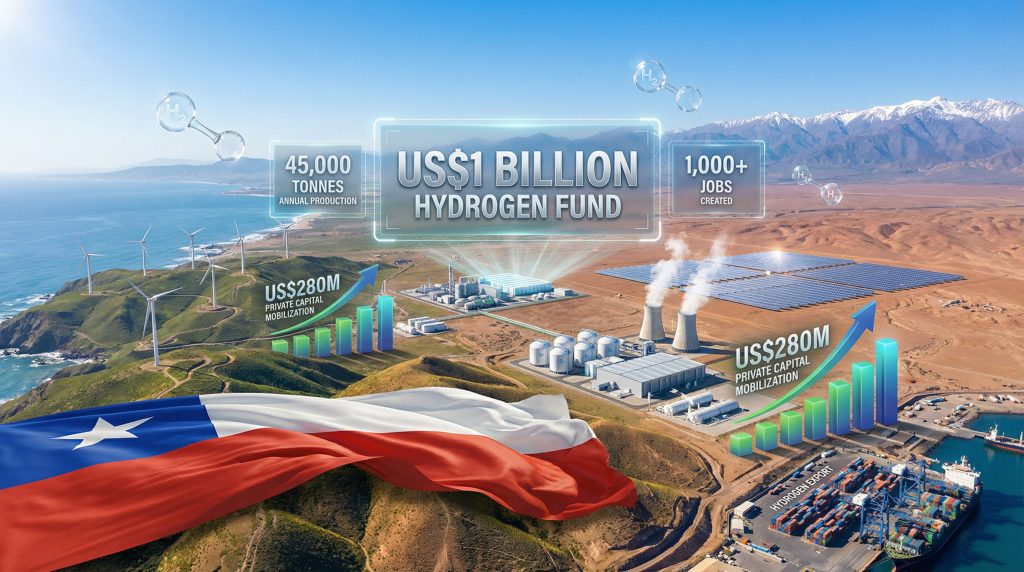
Chile's green hydrogen initiatives target 45,000 tonnes annual production by end-2025, with manufacturing projects creating over 1,000 jobs while reducing import dependency through local electrolyser assembly capabilities.
Disclaimer: This analysis is based on publicly available information and industry projections. Actual outcomes may vary significantly based on technological developments, market conditions, policy changes, and international economic factors. Readers should conduct independent research and consult with qualified professionals before making investment or policy decisions based on this analysis.
Looking to Capitalise on Chile's Energy Transition Opportunities?
Discovery Alert's proprietary Discovery IQ model delivers real-time alerts on significant ASX mineral discoveries, instantly empowering subscribers to identify actionable opportunities in lithium, copper, and renewable energy metals ahead of the broader market. Begin your 30-day free trial today and secure your market-leading advantage in the resources sector driving global energy transformation.