July 23, 2026
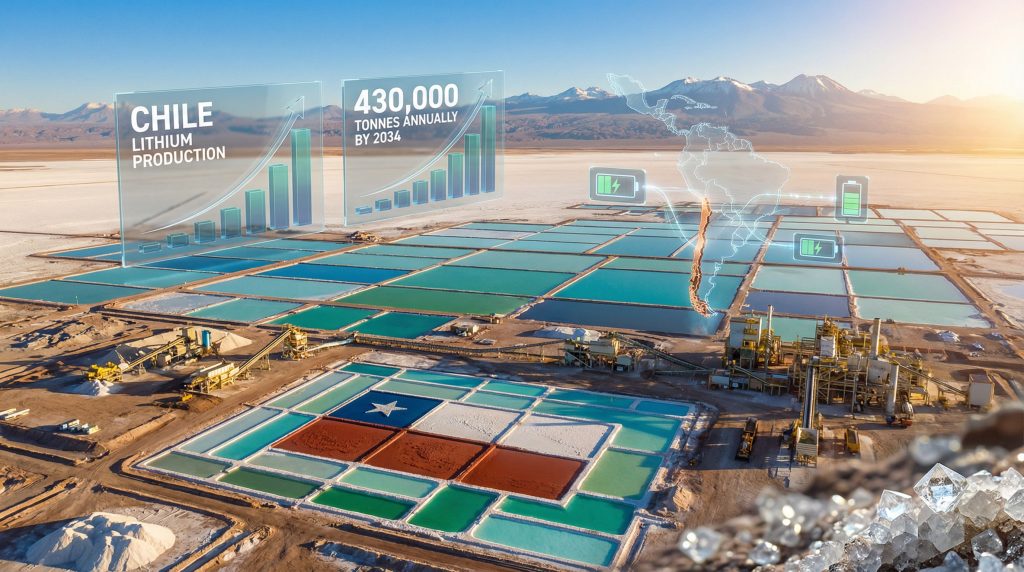
Chile and lithium contracts represent a complex intersection of resource nationalism and global energy transition demands, where constitutional frameworks shape investment flows and production capacity expansion. South America's lithium triangle—encompassing Chile, Argentina, and Bolivia—contains approximately 60% of the world's known lithium reserves, primarily in high-grade brine deposits beneath ancient salt flats. These geological formations require sophisticated extraction technologies and extended development timelines, creating supply chain vulnerabilities during periods of accelerated electric vehicle adoption.
Chile's approach to managing these strategic mineral assets reflects broader tensions between resource nationalism and capital mobilisation requirements. The country's constitutional prohibition on private lithium concessions, established in 1979, creates a unique regulatory environment where state participation becomes mandatory rather than optional, distinguishing Chilean projects from Australia's privately-dominated sector or Argentina's lithium brine market insights.
Chile's Institutional Framework for Lithium Development
Chile's Special Lithium Operation Contracts (CEOLs) represent a sophisticated policy instrument designed to balance state control with private investment requirements. The framework mandates government participation through Codelco or Enami, creating hybrid public-private structures that capture state revenues beyond traditional royalty mechanisms.
Key Framework Components:
- Constitutional classification of lithium as non-concessionable since 1979
- Mandatory state partnership through designated entities
- Presidential discretion over contract award criteria
- Long-term production commitments spanning 20+ years
- Direct award mechanisms for strategic projects
The Codelco-Rio Tinto Maricunga partnership demonstrates the capital intensity required for operational CEOL agreements. Rio Tinto's $900 million investment for a 49.9% stake establishes benchmark investment levels at approximately $16,364 per annual tonne of production capacity, based on targeted output levels. This partnership structure allows Chile to access international capital markets whilst maintaining majority state control through Codelco's participation.
Recent developments indicate institutional friction within Chile's regulatory approval process. The national comptroller's rejection of two January 2026 tender submissions highlights constitutional oversight mechanisms that can delay project implementation. The Contraloría General de la República operates under Article 98 of the Chilean Constitution, wielding authority to review government contracts for legal compliance and fiscal propriety.
Investment Structure Analysis:
| Partnership | Investment | State Partner | Foreign Investor | Production Target |
|---|---|---|---|---|
| Atacama Operations | Ongoing | Codelco-SQM | Historical legacy | Established capacity |
| Maricunga Development | $900M | Codelco (51%+) | Rio Tinto (49.9%) | Planned expansion |
| Pending CEOLs | Variable | Codelco/Enami | Multiple candidates | Development phase |
When big ASX news breaks, our subscribers know first
Comparative Analysis of Global Lithium Regulatory Models
Chile's mandatory state participation model contrasts sharply with regulatory frameworks in other major lithium-producing jurisdictions. Australia's mining lease system allows private companies to secure long-term extraction rights through state-level permitting processes, typically completed within 1-2 years. This regulatory efficiency attracts capital investment despite Australia's higher extraction costs from spodumene (hard rock) deposits.
Argentina's provincial licensing approach creates fragmentation across different jurisdictions, with varying environmental standards and royalty structures. Companies like Albemarle Corporation and Livent Corporation operate multiple projects across Argentine provinces, each subject to distinct regulatory requirements and political economy dynamics.
Production Cost Dynamics
Chilean brine operations maintain significant cost advantages over competing jurisdictions, particularly when considering Australia lithium industry innovations and their impact on production costs:
- Chile: $3,500-5,000 per tonne lithium carbonate equivalent (LCE)
- Australia: $8,000-12,000 per tonne LCE from spodumene operations
- Argentina: $4,000-6,500 per tonne LCE from brine deposits
These cost differentials reflect geological advantages of Chilean salt flat deposits, which contain higher lithium concentrations and require less energy-intensive processing compared to hard rock operations. However, regulatory complexity in Chile and lithium contracts creates permitting timelines of 3-5 years compared to Australia's 1-2 year approval processes.
Water Resource Constraints:
The Atacama Desert's extreme aridity creates water competition between lithium operations, local communities, and fragile ecosystems. New CEOL contracts increasingly mandate water recycling technologies and community benefit sharing arrangements. These environmental compliance requirements add operational complexity but reduce long-term project risk by securing social licence to operate.
Supply Chain Implications of Regulatory Delays
Chile's comptroller rejections of January 2026 tender submissions create cascading effects across global battery metal supply chains. The mining ministry's preparation of Ollague and Laguna Verde direct-award contracts for March 2026 submission represents an alternative pathway to accelerate production capacity, bypassing competitive bidding processes that faced institutional challenges.
Timeline Disruption Analysis:
Current delays push Chilean production expansion targets from 2027-2028 into 2029-2030, creating potential supply deficits during peak electric vehicle adoption periods. Furthermore, the International Energy Agency projects global lithium demand growth from approximately 750,000 tonnes in 2024 to over 2 million tonnes by 2030, driven primarily by battery manufacturing requirements.
These delays increase global market dependence on Australian spodumene concentrate, which requires refining primarily in Chinese facilities. Companies like Tianqi Lithium and Ganfeng Lithium control significant processing capacity, creating supply chain concentration risks for Western automakers seeking battery metal supply security.
Market Concentration Dynamics
Chile's lithium sector remains highly concentrated within two legacy operators, highlighting the importance of understanding global lithium market insights:
- SQM (Sociedad Química y Minera): Operating under historical concessions predating CEOL framework
- Albemarle Corporation: Joint venture partnerships in Atacama operations
- Emerging CEOL partnerships: Codelco-Rio Tinto and potential new entrants
The pending five resubmitted contracts could diversify this producer base, but regulatory uncertainties create investment risk premiums that reduce project net present values by an estimated 8-12%. International mining companies increasingly factor 12-18 month approval delays into project economics when evaluating Chilean opportunities.
Economic Drivers of Chile's Lithium Strategy
Chile's resource nationalism approach reflects strategic objectives beyond immediate fiscal revenue generation. The country seeks to reduce economic dependence on copper exports, which traditionally represent 40-50% of merchandise exports according to Chile's Central Bank statistics.
Revenue Diversification Objectives:
Chile's copper sector contributed approximately $29.4 billion in government revenues during 2023, representing roughly 23% of central government budget revenues. Lithium development offers pathway for export diversification whilst capturing higher value-added processing activities within Chilean territory.
State participation through Codelco or Enami creates revenue capture mechanisms beyond traditional royalty structures. Rather than collecting only resource taxes, the Chilean government captures operational dividends and maintains influence over production pace and allocation decisions.
Technology Transfer Requirements:
New CEOL contracts increasingly mandate local processing capabilities and technology transfer obligations. This reflects policy goals of value-chain integration—capturing refining revenues and potentially battery component manufacturing within Chilean economic zones.
Regional Development Impact
Lithium operations in Antofagasta and Atacama regions provide employment creation and infrastructure development in remote areas economically dependent on mining activities. These regions benefit from:
- Direct employment in extraction and processing operations
- Indirect employment through service provider networks
- Infrastructure investment in transportation and utilities
- Community development programmes mandated by CEOL terms
Local hiring quotas and skills development programmes create social licence benefits whilst adding operational requirements for international investors. Companies must balance these obligations against project economics and operational efficiency objectives.
Investment Capital Allocation Patterns
International mining companies view Chilean partnerships as necessary for accessing premium brine resources, despite regulatory complexity. The March 2026 Ollague and Laguna Verde direct awards could attract $1.5-2 billion in combined investment based on comparable CEOL structures and capital requirements.
Regional Investment Strategies:
- Chinese companies: Seeking vertical integration for battery supply chains through Ganfeng, Tianqi partnerships
- European firms: Diversifying supply sources away from Chinese-controlled assets
- North American players: Securing "friend-shoring" compliant supply for domestic battery manufacturing
Risk Premium Considerations
Political risk premiums associated with Chilean lithium investments reflect several factors, which align with broader mining industry evolution trends:
- Regulatory approval uncertainties extending 12-18 months
- Constitutional oversight through comptroller review processes
- Indigenous consultation requirements under ILO Convention 169
- Environmental impact assessment complexities in desert ecosystems
These risk factors create weighted average cost of capital increases for Chilean projects compared to Australian alternatives. However, Chile's superior resource grades and extraction costs often justify higher risk-adjusted returns for patient capital.
Environmental and Social Compliance Requirements:
Modern CEOL contracts mandate comprehensive environmental management:
- Baseline environmental impact assessments covering ecosystem protection
- Indigenous consultation protocols ensuring community participation
- Water usage monitoring with recycling technology implementation
- Biodiversity offset programmes for habitat conservation
Global Market Position and Strategic Implications
Chile's lithium production expansion could reach significant scale by the mid-2030s, potentially representing 35-40% of projected global supply during peak demand periods. Successful CEOL implementation would position Chile as the dominant force in global lithium supply chains, whilst implementation failures might cede market leadership to Australian producers and emerging African suppliers.
Technology Development Pathways:
Chilean operations increasingly focus on direct lithium extraction (DLE) technologies to minimise environmental impact whilst accelerating production timelines. However, the integration of direct lithium extraction boost technologies requires careful consideration of state partnerships that facilitate technology transfer from international investors to local capability development, creating long-term competitive advantages.
Companies like Summit Nanotech and Lilac Solutions develop DLE technologies that could revolutionise brine processing efficiency. Chilean state partnerships provide testing grounds for these innovations whilst capturing technology benefits within national industrial capacity.
Supply Security Considerations
Western automakers increasingly prioritise supply chain resilience over cost optimisation alone. Chilean lithium partnerships offer strategic diversification away from Chinese processing dominance, supporting "friend-shoring" objectives in battery supply chains.
Market Stabilisation Potential:
Increased Chilean capacity through successful CEOL implementation could prevent supply deficits during 2028-2032 peak EV adoption periods. Price volatility reduction benefits both producers and consumers by creating more predictable long-term supply arrangements.
The March 1, 2026 government transition in Chile could influence regulatory streamlining if new leadership prioritises lithium sector development. However, constitutional lithium ownership provisions and CEOL framework remain established by law rather than executive decree, providing policy continuity across political transitions.
The next major ASX story will hit our subscribers first
Long-Term Strategic Positioning
Chile's evolving CEOL framework represents sophisticated resource nationalism that balances state sovereignty with private sector capital mobilisation requirements. The approach acknowledges that lithium's strategic importance for global energy transition creates both opportunities and responsibilities for major producing nations.
Competitive Positioning Factors:
Chile's success in implementing expanded CEOL programmes will determine whether the country captures dominant market share during the critical 2028-2035 period of accelerated electric vehicle adoption. Alternative scenarios where regulatory complexity deters investment could shift market leadership toward Australian spodumene producers or emerging suppliers in Africa and North America.
The March 2026 contract submissions represent a crucial test of Chile's ability to streamline regulatory processes whilst maintaining constitutional oversight and environmental protection standards. Success would demonstrate that resource nationalism can coexist with efficient capital markets, whilst failure might validate arguments for fully private concession models.
Investment flows toward Chilean lithium projects reflect broader geopolitical considerations beyond pure economic returns. Supply chain security concerns, technology transfer objectives, and environmental sustainability requirements increasingly influence capital allocation decisions in critical mineral sectors.
Disclaimer: This analysis contains forward-looking statements and projections based on currently available information. Chile and lithium contracts involve significant uncertainties and risks, including lithium market conditions, regulatory frameworks, and investment returns that may differ materially from projected outcomes. Readers should conduct independent due diligence and consult qualified professionals before making investment decisions.
Ready to Invest in the Next Major Lithium Discovery?
Discovery Alert's proprietary Discovery IQ model delivers real-time alerts on significant ASX lithium and mineral discoveries, turning complex market data into actionable insights for both short-term traders and long-term investors. Understand why major mineral discoveries can lead to substantial market returns by exploring Discovery Alert's dedicated discoveries page, and begin your 14-day free trial today to position yourself ahead of the market.