June 20, 2026
Understanding the Deep Structural Challenges in Chilean Underground Mining
Chile's mining industry faces unprecedented operational constraints as seismic risks at extreme depths expose fundamental weaknesses in regulatory oversight frameworks. The Codelco El Teniente accident investigation represents a critical examination of institutional failures that extend far beyond traditional safety protocols. Underground copper extraction at depths exceeding 1,500 meters presents unique challenges that regulatory systems developed for surface operations struggle to address effectively.
The evolution of deep mining operations has outpaced regulatory adaptation, creating gaps between technological capabilities and oversight mechanisms. Furthermore, modern underground copper extraction requires sophisticated geomechanical monitoring systems, real-time seismic analysis, and predictive risk assessment protocols that many regulatory frameworks fail to adequately mandate or enforce.
When big ASX news breaks, our subscribers know first
Institutional Response Mechanisms in High-Stakes Mining Incidents
Chile's Servicio Nacional de Geología y Minería (Sernageomin) has implemented comprehensive investigation protocols following the July 2025 seismic event at the world's largest underground copper operation. The regulatory response demonstrates the complexity of modern mining oversight, involving multiple institutional layers and technical specialisations that must coordinate across jurisdictional boundaries.
Key Investigation Components:
- Processing 52 separate regulatory compliance requests
- Establishing new technical reporting standards for deep mining operations
- Implementing enhanced seismic monitoring verification protocols
- Creating precedent-setting documentation requirements
The institutional coordination extends beyond traditional mining regulation into criminal justice frameworks. Chile's Public Ministry has initiated parallel proceedings examining potential quasi-homicide charges, representing a significant escalation in legal accountability for corporate mining operations. This dual-track approach creates unprecedented pressure on mining companies to maintain comprehensive documentation and transparent reporting practices.
The regulatory investigation methodology reflects evolving international best practices for mining incident analysis. Technical assessments now incorporate 3D geological modelling, seismic prediction algorithms, and worker evacuation timeline analysis that extends far beyond traditional accident investigation protocols.
Criminal Justice Integration in Mining Safety Enforcement
The simultaneous technical and criminal investigations establish new precedents for corporate accountability in Chilean extractive industries. Criminal proceedings focus on individual and institutional responsibility, while technical investigations examine systemic failures and preventive measures. This approach mirrors regulatory developments in Peru and Australia, where mining incidents increasingly trigger both administrative and criminal review processes.
Legal frameworks distinguishing criminal liability from regulatory violations remain complex in Chilean mining law. The quasi-homicide charge structure requires demonstrating negligent conduct that directly contributed to worker fatalities, establishing causation between regulatory non-compliance and adverse outcomes.
Systemic Compliance Failures and Institutional Breakdown
Internal auditing processes revealed fundamental problems in technical reporting accuracy following a 2023 rockburst incident that preceded the fatal 2025 event. The discovery of systematic inconsistencies and concealment in regulatory submissions transforms the Codelco El Teniente accident investigation scope from accident analysis into potential corporate misconduct examination.
Critical Compliance Breakdown Areas:
- Incomplete seismic event documentation protocols
- Delayed submission timelines for technical reports
- Inadequate risk communication to oversight bodies
- Systematic gaps in preventive measure implementation
The 2023 incident involved successful worker evacuation procedures that prevented casualties, yet subsequent reporting irregularities suggest institutional failures in transparency and accountability. This pattern indicates problems beyond technical competence, pointing to corporate governance challenges within state-owned mining operations.
Executive accountability measures included dismissing three senior management positions responsible for regulatory compliance oversight. These actions demonstrate corporate recognition of institutional failures while raising questions about internal control systems that allowed reporting irregularities to persist undetected for extended periods.
Audit Discovery and Governance Implications
The audit process that uncovered reporting irregularities represents a watershed moment for state-owned enterprise governance in Chile. Internal controls that failed to prevent or detect compliance violations suggest broader institutional weaknesses that extend beyond individual operational sites.
Regulatory reporting requirements in Chilean mining mandate specific timelines for incident documentation, typically requiring initial notification within 24-48 hours and comprehensive technical reports within specified periods depending on incident severity. The nature of identified irregularities suggests systematic modification or omission of technical data that regulatory bodies relied upon for risk assessment and oversight decisions.
Production Impact Analysis and Market Implications
Long-term operational constraints at Chile's largest underground copper facility demonstrate the intersection of safety requirements and global supply chain stability. Production projections indicate sustained limitations through 2030, reflecting the permanent operational changes required for safe deep mining operations.
| Production Period | Annual Output (tonnes) | Variance from Baseline | Global Market Impact |
|---|---|---|---|
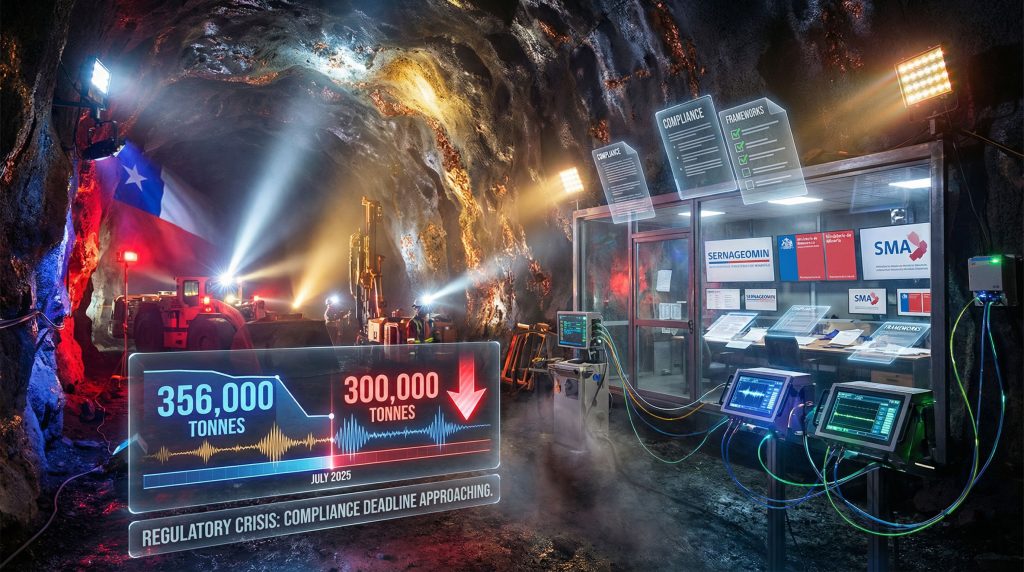
| 2024 (Pre-incident) | 356,000 | Baseline Reference | Normal Supply Flow |
| 2025-2030 (Projected) | 300,000 | -15.7% reduction | Supply Constraint |
| Market Response | N/A | Price Premium Support | +8-12% estimated |
The 56,000-tonne annual production reduction occurs during accelerating global copper demand driven by electrification infrastructure development and data centre expansion. This timing amplifies market impact beyond the absolute tonnage reduction, creating supply-demand imbalances that influence global copper pricing dynamics.
Demand Acceleration Factors:
- Electric vehicle production scaling requiring copper-intensive components
- Power grid modernisation for renewable energy integration
- Data centre construction supporting artificial intelligence computing
- Telecommunications infrastructure expansion for 5G networks
Global Copper Supply Balance Implications
Chile produces approximately 25% of global copper output, with Codelco contributing roughly 10% of world production. The El Teniente reduction represents approximately 0.3% of global annual copper supply, but concentrated impact on seaborne copper markets creates disproportionate price effects during supply-constrained periods.
Alternative copper supply sources face their own operational constraints, including data-driven mining operations in Peru dealing with community relations challenges, Democratic Republic of Congo production affected by infrastructure limitations, and Australian projects facing environmental permitting delays.
Regulatory Framework Evolution and Policy Implications
The Codelco El Teniente accident investigation outcomes will likely generate comprehensive reforms in Chilean mining safety regulation, particularly for deep underground operations where seismic risks require specialised monitoring and response protocols. Regulatory evolution typically follows major incidents, creating new standards that influence industry practices for decades.
Potential Enhanced Requirements:
- Mandatory real-time seismic monitoring systems for operations below specified depths
- Automated incident reporting protocols eliminating manual documentation delays
- Enhanced early warning mechanisms integrating geological prediction models
- Independent safety auditing requirements for state-owned mining enterprises
Corporate governance standards for mining operations may incorporate board-level safety oversight mandates, requiring specialised committee structures and regular safety performance reporting to regulatory bodies. These changes would align Chilean standards with international mining governance best practices developed in Australia and Canada.
Technology Integration Mandates
Regulatory responses increasingly emphasise technology solutions for deep mining safety challenges. Advanced monitoring systems incorporating artificial intelligence and machine learning algorithms can provide predictive risk assessment capabilities that traditional monitoring approaches cannot achieve.
Technology Requirements Under Consideration:
- IoT sensor networks providing continuous geomechanical data
- Automated evacuation systems triggered by seismic thresholds
- Real-time worker location tracking for emergency response
- Redundant communication systems ensuring connectivity during incidents
The implementation timeline for technology mandates typically involves phased approaches allowing engineering marvels underground operations to upgrade systems without disrupting production schedules. Pilot programs and industry consultation processes help refine technical specifications before mandatory implementation.
Political Transition Effects on Investigation Continuity
Chile's political transition introduces uncertainty about investigation priorities and state-owned enterprise governance approaches. While Interior Minister Álvaro Elizalde has defended current management responses, incoming President José Antonio Kast's commitment to reviewing state enterprise operations suggests potential policy shifts affecting Codelco's governance structure.
Political Dynamics Under New Administration:
- Enhanced private sector oversight integration possibilities
- Modified reporting and accountability framework requirements
- Potential governance restructuring affecting board composition
- Increased financial performance scrutiny alongside safety considerations
The investigation timeline extends well into the new administration period, creating potential for policy discontinuity or investigative approach modifications. Political support for current management approaches may shift as new leadership priorities emerge and public pressure for accountability continues.
State Enterprise Governance Reform Implications
Presidential commitments to reviewing state-owned enterprise operations reflect broader concerns about institutional effectiveness and accountability in Chilean public sector management. The investigation becomes a test case for state enterprise governance reform approaches under new political leadership.
Reform possibilities include enhanced independent oversight mechanisms, modified board appointment processes, and increased transparency requirements that could transform state-owned enterprise governance across Chile's economy beyond the mining sector.
The next major ASX story will hit our subscribers first
International Mining Safety Standard Comparisons
Chilean mining safety regulations require evaluation against international best practices, particularly for deep underground operations where seismic risks demand specialised approaches. Countries with extensive deep mining experience provide frameworks for regulatory enhancement and technology integration requirements.
International Regulatory Approaches:
- South Africa: Deep gold mining regulations addressing seismic risks through mandatory monitoring systems
- Canada: Ontario mining safety protocols for underground operations exceeding 1,000 meters depth
- Australia: Integrated safety management systems combining regulatory oversight with industry self-regulation
- Peru: OSINERGMIN enhanced monitoring requirements following mining incidents
Technology standards developed in these jurisdictions provide proven frameworks for seismic monitoring, worker safety protocols, and emergency response systems that Chilean regulators can adapt for local geological and operational conditions.
Depth-Based Risk Assessment Protocols
Mining operations at significant depths face exponentially increasing seismic risks that require specialised assessment and monitoring approaches. Industry standards typically establish depth thresholds triggering enhanced safety requirements, with protocols becoming more stringent as operations extend deeper underground.
Current international practice suggests 1,500-meter depth as a critical threshold requiring enhanced seismic monitoring, automated warning systems, and specialised evacuation protocols. Operations exceeding 2,000 meters depth typically require continuous real-time monitoring and predictive risk assessment systems.
Long-term Industry Transformation Implications
The investigation outcomes extend beyond immediate regulatory changes to influence Chilean mining industry innovation, technology adoption timelines, and international investment considerations. Mining companies operating in Chile must reassess risk management approaches and compliance frameworks in response to enhanced regulatory expectations.
Industry-Wide Impact Areas:
- Enhanced insurance and bonding requirements for deep mining operations
- Modified joint venture partnership structures incorporating safety performance metrics
- Technology transfer agreements emphasising advanced monitoring systems
- International mining company risk assessment modifications for Chilean projects
Foreign direct investment flows into Chilean mining may experience temporary disruption as international companies evaluate enhanced regulatory requirements and compliance costs. However, improved safety standards may ultimately strengthen Chile's reputation as a stable, well-regulated mining jurisdiction.
Innovation Acceleration in Mining Safety Technology
Regulatory pressure creates market opportunities for mining technology companies developing advanced safety systems, seismic monitoring equipment, and predictive risk assessment software. Chilean mining operations may become testing grounds for cutting-edge safety technologies that subsequently gain adoption in international markets.
The intersection of regulatory requirements and technological capabilities drives innovation cycles that benefit the broader global mining industry. Chile's position as a major copper producer ensures that safety innovations developed for Chilean operations influence international mining practices and standards.
According to Reuters' recent analysis, production at Codelco's El Teniente mine will remain at reduced levels for the next five years, highlighting the long-term operational impact of the incident.
Investigation Timeline and Outstanding Questions
Critical technical and institutional questions remain unresolved as the investigation progresses through 2026. The complexity of deep mining operations, regulatory oversight mechanisms, and corporate governance issues requires comprehensive analysis extending well beyond immediate incident causation.
Unresolved Technical Issues:
- Precise seismic event triggers and predictability assessment
- Effectiveness evaluation of existing monitoring system capabilities
- Adequacy analysis of current evacuation procedure protocols
- Correlation examination between 2023 and 2025 incident patterns
Institutional Accountability Questions:
- Regulatory oversight effectiveness in detecting compliance violations
- Systematic changes required in agency monitoring protocols
- Real-time oversight capability enhancement requirements
- Inter-agency coordination improvement mechanisms
The investigation timeline extends through multiple phases, including technical causation analysis, regulatory compliance review, criminal proceedings evaluation, and comprehensive reform recommendation development. Furthermore, each phase contributes essential information for understanding institutional failures and preventing future incidents.
Future Regulatory Development Pathways
The investigation establishes precedents influencing mining safety regulation development across Latin America's extractive industries. Chilean regulatory approaches often serve as models for neighbouring countries, making the Codelco El Teniente accident investigation outcomes significant beyond Chile's borders.
Regional mining regulatory harmonisation efforts may incorporate lessons learned from the investigation, creating improved safety standards across major copper-producing countries including Peru, Mexico, and Argentina. The ABC News coverage of Chile's national mourning declaration following the mine collapse underscores the national significance of this tragedy.
The comprehensive nature of this investigation, combining technical analysis, criminal proceedings, and institutional reform considerations, represents a watershed moment for mining safety regulation in Latin America. Its outcomes will influence mining industry practices, regulatory frameworks, and corporate governance standards for decades to come.
This analysis contains forward-looking assessments based on available information as of February 2026. Regulatory outcomes, production forecasts, and market impacts remain subject to ongoing investigation findings and political developments. Investment decisions should incorporate comprehensive risk assessments and professional consultation.
Looking to Capitalise on Mining Industry Developments?
Discovery Alert provides real-time notifications on significant ASX mineral discoveries using its proprietary Discovery IQ model, delivering actionable insights that help investors identify opportunities ahead of market movements. Visit Discovery Alert's discoveries page to explore historic examples of exceptional returns from major mineral discoveries and begin your 14-day free trial today.