August 6, 2026
The Invisible Architecture of Resource Control: How Industrial Capital Replaced Raw Ore Trade
The history of commodity geopolitics is not written in ore grades or reserve estimates. It is written in the decisions made after the mining is done, in the smelters, refineries, and industrial parks where raw earth becomes tradeable product. For decades, the conventional model was simple: resource-rich developing nations dug, and industrialised nations processed. That model is now being systematically dismantled, and nowhere is this more visible than in the evolving relationship between China and Indonesia over access to critical minerals.
Understanding how China access to Indonesia minerals works today requires looking past the export ban headlines and into the industrial logic that replaced raw ore trade with something far more durable.
When big ASX news breaks, our subscribers know first
Indonesia's Mineral Geography and Why It Cannot Be Ignored
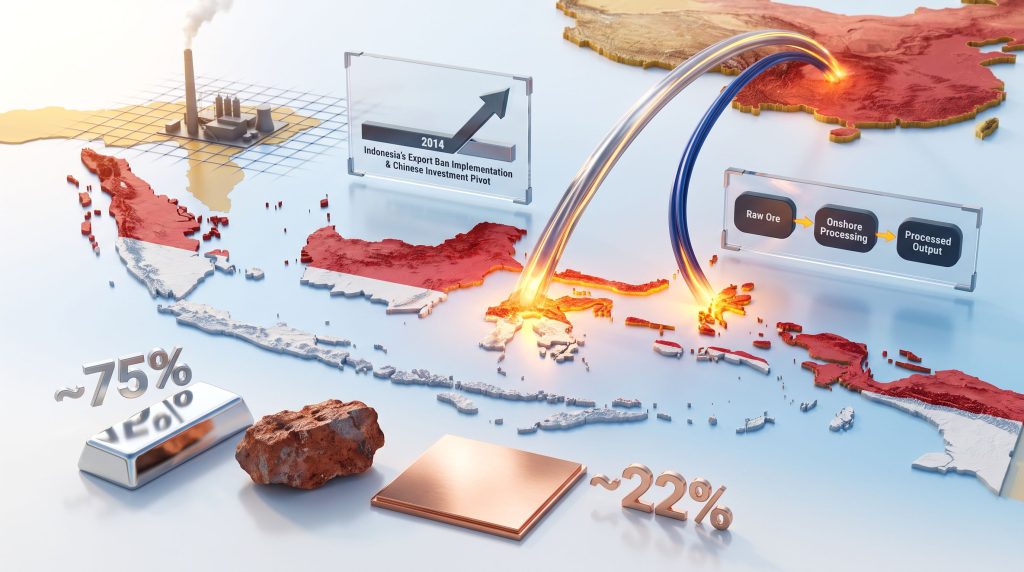
Indonesia sits on one of the most concentrated deposits of strategically critical minerals on the planet. Its nickel reserves alone account for an estimated 22% of proven global supply, making it the single largest national holder of a commodity that now sits at the centre of both stainless steel manufacturing and electric vehicle battery chemistry. Beyond nickel, the archipelago holds substantial bauxite deposits, copper ore, and geological surveys that point to underdeveloped rare earth potential that has barely been touched by commercial extraction.
The country's position within the Indo-Pacific creates additional strategic weight. Sitting astride key maritime shipping corridors that connect East Asian manufacturing hubs to South Asian and Middle Eastern markets, Indonesia's mineral output does not just feed supply chains — it shapes the logistics of how those supply chains are physically organised across the region.
What changed the calculus entirely was not a geological discovery but a policy decision. Starting in 2014 with nickel, and progressively expanding to bauxite and copper concentrates, the Indonesian nickel industry introduced a series of export bans on unprocessed minerals. The stated policy rationale was industrial development through what Indonesian policymakers call the downstreaming agenda: the requirement that mineral commodities be refined or processed domestically before they can be exported in any form.
Critically, this did not reduce Indonesia's mineral output. It redirected where the value-adding step occurs. That distinction matters enormously for understanding who ultimately controls the supply chain.
China's Response: Capital Deployment as Supply Chain Strategy
When raw nickel ore could no longer leave Indonesian ports, Chinese industrial capital did something instructive. Rather than sourcing nickel from alternative global suppliers, it moved the processing infrastructure to Indonesia itself.
The result was the emergence of large-scale Chinese-backed industrial processing zones, most prominently at Morowali in Central Sulawesi and Weda Bay in North Maluku. These are not simple mining operations. They are integrated industrial ecosystems that include nickel smelting, ferro-nickel and nickel pig iron production, supporting power generation, port facilities, and in some cases dedicated residential infrastructure for workers. Tsingshan Group, China's largest private steelmaker, is among the major industrial conglomerates that established a dominant position within these zones.
The strategic outcome of this investment wave is captured in a single estimate: Chinese-backed entities now control approximately 75% or more of Indonesia's nickel refining capacity. The export ban that was designed to force value-adding onshore succeeded in doing exactly that, but the entity capturing most of the value-adding margin is predominantly Chinese nickel investment, not Indonesian-owned enterprise.
Nickel Refining and the Bilateral Relationship: Key Metrics
| Metric | Estimated Figure | Strategic Implication |
|---|---|---|
| Indonesia's share of global nickel reserves | ~22% | Makes Indonesia structurally irreplaceable |
| Chinese-backed share of Indonesian nickel refining | ~75%+ | Midstream processing control concentrated in one bloc |
| First Indonesian nickel export ban | 2014 | Triggered the Chinese industrial investment pivot |
| Major Chinese-backed industrial parks | Morowali, Weda Bay | Geographic concentration of processing assets |
The policy incentive structure that enabled this pivot deserves attention, because it reveals why Chinese industrial capital was better positioned than Western competitors to respond at speed and scale. Indonesia's special economic zones offered tax holidays to qualifying foreign investors. Domestic ore pricing policies maintained below-market input costs for onshore processors. Energy inputs, particularly coal for energy-intensive smelting operations, were made available on terms that supported large-scale industrial production economics. Together, these conditions created a cost environment that systematically favoured capital-rich, vertically integrated industrial operators — exactly the profile of major Chinese industrial conglomerates.
What China Is Now Offering Indonesia, and What the Offer Actually Means
China's ambassador to Jakarta recently proposed a framework of closer economic cooperation framed around supply chain and industrial integration, explicitly linking China's manufacturing capabilities to Indonesia's downstreaming agenda. The suggestion that these two elements could be combined to increase the value of Indonesian commodity output reflects a diplomatic positioning that is worth unpacking carefully.
A visiting senior fellow at the ISEAS-Yusof Ishak Institute in Singapore has observed that foreign investors who add value to minerals within Indonesia can access both a substantial domestic market and export-eligible supply chains, and that there is a clear strategic motivation for external parties to secure as much of that supply chain access as possible.
Analytical framing: When an industrial superpower with existing dominance in processing infrastructure offers to help a resource nation increase the value of its commodities, the proposal cannot be evaluated in isolation from the structural relationships that already exist. The offer functions within, and reinforces, a framework of industrial interdependence that is far easier to deepen than to exit.
The distinction between aid, investment, and strategic positioning is crucial here. What is being proposed is best understood as the third category — an extension of an existing industrial relationship rather than a new form of development assistance. Furthermore, Indonesia's nickel role in the global energy transition only amplifies the strategic stakes of these arrangements.
A Commodity-by-Commodity Look at Chinese Access
Nickel: The Anchor Commodity
Nickel occupies a unique dual role in the China-Indonesia relationship. On one side, it feeds Chinese stainless steel manufacturing through nickel pig iron production, a lower-purity product stream sometimes called Class 2 nickel. On the other, it increasingly feeds battery cathode material production for lithium-ion cells used in electric vehicles, a higher-purity stream known as Class 1 or battery-grade nickel.
The EV transition is elevating the strategic premium attached to Indonesian nickel. As global automakers accelerate battery electric vehicle production timelines, critical minerals demand is projected to grow substantially through the late 2020s. Indonesian ore, processed through Chinese-backed Indonesian refineries, currently represents a significant portion of the feedstock entering Chinese battery supply chains.
Bauxite and Copper: The Next Processing Frontier
Indonesia's bauxite export ban created a situation analogous to nickel: domestic alumina refining capacity needed to be built, and foreign capital was required to build it. Chinese investment interest in bauxite processing has grown, though the sector remains less mature than nickel processing. The investment gap in domestic copper smelting is even more pronounced, representing what may be the next significant wave of industrial capital deployment if Indonesia's copper concentrate restrictions are maintained and tightened.
Rare Earths: Indonesia's Strategic Unknown
Perhaps the least understood dimension of this relationship involves rare earths. Geological surveys indicate that Indonesia holds underdeveloped rare earth deposits that have not yet been commercially extracted at meaningful scale. The structural problem is that Indonesia currently lacks domestic rare earth refining capacity, and the technology required to build it is controlled by a very small number of actors globally — of whom China is by far the most significant.
This creates a potential dependency loop: Indonesia may need Chinese refining technology and expertise to develop a rare earth sector, which would further embed Chinese industrial partners in Indonesia's critical mineral economy. In contrast to more established rare earth supply chains elsewhere, Indonesia's rare earth sector remains largely undeveloped and consequently vulnerable to single-source technological dependence.
The Mutual Dependence Structure: Who Gains, Who Risks
The relationship between China and Indonesia over mineral access is not one of simple exploitation. Both parties derive genuine strategic value, and both carry meaningful risks.
| Stakeholder | Primary Gains | Key Risks |
|---|---|---|
| Indonesia | Industrial investment, processing capacity, employment, revenue diversification | Over-reliance on single foreign investor bloc, geographic economic asymmetry |
| China | Secure processed mineral supply, supply chain embedding, reduced Western disruption exposure | Host-nation policy reversal, regulatory risk, reputational exposure |
| Global Markets | Increased nickel and bauxite processing output, improved supply availability | Concentration risk in Chinese-controlled processing chains |
| Western Economies | Potential indirect access through Indonesian partners | Structural exclusion from upstream processing relationships |
For Indonesia, the industrial park model has delivered tangible outcomes. Processing infrastructure has been built at scale that would have taken decades to accumulate through domestic capital formation alone. Employment in mineral processing zones has been generated at politically significant levels, and export revenues are shifting from low-margin raw ore toward higher-value processed products.
The risk for Indonesia is structural. When the dominant capital deploying party in your industrial economy represents a single national bloc, policy flexibility narrows. Any move to impose new conditions on Chinese-backed industrial operators carries the risk of disrupting the processing output that now underpins a significant portion of export earnings.
For China, the strategic gains are equally clear. Processed mineral supply secured through Indonesian-based facilities is materially harder to disrupt through Western sanctions or trade restrictions than supply flowing through Chinese domestic facilities. By positioning Chinese firms as structurally indispensable partners in Indonesian industrial development, Beijing has anchored key supply chain inputs in a non-aligned nation with its own sovereign interests in maintaining the relationship.
The next major ASX story will hit our subscribers first
What Western Industrial Strategy Has Failed to Match
The gap between Western critical mineral policy ambitions and the capital deployment mechanisms required to realise those ambitions is nowhere more visible than in Indonesia. As noted in Indonesia's nickel diplomacy, the contest between the US and China over critical mineral access is playing out most acutely in the archipelago.
The United States Inflation Reduction Act and the European Union's Critical Raw Materials Act both articulate supply chain diversification goals and preference frameworks for minerals processed in allied or partner nations. However, Indonesian-processed nickel produced in Chinese-backed facilities does not straightforwardly qualify under friend-shoring criteria embedded in these frameworks, even though the processing occurs in a non-Chinese jurisdiction.
Japan has made more concrete moves through mechanisms such as JOGMEC and its major trading house structures, maintaining strategic stakes in Indonesian nickel assets. But the scale of Japanese industrial investment remains well below the level required to structurally rebalance processing control away from Chinese-backed operators.
Structural barrier: Replicating the scale and speed of Chinese industrial park development in Indonesia would require coordinated state-backed financing at a level that Western economies have not yet demonstrated the institutional capacity to deploy in a single bilateral industrial context.
Three Scenarios for the China-Indonesia Mineral Relationship Through 2030
Scenario 1: Deepening Integration (Base Case)
Chinese investment expands across nickel, bauxite, and eventually rare earth processing. Indonesia gains industrial scale but remains structurally dependent on Chinese capital. Global supply chain concentration in Chinese-controlled Indonesian processing increases through the end of the decade.
Scenario 2: Managed Diversification (Reform Case)
Indonesia deliberately courts South Korean, Japanese, and European industrial partners. New processing capacity enters under non-Chinese ownership. Western EV manufacturers gain improved access to Indonesian processed nickel through emerging friend-shoring frameworks, and the global supply chain becomes materially less concentrated.
Scenario 3: Policy Disruption (Risk Case)
Geopolitical deterioration between China and key Western economies triggers Indonesian policy reassessment. Jakarta imposes new conditions on Chinese-backed industrial parks. Global nickel and battery material markets experience price volatility as supply chain assumptions are stress-tested against a new political reality. Consequently, China access to Indonesia minerals could become a central flashpoint in broader economic diplomacy.
Frequently Asked Questions: China's Access to Indonesia's Minerals
Does Indonesia's export ban actually reduce China's access to its minerals?
No. The export ban changed the form of access, not the level of access. Chinese firms responded by investing in onshore processing infrastructure, preserving supply chain control while technically complying with Indonesian domestic processing requirements.
What is the downstreaming agenda?
It is Indonesia's national industrial policy requiring that mineral commodities be processed domestically before export. Applied progressively to nickel from 2014, then to bauxite and copper concentrates, it was designed to capture value-adding activity within Indonesia rather than exporting it embedded in raw ore.
How does Indonesian nickel affect global EV battery supply chains?
Indonesian nickel, processed primarily through Chinese-backed facilities, feeds directly into cathode material production for lithium-ion batteries. Concentration of this processing capacity within a single investor bloc creates supply chain vulnerability for non-Chinese EV manufacturers seeking battery-grade nickel from geopolitically diversified sources.
Why can't Western companies simply replicate China's Indonesian investment model?
The Chinese industrial park model combines state-backed financing with large, vertically integrated industrial conglomerates capable of building smelting, power, and logistics infrastructure at speed. Most Western economies lack both the state financing mechanisms and the private industrial conglomerates with the scale and risk appetite to match this model in a single bilateral context. A triumvirate approach to resilient supply chains has been proposed as one potential framework for broadening partnership engagement in Indonesia.
The Deeper Lesson in Resource Geopolitics
The China-Indonesia mineral relationship illustrates a principle that extends well beyond these two countries. Export bans do not neutralise foreign resource access — they reshape the geography and economics of where access is exercised. The nation that controls processing infrastructure controls supply chain leverage, regardless of who legally owns the ore body.
Indonesia's downstreaming model is achieving its stated industrial development objectives. The more difficult question — one that Indonesian policymakers are increasingly aware of — is whether the distribution of industrial gains from that development is sufficiently balanced to serve long-term national interests. The answer to that question will shape not just the bilateral relationship, but the strategic architecture of global critical mineral supply chains for the decade ahead. China access to Indonesia minerals will, in that sense, remain one of the defining resource geopolitics stories of our time.
Want to Track the Next Major Critical Minerals Discovery Before the Market Does?
Discovery Alert's proprietary Discovery IQ model scans ASX announcements in real time, instantly identifying significant mineral discoveries across nickel, rare earths, and other critical commodities — converting complex geological data into clear, actionable investment insights for traders and long-term investors alike. Explore historic discoveries and their extraordinary returns to understand the scale of opportunity, then begin your 14-day free trial at Discovery Alert to position yourself ahead of the market.