August 25, 2026
When Infrastructure Meets Its Climate Limits
Every industrial system is a product of the assumptions baked into its original design. Engineers who built Europe's refining and power generation backbone in the 1960s and 1970s worked from historical temperature data, seasonal river flow averages, and precipitation patterns that defined the climate of that era. Those assumptions are now systematically failing. The Europe heatwave hitting refineries and power supplies is not simply a weather story. It is an engineering stress test, and the structures being tested were not built to pass it.
When big ASX news breaks, our subscribers know first
Why Europe's Refining Infrastructure Cannot Keep Up With Modern Heat
The Thermodynamic Reality of Air Fin Coolers
The cooling architecture at the heart of most European refineries relies on a principle that is straightforward in moderate climates but increasingly fragile under extreme heat conditions. Air fin coolers transfer heat from hot hydrocarbon process streams into the surrounding atmosphere by exploiting the temperature differential between the two. The wider that gap, the more efficiently heat moves from the process stream to the air. When ambient temperatures climb above 35 to 40 degrees Celsius, that differential collapses, and heat transfer efficiency degrades sharply.
Most of Europe's refining capacity was constructed during a period when sustained summer temperatures above 38 to 40 degrees Celsius were genuinely rare. The engineering specifications for cooling systems, heat exchangers, and process condensers were calibrated accordingly. Unlike modern industrial facilities designed with climate adaptation in mind, these legacy assets lack the redundant cooling capacity needed to sustain full throughput when ambient temperatures routinely exceed their design parameters.
Water-cooled systems face a compounding version of the same problem. Reduced river flows cut the available volume of cooling water, while the water that remains is already thermally elevated from weeks of sustained heat. European environmental regulations add a further binding constraint by imposing strict discharge temperature limits on water returned to natural waterways after industrial use. When river temperatures are already high, the permissible thermal differential narrows further, forcing operational slowdowns even before physical water scarcity becomes the primary issue.
| Cooling System Type | Normal Operating Condition | Heatwave Constraint |
|---|---|---|
| Air fin coolers | Relies on ambient-to-process temperature gap | Gap narrows sharply above 35-40°C |
| Once-through river cooling | Requires high-volume, low-temperature river intake | Low flow and warm water create dual failure |
| Recirculating cooling towers | More resilient but still water-dependent | Evaporation rates increase under heat stress |
Throughput Cuts and the Diesel Crack Surge
Commodity analysts at Standard Chartered have identified a particularly damaging dynamic at work during the current European summer: extreme heat simultaneously increases fuel demand through higher power generation requirements while constraining refineries' physical ability to produce fuels efficiently. This two-sided squeeze creates disproportionate pressure on refinery margins, amplifying the effect beyond what either demand or supply disruption would produce independently.
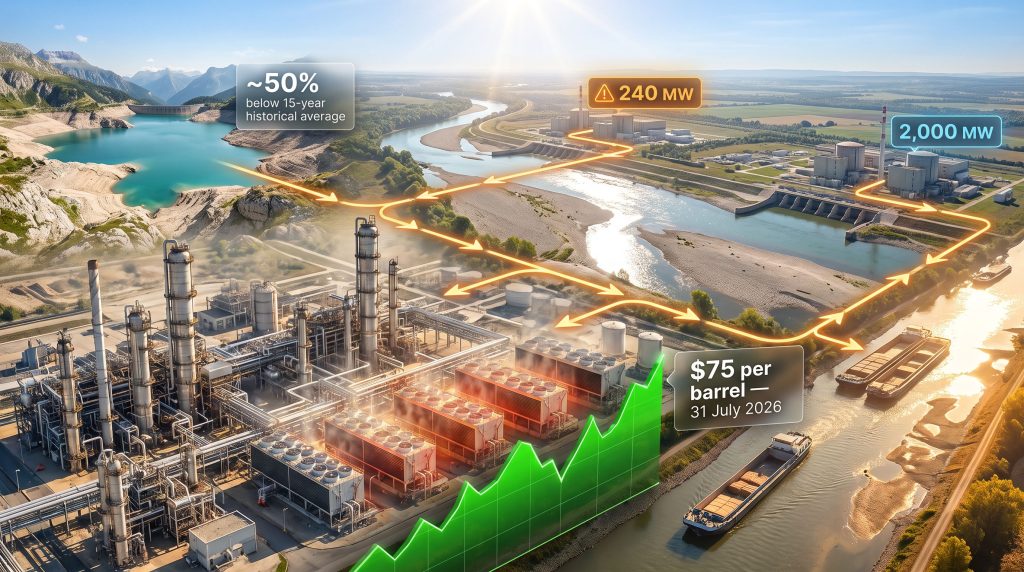
The ICE gasoil-Brent crude crack spread, the primary benchmark for European diesel profitability, surpassed $75 per barrel on 31 July 2026, approaching territory not visited in approximately two decades. Industry modelling suggests that sustained peak heat scenarios can reduce European refining capacity by up to 1 million barrels per day, with Mediterranean facilities particularly exposed to run rate reductions of 5 to 15% during prolonged extreme heat events.
What happens to refineries during a heatwave? During extreme heat, refinery cooling systems lose efficiency as the temperature gap between ambient air and process streams narrows. This forces operators to reduce throughput or shut down individual process units. Water-cooled systems face additional pressure from reduced river flows and elevated water temperatures. The combined effect tightens refined fuel supply and drives diesel margins sharply higher.
Critically, the crack spread elevation is not a crude oil price phenomenon. It reflects a specific supply-side constraint on refined product production, meaning the physical availability of diesel is genuinely constrained relative to demand. This distinction matters for anyone interpreting the price signal: the problem is not at the wellhead, it is in the processing and distribution infrastructure.
How River Systems Are Undermining Europe's Power Grid
Hungary's Paks Plant: A Nuclear Crisis in Numbers
The Danube has fallen to record-low levels across Central Europe in the summer of 2026, and the consequences for nuclear power generation have been severe. Hungary's Paks Nuclear Power Plant, which under normal conditions generates approximately 2,000 megawatts and supplies roughly half of Hungary's total electricity output, reduced generation to just 240 megawatts as river intake volumes became insufficient to sustain full-power operation. Three of the plant's four operational turbines were progressively taken offline.
Hungarian authorities warned that a complete shutdown remained a live risk if river levels continued declining. Such an event would represent the first full stoppage in the facility's 44-year operational history. The scale of that dependency is worth pausing on. A single river system, reduced by drought and heat, had brought one of Central Europe's primary electricity sources to the edge of total failure.
The technical reason for this vulnerability lies in the cooling architecture both Paks and Romania's Cernavoda plant share: once-through river cooling systems that draw water directly from the Danube in large volumes, use it to absorb reactor heat, and return it downstream. A typical nuclear reactor using once-through cooling draws between 25,000 and 60,000 gallons of water per megawatt-hour of electricity generated. There is no local buffer or workaround when the river itself fails to deliver.
Romania's Emergency Response
Romania's situation escalated rapidly enough to trigger a nationwide state of emergency, declared in response to collapsing electricity production and constrained cross-border import capacity. The Romanian military deployed 180 kilograms of explosives in a controlled detonation targeting a Danube rock formation along the Bala channel. The objective was to redirect greater water volume toward the Cernavoda nuclear complex, reflecting the degree of desperation facing grid operators.
Despite that intervention, state-owned utility Nuclearelectrica was forced to shut down one of Cernavoda's two active reactor units. That unit normally supplies approximately one-fifth of Romania's national electricity. Major industrial consumers including automotive manufacturing operations run by Dacia and Ford suspended production to reduce grid demand pressure, a measure that illustrates how quickly generation shortfalls cascade outward into the broader industrial economy.
Hydropower Collapse Across Alpine and Nordic Regions
The Danube crisis is one dimension of a wider hydropower emergency unfolding across Europe. Two distinct regions are experiencing severe supply shortfalls simultaneously. Furthermore, research from Ember Energy highlights how these events intensify green transition pressures across the continent's energy systems.
| Region | Key Metric | Impact |
|---|---|---|
| Alpine Region (Austria, Switzerland, France, N. Italy) | Reservoir inflows approximately 50% below 15-year historical average | Hundreds of millions of euros in lost utility earnings at EDF and Verbund |
| Nordic Region (Norway) | Lowest snow reserves in 20 years | Approximately 25 TWh energy deficit |
| Norway dependency context | Roughly 90% of electricity from hydropower | Structural exposure to precipitation and snowmelt shortfalls |
Norway's situation deserves particular attention precisely because its energy system is so thoroughly built around hydropower. When snowpack and precipitation fall sharply below historical averages, there is no rapid substitution available. The country's 25 terawatt-hour deficit represents a structural gap that gas imports and interconnector flows can only partially offset, and only at significantly elevated cost.
The Inland Logistics Fracture
Why Low River Levels Raise Fuel Costs Beyond the Power Sector
Europe's inland waterway network functions as a critical artery for moving crude oil, refined petroleum products, and refinery feedstocks between coastal import terminals and inland industrial consumers. The Rhine and Danube systems carry a substantial share of this freight. When river levels fall, barge operators must reduce cargo loads to maintain safe draft clearances, cutting the volume of fuel that can be moved per vessel journey and raising per-unit transportation costs.
The Rhine had not reached the historically severe low-water benchmarks recorded during the 2018 and 2022 disruptions at the time of reporting, but directional trends were worsening and logistics costs were already rising. Those precedent events are instructive. During both episodes, fuel delivery costs in Germany surged as barge capacity constraints forced operators toward more expensive alternative transport modes. Regional fuel price premiums emerged entirely independent of global crude market dynamics. The same mechanism is now operating again, layered on top of the refinery and power generation pressures.
The 2018 and 2022 Rhine precedents established a critical pattern: inland waterway disruptions can translate into regional fuel price premiums with remarkable speed, even when global crude supply is adequate. In 2026, that mechanism is one of several simultaneous pressures operating concurrently across Europe's energy system.
The Six-Stage Cascade: How Simultaneous Failures Compound
Understanding why the Europe heatwave hitting refineries and power supplies is so damaging requires mapping how individual disruptions interact and amplify one another.
-
Heat reduces refinery throughput as cooling systems lose efficiency, cutting the volume of refined product entering the market.
-
Nuclear and hydropower generation falls as river levels drop and reservoir inflows decline, increasing grid stress and raising demand for gas-fired backup generation.
-
River levels decline further as drought persists, shrinking barge cargo capacity and making inland fuel distribution more expensive and less reliable.
-
Environmental discharge regulations tighten operational windows, preventing refiners from compensating by running harder during cooler overnight periods.
-
Middle East supply disruptions persist, removing any external crude buffer that might otherwise offset domestic production shortfalls.
-
Diesel crack spreads spike toward 20-year highs, translating the physical supply shortage into elevated end-user fuel costs that amplify inflationary pressure across the economy.
Each stage feeds the next. The absence of any one of these pressures would make the overall situation manageable. Their simultaneous presence creates a supply shock that existing market mechanisms are poorly positioned to absorb quickly. These dynamics also compound the energy transition challenges that governments across the continent are already navigating.
Reading the Market Signals and Longer-Term Structural Risks
What the ICE Gasoil Crack Spread Is Actually Telling the Market
The ICE gasoil-Brent crack spread is frequently described as a measure of refinery profitability, but in the current context it functions more precisely as a real-time indicator of physical diesel scarcity. A reading above $75 per barrel places the market in territory approaching 20-year highs, and the drivers are supply-side rather than crude-driven. This distinction has practical implications for analysts and market participants attempting to interpret the signal.
When crack spreads rise because crude prices fall, refined product prices are being partially supported by input cost relief. When crack spreads rise because refined product is scarce relative to demand, the signal is more structurally significant. The latter is precisely what is occurring in Europe during summer 2026. Standard Chartered analysts have indicated that further upside remains possible if heat and drought conditions intensify or persist beyond seasonal norms. This is a forward-looking statement and should be treated as an analytical projection rather than a certainty.
The downstream effects extend well beyond fuel prices at the pump. Elevated diesel margins cascade into freight costs, agricultural input costs from diesel-dependent farm machinery, and industrial energy costs. Power generation operators relying on diesel backup units face structurally higher operating costs during grid stress events. The result is a compounding inflationary input cost environment for European manufacturers arriving precisely when grid stress and production curtailments are already squeezing output capacity. However, there are broader geopolitical supply risks that further complicate Europe's energy security picture.
Climate Change as a Permanent Engineering Variable
Research from the World Weather Attribution group has established that human-driven climate change has materially increased both the probability and severity of extreme heat events across Europe. The operational disruptions documented in summer 2026 are not anomalies within a stable long-term climate distribution. They represent the leading edge of an emerging baseline that European energy infrastructure must be evaluated against, not as exceptional events to be absorbed and forgotten.
Adapting to this reality would require significant capital commitment across multiple infrastructure categories.
-
Refinery modernisation: Retrofitting air fin coolers with higher-capacity designs, installing supplemental wet cooling systems, and redesigning heat exchanger networks for higher ambient temperature tolerances.
-
Nuclear cooling diversification: Transitioning river-dependent plants from once-through cooling toward closed-loop or dry cooling architectures, a capital-intensive but strategically necessary investment.
-
Hydropower reservoir management: Implementing dynamic seasonal water management strategies designed to preserve reservoir levels as a buffer against low-inflow periods rather than maximising short-term generation.
-
Inland logistics resilience: Expanding pipeline infrastructure and coastal or rail fuel distribution capacity to reduce structural dependence on inland waterway barge transport during low-water periods. In addition, investing in renewable energy solutions for industrial operations can offer meaningful relief during grid stress events.
None of these adaptations are technically complex. What they share is significant capital cost, long implementation timelines, and the political and commercial challenge of investing in resilience against scenarios that historically occurred rarely enough to be treated as acceptable risk. That calculus has now changed. The decarbonisation benefits of accelerating this infrastructure overhaul are consequently becoming harder for policymakers to ignore.
The next major ASX story will hit our subscribers first
Europe's Multi-System Energy Stress in Summary
| Stress Vector | Mechanism | Market Impact |
|---|---|---|
| Refinery cooling failure | Heat reduces cooling efficiency across air fin and water systems | Diesel supply tightens; crack spreads approach 20-year highs |
| Nuclear generation cuts | Low Danube flows force once-through cooling shutdowns at Paks and Cernavoda | Grid stress; emergency measures; industrial demand curtailment |
| Hydropower deficit | Alpine and Nordic reservoir inflows 25-50% below historical averages | Hundreds of millions in utility earnings losses; electricity price spikes |
| Inland logistics degradation | Low Rhine and Danube levels reduce barge cargo capacity | Higher per-unit fuel transport costs; regional supply distribution constraints |
| Regulatory binding constraints | Environmental discharge temperature limits restrict cooling flexibility | Operational windows narrow; throughput reductions become mandatory |
| Middle East supply disruption | Ongoing geopolitical conflict reduces available crude buffer | No external offset available for domestic production shortfalls |
The convergence of these pressures in a single summer is the clearest evidence yet that the Europe heatwave hitting refineries and power supplies demands a systematic policy and engineering response. The assumptions that underpinned the construction of this infrastructure have been overtaken by the operating environment it now faces. Acknowledging that gap is the necessary first step toward addressing it.
This article contains forward-looking projections and market analysis. Readers should not treat any analysis of price movements, capacity impacts, or seasonal outlooks as investment advice or guaranteed outcomes. Energy market conditions are subject to rapid change.
Want to Stay Ahead of the Commodity Disruptions Reshaping Energy Markets?
When supply shocks like Europe's refinery and power generation crisis drive diesel crack spreads toward 20-year highs, the downstream effects ripple rapidly into minerals, metals, and ASX-listed resource companies — and Discovery Alert's proprietary Discovery IQ model scans ASX announcements in real time, alerting subscribers to significant mineral discoveries the moment they emerge, so both traders and long-term investors can act before the broader market catches on. Explore historic examples of major mineral discoveries and their market returns, then begin your 14-day free trial at Discovery Alert to secure a market-leading edge.