June 20, 2026
The Hidden Architecture of the Global Minerals Race
Every electric vehicle battery assembled today carries within it a quiet history of geological extraction, chemical transformation, and geopolitical calculation. The materials inside those cells — lithium, cobalt, manganese, graphite — do not travel in a straight line from mine to manufacturer. They pass through a complex web of processing facilities, refineries, and intermediate manufacturing stages before becoming the components that power the energy transition. And increasingly, the companies controlling those intermediate stages are Chinese, and the geography where those stages are being built is African.
Understanding why this is happening requires stepping back from individual project announcements and examining the structural logic driving Chinese capital into African processing infrastructure. This is not simply a story about resource access. It is a story about who controls the transformation steps that multiply the value of raw ore — and who ultimately captures the economic surplus that transformation generates.
When big ASX news breaks, our subscribers know first
From Ore to Oxide: Why Processing Stages Define Mineral Wealth
The Compounding Value of Each Processing Step
A tonne of raw bauxite ore is worth a fraction of a tonne of refined alumina. A tonne of alumina is worth a fraction of a tonne of primary aluminium. And a tonne of primary aluminium is worth substantially less than the finished components manufactured from it. This compounding logic applies across virtually every critical mineral relevant to the energy transition.
The Beneficiation Principle: Mineral beneficiation refers to the sequential transformation of raw ore into progressively higher-value products. Each processing stage typically multiplies the economic value of the underlying resource. Countries that export only raw ore forfeit the majority of potential revenue to whoever controls the downstream transformation chain.
This is the arithmetic that African governments have understood for years but have historically lacked the capital, infrastructure, and technical capacity to act upon at scale. Chinese firms have now inserted themselves into that gap — not as philanthropic development partners, but as strategic actors whose investment decisions reflect long-term calculations about supply chain control, resource security, and geopolitical leverage.
Africa's Mineral Reserves: The Scale of What Is at Stake
The continent's endowment of critical minerals demand relevant to the energy transition is extraordinary by any measure:
| Mineral | Leading African Producer | Current Processing Status | Primary Refining Destination |
|---|---|---|---|
| Bauxite / Alumina | Guinea | Mostly raw ore exported | China |
| Lithium | Zimbabwe | Early-stage local processing | China |
| Cobalt | DRC | Limited in-country refining | China |
| Copper | DRC | Concentrate; smelting emerging | China |
| Rare Earths | Multiple | Negligible local processing | China (~85–90% global refining) |
The pattern across each row is structurally identical: Africa holds the geological asset, while China holds the processing infrastructure. The financial surplus generated by converting ore into refined intermediates flows accordingly.
China in Africa Mineral Processing: The Three-Layer Investment Architecture
How Chinese Firms Are Structuring Their Positions
The investment model being deployed by Chinese firms across Africa is not a simple mine-and-export arrangement. It operates across at least three distinct layers:
-
Resource access layer — mine ownership stakes, long-term offtake agreements, and royalty arrangements that secure raw material supply regardless of what downstream policies African governments implement.
-
Intermediate processing layer — alumina refineries, lithium sulfate plants, copper smelters, and cobalt hydroxide processing facilities built within African jurisdictions to satisfy local content and export restriction policies.
-
Enabling infrastructure layer — power supply arrangements, logistics networks, and workforce training commitments that reduce operational risk and create institutional dependencies that persist beyond individual project cycles.
This three-layer model is structurally more resilient than a pure extraction play. If an African government bans raw ore exports — as Zimbabwe has done with lithium concentrate — a Chinese firm with in-country processing capacity can continue operating profitably. Firms without processing infrastructure face immediate disruption.
Guinea: The Bauxite-to-Alumina Transformation Play
Guinea is the world's largest bauxite producer, and its government has been explicit about its industrialisation ambitions. The national target is the construction of five new alumina refineries by 2030, each representing a significant capital commitment and a material step up the processing value chain.
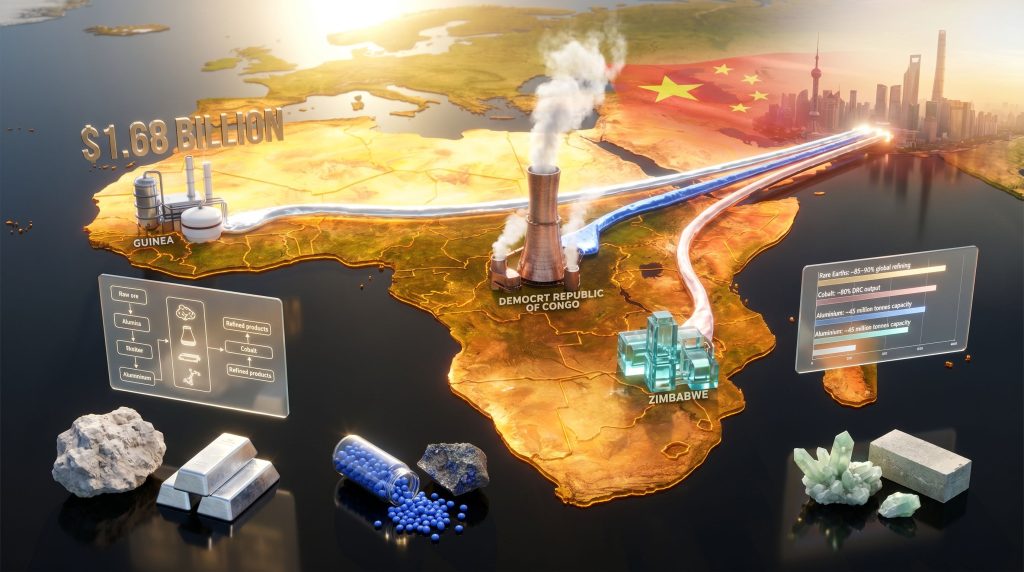
Chinese capital is central to this ambition. In May 2026, Chalco (the Aluminum Corporation of China, a state-owned enterprise) signed a $1.68 billion alumina refinery agreement with Guinea, representing one of the largest single processing investment commitments made on the continent in recent years. Parallel refinery initiatives have been launched by State Power Investment Corporation (SPIC) and Winning Consortium Alumina Guinea (WCAG). Guinea's state-owned Nimba Mining Company has also expressed refinery development ambitions of its own.
The bilateral dependency underpinning these investments is significant. More than 70% of Guinea's current bauxite exports flow to China, creating a relationship in which both parties have strong incentives to maintain and deepen processing ties. For Guinea, Chinese capital finances the industrial infrastructure it cannot fund domestically. For China, proximity to the world's largest bauxite reserve reduces exposure to supply disruptions while embedding Chinese firms into the early stages of the aluminium production chain.
The Chalco agreement also includes a workforce development component — an engineering school designed to enrol up to 100 students per program annually over a 10-year period. Whether such commitments translate into genuine technology transfer and skills retention, rather than primarily serving as a public relations mechanism, remains a critical open question.
Zimbabwe: Lithium Processing as Industrial Policy in Action
Zimbabwe holds Africa's largest lithium reserves and is the continent's leading lithium producer. The country's government has pursued an unusually assertive export restriction strategy, using progressive policy tightening to force processing investment within its borders. Furthermore, these energy transition minerals policies are reshaping how global capital views the region:
-
February 2026: Temporary embargo on raw lithium concentrate exports introduced.
-
April 2026: Producer quota system adopted as an interim framework.
-
Target: 2027: Full ban on raw lithium concentrate exports planned.
Chinese firms have responded by building processing capacity locally rather than losing market access entirely. Zhejiang Huayou Cobalt opened Zimbabwe's first lithium sulfate refinery, marking the country's first meaningful step up the battery materials value chain. Sinomine Resource and Sichuan Yahua Industrial are constructing additional facilities linked to their respective mining operations.
It is worth noting that China currently absorbs approximately 15% of Zimbabwe's lithium concentrate exports, according to Reuters, making Zimbabwe's export restrictions a more immediate threat to other buyers than to Chinese-linked firms that are already pivoting toward in-country processing.
DRC: Copper Smelting and the Cobalt Calculus
The Democratic Republic of Congo produces approximately 80% of the world's cobalt, and Chinese-linked entities are estimated to control around 80% of total DRC cobalt output. The Congo cobalt rivalry between global powers adds further complexity to this already fraught supply landscape. This degree of supply chain concentration has no parallel in any other critical mineral, and it gives China structural leverage over the entire electric vehicle battery industry that would take decades and hundreds of billions of dollars to replicate elsewhere.
The recent commissioning of the Kamoa-Kakula copper smelter adds another dimension to China's DRC positioning. Presented as Africa's largest copper smelting facility, the plant converts copper concentrate into blister copper, a processing step that significantly increases the value of the output product. Zijin Mining, a major Chinese mining corporation, holds a 39.6% stake in the Kamoa-Kakula project, giving Chinese capital direct participation in what is currently among the most significant copper processing investments on the continent.
Why African Governments Are Accelerating Export Restrictions
Export Bans as Industrial Leverage Tools
The policy shift underway across African mineral-producing nations is less about nationalism than it is about sophisticated industrial strategy. Governments have observed that passive raw material export generates a fraction of the revenue that processed intermediates command, and they are using export restrictions as leverage to attract processing investment they cannot finance independently.
| Country | Mineral | Policy Instrument | Timeline |
|---|---|---|---|
| Zimbabwe | Lithium | Export ban on raw concentrate | Target: 2027 |
| Guinea | Bauxite | Export restrictions under consideration | TBC |
| DRC | Cobalt/Copper | Local processing requirements | Ongoing |
| Namibia | Lithium | Processing-first licensing conditions | Active |
The strategic logic is straightforward: if raw ore cannot leave the country without being processed first, then anyone who wants access to that resource must bring their processing investment with them. African governments are betting that the value of their geological endowment is large enough to attract that investment on their terms rather than on the terms of the capital provider.
The Competitive Pressure Reshaping African Leverage
Intensifying global competition for African critical minerals is materially improving African governments' negotiating positions. The United States is attempting to build alternative critical minerals supply chains through mechanisms including the Minerals Security Partnership. The European Union's Critical Raw Materials Act creates framework incentives for diversified sourcing. Japan and Gulf states are pursuing bilateral offtake agreements and equity positions in African projects.
A 2025 report from the Centre for Social and Economic Progress (CSEP) titled India, Africa and Critical Minerals: Towards a Green Energy Partnership observed that African producers are increasingly prioritising partnerships that deliver genuine downstream value rather than extraction-only arrangements. Governments are showing a stronger preference for partners with clear strategies that centre African interests at the processing level, not just at the extraction level.
This competitive dynamic benefits African governments even when Chinese capital ultimately wins the processing investment competition — because the presence of rival suitors forces Chinese firms to offer better processing terms, deeper localisation commitments, and more substantial infrastructure contributions than they might otherwise consider necessary.
The Value Chain Gap That Remains After Processing Investment
Intermediate Processing Is Not the Same as Industrial Transformation
One of the most important analytical distinctions in evaluating China in Africa mineral processing is the difference between intermediate processing and full manufacturing. These stages are not interchangeable, and conflating them overstates the economic benefit that current investment flows are generating for African economies.
Alumina refining, for example, transforms bauxite ore into an intermediate chemical product that serves as the feedstock for aluminium smelting. However, aluminium smelting is itself an energy-intensive intermediate stage, and the highest-margin value in the aluminium supply chain is generated at the manufacturing level — in aerospace components, automotive parts, and precision engineering products. Africa is currently being invited into the second or third stage of a seven-stage value chain.
China itself remains the world's dominant aluminium processing hub. According to the USGS, China's aluminium production capacity reached approximately 45 million tonnes out of a global total of roughly 79 million tonnes in 2025. This means that even as Chinese firms invest in African alumina refining, the dominant refining and manufacturing hub remains firmly in China, and the bulk of the value-added surplus continues to accrue there.
Environmental and Governance Risks That Processing Investment Brings
Processing facilities generate substantially greater environmental loads than extraction operations alone. Chemical waste streams, water contamination risks, air quality impacts, and energy intensity all increase meaningfully when processing operations are introduced. West African communities near Chinese-linked mining and processing operations have reported environmental degradation linked to inadequate regulatory oversight, a pattern documented by the Atlantic Council in its analysis of Chinese mining activity in West Africa.
Several additional governance risks compound this picture:
-
Weak regulatory frameworks in multiple African jurisdictions limit governments' ability to enforce environmental and labour standards against large capital providers.
-
Revenue transparency varies significantly across Chinese-linked projects, with profit repatriation practices frequently subject to limited public scrutiny.
-
Artisanal mining conflicts in DRC cobalt zones remain unresolved alongside large-scale Chinese investment, creating persistent social tensions that regulatory frameworks have not adequately addressed.
-
Technology transfer commitments announced at project inception are inconsistently delivered, with training programmes often narrower in scope and shorter in duration than initial announcements suggest.
Can Western Actors Compete With China's Integrated Investment Model?
The Structural Advantage China Has Built Over Decades
China's dominance in critical mineral processing is not a recent development. It reflects investment decisions made over two to three decades, when Western governments and firms largely disengaged from resource processing as a strategic priority. The critical minerals geopolitics of this era have left a lasting imprint on global supply chain architecture. China now controls approximately 85–90% of global rare earth refining and processing capacity, along with dominant positions in cobalt, lithium, graphite, and manganese processing. These positions took decades to build and cannot be replicated quickly regardless of the policy frameworks Western governments now introduce.
The integrated investment model China deploys in Africa — combining mine equity, processing infrastructure, logistics, and finance within a single package executed by state-linked capital — has no direct Western equivalent at the moment. Multilateral development finance institutions, private equity, and bilateral aid programmes can each contribute pieces of an alternative model, but none currently assembles those pieces with the coherence, speed, and scale that Chinese state capital can mobilise.
A Forward Scenario: What Africa's Processing Ambitions Could Mean by 2030
Scenario Analysis: If Guinea achieves its five-refinery target by 2030 and Zimbabwe enforces its planned 2027 lithium concentrate export ban, global aluminium and battery material supply chains would face a meaningful structural reorientation. Chinese firms already embedded in African processing infrastructure would benefit from both proximity to raw material supply and established operating relationships with African governments. Western buyers seeking to source refined intermediates from these jurisdictions would find that Chinese capital has already secured dominant positions across the processing layer — potentially at terms that make competing sourcing arrangements structurally more expensive.
The deepest question for Africa's long-term development trajectory is not whether Chinese processing investment will arrive. It is already arriving. The question is whether African governments can sustain the regulatory pressure needed to push Chinese and other investors further up the value chain, toward the energy-intensive manufacturing and precision engineering stages where the highest-margin economic surplus is actually generated. That outcome depends on power infrastructure investment, technical education at scale, and consistent political will to enforce progressive localisation requirements over investment cycles that span decades rather than years. Indeed, research from the Stimson Center on US-China competition for African resources underscores just how consequential these policy choices will be in the years ahead.
The next major ASX story will hit our subscribers first
Key Takeaways for Investors and Analysts Tracking the Critical Minerals Sector
-
China in Africa mineral processing has evolved from raw material access into value chain positioning, with processing infrastructure now a primary strategic objective rather than an incidental component of resource deals.
-
African governments are deploying export restrictions as industrial leverage tools, with Zimbabwe and Guinea at the leading edge of a policy trend that is spreading across the continent.
-
The gap between intermediate processing and full manufacturing remains wide. Current investment flows position Africa within the middle stages of global value chains, not at the high-margin manufacturing end.
-
China controls approximately 45 million tonnes of global aluminium production capacity (USGS, 2025) out of roughly 79 million tonnes worldwide, illustrating that African processing investment complements rather than displaces China's domestic industrial base.
-
Environmental, governance, and technology transfer risks are material variables that will influence whether processing investment generates genuine long-term development gains or primarily serves to extend Chinese supply chain control into African territory.
-
Western actors face a structural disadvantage in competing with China's integrated investment model, but intensifying geopolitical competition is improving African governments' negotiating leverage regardless of which capital ultimately wins individual project competitions.
This article contains forward-looking analysis and scenario projections that involve assumptions about future policy, investment, and market conditions. These projections should not be interpreted as financial advice or as predictions of specific outcomes. Readers should conduct independent research before making investment or strategic decisions based on the information presented here.
Want to Track the Next Major Mineral Discovery Before the Market Does?
Discovery Alert's proprietary Discovery IQ model scans ASX announcements in real time, instantly identifying significant mineral discoveries across critical commodities — from lithium and cobalt to copper and rare earths — and delivering actionable alerts directly to subscribers. Explore historic examples of major discovery returns or start your 14-day free trial today to position yourself ahead of the market.