July 8, 2026
The Industrial Logic Behind China's Unshakeable Grip on Global Aluminium Foil
Few materials better illustrate the intersection of industrial policy and commodity demand than aluminium foil. While most commodity markets ebb and flow with macroeconomic cycles, China aluminium foil consumption has demonstrated a different kind of resilience, one rooted in deliberate alignment between national manufacturing priorities and the materials those priorities consume. Understanding this dynamic requires looking beyond headline production numbers and into the structural mechanics driving consistent demand growth across multiple end-use verticals.
When big ASX news breaks, our subscribers know first
How Large Is China's Aluminium Foil Market, Really?
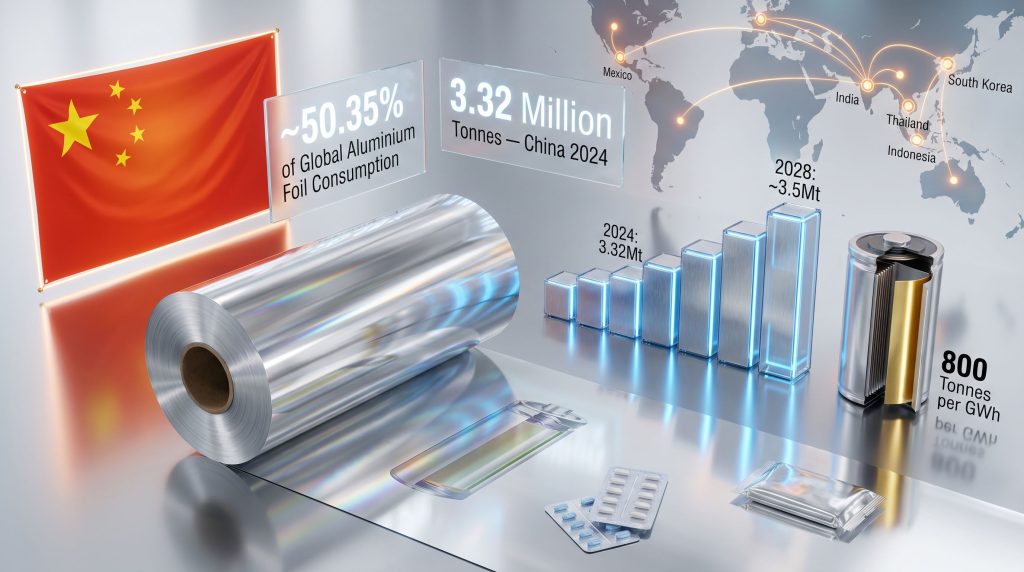
The scale of China's position in global aluminium foil consumption is difficult to overstate. In 2024, domestic consumption reached approximately 3.32 million tonnes, accounting for roughly 50.35% of total global aluminium foil usage. To contextualise that figure: China alone consumes more aluminium foil than every other country on the planet combined.
This trajectory has been building steadily. In 2020, domestic consumption stood at 2.84 million tonnes, with per capita usage of 1.61 kg already more than double the global average of 0.7 kg at the time. The projection for 2028 places per capita consumption near 2.5 kg, a figure that signals continued structural demand expansion before any meaningful saturation.
China Aluminium Foil Consumption: Key Data at a Glance
| Metric | Data Point |
|---|---|
| 2020 Domestic Consumption | 2.84 million tonnes |
| 2020 Per Capita Consumption | 1.61 kg (vs. global avg. 0.7 kg) |
| 2024 Domestic Consumption | ~3.32 million tonnes |
| 2024 Global Consumption Share | ~50.35% |
| 2028 Projected Consumption | ~3.5 million tonnes |
| 2028 Projected Per Capita | ~2.5 kg |
| 2024 Market Revenue Estimate | USD 5.9–10.58 billion |
| 2033 Projected Revenue | USD 17.11 billion |
What makes these numbers analytically interesting is not just their size, but the conditions under which they have been achieved. China's industrial demand trends have faced well-documented headwinds, including a prolonged real estate downturn and softening conventional manufacturing output. Despite this, aluminium foil consumption has continued climbing, suggesting the demand base has fundamentally decoupled from legacy growth drivers.
China's per capita aluminium foil consumption already exceeds the global average by more than double, and is projected to approach 2.5 kg by 2028, signalling continued structural demand growth well before any per capita stabilisation point is reached.
What Structural Forces Are Sustaining China's Aluminium Foil Demand?
The Policy-Demand Alignment Effect
One of the less-discussed features of China's aluminium foil market is how deeply consumption has become embedded within sectors that receive sustained national policy support. This is not cyclical demand responding to consumer sentiment or housing activity. It is industrial demand tied to electrification, pharmaceutical manufacturing, advanced electronics, and renewable energy infrastructure.
This creates what analysts describe as a structurally resilient consumption base. When traditional demand drivers contract, the foil market does not contract with them in equal measure, because the growth segments are insulated by long-term policy commitments rather than short-term economic conditions. Furthermore, the battery raw materials market continues to reinforce this alignment, deepening the structural ties between aluminium foil demand and energy transition priorities.
Battery-Grade Foil: The Dominant Growth Vector
Among all emerging demand segments, battery-grade aluminium foil has attracted the most significant investment and attention, and for good reason. Within a lithium-ion battery cell, aluminium foil functions as the positive current collector, the conductive substrate onto which the cathode material is deposited. There is no commercially viable substitute for this application at scale, making it a non-discretionary input in EV manufacturing.
The scale implications are substantial:
- China accounted for more than 60% of global EV sales in recent years, creating an enormous captive demand pool for battery foil domestically.
- Industry estimates indicate that every gigawatt-hour (GWh) of battery production requires approximately 800 tonnes of aluminium foil, a ratio that scales directly with battery output capacity.
- Multiple dedicated battery aluminium foil facilities have been commissioned in China, with combined capacities exceeding one million tonnes, reflecting long-term supply chain commitments from manufacturers.
- Battery foil demand is considered less sensitive to short-term economic fluctuations than packaging foil, because it is driven by infrastructure investment cycles rather than consumer behaviour.
Each GWh of lithium-ion battery production requires approximately 800 tonnes of aluminium foil. As China's EV and energy storage sectors continue scaling, this creates a demand base that grows in direct proportion to battery output capacity, independent of broader consumer spending trends.
Energy Storage: A Parallel and Growing Demand Channel
Beyond automotive batteries, China's accelerated deployment of grid-scale renewable energy infrastructure has created a secondary demand channel for battery-grade foil. Large-format lithium-ion battery installations used in grid stabilisation and solar energy storage are expanding rapidly, and each installation carries the same material intensity requirements as EV batteries. In addition, China's battery recycling outlook adds another layer of complexity to supply planning, as recovered materials increasingly feed back into production pipelines. This provides a demand backstop that operates on a different cycle from automotive sales, adding further resilience to the foil consumption outlook.
Pharmaceutical Packaging: Stable and Predictable
Pharmaceutical-grade aluminium foil represents a lower-growth but highly stable consumption segment. Its use in blister packs, sterile medical pouches, and barrier pharmaceutical packaging is driven by regulatory requirements rather than consumer preference, making it highly resistant to economic downturns. China's expanding domestic pharmaceutical manufacturing base ensures this segment remains a dependable contributor to overall foil demand.
Food Packaging, E-Commerce, and Recyclability Trends
Food packaging continues to represent a significant share of total foil usage. In 2022, approximately 2.45 million tonnes of aluminium foil output was directed toward food packaging applications, representing close to half of total production at the time. Online food delivery platforms and packaged food logistics require multilayer foil packaging for thermal management, hygiene compliance, and shelf-life extension.
Additionally, the growing consumer and regulatory preference for recyclable packaging materials over single-use plastics is creating incremental demand tailwinds for aluminium foil, given its superior recyclability profile. According to industry analysts, China's green packaging transition is accelerating this shift, with aluminium foil increasingly positioned as a sustainable alternative in consumer and industrial packaging applications.
Semiconductors and Consumer Electronics: An Emerging Premium Segment
A less widely discussed but analytically important demand driver is China's domestic semiconductor push. Speciality aluminium foil is used in thermal management systems, chip packaging, and precision electronic component manufacturing. As China invests in domestic critical minerals and semiconductors supply chain development, demand for high-specification foil grades is expected to grow, representing a premium-margin segment with above-average growth potential compared to conventional packaging foil.
How Does China's Production Infrastructure Support Consumption at Scale?
Manufacturing Depth as a Competitive Moat
China's aluminium foil production infrastructure is unmatched globally in both scale and integration. The country operates more than 160 aluminium foil rolling mills with an installed production capacity of 6.1 to 6.5 million tonnes. More than one million tonnes of new capacity has been added in recent years, enabling simultaneous expansion of domestic supply and export volumes.
By 2030, production capacity is projected to approach 7.5 million tonnes, a level that analysts increasingly describe as approaching a structural ceiling for domestic capacity growth. Beyond this point, further capacity addition would require export absorption to justify the investment economics. The leading aluminium mining companies are already positioning themselves to capitalise on this expanding production pipeline.
Production vs. Consumption: The Export Surplus Dynamic
| Year | Production (est.) | Domestic Consumption | Exports |
|---|---|---|---|
| 2020 | ~4.0 million tonnes | 2.84 million tonnes | ~1.1 million tonnes |
| 2022 | ~5.0 million tonnes | ~2.9 million tonnes | ~1.1 million tonnes |
| 2023 | ~4.5 million tonnes | ~3.1 million tonnes | 1.31 million tonnes |
| 2024 | ~4.7 million tonnes | 3.32 million tonnes | 1.55 million tonnes |
| 2030 (proj.) | Up to 7.5 million tonnes | ~3.5 million tonnes | Export-led growth |
The production surplus dynamic reveals an important strategic reality. As domestic per capita consumption approaches projected saturation levels near 2.5 kg post-2028, the incremental production capacity being built today will increasingly require export market absorption. Consequently, China's role as the global supply hub is set to intensify rather than moderate over the coming decade.
How Significant Are China's Aluminium Foil Exports to Global Trade?
Export Growth That Outpaces Domestic Consumption Growth
China's aluminium foil exports grew from 1.31 million tonnes in 2023 to 1.55 million tonnes in 2024, representing a year-on-year increase of 18.3%. Compared with 2014 export volumes, the cumulative expansion reaches 79.3%, reflecting sustained and compounding international demand for Chinese foil products across multiple geographies.
Export value reached USD 5.7 billion in 2024, demonstrating that China's global market influence extends well beyond volume metrics and into trade value leadership.
China's Top Aluminium Foil Export Destinations (2024)
| Rank | Destination Market |
|---|---|
| 1 | India |
| 2 | Thailand |
| 3 | Indonesia |
| 4 | Mexico |
| 5 | South Korea |
The geographic spread of China's export base is notable. The top five destinations span South Asia, Southeast Asia, Latin America, and Northeast Asia, reflecting broad-based international demand rather than dependence on any single trade corridor. India's position as the largest single destination reflects both its growing domestic packaging and pharmaceutical manufacturing sectors and its relatively limited domestic foil production capacity.
Why Export Dependency Will Intensify Post-2028
As domestic per capita consumption approaches the projected 2.5 kg threshold, the growth rate of incremental domestic demand will naturally moderate. Producers with expanding capacity will face a structural imperative to redirect surplus output toward international markets. Emerging economies across Southeast Asia, South Asia, and Latin America represent the primary growth corridors for this export expansion, given their rising urbanisation rates, growing middle-class consumer bases, and underdeveloped domestic foil production infrastructure.
Research into global aluminium foil market trajectories further supports this view, projecting robust international demand growth through to the early 2030s, particularly across developing markets where packaging infrastructure remains immature.
Scenario Analysis: Three Demand Trajectories to 2030
Forecasting China aluminium foil consumption trajectory involves genuine uncertainty across multiple variables. Three distinct scenarios reflect the plausible range of outcomes:
Scenario 1: Accelerated EV and Energy Storage Expansion
- China's EV penetration rate exceeds 50% of new vehicle sales ahead of schedule.
- Battery foil demand grows above baseline projections across both automotive and grid storage applications.
- Total domestic consumption approaches 3.8 to 4.0 million tonnes by 2030.
Scenario 2: Base Case Steady Industrial Modernisation
- Consumption tracks toward the projected 3.5 million tonne threshold by 2028, with moderate growth to approximately 3.6 to 3.7 million tonnes by 2030.
- Export volumes absorb surplus production capacity as domestic per capita consumption stabilises.
- This scenario is broadly consistent with current investment and policy signals.
Scenario 3: Demand Moderation from Policy Recalibration
- A slowdown in EV support programmes or grid storage deployment tempers battery foil demand growth.
- Consumption growth reverts toward food packaging and pharmaceutical sectors as primary drivers.
- Overall trajectory slows, with total consumption potentially remaining below 3.5 million tonnes through 2030.
Disclaimer: Scenario projections are based on current industry estimates and publicly available data. They involve assumptions that may not materialise and should not be interpreted as investment advice or guaranteed forecasts.
The next major ASX story will hit our subscribers first
Reframing China's Aluminium Foil Leadership: From Scale to Strategic Coherence
The conventional narrative frames China's dominance in aluminium foil as a function of manufacturing scale, abundant raw material access, and cost competitiveness. While these factors remain relevant, they are insufficient to explain why consumption has continued growing through a period of broader economic deceleration.
The more accurate analytical framing positions China's leadership as a product of industrial policy coherence: the deliberate and sustained alignment of capacity investment, sectoral development priorities, and downstream manufacturing build-out. Battery foil capacity is not being built speculatively. It is being built in direct response to committed EV and energy storage manufacturing pipelines that are themselves products of coordinated industrial strategy.
For global aluminium producers, converters, traders, and downstream manufacturers, this distinction carries significant practical implications. Capacity planning, trade positioning, and investment allocation decisions made on the assumption that China's foil dominance is a cyclical or cost-driven phenomenon will systematically underestimate the durability and adaptability of that dominance.
The more productive analytical question is not whether China will maintain its leadership in global aluminium foil consumption, but rather which specific segments will drive the next phase of growth and which international markets will absorb the surplus production that domestic saturation will eventually generate. Both questions point toward the same conclusion: China's influence over the global aluminium foil market is structural, durable, and becoming more sophisticated over time.
Frequently Asked Questions: China Aluminium Foil Consumption
What percentage of global aluminium foil does China consume?
China accounts for approximately 50.35% of global aluminium foil consumption, based on 2024 data showing domestic usage of approximately 3.32 million tonnes against estimated global consumption figures.
What is the fastest-growing segment of China's aluminium foil market?
Battery-grade aluminium foil is the fastest-growing consumption segment, driven by China's dominance in EV manufacturing and grid-scale energy storage deployment. Each GWh of battery production requires approximately 800 tonnes of aluminium foil.
How much aluminium foil does China export?
China exported 1.55 million tonnes of aluminium foil in 2024, valued at approximately USD 5.7 billion. India was the largest single export destination, followed by Thailand, Indonesia, Mexico, and South Korea.
When will China's aluminium foil production approach capacity limits?
China's production capacity is projected to approach 7.5 million tonnes by 2030, a level analysts consider close to a structural ceiling for domestic capacity expansion. Beyond this point, growth is expected to be driven primarily by export market development as domestic per capita consumption stabilises near 2.5 kg.
Why does China's aluminium foil demand remain resilient despite economic headwinds?
China's aluminium foil consumption has decoupled from traditional economic growth drivers because an increasing proportion of demand originates from sectors tied to long-term industrial policy commitments, including EV manufacturing, renewable energy storage, pharmaceutical packaging, and semiconductor production. These sectors carry different demand dynamics compared to conventional consumer-facing industries.
Want to Track the Next Major ASX Mineral Discovery Before the Market Moves?
Discovery Alert's proprietary Discovery IQ model delivers real-time alerts on significant ASX mineral discoveries — including those tied to the aluminium and battery materials supply chains driving China's industrial transformation — instantly translating complex data into actionable investment insights for traders and investors at every experience level. Explore Discovery Alert's discoveries page to understand how historic mineral discoveries have generated substantial returns, and begin your 14-day free trial today to position yourself ahead of the broader market.