
May 22, 2026
The Hidden Logic of Industrial Surplus in a Renewable Energy World
For most of the past two decades, energy economists have debated how to store renewable electricity once it is generated. Battery technology, pumped hydro, and hydrogen have dominated that conversation. Yet one of the most underexamined flexibility mechanisms may already exist at scale, embedded in the physical infrastructure of heavy industry itself. The China aluminium overcapacity renewable power grid dynamic is drawing renewed attention not because of its output, but because of its consumption patterns and what those patterns could mean for grid operators managing an increasingly volatile power system.
The intersection of China's overcapacity problem and its renewable energy integration challenge is producing a reappraisal of what industrial surplus actually means in a decarbonising economy. When viewed through a power systems lens rather than a purely economic one, the same idle smelting capacity that trade analysts have long criticised as market-distorting may turn out to be a strategically valuable grid asset hiding in plain sight.
When big ASX news breaks, our subscribers know first
What Makes Aluminium Smelting Uniquely Relevant to Grid Stability
Primary aluminium production is built around electrolysis. Alumina is dissolved in molten cryolite and subjected to a continuous, high-amperage electrical current that strips oxygen from aluminium oxide and deposits molten metal at the cathode. This process, known as the Hall-Heroult method, cannot be interrupted abruptly without causing significant damage to the electrolytic cells, or pot lines, in which it occurs.
This characteristic has historically caused grid operators to treat aluminium smelters as rigid, non-negotiable baseload consumers. The assumption was that smelters draw constant power and cannot participate in demand-response schemes in any meaningful way. That assumption is now being seriously challenged by research examining how smelter amperage can be modulated within a defined technical range to respond to real-time grid conditions.
The key insight emerging from recent academic analysis is that overcapacity is not merely a byproduct of poor industrial planning. It is, structurally speaking, the enabling condition for flexibility. A smelter operating at 95% of its rated capacity has almost no room to absorb additional renewable energy during a surplus event. A smelter operating at 70% of capacity, by contrast, can ramp upward significantly when solar or wind generation floods the grid, absorbing energy that would otherwise be curtailed.
Technical note: In aluminium smelting, the tolerable range for amperage variation without causing pot instability or metal quality degradation is typically within 10 to 15 percent of design current. Advanced process control systems can extend this range and manage the thermal balance of the pot line during load-shifting events, but this requires significant investment in monitoring and automation infrastructure.
China's Renewable Expansion and the Curtailment Problem
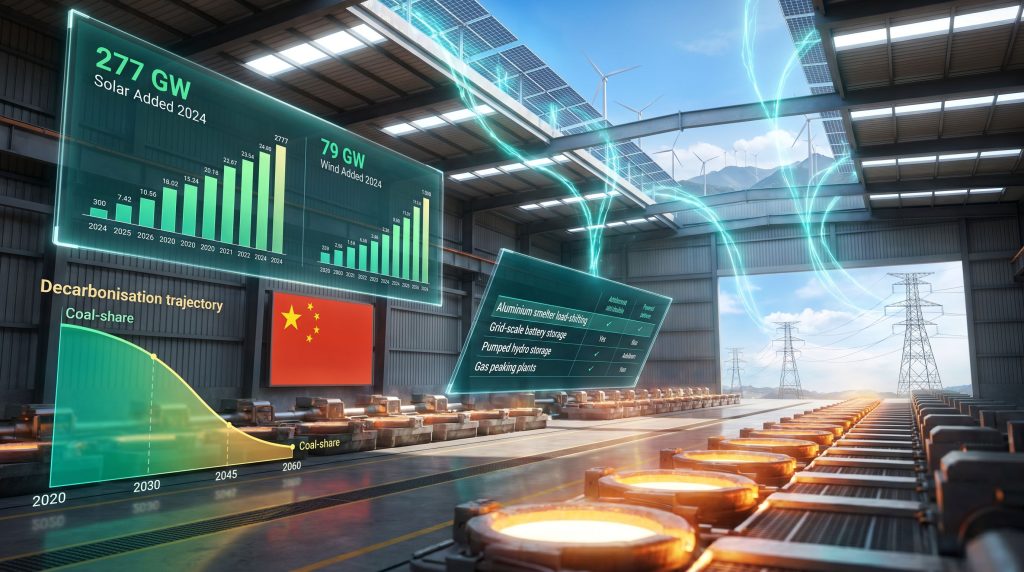
The scale of China's renewable energy buildout is difficult to overstate. According to data from DNV, China added 277 GW of solar capacity and 79 GW of wind capacity in 2024 alone. Renewable energy sources collectively accounted for approximately 36% of Greater China's total electricity generation in 2024, a figure that is rising rapidly as new capacity connects to the grid faster than transmission and balancing infrastructure can absorb it.
The consequence of this pace of deployment is chronic curtailment, particularly in the renewable-rich southwestern and northwestern provinces where solar irradiance and wind resources are strongest but transmission capacity to demand centres on the eastern seaboard remains constrained. When wind turbines and solar arrays generate more electricity than the grid can route or consume, that energy is wasted. Furthermore, curtailment represents both an economic loss for generators and a setback for decarbonisation targets, because every megawatt-hour curtailed is effectively a zero-carbon resource that displaces nothing.
Traditional balancing tools such as pumped hydro, gas peaking plants, and grid-scale batteries address this problem from the supply side. They store or release energy to match generation with demand. However, at the scale now required by China's grid, demand-side flexibility offers a compelling complementary approach, and aluminium smelters are one of the few industrial loads large enough to move the needle at system level. The broader push toward renewable energy in mining and heavy industry illustrates just how far this thinking has evolved across the region.
The Geography of Decarbonisation: Why Province Matters
The strategic relocation of Chinese aluminium production from coal-heavy northern provinces toward hydropower-abundant southwestern regions is one of the more consequential industrial shifts of the past decade, and it is still accelerating. Provinces such as Yunnan, Sichuan, and Guizhou offer both lower-cost hydroelectricity and substantially lower carbon intensity per tonne of metal produced, making them attractive destinations for smelter investment under China's evolving energy pricing and environmental policy frameworks.
This geographic redistribution matters enormously for grid flexibility because the type of power connection fundamentally determines whether a smelter can participate in grid-balancing services. A smelter drawing electricity from a captive coal-fired power plant operates as an isolated system. Its consumption has no meaningful relationship with the broader grid's real-time supply-demand balance. A smelter connected to a shared renewable grid, by contrast, can receive price signals, respond to grid operator instructions, and physically absorb or reduce load in ways that benefit the wider system.
The decarbonisation trajectory for Chinese aluminium power supply, based on current modelling, follows an approximate pathway:
| Year | Estimated Captive Coal Power Share in Aluminium Production |
|---|---|
| 2020 | 60 to 70% |
| 2030 (projected) | ~40% |
| 2045 (projected) | Renewables become primary energy source |
| 2060 (projected) | ~20% |
This transition is not merely an environmental story. It is, consequently, the structural precondition for unlocking the full demand-side flexibility potential of the sector. Initiatives around green metals production in other parts of the world provide useful comparison points for how industrial decarbonisation can reshape supply chain dynamics at scale.
Quantifying the Value: What Flexible Smelting Could Be Worth
Independent modelling on the potential system cost savings from deploying aluminium smelter overcapacity as a seasonal grid-balancing mechanism produces striking figures. Under scenarios aligned with a 2050 net-zero trajectory, the estimated annual electricity system cost savings range from approximately 15 billion CNY per year under conservative flexibility deployment assumptions to as much as 72 billion CNY per year under aggressive deployment, with mid-range estimates clustering around 40 to 50 billion CNY annually.
These figures reflect avoided curtailment costs, reduced need for expensive peaking capacity, and the ability to absorb low-cost renewable generation during periods of surplus rather than spilling it.
| Scenario | Estimated Annual System Cost Savings (CNY) |
|---|---|
| Conservative flexibility deployment | ~15 billion CNY/year |
| Mid-range estimate | ~40 to 50 billion CNY/year |
| Aggressive flexibility deployment (2050 net-zero scenario) | ~72 billion CNY/year |
Source: Independent modelling referenced in academic research on aluminium smelting flexibility in China's electricity system. These are modelled projections and carry inherent uncertainty. Readers should not treat them as guaranteed outcomes.
How Smelter Flexibility Compares to Other Grid-Balancing Tools
Demand-side flexibility from aluminium smelters does not compete with battery storage or pumped hydro. It complements them. Each balancing tool operates across a different time horizon and cost profile, and the most resilient grid architectures will deploy all of them in concert.
| Flexibility Tool | Response Speed | Cost Profile | Scalability | Carbon Impact |
|---|---|---|---|---|
| Aluminium smelter load-shifting | Minutes to hours | Low marginal cost | High (existing assets) | Neutral to positive |
| Grid-scale battery storage | Seconds to minutes | High capital cost | Moderate | Dependent on grid mix |
| Pumped hydro storage | Hours to days | Very high capital cost | Limited by geography | Low carbon |
| Gas peaking plants | Minutes | Moderate capital cost | High | High carbon |
What distinguishes smelter-based demand response is that it leverages already-built infrastructure at marginal cost. The capital has been spent. The facilities exist. The question is whether the operational and commercial frameworks can be constructed to activate that latent flexibility value.
DNV's assessment of China's energy policy direction supports this framing, noting a discernible shift from pure generation capacity expansion toward system integration, grid investment, and storage as the next phase of the energy transition. Research into how China is decarbonising aluminium's electricity supply offers further depth on the mechanisms driving this structural shift.
The next major ASX story will hit our subscribers first
Barriers That Stand Between Potential and Reality
Despite the compelling systems-level logic, several significant obstacles sit between the theoretical flexibility value of the China aluminium overcapacity renewable power grid opportunity and its practical realisation.
Technical constraints are real but manageable. Pot lines can only tolerate a limited range of amperage variation before the thermal equilibrium of the electrolytic process is disrupted. Sustained or frequent load-shifting events increase the risk of pot instability, premature cathode degradation, and off-specification metal. Advanced process control systems can extend the operational envelope, but these require capital investment and skilled operators.
Commercial misalignment is perhaps the more immediate obstacle. Smelter operators are incentivised to maximise throughput and minimise per-tonne production costs. Grid operators need system-level flexibility. Without standardised compensation frameworks that translate flexibility provision into direct financial benefit for smelter operators, the economic incentive to participate in demand-response programmes remains weak.
Market structure gaps compound this problem. China's electricity market reforms are still maturing. Spot pricing mechanisms that could theoretically reward real-time demand responsiveness are not yet uniformly operational across the provinces where the largest smelting concentrations exist.
Risk Callout: The flexibility value of aluminium smelter overcapacity remains theoretical until electricity market mechanisms are designed to compensate smelter operators adequately. Without clear, transparent pricing signals tied to grid conditions, there is limited commercial rationale for smelters to accept the operational risks associated with load-shifting.
International Precedents Worth Examining
China is not approaching this challenge in a complete vacuum of comparative experience. Norway has operated aluminium smelters as active grid flexibility assets within its hydropower-dominated electricity system for decades. Norwegian smelter operators have long negotiated electricity supply arrangements that tie consumption volumes to reservoir levels and grid conditions, effectively making their facilities responsive to the hydrological cycle. Iceland presents a similar model, where energy-intensive industry and renewable power management are so deeply integrated that industrial demand is treated as a grid-balancing instrument as a matter of course.
The structural difference between those contexts and China's is one of scale and market complexity. Norway and Iceland have small, relatively simple grid systems where bilateral agreements between a handful of industrial consumers and grid operators can achieve meaningful balancing outcomes. China's grid is orders of magnitude larger, more regionally fragmented, and subject to far more complex political and regulatory dynamics. Translating the principle is straightforward. In contrast, implementing it at Chinese scale requires institutional architecture that does not yet fully exist.
Policy Signals and the 15th Five-Year Plan Window
China's 15th Five-Year Plan, commencing in 2026, carries significant implications for how this intersection of overcapacity and grid flexibility might be formalised. The plan's emphasis on what Beijing terms New Productive Forces and green industrial transformation creates a policy environment in which reframing overcapacity as a grid asset is at least conceptually compatible with official objectives.
This does not mean that aluminium smelters will automatically receive demand-response programme status or that specific projects have received designated support. Rather, the broader policy direction creates a window during which the commercial and regulatory frameworks necessary to activate smelter flexibility could be designed and piloted. Whether that window is used effectively will depend on coordination between grid operators, provincial governments, smelter operators, and electricity market regulators.
Key indicators worth monitoring over the next three to five years include:
- Progress on electricity spot market expansion and real-time pricing mechanisms in Yunnan and Sichuan
- Capacity utilisation rates at southwestern hydropower-connected smelters versus northern coal-connected facilities
- Renewable curtailment rates in southwestern provinces as a proxy for grid integration effectiveness
- Any policy announcements specifically addressing industrial demand response within the Five-Year Plan framework
Reframing Overcapacity for the Global Aluminium Debate
Western governments and trade bodies have spent years framing Chinese aluminium overcapacity primarily as a market-distorting problem, one in which subsidised production suppresses global prices and disadvantages producers in higher-cost jurisdictions. That framing is not without merit from a trade economics perspective. However, the emerging analysis of smelter flexibility introduces a second-order argument that complicates this picture considerably.
If surplus smelting capacity serves a legitimate systemic function within China's energy transition architecture, then the overcapacity problem is not simply a product of industrial policy gone wrong. It is, at least in part, a structural feature of a power system undergoing rapid transformation. This has direct implications for how China's metals demand is interpreted in global commodity markets and trade policy discussions.
This has implications for carbon border adjustment mechanisms, green aluminium premium structures, and the way downstream industries evaluating their supply chain decarbonisation options should think about Chinese production. Electric vehicle manufacturers, renewable energy equipment producers, and aerospace companies all face growing pressure to account for the embodied carbon of the aluminium they consume. A Chinese aluminium sector that is systematically transitioning toward renewable power sourcing, and whose overcapacity is functioning as a grid-balancing mechanism that reduces renewable curtailment, presents a more nuanced carbon story than the one currently embedded in most procurement frameworks.
Three Scenarios for the Decade Ahead
How this dynamic resolves over the next ten years will depend on decisions made across multiple institutional layers. Three broad scenarios frame the range of plausible outcomes:
-
Managed Integration: Beijing formalises demand-response compensation frameworks for aluminium smelters, electricity market spot pricing mechanisms mature in key southwestern provinces, and smelter flexibility becomes a recognised and remunerated grid service. Curtailment falls meaningfully, system costs decline, and the sector's decarbonisation trajectory accelerates.
-
Partial Transition: The geographic shift toward renewables continues and carbon intensity per tonne of aluminium falls, but flexibility mechanisms remain underdeveloped due to commercial misalignment and market structure gaps. Curtailment persists at elevated levels, and the economic value embedded in the China aluminium overcapacity renewable power grid relationship goes largely unrealised.
-
Structural Consolidation: Overcapacity is reduced through deliberate industrial consolidation driven by profitability pressures or state direction. The flexibility option is effectively removed, and grid balancing relies more heavily on storage and transmission infrastructure. Market economics improve but the systemic value of demand-side flexibility from smelters is foregone.
No single scenario is predetermined. Furthermore, the probability weighting across these pathways will shift as electricity market reform progress, aluminium price dynamics, and provincial policy coordination evolve. Broader mining electrification trends and mining decarbonisation benefits will also shape the commercial context in which these scenarios play out. Investors and analysts tracking the intersection of China's industrial policy and energy transition would do well to treat these three scenarios as a live framework rather than a static prediction. An Asia Society analysis of China's primary aluminium industry offers additional strategic context for those seeking a deeper institutional perspective on these shifts.
Disclaimer: This article contains forward-looking projections, modelled cost estimates, and scenario analyses that are inherently uncertain. Nothing in this article constitutes financial or investment advice. Readers should conduct independent research before making decisions based on the information presented.
Want to Stay Ahead of Major Mineral Discoveries Shaping the Commodities Landscape?
As China's aluminium sector and renewable energy transition reshape global commodity markets, Discovery Alert's proprietary Discovery IQ model delivers real-time ASX mineral discovery alerts, turning complex market signals into actionable investment insights for traders and long-term investors alike. Explore historic discoveries and the returns they generated on Discovery Alert's dedicated discoveries page, and begin your 14-day free trial today to position yourself ahead of the market.