July 15, 2026
What China's 600 GWh Battery Surge Reveals About Global Energy Infrastructure
The transformation of global energy markets is accelerating at unprecedented speeds, driven by the convergence of artificial intelligence computing demands, renewable energy deployment, and grid modernisation requirements. China battery production expansion has emerged as the critical bottleneck determining which economies can successfully transition to sustainable energy systems while supporting next-generation computing infrastructure.
China's battery production landscape is experiencing a dramatic reconfiguration that extends far beyond traditional electric vehicle applications. The strategic pivot toward energy storage systems reflects fundamental changes in how nations approach energy security, grid stability, and technological competitiveness in an increasingly digital economy.
When big ASX news breaks, our subscribers know first
What Does China's 600 GWh Battery Expansion Mean for Global Energy Markets?
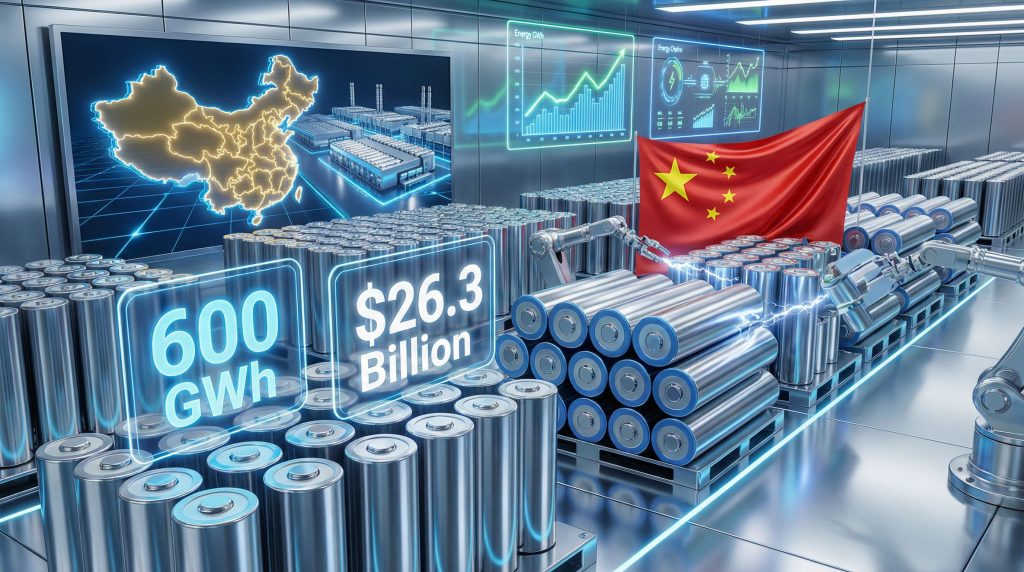
China battery production expansion has committed to adding over 600 gigawatt-hours (GWh) of new energy storage system production capacity within just the first two months of 2026. This expansion represents a fundamental shift in global energy infrastructure development, with implications extending far beyond traditional battery applications.
Breaking Down the Scale of China's 2026 Manufacturing Commitments
The scope of China battery production expansion demonstrates unprecedented industrial coordination. Nineteen mainland Chinese battery producers are collectively investing 180 billion yuan ($26.3 billion) to construct new lithium-ion battery manufacturing facilities. When completed, these projects will generate 900 GWh of annual production capacity, with some facilities scheduled to begin operations in late 2026.
To contextualise this scale, each gigawatt-hour of battery capacity can supply approximately 750,000 households for an entire year. The planned 900 GWh annual capacity theoretically represents enough energy storage to power 675 million households globally, highlighting the massive infrastructure implications of China's expansion plans.
Energy Storage Systems vs Electric Vehicle Battery Allocation Strategy
The strategic allocation of new capacity reveals critical insights into global energy market evolution. Seventy percent of the 900 GWh capacity will be dedicated to energy storage systems, while only thirty percent will serve electric vehicle applications. This 70/30 split represents a dramatic departure from previous battery manufacturing priorities.
Energy storage systems comprise integrated solutions including:
- Battery cells and modules
- Battery management systems for operational control
- Power conversion equipment for grid integration
- Control systems managing energy flow and storage
Investment Capital Flow Analysis: $26.3 Billion in New Facility Development
The $26.3 billion investment across 19 manufacturers represents an average commitment of approximately $1.38 billion per company. This capital deployment indicates sustained confidence in energy storage market growth, with manufacturers expecting returns on investments spanning multiple years of production cycles.
The investment timeline suggests manufacturers anticipate continued growth in artificial intelligence computing infrastructure, which requires massive electrical power paired with renewable energy sources. Energy storage systems bridge the gap between intermittent renewable generation and consistent power demands from data centres and computing facilities.
How Will China's Battery Capacity Compare to Global Competitors by 2027?
China's 600+ GWh capacity announcement represents approximately 10.3 times the total battery storage capacity installed across the United States during 2025, which totalled 58 GWh. This comparison underscores the widening gap between Chinese production capabilities and international competitors.
US Market Position: The 58 GWh Baseline Challenge
The United States deployed 58 GWh of battery storage capacity in 2025, establishing a baseline for measuring China's expansion scale. However, this figure represents installed storage capacity rather than annual production capacity, creating methodological differences in direct comparisons.
American battery manufacturing focuses primarily on domestic market needs, with companies like Tesla, GM, and Ford developing integrated supply chains. The US approach emphasises technological innovation and domestic supply chain security rather than absolute production volume.
European Battery Alliance Response Strategies
European manufacturers are pursuing technological differentiation through solid-state battery development and advanced materials research. The European Battery Alliance coordinates industrial policy across member states, emphasising sustainable production methods and circular economy principles.
European capacity expansion focuses on strategic partnerships with automotive manufacturers and grid operators, prioritising quality and technological advancement over pure production volume. This approach creates opportunities for premium market positioning despite lower absolute capacity numbers.
South Korea and Japan's Competitive Positioning
South Korean manufacturers like LG Energy Solution and SK Innovation maintain technological leadership in specific battery chemistries and applications. Japanese companies including Panasonic focus on high-performance applications and advanced materials development.
These manufacturers compete through technological innovation rather than capacity scaling, developing specialised applications for aerospace, medical devices, and premium automotive segments where performance requirements exceed standard specifications.
Which Chinese Battery Manufacturers Are Leading the Expansion Wave?
The expansion involves major established players alongside emerging manufacturers seeking market share through aggressive capacity additions. Contemporary Amperex Technology Ltd (CATL) leads as China's dominant battery manufacturer, while Gotion High-tech represents emerging companies challenging established market positions.
CATL's Market Dominance Strategy and Production Scaling
CATL maintains its position as China's leading battery manufacturer through continuous capacity expansion and technological development. The company's strategy involves vertical integration across the battery supply chain, from raw materials processing through finished battery systems.
Furthermore, CATL's expansion focuses on both domestic Chinese markets and international operations, establishing manufacturing facilities in Europe and considering North American production. This geographic diversification strategy reduces geopolitical risks while maintaining cost advantages.
BYD's Integrated Manufacturing Approach
BYD operates as both a battery manufacturer and electric vehicle producer, creating synergies between battery development and automotive applications. This integrated approach allows BYD to optimise battery specifications for specific vehicle platforms while developing energy storage solutions.
The company's blade battery technology emphasises safety and longevity, positioning BYD for applications requiring extended operational life and minimal maintenance. These characteristics align with utility-scale energy storage requirements.
Emerging Players: Gotion High-tech and Market Disruption Potential
Gotion High-tech represents the emerging manufacturer category, pursuing aggressive expansion strategies to capture market share from established competitors. These companies often focus on cost optimisation and rapid scaling rather than premium applications.
Emerging manufacturers create competitive pressure on established players, driving innovation and cost reduction across the industry. Their participation in the 600+ GWh expansion indicates confidence in sustained market growth and willingness to invest in production capacity ahead of confirmed demand.
Why Are Energy Storage Systems Driving 70% of New Battery Production?
The strategic focus on energy storage systems reflects fundamental changes in global energy infrastructure requirements. Artificial intelligence computing infrastructure generates massive electricity demands while renewable energy adoption accelerates globally, creating unprecedented needs for grid-scale energy storage.
AI Computing Infrastructure Demands and Grid Stability Requirements
Modern artificial intelligence applications require enormous computational power, with large data centres consuming electricity equivalent to small cities. A typical large-scale AI computing facility can draw 100-300+ megawatts continuously, creating substantial challenges for grid operators managing power supply.
These facilities increasingly operate on renewable energy to meet sustainability commitments, but solar and wind generation patterns don't align with consistent computing demands. Energy storage systems provide the critical buffer allowing renewable energy sources to power AI infrastructure reliably.
The relationship between AI development and energy storage creates compound growth opportunities. As AI applications expand across industries, the associated energy storage requirements multiply, driving sustained demand for battery-grade lithium refinery capacity.
Renewable Energy Integration Challenges Across Global Markets
Renewable energy sources present inherent intermittency challenges that energy storage systems address. Solar generation peaks during midday hours while wind patterns vary unpredictably, creating mismatches with electrical demand patterns.
Energy Storage System Applications by Sector:
| Application Type | Primary Function | Typical Capacity Range |
|---|---|---|
| Utility-scale renewable integration | Grid balancing and peak shaving | 50-500 MWh |
| Commercial backup power systems | Business continuity during outages | 1-50 MWh |
| Residential energy independence | Household backup and solar storage | 10-100 kWh |
| Industrial load balancing | Manufacturing process stability | 5-200 MWh |
Grid operators worldwide are implementing energy storage requirements for new renewable energy projects, creating regulatory demand for battery systems. These mandates ensure renewable energy installations contribute to grid stability rather than creating additional volatility.
Grid Modernisation Trends in Developing Economies
Developing economies often lack extensive electrical grid infrastructure, creating opportunities for modern grid designs incorporating energy storage from initial deployment. These markets can implement advanced grid management systems without retrofitting existing infrastructure.
Countries in Africa, Southeast Asia, and Latin America are developing renewable energy projects with integrated storage systems, bypassing traditional fossil fuel infrastructure. This leapfrog development pattern creates substantial markets for energy storage systems manufactured as part of the critical minerals energy transition.
One gigawatt-hour of battery capacity can power approximately 750,000 households for an entire year, highlighting the massive scale of China's planned expansion and its potential impact on global energy access.
What Are the Economic Implications of China's Battery Manufacturing Dominance?
China battery production expansion creates significant economic implications through supply chain control, pricing power, and international trade dynamics. The scale of investment and production capacity positions Chinese manufacturers to influence global battery markets substantially.
Supply Chain Control and Pricing Power Dynamics
Chinese manufacturers' capacity expansion creates potential supply chain concentration risks for global energy storage deployment. With 900 GWh of annual production capacity, Chinese companies could supply the majority of global energy storage requirements, creating dependencies for international projects.
This concentration provides Chinese manufacturers with significant pricing power, particularly for standardised energy storage applications where technological differentiation is limited. Large-scale production enables cost advantages that smaller international competitors struggle to match.
The economic leverage extends beyond battery cells to include critical materials processing, battery management systems, and power electronics manufacturing. Chinese companies increasingly control multiple supply chain stages, amplifying their market influence.
Technology Transfer and Intellectual Property Considerations
International customers purchasing Chinese battery systems gain access to current technology while potentially becoming dependent on continued technology updates and support services. This relationship creates ongoing economic ties extending beyond initial equipment purchases.
Intellectual property concerns arise when Chinese manufacturers develop technologies through partnerships with international companies, then scale these technologies through massive domestic production capacity. The balance between collaboration and competition creates complex economic relationships.
Trade Policy Responses from Western Governments
Western governments are implementing various policy responses to address Chinese battery manufacturing dominance, including domestic production incentives, import restrictions, and strategic partnership requirements. These policies aim to maintain supply chain security while managing economic competitiveness.
The United States and European Union are developing domestic battery manufacturing capabilities through subsidies, tax incentives, and regulatory preferences for locally-produced systems. However, the scale of Chinese capacity expansion presents significant challenges for these policy approaches.
The next major ASX story will hit our subscribers first
How Will Overcapacity Concerns Shape China's Battery Export Strategy?
The massive scale of China's planned battery production capacity raises questions about market absorption and potential overcapacity scenarios. With 900 GWh of annual production capacity, Chinese manufacturers must develop export strategies to utilise their full production potential.
Domestic Market Saturation and International Expansion Plans
China's domestic market for energy storage systems is expanding rapidly but may not absorb the full 900 GWh annual production capacity. This creates incentives for Chinese manufacturers to develop international markets and establish global distribution networks.
Export strategies likely focus on developing economies with expanding renewable energy infrastructure and limited domestic battery manufacturing capabilities. These markets offer growth opportunities without direct competition from established local manufacturers.
Chinese manufacturers may also pursue strategic partnerships with international project developers, offering competitive pricing and integrated solutions for utility-scale energy storage projects. These partnerships provide market access while reducing regulatory barriers in target countries.
Quality Standards vs Volume Production Trade-offs
Rapid capacity expansion creates potential tensions between production volume and quality standards. Maintaining consistent quality across multiple new manufacturing facilities requires substantial investment in process control, testing equipment, and workforce training.
International markets often require compliance with specific quality standards and certification processes that may differ from domestic Chinese requirements. Managing these compliance requirements while scaling production presents operational challenges for manufacturers.
Quality concerns could create market segmentation opportunities, with premium applications requiring higher standards commanding price premiums while cost-sensitive applications accept standardised quality levels.
Government Regulatory Adjustments and Industry Consolidation
Chinese government policies may evolve to address potential overcapacity through industry consolidation, export promotion, or production coordination among manufacturers. Regulatory adjustments could influence how the 900 GWh capacity is utilised across domestic and international markets.
Industry consolidation could occur naturally as smaller manufacturers struggle with competitive pressures from large-scale producers. This consolidation process creates both risks and opportunities for investors depending on their portfolio positioning.
What Technologies Are Driving Next-Generation Battery Performance?
Technological developments in battery chemistry, energy density, and manufacturing processes are enabling the massive capacity expansion while improving performance characteristics. These advances make energy storage systems more economically viable for diverse applications.
Lithium Iron Phosphate (LFP) Dominance in Cost-Effective Applications
Lithium Iron Phosphate (LFP) battery chemistry has emerged as the preferred technology for many energy storage applications due to its cost advantages, safety characteristics, and long cycle life. Chinese manufacturers have achieved significant cost reductions in LFP production, making these batteries competitive with alternative technologies.
LFP batteries offer 3,000-5,000 charge cycles compared to 1,000-2,000 cycles for traditional lithium-ion chemistries. This longevity makes LFP particularly attractive for utility-scale energy storage where replacement costs are significant operational considerations.
The safety characteristics of LFP technology reduce fire risks and thermal runaway concerns, enabling simplified installation procedures and reduced insurance costs for energy storage projects. These advantages contribute to lower total system costs beyond the battery components themselves.
Solid-State Battery Breakthroughs and Commercial Viability Timelines
Solid-state battery technology represents the next major advancement in battery performance, offering higher energy density and improved safety characteristics. Chinese manufacturers are investing in solid-state development while maintaining focus on current lithium-ion production scaling.
Commercial solid-state batteries are expected to achieve 400-800+ Wh/kg energy density compared to 250-300 Wh/kg for current lithium-ion technologies. These improvements enable smaller, lighter battery systems for equivalent energy storage capacity.
However, solid-state manufacturing costs remain significantly higher than lithium-ion production, limiting initial applications to premium markets. Mass production cost reductions may require several years of development and manufacturing optimisation.
Energy Density Improvements: From 250 Wh/kg to 800+ Wh/kg Potential
Current lithium-ion batteries achieve approximately 250-300 Wh/kg energy density in commercial applications, while laboratory developments demonstrate potential for 400-500 Wh/kg in near-term improvements. Advanced solid-state technologies target 800+ Wh/kg energy density in future generations.
These energy density improvements enable more compact energy storage installations, reducing real estate requirements and installation costs for utility-scale projects. Higher density also improves transportation economics for mobile applications.
Manufacturing scale advantages allow Chinese producers to implement energy density improvements across large production volumes, accelerating the transition from laboratory developments to commercial applications. The focus on these improvements reflects understanding that decarbonisation mining benefits require enhanced technology performance.
Which Global Regions Will Benefit Most from China's Battery Production Surge?
China's expanded battery production capacity will create supply availability for global energy storage projects, with certain regions positioned to benefit disproportionately based on infrastructure development needs and economic conditions.
Southeast Asian Infrastructure Development Projects
Southeast Asian countries are implementing large-scale renewable energy projects requiring substantial energy storage capacity. Countries like Indonesia, Thailand, and Vietnam have announced utility-scale solar and wind projects that depend on battery storage for grid integration.
These markets offer favourable conditions for Chinese battery manufacturers, including geographic proximity, established trade relationships, and regulatory environments open to international technology suppliers. Infrastructure development timelines align with Chinese production capacity availability.
Regional economic development initiatives, including China's Belt and Road Initiative, create financing mechanisms supporting energy storage project development in Southeast Asian markets. These financing arrangements often favour Chinese technology suppliers.
African Renewable Energy Initiative Support
African countries are developing renewable energy capacity to address growing electricity demand and improve energy access. Many African nations lack extensive existing electrical infrastructure, creating opportunities for modern grid designs incorporating energy storage from initial development.
The African continent's abundant solar and wind resources require energy storage systems to maximise utilisation and provide reliable power supply. Chinese battery manufacturers can supply cost-effective storage solutions supporting these renewable energy developments.
International development organisations and climate finance mechanisms provide funding for African renewable energy projects, creating market opportunities for competitively-priced energy storage systems from Chinese manufacturers.
Latin American Grid Modernisation Opportunities
Latin American countries are modernising electrical grids and expanding renewable energy capacity, creating demand for advanced energy storage systems. Countries like Chile, Brazil, and Mexico have established renewable energy targets requiring storage integration.
Mining operations throughout Latin America are adopting renewable energy systems with battery storage to reduce operational costs and environmental impacts. These industrial applications provide stable, large-scale demand for energy storage systems.
Regional trade agreements and economic partnerships facilitate technology imports from China, creating favourable conditions for battery system exports to Latin American markets.
How Should Investors Evaluate China's Battery Sector Growth Trajectory?
Investment analysis of China's battery sector expansion requires careful consideration of multiple risk factors, market dynamics, and long-term sustainability indicators. The scale of capacity addition creates both opportunities and potential concerns for investors.
Market Concentration Risks and Diversification Strategies
The concentration of battery manufacturing capacity among Chinese producers creates market concentration risks for global energy storage supply chains. Investors should evaluate exposure to supply chain disruptions, regulatory changes, and geopolitical tensions affecting Chinese manufacturers.
Diversification strategies might include investments in non-Chinese battery manufacturers, battery materials suppliers, or energy storage system integrators that can utilise batteries from multiple sources. This approach reduces dependency on any single manufacturing region.
Investment Risk Assessment Matrix:
| Risk Category | Impact Level | Mitigation Strategies |
|---|---|---|
| Technology obsolescence risk | High | Diversified technology investments |
| Geopolitical trade restrictions | Medium | Geographic diversification |
| Raw material price volatility | High | Vertical integration or long-term contracts |
| Market oversaturation potential | Medium | Focus on growth markets and applications |
Raw Material Supply Chain Dependencies
Battery manufacturing requires critical materials including lithium, cobalt, nickel, and rare earth elements. China's battery expansion increases demand for these materials, potentially creating price pressures and supply chain constraints.
Investors should evaluate raw material supply security, price volatility risks, and potential substitution technologies that could affect material demand. Recycling technology development may also influence long-term material requirements and supply dynamics.
Geographic concentration of critical material deposits creates additional supply chain risks, particularly for cobalt (concentrated in Democratic Republic of Congo) and lithium (concentrated in South America and Australia). Understanding lithium market supply-demand dynamics becomes crucial for investment decisions.
Long-term Sustainability of Current Expansion Rates
The current pace of battery manufacturing expansion may not be sustainable indefinitely, as market demand must eventually align with production capacity. Investors should evaluate demand growth scenarios and potential capacity utilisation rates.
Market maturation could lead to industry consolidation, with less efficient manufacturers exiting the market or being acquired by larger competitors. This consolidation process creates both risks and opportunities for investors depending on their portfolio positioning.
Technological disruptions, such as alternative energy storage technologies or breakthrough battery improvements, could affect the long-term value of current manufacturing investments.
What Are the Environmental and Sustainability Implications?
China's massive battery production expansion carries significant environmental implications through manufacturing processes, resource consumption, and end-of-life disposal considerations. These factors influence the overall sustainability of the energy storage transition.
Carbon Footprint of Massive Manufacturing Scale-Up
Battery manufacturing processes are energy-intensive, particularly for lithium-ion cell production and materials processing. The carbon footprint of producing 900 GWh annually could be substantial unless manufacturing facilities utilise renewable energy sources.
Chinese manufacturers are increasingly implementing renewable energy systems at production facilities to reduce manufacturing carbon footprints. However, the rapid expansion timeline may create pressures to utilise available energy sources regardless of carbon intensity.
Life-cycle analysis must consider both manufacturing emissions and operational benefits from enabling renewable energy storage. The net carbon impact depends on how manufactured batteries are ultimately utilised and what energy sources they replace or enable.
Battery Recycling Infrastructure Development Needs
The massive scale of battery production will eventually require corresponding recycling capacity to manage end-of-life battery systems. Current recycling infrastructure may be inadequate for processing 900 GWh worth of batteries annually when they reach end-of-life.
Recycling technology development focuses on recovering valuable materials including lithium, cobalt, nickel, and other components for reuse in new battery production. Effective recycling reduces dependence on virgin material mining while managing waste disposal challenges.
Regulatory frameworks for battery recycling are evolving globally, with some jurisdictions implementing producer responsibility requirements that hold manufacturers accountable for end-of-life battery management.
Resource Extraction Impact on Global Lithium Markets
Increased battery production drives demand for lithium, potentially accelerating mining operations in Australia, Chile, Argentina, and other lithium-rich regions. The environmental impacts of lithium extraction vary significantly depending on extraction methods and local environmental conditions.
Brine extraction methods used in South American salt flats require large water volumes and extended processing times, potentially affecting local water resources. Hard rock mining operations in Australia and other regions have different environmental considerations including land disturbance and processing waste.
Alternative lithium sources, including recycled batteries and alternative extraction technologies, may help mitigate environmental impacts while supporting continued battery production growth.
What Are the Key Takeaways from China's Battery Expansion?
China's commitment to adding 600+ GWh of battery production capacity represents a transformative development in global energy infrastructure. The strategic allocation of 70% toward energy storage systems rather than electric vehicle applications indicates recognition of grid-scale storage as the primary growth market.
When Will These New Facilities Begin Production?
Some manufacturing facilities are scheduled to begin production in late 2026, with full capacity ramp-up continuing into 2027 and beyond. The staggered timeline reflects the complexity of establishing large-scale battery manufacturing operations and obtaining necessary regulatory approvals.
Construction and commissioning of battery manufacturing facilities typically requires 12-24 months from groundbreaking to initial production, depending on facility size and technology complexity. Additional time is needed for production optimisation and quality certification processes.
The 19 manufacturers participating in the expansion will likely have different timelines based on their individual capacity requirements, technology choices, and site preparation status. Market impact will occur gradually as facilities come online rather than simultaneously.
How Will This Affect Global Battery Prices?
Increased production capacity generally creates downward pressure on battery prices through economies of scale and competitive pressures among manufacturers. The 900 GWh annual capacity represents substantial supply addition that could influence global pricing dynamics.
However, price impacts depend on demand growth rates and raw material costs, which could offset some manufacturing cost reductions. Strong demand growth from energy storage applications and continued EV adoption may absorb increased capacity without significant price declines.
Market segmentation between premium applications requiring advanced specifications and cost-sensitive applications accepting standard performance may create different pricing trajectories for various battery categories.
What Quality Standards Apply to Energy Storage Batteries?
Energy storage battery systems must comply with various international standards including IEC 62619 for safety requirements, UL 9540 for energy storage systems, and regional electrical codes governing grid-connected installations.
Quality standards for utility-scale applications typically require:
- Cycle life testing demonstrating minimum performance over expected operational periods
- Safety certifications covering thermal runaway prevention and fire suppression
- Grid integration compliance including power quality and control system requirements
- Environmental durability testing for outdoor installation conditions
Chinese manufacturers must achieve international certifications to access global markets, creating quality improvement incentives despite rapid capacity scaling pressures. Certification processes may influence production timelines and market entry strategies.
The scale and timing of China's battery manufacturing expansion will fundamentally reshape global energy storage markets. Furthermore, understanding these developments helps stakeholders navigate the evolving landscape of renewable energy integration and grid modernisation requirements. Readers interested in learning more about China's battery manufacturing developments can explore additional industry analysis from Stanford's China brief on EV battery dominance and detailed market reports from Energy Trend's analysis.
Considering Investing in Critical Minerals Behind China's Battery Revolution?
Discovery Alert's proprietary Discovery IQ model delivers real-time notifications on significant ASX mineral discoveries, instantly empowering subscribers to identify actionable opportunities in the lithium, cobalt, and rare earth sectors driving global battery production. Understand why major mineral discoveries can lead to substantial market returns by exploring Discovery Alert's dedicated discoveries page, showcasing historic examples of exceptional outcomes in the critical minerals space.