June 27, 2026
The Hidden Fault Lines in Underground Coal: Why Gas Explosions Keep Happening
Long before the dust settles on any coal mine disaster, the underlying conditions that made it possible were already in place. Methane and carbon monoxide accumulate silently in underground workings over weeks and months. Ventilation systems degrade incrementally. Monitoring data gets quietly adjusted to avoid unwanted regulatory scrutiny. And then, without warning, a spark converts years of accumulated risk into a single catastrophic event.
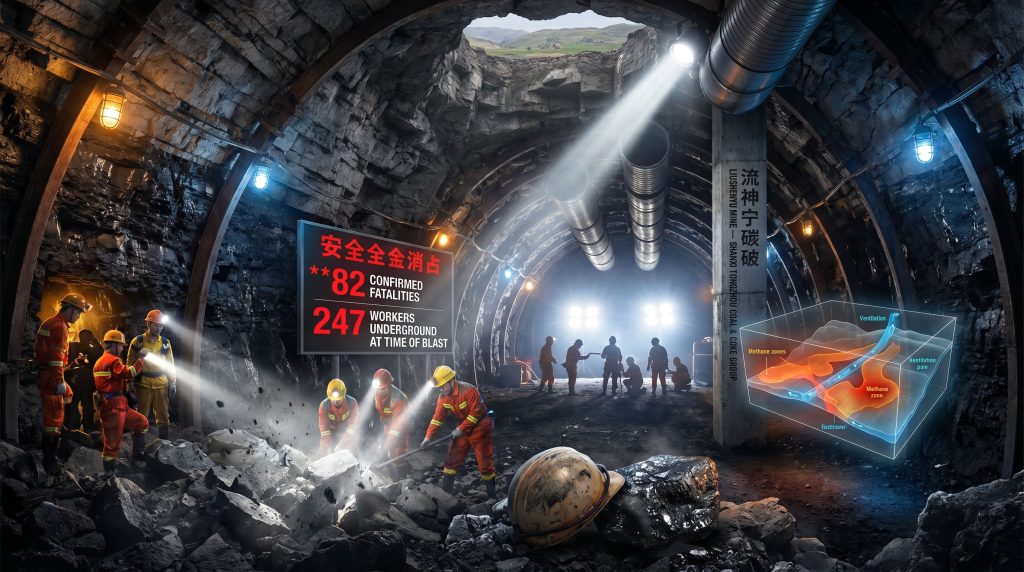
This is the structural reality that the China coal mine blast investigation at the Liushenyu mine in Shanxi province has forced back into the global spotlight. With 82 confirmed fatalities, this is the deadliest underground mine collapse incident in China in more than 16 years, and the investigation it has triggered reaches far beyond a single operator in a single province.
When big ASX news breaks, our subscribers know first
Scale of the Disaster: Key Statistics at a Glance
The raw numbers from the Liushenyu explosion paint a grim picture of both the physical force of the blast and the complexity of the rescue operation that followed.
| Metric | Detail |
|---|---|
| Confirmed fatalities (revised) | 82 |
| Workers underground at time of blast | 247 |
| Missing persons (post-rescue update) | 2 |
| Hospitalized survivors | 128 |
| Emergency rescue personnel deployed | 345 (across 6 teams) |
| Mine annual production capacity | 1.2 million tonnes |
| Last comparable disaster | 2009 Xinxing Mine, Heilongjiang (108 deaths) |
| Years since China's last deadlier incident | 16+ years |
The death toll was initially reported at 90 before being revised downward to 82 following more precise headcount verification, a revision that itself underscores one of the investigation's central concerns: the systemic difficulty of knowing exactly how many workers are underground at any given time.
Under Chinese regulatory classifications, any accident resulting in 30 or more deaths is formally designated a "very serious accident," triggering mandatory State Council-level investigation, sweeping industry audits, and the potential for criminal prosecution of operators and officials.
Understanding Underground Gas Explosions in Coking Coal Mines
To properly understand what happened at Liushenyu, it helps to understand the specific hazard profile of coking coal operations. Not all coal is equal in terms of underground gas risk.
Coking coal, used primarily in steelmaking and closely linked to steel market demand, is a higher-rank coal variety that tends to contain elevated concentrations of methane trapped within its molecular structure. As seams are mined and exposed, this gas is released into the surrounding atmosphere. The deeper the seam and the higher the coal rank, the greater the volume of gas liberation per tonne of coal extracted.
In contrast to thermal coal mines, which may operate in lower-rank lignite or sub-bituminous seams with comparatively modest gas emission rates, high-rank coking coal operations require significantly more aggressive ventilation management and continuous atmospheric monitoring to keep methane concentrations below the explosive threshold of approximately 5% by volume in air.
Early reporting on the Liushenyu blast indicated that a carbon monoxide alert may have preceded the explosion, though the precise ignition sequence remained under active investigation at the time of reporting. Carbon monoxide at elevated concentrations can indicate incomplete combustion events or smouldering within a mine, which may themselves create conditions for a subsequent methane ignition.
The technical failure modes investigators are examining include:
- Ventilation system performance – whether airflow volumes and pressure differentials were maintained within regulatory requirements
- Sensor data authenticity – whether gas monitoring readings were recorded accurately or manipulated to avoid triggering shutdown protocols
- Ignition source identification – sparks from equipment, electrical faults, blasting operations, or friction events are all candidate causes
- Underground atmospheric modelling – reconstructing the gas concentration distribution at the time of the blast
- Barrier and isolation integrity – whether pressure-relief and explosion-containment structures functioned as designed
What Investigators Are Looking For: The Four Systemic Failures
The State Council investigation team has publicly identified a cluster of illegal or non-compliant practices as priority targets for forensic scrutiny. Furthermore, these are not speculative areas of interest; they represent recurring patterns observed across multiple major Chinese coal mining accidents over the past two decades.
1. Falsified Monitoring Data
Perhaps the most troubling systemic issue in Chinese underground coal mining is the documented practice of manipulating gas sensor readings to satisfy regulatory requirements while continuing to operate in unsafe conditions. Sensors can be repositioned to areas of better airflow, data loggers can be tampered with, or readings can be manually overridden in mine management systems.
Investigators will cross-reference continuous monitoring records against maintenance logs, ventilation surveys, and worker testimony to assess whether data integrity was maintained at Liushenyu. This issue is at the heart of broader mining safety transformation efforts across the sector.
2. Undisclosed Work Sites
The investigation team called for a national audit of concealed underground operations, a directive that points to a known problem in Chinese mining: the existence of working areas not declared to safety regulators. These hidden sections may extend beyond permitted mining boundaries, operate in higher-risk zones, or simply exist to enable production volumes that exceed licensed capacity.
From an emergency management perspective, undisclosed work sites are catastrophic, as rescue teams cannot deploy effectively without accurate maps of underground workings.
3. Opaque Headcount Systems
The inability to confirm exactly how many workers were underground during the Liushenyu blast — evidenced by the initial discrepancy between a reported workforce of 247 underground and subsequent uncertainty about the missing persons count — reflects a systemic failure in personnel tracking. Modern mines use electronic tag-in/tag-out systems to maintain real-time headcounts, but compliance varies enormously across Chinese operations, particularly those employing informal or subcontracted labour.
4. Improper Subcontracting
Labour subcontracting arrangements introduce accountability gaps that can be fatal in high-risk environments. Subcontracted workers may not receive equivalent safety training, may not be captured in official headcount systems, and may face pressure from intermediary contractors to continue working in conditions that direct employees would be permitted to refuse. The investigation team's explicit focus on subcontracting signals that Liushenyu's workforce arrangements are under scrutiny.
These four failure modes are not unique to the Liushenyu mine. Industry safety researchers have identified them as endemic across mid-sized Chinese coal operations, suggesting the scope of the national audit ordered in the wake of this disaster will be extensive and consequential.
Who Operates the Liushenyu Mine?
| Attribute | Detail |
|---|---|
| Mine name | Liushenyu Coal Mine |
| Owner/operator | Shanxi Tongzhou Coal & Coke Group |
| Location | Shanxi Province, northern China |
| Primary product | Coking coal |
| Annual production capacity | 1.2 million tonnes |
| Provincial context | Shanxi produces approximately 1.3 billion tonnes of coal per year |
The Liushenyu mine is a mid-sized coking coal operation within one of the world's most prolific coal-producing provinces. At 1.2 million tonnes of annual production capacity, it represents a fraction of Shanxi's total output. However, its significance to the broader investigation lies not in its size but in what it may reveal about compliance culture across the sector.
At least one senior executive of Shanxi Tongzhou Coal & Coke Group was formally detained by authorities following the blast, with further detentions anticipated as the investigation broadens. The detention was confirmed by the rescue command headquarters and reported through official state media channels.
China's Coal Mine Safety History: Progress and Persistent Vulnerability
The China coal mine blast investigation at Liushenyu must be understood against a backdrop of dramatic, genuine progress in mining safety over the past two decades, alongside structural vulnerabilities that this progress has not fully eliminated.
Historical Fatality Comparison
| Year | Mine | Province | Deaths | Cause |
|---|---|---|---|---|
| 2026 | Liushenyu Mine | Shanxi | 82 (confirmed) | Gas explosion |
| 2009 | Xinxing Mine | Heilongjiang | 108 | Gas explosion |
| 2007 | Xinyao Mine | Shandong | 172 | Flooding |
| 2004 | Daping Mine | Henan | 148 | Gas explosion |
The decline from thousands of annual coal mining deaths in the early 2000s to the current era — where a disaster with 82 fatalities represents a 16-year worst-case event — reflects real structural change. This transformation has been driven by:
- Consolidation of tens of thousands of small, poorly regulated mines into larger operations subject to more rigorous oversight
- Mandatory installation of methane drainage systems, gas monitoring networks, and automated ventilation controls
- Increased criminal liability for operators, supervisors, and local government officials following major incidents
- Reduced reliance on artisanal-scale extraction methods in high-gas seams
However, the Liushenyu disaster reveals that three structural contradictions continue to create residual risk within the system.
Production pressure versus safety culture: China's government has actively pushed coal output to record levels in recent years to address energy security concerns. This creates a tension at the operational level where managers face simultaneous pressure to maximise output and comply with safety protocols that, if properly enforced, would require production slowdowns or temporary shutdowns in hazardous conditions.
Data integrity versus regulatory compliance: A safety regime that relies heavily on self-reported monitoring data is inherently vulnerable to manipulation, particularly in environments where the consequences of reporting unsafe readings — loss of production quotas, regulatory fines, or shutdown orders — are perceived as more immediately damaging than the probabilistic risk of an explosion.
Regulatory capture at the local level: Mine operators in Chinese provinces have historically maintained financial and social relationships with local government officials responsible for oversight. While national-level regulations are stringent on paper, enforcement quality can vary significantly depending on the independence of local inspectors.
The next major ASX story will hit our subscribers first
Leadership Response: The Political Weight of the Disaster
The speed and seniority of the political response to the Liushenyu explosion is itself informative. Within 48 hours of the blast, coordinated directives had been issued by three of China's most senior leaders.
President Xi Jinping called for strengthened risk inspection protocols and more rigorous hazard controls across high-risk industries, with particular attention to seasonal factors such as heavy rainfall that can compromise underground structural stability and drainage systems.
Premier Li Qiang directed authorities to ensure transparent and timely information disclosure, a directive that implicitly acknowledges historical concerns about delayed or incomplete reporting following major industrial accidents in China.
Vice Premier Zhang Guoqing was dispatched directly to Shanxi to oversee rescue coordination, medical logistics, and post-incident management, providing direct central government oversight of a situation that might otherwise be managed at the provincial level.
This trilateral leadership response, coordinated within a narrow window following the incident, signals that the Liushenyu blast carries political weight likely to accelerate regulatory reform timelines that might otherwise progress slowly through bureaucratic channels.
Coal Supply Implications: A Sensitive Moment for Energy Markets
The timing of the Shanxi explosion adds a layer of economic complexity to what is already a significant human and regulatory event. In addition, the coal supply challenges already present in 2025 have made the situation considerably more acute.
China's domestic coal market was already operating under supply pressure at the time of the blast, driven by three converging factors:
- Elevated summer demand – Peak electricity consumption during warmer months increases coal burn at power stations, tightening available supply
- Indonesian export disruption – Indonesia, a major supplier of both thermal and coking coal to Chinese buyers, has been implementing significant changes to its export framework, creating uncertainty in import volumes
- LNG supply shortfalls – Reduced availability of liquefied natural gas from Persian Gulf suppliers has increased the substitution demand for coal as a flexible fuel source
The post-accident safety crackdown, which will trigger mandatory inspections and potential temporary operational suspensions across mines in Shanxi and neighbouring provinces, introduces a supply-side constraint at precisely the moment when demand is most acute.
Despite energy transition pressures and China's record investment in renewable energy capacity, coal continues to underpin approximately 55 to 60% of national electricity generation, while coking coal remains indispensable for the country's steel industry. There is no near-term substitute that can absorb the volume of energy service that coal provides across these sectors, which means that supply disruptions from safety-related shutdowns translate directly into energy market stress.
Human Cost and Rescue Operations
Beyond the statistics and regulatory analysis, the Liushenyu disaster represents a profound human tragedy for the workers and families of Shanxi province.
Six emergency response teams totalling 345 personnel, dispatched by China's Ministry of Emergency Management, worked through the aftermath of the explosion in conditions of poor visibility, toxic atmospheric contamination, and structural uncertainty. Survivors were treated for injuries consistent with carbon monoxide poisoning, blast overpressure trauma, and crush injuries.
One survivor, interviewed by Beijing News following the rescue, described regaining consciousness in complete darkness after being rendered unconscious by the force of the explosion, then navigating through dust-saturated air to reach safety. The account illustrates both the disorienting violence of an underground gas explosion and the exceptional circumstances under which survivors must act to preserve their own lives.
Of the 247 workers reported underground at the time of the blast, 128 were hospitalised, 82 were confirmed dead, and 2 remained missing following the conclusion of active search and rescue operations.
Frequently Asked Questions: China Coal Mine Blast Investigation
What caused the Liushenyu mine explosion in Shanxi?
The blast is believed to have involved a gas explosion in the underground workings of the Liushenyu mine. Early reports indicated a carbon monoxide alert preceded the incident. The State Council investigation team is conducting forensic analysis to determine whether the ignition resulted from equipment failure, ventilation breakdown, blasting operations, or a combination of factors.
How does China classify a very serious mining accident?
Under China's Work Safety Law, any accident resulting in 30 or more deaths is classified as a very serious accident. This classification mandates a State Council-level investigation, criminal accountability proceedings, and comprehensive industry-wide safety audits. With 82 confirmed deaths, the Liushenyu explosion comfortably exceeds this threshold.
Will the investigation affect coal supply and prices in China?
Post-accident safety crackdowns in China's coal sector typically result in inspections and temporary suspensions across broader provincial networks of mines. Consequently, combined with elevated summer demand and existing disruptions to Indonesian coal exports, the Liushenyu investigation creates upward pressure on domestic coal prices in the near term.
How does this disaster compare to China's mining safety trajectory?
China has reduced coal mining deaths dramatically over two decades, from several thousand annually in the early 2000s to low hundreds in recent years. The Liushenyu explosion, at 82 deaths, represents the worst single incident since 2009, marking a significant setback to this long-term safety improvement trend.
Key Takeaways
- The Liushenyu explosion is the deadliest coal mine disaster in China in more than 16 years, with 82 confirmed fatalities from a workforce of 247 underground at the time of the blast
- The China coal mine blast investigation is examining four systemic failure modes: falsified monitoring data, undisclosed work sites, opaque headcount systems, and improper subcontracting arrangements
- Coking coal operations carry specific gas explosion risks related to higher coal rank and greater methane content compared to thermal coal seams
- Coordinated leadership directives from President Xi Jinping, Premier Li Qiang, and Vice Premier Zhang Guoqing signal the political gravity of the incident and suggest accelerated regulatory reform
- The timing of the disaster, during peak summer demand with Indonesian coal exports already disrupted, amplifies the energy market significance of the post-accident safety crackdown
- China's long-term coal safety improvement record is real but incomplete, with structural tensions between production targets, data integrity, and regulatory independence continuing to create residual risk across the sector
This article contains references to ongoing investigations and forward-looking assessments of regulatory and market impacts. Outcomes may differ materially from current expectations as new information emerges from the State Council investigation. Nothing in this article constitutes financial or investment advice.
Want to Stay Ahead of Significant ASX Mineral Discoveries Before the Broader Market?
Discovery Alert's proprietary Discovery IQ model delivers real-time alerts on significant ASX mineral discoveries, transforming complex data across 30-plus commodities into clear, actionable insights for both short-term traders and long-term investors. Explore how major mineral discoveries have historically generated substantial returns on Discovery Alert's dedicated discoveries page, and begin your 14-day free trial today to secure a market-leading edge.