August 13, 2026
The Underground Time Bomb: Understanding Why China's Coal Mines Remain Dangerously Volatile
Every major coal-producing nation wrestles with the tension between energy output and worker safety, but nowhere is that tension more acute than in the underground mines stretching beneath China's northern provinces. The physics of methane accumulation do not negotiate with production quotas. When conditions align underground, a China coal mine explosion unfolds in seconds, regardless of what regulatory frameworks exist on paper above ground. Understanding why these events keep occurring requires looking well beneath the headlines.
When big ASX news breaks, our subscribers know first
China's Coal Sector: Scale That Defies Easy Comparison
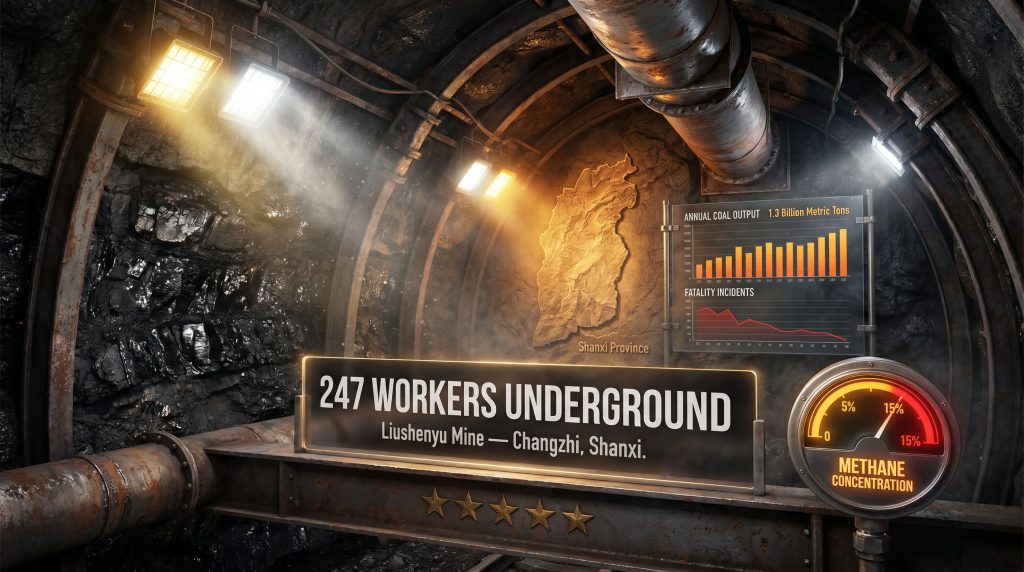
The numbers alone reframe the conversation. China is responsible for producing roughly one-third of the world's total coal output, and Shanxi province sits at the centre of that industrial machine. In a single year, Shanxi's mining operations extracted approximately 1.3 billion metric tons of coal, representing close to 30% of China's entire national production figure.
To contextualise Shanxi's scale: the province covers a geographic area larger than Greece, supports a population of approximately 34 million people, and employs hundreds of thousands of underground miners. The sheer density of mining activity across this single province means that when safety systems fail, the consequences are felt quickly and broadly. Among the global coal producers, China's dominance is unmatched.
Despite accelerating investment in solar, wind, and hydropower capacity, coal continues to generate the majority of China's electricity. The structural dependence on coal-fired power generation is not disappearing on a short timeline. This creates a persistent operational reality: mines face continuous pressure to maintain and increase output, and that pressure does not always align comfortably with the time and capital required to maintain rigorous safety standards.
What Happened at the Liushenyu Mine in Changzhi City
On a Friday evening in Changzhi City, Shanxi Province, a gas explosion tore through the workings of the Liushenyu coal mine. At the time of the blast, 247 workers were present underground, a figure that immediately illustrated the scale of the emergency that followed.
According to state media reporting via Xinhua, at least 8 workers were killed and 38 remained trapped beneath the surface. By early Saturday morning, rescue teams had successfully brought 201 workers safely to the surface, representing a significant logistical effort given the conditions underground following an explosion of this nature.
Chinese President Xi Jinping issued a directive demanding an all-out rescue operation, a thorough investigation into causation, and clear accountability for those found responsible. The cause of the blast was under active investigation at the time of initial reporting. Presidential involvement of this kind is now standard protocol following major mining disasters, reflecting how politically sensitive these events have become within China's governance framework.
The survival of 201 workers from an underground gas explosion involving 247 people represents a significant rescue outcome, but the confirmed deaths and dozens trapped underscore the persistent human cost of coal extraction at this scale.
The Mechanics of a Coal Mine Gas Explosion
To understand why these incidents recur, it helps to examine the physical and operational conditions that produce them. Underground coal seams naturally emit methane gas (CH₄), a byproduct of the biological and geological processes that created the coal itself over millions of years. This gas, sometimes called firedamp in traditional mining terminology, is both colourless and odourless, making its accumulation invisible without monitoring equipment.
The critical danger zone emerges when methane concentrations in an enclosed underground space reach between 5% and 15% by volume. Within this range, the gas-air mixture becomes highly explosive upon contact with any ignition source. That ignition source can be surprisingly mundane: an electrical spark from equipment, friction between metal components, or in some documented cases, static discharge.
Key Preconditions That Create Explosion Risk
- Ventilation system failure — insufficient airflow allows methane to accumulate to dangerous concentrations rather than being continuously diluted and expelled
- Degraded or absent monitoring systems — gas sensors that are outdated, poorly calibrated, or simply not installed fail to provide early warning before concentrations reach the explosive threshold
- Geological surprises — unexpected fault lines, gas pockets known as goafs, or sudden pressure changes in the strata can release volumes of methane that overwhelm even functional ventilation systems
- Production pressure dynamics — when output targets dominate decision-making, safety protocol shortcuts become more likely at both the supervisory and operational levels
- Spontaneous combustion in coal seams — some Chinese coal seams, particularly in Shanxi, have a high propensity for spontaneous combustion, which can serve as an ignition source in methane-rich environments
A less commonly discussed technical factor is the role of coal rank and gas content variability. Higher-rank coals, such as anthracite and bituminous coals prevalent in parts of Shanxi, tend to have higher inherent methane content per tonne. This means mines operating in these geological formations face systematically elevated baseline gas risks compared to mines extracting lower-rank lignite deposits elsewhere.
Historical Context: China's Long Record of Mining Disasters
The Liushenyu explosion is not an isolated event but rather a continuation of a pattern that stretches back decades. Reviewing the historical record of coal mining accidents provides essential context for assessing whether current safety trajectories represent genuine improvement or incremental progress against a persistently dangerous baseline.
| Disaster | Year | Location | Confirmed Deaths | Primary Cause |
|---|---|---|---|---|
| Benxihu (Honkeiko) Mine | 1942 | Liaoning Province | ~1,549 | Gas explosion and fire |
| Laobaidong Mine | 1960 | Datong, Shanxi | ~684 | Gas explosion |
| Xinjing Open-Pit Mine | 2023 | Inner Mongolia | 53 | Slope collapse |
| Liushenyu Mine | 2025 | Changzhi, Shanxi | 8+ | Gas explosion |
The 1942 Benxihu disaster remains one of the deadliest mining events ever recorded globally, a benchmark that reflects conditions under wartime industrial management rather than modern regulation. The 1960 Laobaidong explosion in Datong, also in Shanxi, claimed hundreds of lives during a period when Chinese mine safety infrastructure was still rudimentary.
What is more analytically significant is the 2023 Xinjing collapse in Inner Mongolia's Alxa Left Banner region. The post-disaster investigation into that event uncovered a catalogue of systemic failures rather than a single accidental cause. Investigators found evidence of illegal construction activity conducted without proper authorisation, falsified production and operational records that concealed actual risk levels from regulators, contractor negligence from third-party operators who prioritised speed over compliance, and a breakdown in local supervisory oversight bodies that failed to detect or act on known violations. Criminal and administrative penalties followed.
The pattern emerging from Chinese mine disaster investigations is consistent: the proximate cause may be a gas build-up or structural failure, but the underlying cause is almost always a chain of human and institutional decisions that allowed dangerous conditions to persist.
Shanxi Province: Where China's Coal Heartland Concentrates Both Output and Risk
Shanxi's dominance in Chinese coal production is not accidental. The province sits atop geological formations that contain some of China's most accessible and high-quality coal reserves, particularly coking coal and high-grade thermal coal deposits that have been commercially extracted for well over a century.
This long extraction history has a double-edged character. On one side, it means Shanxi possesses experienced mining workforces and established infrastructure. On the other, it means that many of the province's older mines are operating in increasingly complex geological conditions as the most easily accessible seams become exhausted and operations push deeper or into more structurally challenging rock formations.
Deeper mines are not simply bigger versions of shallower ones. Greater depth introduces higher ambient rock stress, elevated ground temperatures, and increased natural gas pressures within coal seams. Each of these factors compounds the methane explosion risk independently of whether a mine's safety systems are adequate for surface-level operations. A ventilation system designed for a shallower seam profile may be wholly inadequate once a mine extends to greater depths.
The Consolidation Policy and Its Unintended Dynamics
China's government pursued an aggressive mine consolidation program from the mid-2000s onward, forcibly merging thousands of small private mines into larger state-owned or major private enterprises. The policy rationale was sound: larger operations can invest more capital in safety technology, hire dedicated safety personnel, and implement standardised protocols across multiple sites.
By several measures, the consolidation strategy succeeded. China's coal mine fatality rates declined substantially between 2005 and the early 2020s, driven in part by the elimination of the most dangerous small and informal operations. The total number of licensed coal mines was reduced from tens of thousands to a fraction of that figure.
However, consolidation introduces its own risk dynamic. Larger mines, by definition, employ more workers simultaneously underground. When safety systems fail in a large consolidated operation, the potential casualty count is structurally higher than in a small mine. The 247 workers underground at the time of the Liushenyu explosion reflect precisely this dynamic. Consolidation may have reduced the frequency of incidents, but it has not necessarily reduced the severity of those that do occur.
The next major ASX story will hit our subscribers first
Government Response Architecture: From Crisis Management to Structural Reform
The Chinese government's response to major mining disasters has become increasingly formalised over the past two decades. The pattern following the Liushenyu explosion — involving a presidential directive, state media reporting through Xinhua, and simultaneous calls for rescue and accountability — mirrors responses to earlier major incidents.
| Response Dimension | Historical Pattern (Pre-2000s) | Contemporary Pattern (2020s) |
|---|---|---|
| Presidential involvement | Rare, reserved for catastrophic events | Standard protocol for significant incidents |
| Public information release | Delayed, often restricted | Faster via state media channels |
| Post-disaster inspections | Ad hoc, regionally variable | Systematic province-wide safety sweeps |
| Criminal accountability | Limited, inconsistent | More consistent prosecution of responsible parties |
| Mandatory safety investment | Minimal regulatory requirement | Increasing capital requirements mandated |
China's National Mine Safety Administration holds formal authority over mine safety standards nationally, but enforcement quality varies considerably by region and by the political economy of local governments that depend on mining tax revenues. The accountability gap identified consistently in post-disaster investigations points to a structural tension: local officials responsible for overseeing mine safety also benefit economically from maximising mine output, creating an institutional conflict that regulatory frameworks alone cannot fully resolve.
Market Implications: When Chinese Mine Safety Becomes a Global Energy Variable
China's position as simultaneously the world's largest coal producer and its largest consumer means that domestic supply disruptions do not translate directly into global export shortfalls in the way that, for example, an Australian or Indonesian mine closure might. Most Chinese coal never enters the seaborne market. Furthermore, understanding the broader context of global coal reserves helps illustrate why Chinese domestic disruptions carry such outsized regional significance.
However, the indirect market implications are real and have been observed in previous post-disaster scenarios:
- Mandatory safety inspection shutdowns following major incidents temporarily reduce domestic output as regulatory bodies sweep mine operations across affected provinces
- Reduced domestic supply during peak demand seasons forces Chinese utilities and industrial users to seek replacement tonnes from international markets
- Price signal transmission through Asian thermal coal benchmarks, including the Newcastle spot price, can reflect Chinese domestic supply tightness within days of a major incident
- Long-term investment signals regarding the cost of compliance in Chinese coal operations affect capital allocation decisions by both domestic and international mining investors
Countries including India, Japan, South Korea, and several Southeast Asian importers monitor Chinese domestic supply conditions precisely because these secondary market effects are well established. In addition, India's coal market is particularly sensitive to Chinese supply disruptions, given the competitive dynamics across Asian thermal coal benchmarks. A safety-driven production pause in Shanxi is not simply a domestic Chinese regulatory matter; it is an energy security variable with regional price implications.
Consequently, coal supply challenges in China reverberate across global energy markets, and the energy export challenges faced by countries like Australia are often shaped in part by what happens inside Chinese mines. These interconnections make the safety record of Chinese mining a genuinely international concern.
Frequently Asked Questions: China Coal Mine Explosions
What caused the Liushenyu coal mine explosion?
The explosion at the Liushenyu mine in Changzhi City, Shanxi Province, was identified as a gas explosion. The specific trigger was under official investigation at the time of initial reporting. Gas explosions in underground coal mines typically result from methane accumulating to concentrations between 5% and 15% in enclosed spaces combined with an ignition source.
How many workers were involved at the Liushenyu mine?
A total of 247 workers were underground when the explosion occurred. At least 8 fatalities were confirmed, 38 workers remained trapped underground, and 201 were successfully brought to the surface by rescue teams.
Why is Shanxi province so central to Chinese coal production?
Shanxi contains some of China's largest and most accessible high-quality coal reserves. Annual output from the province reached approximately 1.3 billion metric tons, representing close to 30% of China's national total. The province's long extraction history and geological endowment make it the undisputed centre of Chinese coal production.
Has China's coal mine safety record improved over time?
Fatality rates per million tonnes of coal produced have declined significantly since the mid-2000s, driven by mine consolidation policies and increased regulatory investment. However, absolute fatality numbers remain among the highest globally due to the scale of the sector, and large-scale disasters — including a China coal mine explosion of the type seen at Liushenyu — continue to occur periodically.
How do Chinese mining disasters affect international energy markets?
While China is primarily a domestic consumer rather than a major coal exporter, safety-driven production shutdowns can tighten regional supply and contribute to short-term price movements in Asian thermal coal markets. Countries including Japan, India, and South Korea that import seaborne coal monitor Chinese domestic supply conditions closely for this reason.
Key Takeaways
- Shanxi province extracted approximately 1.3 billion metric tons of coal in a single year, representing nearly one-third of China's total national output
- The Liushenyu mine explosion involved 247 workers underground, resulting in at least 8 confirmed deaths, 38 trapped, and 201 successfully rescued
- Gas explosions result from methane accumulating to 5–15% concentration in enclosed spaces, with ventilation failure and monitoring gaps as primary preconditions
- Post-disaster investigations consistently reveal systemic institutional failures rather than purely accidental causes, including falsified records, contractor negligence, and supervisory breakdown
- China's mine consolidation strategy reduced incident frequency but may have increased potential severity by concentrating larger workforces underground simultaneously
- Safety-driven production pauses in Shanxi carry secondary price implications for Asian thermal coal markets, making Chinese mine safety a relevant variable for regional energy importers
Readers seeking further context on coal mine safety patterns and China's energy sector can explore related reporting from ET EnergyWorld at energy.economictimes.indiatimes.com, which covers ongoing developments in global coal markets and mining safety regulation.
Disclaimer: This article contains references to historical fatality statistics and forward-looking observations about market dynamics. Casualty figures and investigation findings referenced reflect information available at the time of initial reporting. Readers should consult current official sources for updated information. Market impact assessments are observational rather than investment advice.
Want To Stay Ahead of Major ASX Mineral Discoveries Before the Broader Market Reacts?
While China's coal sector dominates global energy headlines, the real opportunity for investors lies in identifying significant mineral discoveries the moment they're announced — and Discovery Alert's proprietary Discovery IQ model does exactly that, delivering real-time ASX alerts that turn complex geological data into actionable opportunities for both short-term traders and long-term investors. Explore how historic discoveries have generated substantial returns and begin your 14-day free trial at Discovery Alert to position yourself ahead of the market.