July 15, 2026
When Safety Collapses, So Does Supply: Understanding China's Coal Output Crisis
The global coal market rarely moves on a single event. Supply disruptions tend to accumulate gradually, shaped by seasonal demand swings, weather anomalies, and policy adjustments that play out over months. Yet occasionally, a singular catastrophic failure cuts through those gradual rhythms and forces an immediate reckoning with how fragile concentrated industrial systems truly are. China coal mining output falls after deadly blast events such as the Liushenyu explosion demonstrate precisely that kind of rupture, when a deadly underground explosion in Shanxi province triggered a regulatory response so sweeping that it produced the sharpest monthly output decline the country has recorded in a decade.
Understanding why this matters requires more than reading the headline statistics. It demands an examination of how China's coal supply chain is structured, why safety enforcement operates the way it does, and what the downstream consequences look like for industries that have no short-term substitute for the fuel they depend on.
When big ASX news breaks, our subscribers know first
Understanding the Scale: What the June 2026 Output Data Actually Reveals
China Produced 381 Million Tons of Coal in June — Here's Why That Number Matters
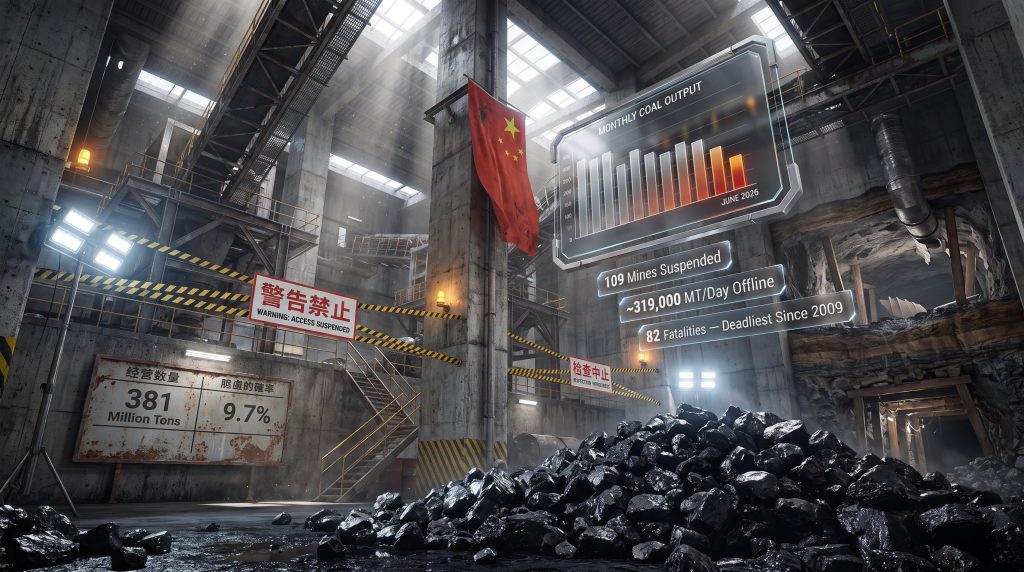
China's National Bureau of Statistics confirmed that national coal output in June 2026 reached 381 million tons, representing a 9.7% year-on-year decline. That figure is not just a statistical anomaly. It is the largest single-month contraction recorded since 2016, arriving against a backdrop of years of consistent production growth that followed the supply-side reforms of that earlier period.
To appreciate the significance, consider the trajectory. After 2016's output contraction, China rebuilt production capacity aggressively through the late 2010s and early 2020s, driven by energy security priorities and industrial demand. By 2025, national coal output had grown substantially from its post-2016 trough. The June 2026 reversal, furthermore, lands with amplified force precisely because it disrupts a production base that had expanded to underpin China's energy and industrial systems.
| Metric | Figure |
|---|---|
| June 2026 coal output | 381 million tons |
| Year-on-year decline | 9.7% |
| Last comparable decline | 2016 (decade-record) |
| Shanxi's share of national output | ~25% |
| Mines suspended in Shanxi | 109 |
| Capacity taken offline (Shanxi) | ~319,000 metric tons/day |
| Total offline capacity (all provinces) | ~16.85 million tons |
How This Decline Compares to Previous Supply Disruptions
China's 2016 coal output contraction was a deliberate policy outcome, engineered through supply-side structural reforms that closed unprofitable and unsafe smaller mines as part of a national deleveraging strategy. What makes the June 2026 decline structurally different is that it was entirely unplanned, triggered not by policy design but by a catastrophic safety failure and the administrative response it demanded.
That distinction matters for market pricing. Planned supply reductions allow traders, steelmakers, and utilities to position in advance. Unplanned disruptions compress the adjustment window and amplify price volatility, particularly for coking coal, where the downstream consumption cycle in blast furnace steelmaking cannot simply be paused.
Shanxi's structural role compounds this sensitivity. The province is not merely a large coal producer. It is the dominant source of metallurgical coking coal in China, the variety used in steel production rather than power generation. When Shanxi's output contracts, it is primarily the steel sector that absorbs the shock first. This is closely linked to broader China steel and iron ore market pressures that were already building heading into 2026.
What Caused the Collapse? Anatomy of the Liushenyu Mine Disaster
A Single Explosion With Nationwide Consequences
In late May 2026, a gas explosion tore through the Liushenyu coal mine in Shanxi province, killing at least 82 workers. The death toll places it among the worst coal mining disasters China has recorded since 2009, making it a defining safety event for the sector's recent history.
The mine operator, Tongzhou Group, subsequently faced official findings of serious illegal violations in its operational conduct. Investigators identified evidence suggesting the use of hidden tunnels and falsified safety documentation, allegations that pointed to deliberate concealment of hazardous conditions rather than simple negligence. All four of Tongzhou Group's operating mines in Shanxi were ordered to cease production immediately.
The combination of an extreme death toll, allegations of deliberate concealment, and the political sensitivity of a high-profile industrial disaster created conditions where regulatory restraint was not a viable option. The response had to be visibly comprehensive.
The Regulatory Hammer: How Safety Inspections Cascaded Into a Supply Shock
China's senior leadership directed an extensive rescue effort and thorough investigation into the disaster. What followed was a blanket safety inspection program that extended well beyond the Tongzhou Group's operations. Inspectors scrutinised gas drainage systems, ventilation infrastructure, and underground emergency protocols across 109 mines in Shanxi alone, with the inspection scope eventually reaching into neighbouring Shaanxi and Henan provinces.
The critical mechanism that converted a localised disaster into a national supply shock was the administrative decision to implement broad suspension orders rather than targeted closures. Under targeted enforcement, only mines with demonstrated violations would halt production. Under the blanket approach adopted, however, any mine that could not immediately demonstrate full compliance was suspended pending inspection completion.
This is a well-established pattern in Chinese industrial safety regulation. Politically sensitive disasters tend to generate response campaigns that prioritise visible breadth of enforcement over operational precision. The resulting supply impact is systematically larger than the underlying safety problem would require, but the political logic is coherent from the regulator's perspective.
Structural Insight: Shanxi alone holds approximately 1.3 billion tons of annual production capacity, representing nearly one-third of China's total national output. When inspections freeze even a fraction of that capacity, the supply effects propagate across the entire downstream industrial chain within weeks.
How Big Is the Supply Hole? Quantifying the Offline Capacity
Coking Coal vs. Thermal Coal: Two Different Damage Profiles
Not all coal is interchangeable, and the Shanxi disruption's damage profile differs substantially between coal types. This distinction is underappreciated by generalist market observers but is fundamental to understanding which sectors face the most acute near-term pressure.
| Coal Type | Short-Term Impact | Projected Decline |
|---|---|---|
| Coking coal (Shanxi) | Steel sector supply squeeze | 10-15% output reduction |
| National coking coal supply | Late May-June disruption | 7-10% decline |
| July-August projected decline | Recovery phase | 3-5% vs. prior year |
| Thermal coal | Power generation pressure | Indirect, secondary effect |
Coking coal, sometimes called metallurgical coal, undergoes a chemical transformation process called carbonisation to produce coke, the carbon-rich material that acts as both fuel and reducing agent in blast furnace steelmaking. There is no viable short-term substitute. Coal-fired direct reduction or electric arc furnace production can partially offset demand, but not at the scale or speed required to absorb a sudden Shanxi supply shock.
Thermal coal, used primarily in power station combustion, faces a secondary but still meaningful impact. Tighter overall coal availability and elevated coking coal prices tend to create price spillover effects in thermal markets, particularly when grid operators are simultaneously managing elevated electricity demand.
Which Downstream Industries Are Most Exposed?
-
Steel production: Blast furnace operators depend on coking coal with specific volatile matter content and coking strength parameters. Shanxi's hard coking coal is among the highest quality available domestically in China, and substitution with lower-grade alternatives reduces furnace efficiency and coke quality.
-
Power generation: Thermal power plants face indirect tightness as overall coal supply contracts and logistics networks that serve both markets experience congestion.
-
Coal-to-chemicals processing: China's substantial coal chemical industry, which produces methanol, ammonia, and synthetic materials from coal feedstocks, is directly exposed to feedstock cost increases when Shanxi output falls.
What Does This Mean for China's Power Grid and Energy Security?
Thermal Power's Fragile Comeback Under Additional Pressure
Thermal power generation rose just 0.5% in June 2026, the slowest monthly growth rate recorded for the year. The first-half figure of 2.9% growth represented a meaningful recovery from 2025, when thermal generation contracted on an annual basis for the first time in a decade. That 2025 contraction was itself a historically unusual event, reflecting a period of particularly strong renewable output.
The coal supply shock from Shanxi has arrived at precisely the wrong moment in this cycle. Thermal power is being called upon to compensate for renewable energy underperformance, but the coal supply that thermal plants require is simultaneously under pressure from the Shanxi inspection program. This dynamic is further complicated by China's coal plant strategy, which positioned thermal capacity as a renewable backup rather than a primary generation source.
Why Renewables Are Not Filling the Gap
China's renewable energy buildout has been extraordinary by any historical benchmark, with record solar and wind installations in recent years. Yet the generation data from mid-2026 reveals a paradox that challenges simplistic narratives about the energy transition's pace.
-
Wind generation fell 5.6% in June 2026 despite record installed capacity added in the prior year.
-
First-half wind output was down 1.9% year-on-year across China.
-
Curtailment, the forced shutdown of renewable generators to prevent grid overloading, is reducing effective output below what installed capacity would theoretically deliver.
-
Below-average wind speeds in 2026 have compounded the curtailment problem, creating a double squeeze on wind-based generation.
Energy Policy Paradox: China is simultaneously commissioning record renewable generation capacity and becoming more dependent on coal-fired baseload to keep the grid stable. The Shanxi disaster has exposed a critical vulnerability in this transition period: coal cannot be easily replaced on short notice, and renewables cannot yet be relied upon as firm, dispatchable generation when weather conditions underperform.
The curtailment dynamic is particularly counterintuitive. China's transmission grid in many regions lacks the flexibility and storage integration to absorb the peak output from newly installed renewable capacity. Grid operators are therefore forced to curtail wind and solar during periods of oversupply while simultaneously running coal plants to maintain baseload stability. This structural mismatch means the effective utilisation rate of China's renewable fleet lags significantly behind its nominal installed capacity figures.
How Are Coal Markets Responding? Price and Trading Dynamics
Coking Coal Futures React Immediately
Market participants wasted little time processing the implications of the Shanxi suspension orders. Coking coal futures surged to daily price limits on Chinese commodity exchanges in the days following the announcement of mass mine closures, reflecting a sudden repricing of near-term supply availability.
What is instructive about the futures reaction is what it reveals about trader expectations regarding inspection timelines. Daily limit moves suggest market participants were not pricing a short, sharp disruption but were instead factoring in the possibility of an extended inspection and compliance process stretching beyond the initial suspension period.
Thermal coal futures also firmed, though less dramatically, consistent with the secondary nature of the thermal coal impact from a Shanxi-specific event.
Is This a Short-Term Spike or a Structural Shift?
Analyst consensus points toward a gradual normalisation of supply through late summer 2026, with the most likely scenario involving phased resumption of Shanxi operations as mines demonstrate compliance with safety requirements. The projected 3-5% output deficit for July-August relative to prior-year levels suggests markets should anticipate continued tightness rather than an immediate snapback.
The key uncertainty is whether inspectors discover additional serious violations beyond those already attributed to Tongzhou Group. If extended closures follow from new findings, the supply recovery timeline could shift meaningfully, sustaining elevated prices through the second half of the year. These dynamics also have implications for the global crude steel outlook, given Shanxi's central role in metallurgical coal supply.
The next major ASX story will hit our subscribers first
China's Coal Mining Safety Record: A Systemic Problem, Not an Isolated Event
Decades of Underreported Risk in Underground Operations
China operates the world's most extensive underground coal mining network and has historically recorded the highest absolute coal mining fatality counts globally. The Liushenyu disaster's death toll of 82 workers is being contextualised against the 2009 benchmark, when several large-scale accidents made that year one of the most deadly in recent Chinese mining history.
The allegations of hidden tunnels and falsified safety records at the Tongzhou Group operation point to a governance problem that goes beyond one company. Underground coal mines in China's major producing provinces operate under intense production quota pressure, particularly during periods when national energy demand is elevated. That pressure creates structural incentives to defer safety investments, conceal non-compliant workings, and underreport hazardous conditions to provincial inspectors.
What the Illegal Violations Allegation Reveals About Sector Governance
-
Regulatory capture risk: Provincial mining oversight in major coal regions operates in an environment where local economic dependencies on mining output create implicit pressure against aggressive enforcement.
-
Enforcement cycles: The pattern that has characterised Chinese coal safety regulation over many decades involves a period of relatively relaxed enforcement, a high-profile disaster, a campaign-style inspection and closure response, short-term compliance improvement, and gradual reversion as political attention moves on.
-
Gap between national standards and local practice: China's national coal safety framework includes technically rigorous requirements for gas drainage, ventilation design, and emergency response systems. The gap between these written standards and actual underground operational practice at smaller and mid-sized operators can be substantial.
Broader mining safety and sustainability challenges are not unique to China, however the concentrated scale of Chinese underground coal operations means the consequences of governance failures are particularly severe.
Governance Warning: Production quota pressure in China's major coal provinces creates systematic incentives to defer safety investment. Periodic inspection campaigns have historically delivered temporary compliance improvements without resolving the underlying incentive structures that create risk in the first place.
What Happens Next? Recovery Timeline and Remaining Risk Factors
Short-Term Outlook: When Will Shanxi's Mines Come Back Online?
The phased resumption of Shanxi operations is expected to begin as inspections conclude and mines demonstrate full compliance documentation. Larger operators with established safety management systems and better regulatory relationships are likely to receive restart approvals ahead of smaller, less capitalised operations.
Government production targets will play a meaningful role in the pace of this restart. China's central planning framework sets annual coal output objectives that carry significant political weight, and a sustained production shortfall creates its own pressure on provincial authorities to accelerate the compliance verification process.
Scenario Modelling: Three Possible Outcomes for H2 2026 Coal Supply
| Scenario | Assumption | National Output Impact |
|---|---|---|
| Base Case | Inspections conclude by August; phased restart | Full-year decline contained at 3-5% |
| Extended Disruption | Additional violations found; shutdowns prolonged | H2 output down 6-8%; price pressure sustained |
| Accelerated Recovery | Political pressure drives rapid restart approvals | July bounce partially offsets June losses |
Medium-Term Risk: Will This Trigger Lasting Regulatory Reform?
The honest assessment of China's coal safety regulatory history suggests that lasting structural reform following disasters is the exception rather than the rule. The scale of the Liushenyu event, its death toll, and the scale of the output disruption it triggered create genuine political pressure for more durable changes to Shanxi's provincial licensing and inspection frameworks.
Whether that pressure translates into enforceable institutional change, or whether the enforcement cycle simply runs its course before reverting, is the medium-term question that will determine whether the instance where China coal mining output falls after deadly blast events is ultimately remembered as a singular shock or as a turning point in how China manages the concentrated risk embedded in its coal supply chain.
In addition, supply chain disruptions of this magnitude have a tendency to expose vulnerabilities in downstream industrial planning that were previously obscured by stable supply conditions. Consequently, both domestic and international steelmakers may be forced to reconsider their feedstock sourcing strategies in response.
Key Takeaways: What the Shanxi Disaster Tells Us About China's Energy Vulnerabilities
-
A single safety event in one province removed approximately 10% of Shanxi's daily output capacity and produced the country's largest annual production decline in ten years.
-
China's energy transition is structurally incomplete: coal is simultaneously being positioned for phase-out and being relied upon more heavily as renewable curtailment rises and grid integration lags behind installation pace.
-
The coking coal supply chain, which is critical to global steel production economics, is more geographically concentrated and operationally fragile than commodity market pricing typically reflects in stable periods.
-
Regulatory enforcement in China's coal sector follows a well-documented cyclical pattern: disaster, campaign, short-term compliance, gradual reversion. Investors and industrial planners should incorporate this cycle into medium-term supply modelling rather than treating each inspection wave as a structural break.
-
The distinction between thermal coal and coking coal impact profiles matters enormously for downstream sector exposure. Steel producers face the sharpest near-term constraints, while power utilities face a secondary but meaningful tightening.
Frequently Asked Questions: China Coal Output Decline 2026
What caused China's coal mining output falls after the deadly blast in 2026?
A gas explosion at the Liushenyu coal mine in Shanxi province killed at least 82 workers in late May 2026, triggering mandatory safety inspections that led to the suspension of 109 mines in Shanxi and extended reviews in Shaanxi and Henan provinces.
How large was China's coal output decline in June 2026?
China produced 381 million tons of coal in June 2026, a 9.7% year-on-year decline confirmed by the National Bureau of Statistics, representing the steepest monthly contraction since 2016.
Which industries face the greatest exposure from the Shanxi supply disruption?
Steel manufacturing faces the most direct impact through coking coal supply constraints. Thermal power generation and coal-to-chemicals processing facilities face secondary but significant feedstock pressures.
Will coking coal prices remain elevated through the second half of 2026?
Analysts project continued price firmness through July and August 2026 as inspection processes conclude and phased production restarts occur. The base case projects a 3-5% national supply deficit relative to prior-year levels during this recovery window, with price risks skewed to the upside if additional safety violations extend the shutdown timeline.
How does the Liushenyu disaster compare historically?
With 82 fatalities confirmed, the Liushenyu explosion is China's deadliest coal mining accident in over 15 years, surpassing the scale of incidents recorded since 2009 and placing it among the most significant safety events in the recent history of China's mining sector.
Disclaimer: This article contains forward-looking projections and analyst scenario estimates regarding coal supply recovery timelines and price trajectories. These projections involve significant uncertainty and should not be construed as investment advice. Readers should conduct their own due diligence before making any investment or commercial decisions based on the information presented here.
Want To Stay Ahead of the Next Major Commodity Supply Shock?
Discovery Alert's proprietary Discovery IQ model scans ASX announcements in real time, instantly identifying significant mineral discoveries and actionable investment opportunities before the broader market reacts — the kind of edge that matters most when supply disruptions reshape commodity pricing overnight. Explore how historic mineral discoveries have generated substantial returns and begin your 14-day free trial at Discovery Alert to position yourself ahead of the market.