
August 6, 2026
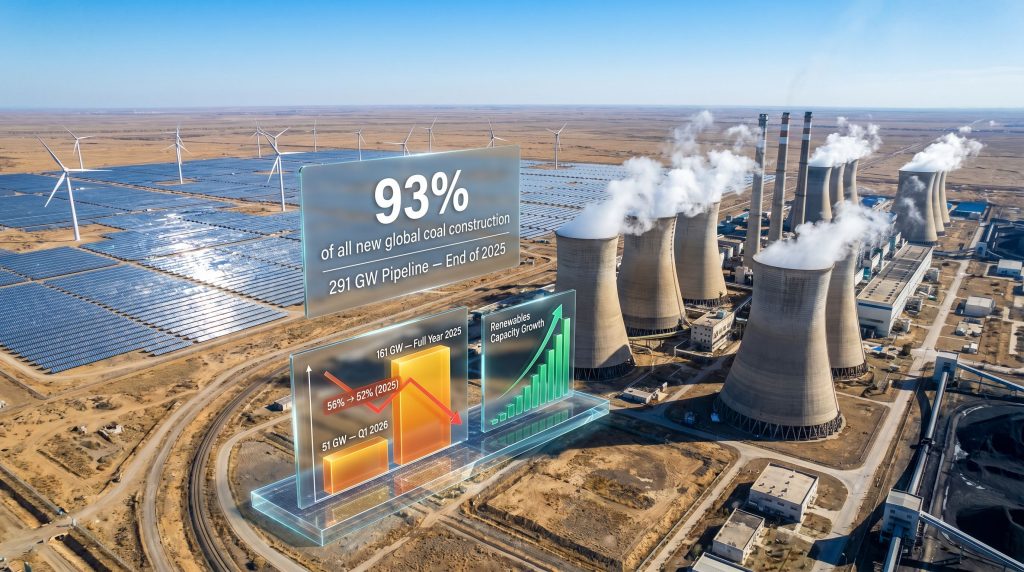
The Structural Paradox Shaping the World's Most Consequential Energy Market
Few contradictions in modern energy policy are as striking as the one playing out across China's power sector right now. The country simultaneously holds the top position globally for new solar and wind capacity additions while also accounting for an estimated 93% of all new coal power construction worldwide. This is not a temporary anomaly or a transitional blip. It reflects deep structural forces that policymakers, investors, and climate analysts are only beginning to fully reckon with.
Understanding why Chinese firms speed up plans to build new coal power plants requires moving beyond surface-level policy reading. The answer lies in the intersection of grid engineering logic, provincial economics, energy security doctrine, and the political calculus of managing a grid that must serve 1.4 billion people reliably.
When big ASX news breaks, our subscribers know first
What the Numbers Actually Reveal
The raw data from Global Energy Monitor (GEM) paints a picture of accelerating momentum rather than a slowing trend. Chinese companies filed requests for 51 gigawatts of new coal-fired capacity in just the first quarter of 2026, a rate that outpaces even the record-breaking 2025 full-year figure of approximately 161 to 162 GW of proposals.
| Metric | Figure | Period |
|---|---|---|
| New coal proposals (Q1 2026) | 51 GW | January to March 2026 |
| Full-year proposals (2025 record) | ~162 GW | Full Year 2025 |
| New coal capacity commissioned | 78 GW | Full Year 2025 |
| Construction starts/restarts (H1 2025) | 46 GW | First Half 2025 |
| Total global coal pipeline (China) | ~291 GW | End of 2025 |
| Proposals approved in Q1 2026 | 3 GW | January to March 2026 |
| Coal plant utilization rate | 52% (down from 56%) | 2025 vs. Prior Year |
One figure in this table stands out above the others as particularly important: only 3 GW of the 51 GW proposed in the first quarter of 2026 actually received formal approval. That is an approval rate of less than 6%, which raises the critical question of whether the volume of proposals itself is meaningful as an economic signal, or whether the bottleneck sits entirely at the permitting stage.
The Approval Gap and What It Signals
The enormous disparity between proposals and approvals can be interpreted through two very different lenses. The first is that Beijing is deliberately throttling the pipeline, using administrative controls to manage grid overcapacity concerns without formally reversing the coal buildout narrative. The second interpretation is less reassuring: the gap may simply reflect bureaucratic processing lag, meaning approvals could follow proposals in waves rather than in real time.
For investors and energy market analysts, the distinction matters considerably. A deliberate regulatory throttle is a policy instrument that can be adjusted in either direction. An administrative backlog, by contrast, implies that approved capacity could surge unexpectedly once the queue clears.
The Driving Forces Behind China's Coal Acceleration
Energy Security After 2021: A Trauma That Changed Everything
The power shortages that struck China in 2021 and 2022 were not minor inconveniences. Rolling blackouts disrupted industrial production across multiple provinces, exposed the fragility of over-reliance on a grid still integrating large volumes of intermittent renewable energy, and created a political pressure point that reverberated through energy planning for years afterward.
That experience fundamentally recalibrated China's tolerance for grid reliability risk. Coal was repositioned not just as a legacy fuel but as a dispatchable backstop capable of generating electricity on demand regardless of weather conditions. Furthermore, in a grid where solar output drops to zero at night and wind capacity factors fluctuate seasonally, this argument carries genuine engineering weight. China's coal backup strategy illustrates precisely how this logic has been institutionalised into national planning frameworks.
Provincial Economics and the Structural Coal Lobby
Coal expansion is not uniformly distributed across China. Construction activity is concentrated in provinces with deep economic dependencies on the fossil fuel sector:
- Xinjiang serves as a remote energy hub, developing large-scale base-load coal plants to feed transmission lines to eastern demand centres.
- Inner Mongolia operates as the coal production heartland, with integrated mine-mouth power stations that co-locate generation with extraction.
- Shandong represents a high-density industrial demand centre where grid stability and continuous industrial supply are primary concerns.
- Shaanxi functions as a major coal-producing province with export-linked generation capacity closely tied to national coal output volumes.
For local governments in these provinces, coal infrastructure investment represents employment, GDP growth, and tax revenue. These economic incentives operate largely independently of national climate commitments, creating a persistent bottom-up pressure toward continued expansion even when top-down signals suggest restraint.
The Pre-Regulatory Rush Dynamic
A pattern observed across multiple infrastructure sectors globally appears to be at work in China's coal buildout: developers accelerating proposals ahead of anticipated tightening of approval criteria. If policymakers are expected to impose stricter emissions-related permitting requirements in coming years, there is a rational incentive to secure approvals under the current framework while it remains accessible.
GEM researcher Christine Shearer has observed that the core debate inside China has shifted from whether renewable energy can scale quickly enough toward whether policymakers are actually willing to allow coal's operational role to contract as clean energy expands. This framing suggests the obstacle is political will rather than technical capacity.
Beijing's Stated Policy vs. Ground-Level Reality
China's central government has committed to peaking coal consumption before 2030. In April 2026, the environment ministry announced intentions to rationally control coal-powered capacity additions. Permit approval rates did decline by more than 30% in early 2024 relative to late 2023, confirming that some regulatory friction is real.
Yet the disconnect between stated intent and corporate behaviour persists. This gap reflects something important about how China's energy governance actually works: central policy sets directional signals while provincial and corporate actors respond to local incentive structures that do not always align with national targets.
The distinction Beijing draws between coal consumption peaking and coal capacity peaking is not semantic. A plant can be built, approved, and connected to the grid while operating at low utilisation, technically consistent with consumption constraints while locking in physical infrastructure for decades.
The Utilization Rate Problem: A Warning Sign Hiding in Plain Sight
Perhaps the most underappreciated figure in China's coal data is the decline in plant utilisation from 56% to 52% in a single year. In power sector economics, utilisation rate is a proxy for whether new capacity makes financial sense. A coal plant operating at 52% capacity factor is already running below optimal thresholds for debt service coverage on the capital investment required to build it.
Adding hundreds of gigawatts of new capacity to a system with declining utilisation rates raises serious questions about capital allocation:
- New plants entering service will compete with existing plants for dispatch, pushing utilisation rates further downward.
- At utilisation rates below 45%, many coal plants become economically marginal or operate at a loss on a variable cost basis.
- State-owned utilities carrying coal assets on their balance sheets face increasing pressure from falling asset productivity even before accounting for long-term transition risk.
Shearer's assessment, as reported by Global Energy Monitor, underscores this concern directly: the current proposal wave risks tying up capital that could be deployed more productively elsewhere in the power system. Consequently, the energy transition in mining and power generation faces a structural tension that utilisation statistics make increasingly difficult to ignore.
When Coal's Abundance Meets Its Hidden Costs
The argument for domestic coal self-sufficiency carries a risk premium that rarely appears in energy planning documents. China's coal supply chain depends on a domestic mining industry that operates at extraordinary scale under persistently hazardous conditions.
A catastrophic mine explosion in May 2026 killed at least 82 workers, making it the deadliest such incident in more than 16 years. Events of this scale do not just represent human tragedy. They have measurable market effects:
| Impact Category | Short-Term Effect | Medium-Term Effect |
|---|---|---|
| Thermal coal spot prices | Spike on supply disruption fears | Normalisation as output resumes |
| Coal mining equities | Rally on scarcity premium | Pullback as safety reviews conclude |
| Regulatory environment | Heightened safety inspections | Potential production curtailments |
| Public and political sentiment | Increased scrutiny of expansion | May strengthen calls for faster transition |
Safety-driven production curtailments can be surprisingly durable. Following major accidents, Chinese regulators have historically mandated sector-wide safety inspections that temporarily reduce national coal output, creating short-lived but sharp price spikes across both domestic and seaborne thermal coal markets. This dynamic creates a recurring volatility pattern that traders in coal-exposed equities have learned to anticipate.
The next major ASX story will hit our subscribers first
Did Geopolitical Shocks Accelerate the Buildout?
The timing of the Q1 2026 proposal surge prompted questions about whether geopolitical energy shocks generated by US and Israeli strikes on Iran at the end of February contributed to the acceleration. GEM's data, however, provides a clear answer: the 51 GW of proposals was distributed evenly across all three months of the quarter rather than clustering in March after the late-February event.
This even distribution confirms that the buildout momentum was already structurally embedded before the geopolitical shock occurred. Shearer noted in her analysis of the data that while a crisis of this nature may reinforce the political justification for continued coal development, the underlying expansion trajectory was already in motion regardless. The geopolitical shock amplifies the narrative but does not explain the data.
Three Scenarios for Where This Leads
Scenario 1: Managed Transition
Coal capacity peaks around 2027 to 2028 as approval rates tighten meaningfully. Utilisation continues declining as renewables absorb incremental demand. New coal plants operate primarily as seasonal or emergency backup capacity, limiting their actual emissions contribution even as their installed capacity remains on the books.
Scenario 2: Structural Overcapacity
Continued approvals at the current pace push total coal capacity well beyond 300 GW of underutilised infrastructure. Utilisation rates fall below 45%, rendering new plants economically marginal. Stranded asset risk escalates across state-owned utilities and independent power producers alike.
Scenario 3: Prolonged Coal Dependence
Sustained electricity demand growth driven by artificial intelligence data centres, electric vehicle charging infrastructure, and industrial expansion justifies higher coal utilisation rates. The government delays the coal peak target beyond 2030. Global climate commitments face credibility challenges as the gap between stated policy and measured outcomes widens.
Disclaimer: Scenario projections involve significant uncertainty and represent analytical frameworks rather than forecasts. Energy transition timelines are subject to policy, economic, and technological variables that cannot be reliably predicted.
What This Means for Global Coal Markets
For energy investors and commodity market participants, the fact that Chinese firms speed up plans to build new coal power plants presents a layered signal that resists simple interpretation:
- Short term: Strong domestic construction demand supports global prices for metallurgical coal and coal-related equipment. The mine disaster dynamic introduces periodic price volatility that creates tactical opportunities in coal-exposed equities.
- Medium term: Overcapacity risk in China's power sector could suppress domestic coal prices over time, potentially reducing China's appetite for seaborne thermal coal imports. In addition, the China steel demand outlook adds another layer of complexity to how commodity markets price future Chinese energy consumption.
- Long term: The trajectory of renewables integration will ultimately determine whether the current generation of new coal plants becomes a bridge asset or a stranded one. The declining utilisation trend already points toward a future in which much of the capacity being proposed today may never achieve the dispatch rates required for economic viability.
Furthermore, the broader implications extend well beyond coal itself. Critical minerals demand tied to China's renewable buildout will continue growing regardless of how the coal story resolves, as grid infrastructure at this scale requires vast quantities of copper, lithium, and rare earth materials.
Three Policy Levers That Will Determine the Outcome
- Approval rate management: Whether the gap between proposals and permits narrows or widens will signal Beijing's true intent more clearly than any policy statement. A sustained 5% to 10% approval rate implies genuine throttling. A widening approval pipeline would indicate that central control is weakening.
- Utilization floor policies: Some analysts have raised the possibility that Beijing could establish minimum dispatch requirements for coal plants to protect the financial viability of state-owned generators. Such a policy would directly conflict with renewable energy's cost advantage as its marginal cost of generation approaches zero.
- Carbon pricing expansion: China's national emissions trading scheme currently covers the power sector but with allocation methods that limit the financial pain of carbon pricing on coal generators. Meaningful expansion of the scheme's stringency would change the investment calculus for new coal proposals fundamentally.
Frequently Asked Questions
How much new coal capacity is China proposing in 2026?
Chinese firms submitted proposals for 51 gigawatts of new coal-fired power capacity in Q1 2026 alone, exceeding the record-setting pace of 2025, which logged approximately 162 GW of proposals across the full year according to Global Energy Monitor.
Why does China keep building coal plants despite its 2030 peak target?
Beijing's coal peak commitment applies specifically to consumption levels, not installed capacity. Energy security doctrine, grid reliability requirements, and provincial economic interests continue driving new proposals even as central policy signals eventual constraint. As reported by Carbon Brief, China's construction of new coal power plants reached a 10-year high in 2024, reinforcing how persistent this structural gap has become.
Are new coal plants actually receiving approval?
Approval rates are dramatically below proposal volumes. Of the 51 GW proposed in Q1 2026, only 3 GW received formal approval according to GEM data. Whether this reflects deliberate regulatory throttling or administrative processing delays remains an open analytical question with significant implications.
What does falling utilization mean for coal investors?
A decline from 56% to 52% utilisation in a single year signals that existing capacity is already being underutilised as renewables absorb incremental demand. Adding more capacity into this environment increases the probability that new plants will generate below economically viable thresholds, elevating stranded asset risk across the sector. Indeed, analysis from Energy and Clean Air confirms that the structural shift toward renewables is already measurably displacing coal's share of generation in China's power mix.
Want to Track the Commodity Ripple Effects of China's Energy Shift?
As China's coal buildout reshapes global energy and commodity markets, Discovery Alert's proprietary Discovery IQ model instantly identifies significant ASX mineral discoveries — from copper and lithium to rare earths — that stand to benefit from the critical minerals demand driving China's parallel renewable expansion. Explore historic discoveries and their market-defining returns, then begin your 14-day free trial to position yourself ahead of the next major find.