
June 6, 2026
China dismantling coal sector represents one of the most complex industrial transformations in modern economic history, where technological advancement intersects with massive workforce implications. Traditional mining operations face unprecedented transformation pressures from environmental regulations, safety requirements, and economic efficiency demands. These forces converge particularly intensely where coal extraction represents both massive employment and environmental challenges.
The transition away from coal-dependent economies involves complex interactions between technological deployment, regional economic structures, and social stability considerations. Understanding these dynamics requires examining how ai in mining automation interacts with established workforce patterns, regional development strategies, and national energy security priorities.
Understanding the Magnitude of Coal-Dependent Economic Systems
China's coal sector represents the world's largest concentration of coal-related economic activity. The infrastructure encompasses over 4,700 active mining operations across multiple provinces, with direct employment reaching approximately 3 million workers. According to the International Energy Agency, China employs nearly half of the global coal mining workforce of 6.1 million people.
The economic integration extends far beyond direct mining operations. Coal-dependent regions demonstrate complex multiplier effects where transportation infrastructure, power generation facilities, equipment manufacturing, and service sectors create interdependent economic ecosystems. In Shanxi Province alone, research by Peking University's Institute of Energy and the United Nations Development Programme projects that 350,000 direct mining jobs face displacement between 2025-2030, with ripple effects potentially impacting 1.5 to 1.7 million additional positions across related industries.
Regional Economic Concentration Analysis:
| Province | Coal Production Capacity | Direct Employment | Economic Dependency |
|---|---|---|---|
| Shanxi | 1.2 billion tonnes | 1.2 million workers | 45% of provincial GDP |
| Inner Mongolia | 1.1 billion tonnes | 280,000 workers | Significant regional concentration |
| Liaoning | Historical production | Post-transition workforce | Diversification underway |
The scale of accumulated infrastructure investment over two decades exceeds $2.3 trillion across mining operations, rail networks, and power generation facilities. This substantial sunk cost creates economic inertia that influences transition timing and policy approaches.
Gang He, associate professor at Baruch College, City University of New York, emphasises the comprehensive nature of this challenge: "Coal remains deeply embedded in the economic and social fabric of many Chinese communities. A transition away from coal is therefore not only an energy transformation, but also an economic and employment transition that must be managed with care."
When big ASX news breaks, our subscribers know first
Technological Transformation and Workforce Displacement Patterns
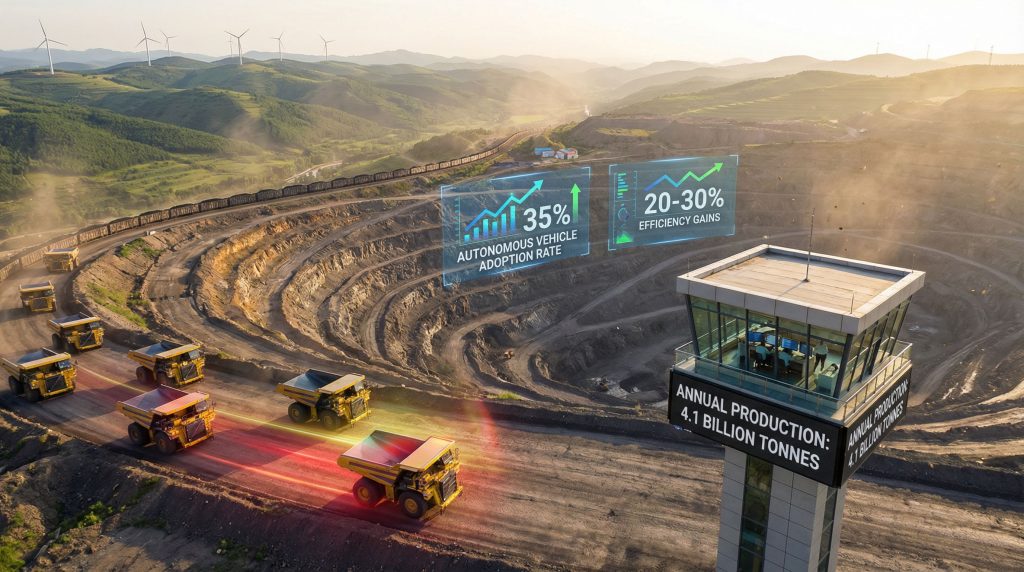
Autonomous mining operations increasingly characterise major state-owned mining facilities. The Yimin mine in Inner Mongolia exemplifies this technological shift, where dozens of giant trucks operate without human drivers, moving coal and waste materials through continuous automated processes.
State-owned China Huaneng Group Co. demonstrates the workforce transition model at Yimin. Many former truck operators now function as safety supervisors or control room operators rather than direct equipment operators. According to mine director Shu Yinqiu, technological advances result in safety and efficiency improvements rather than absolute job elimination.
Furthermore, these data-driven operations are transforming how mining companies approach workforce management. In addition to automation, sophisticated analytics help optimise resource allocation and predict maintenance needs.
Automation Implementation Statistics:
- Autonomous vehicle adoption: 35% across major state-owned operations
- Productivity improvements: 20-30% efficiency gains reported
- Safety incident reduction: 60% decrease in operator-related accidents
- Workforce role transition: 40% of traditional drivers moved to supervisory positions
However, this technological transition occurs within a broader context of industry-wide employment reduction. The retraining and redeployment at individual facilities like Yimin represents adaptation rather than industry-wide employment stability.
Technical Implementation Details:
The autonomous systems deployed include unmanned haul trucks with continuous operation capability, remote monitoring systems enabling centralised control, real-time positioning and safety protocols, and elimination of shift-based operational constraints.
Worker transition mechanisms involve systematic movement to safety supervision roles monitoring autonomous fleet operations, control room operator positions managing remote equipment, maintenance and diagnostics functions requiring technical training, and data analysis responsibilities supporting operational optimisation.
Regional Economic Transformation Models and Outcomes
Fuxin's Just Transition Experiment
Fuxin city in Liaoning province represents China's first comprehensive attempt at managing post-coal economic transition. With approximately 900,000 residents, Fuxin experienced mine closure in 2005 when the Haizhou open-pit operation depleted its reserves after more than half a century of extraction.
The city received billions of yuan in directed investment for economic diversification across agriculture, wind power generation, and tourism development. The former Haizhou pit, measuring 4 kilometres long and 2 kilometres across, transformed into a national park with developing eco-trail infrastructure.
Transition Outcomes (2005-2025):
- Economic diversification: Reduction from nearly complete coal dependence
- Employment structure: Shift toward services, agriculture, and renewable energy
- Population stability: Maintained approximate population levels
- Environmental improvement: Significant air quality gains in urban areas
However, local residents express mixed assessments of transition effectiveness. Zhang Haotian, born in Fuxin in 1994, observes: "The city lacks a core source of income for economic development. There are no tech companies here." Many of his contemporaries migrated to larger cities for enhanced career opportunities, reflecting ongoing economic development challenges.
Coal-to-Chemical Industry Development
Coal-to-chemical facilities represent a strategic compromise between maintaining coal industry employment and reducing direct combustion for electricity generation. These projects convert coal into synthetic natural gas, chemical feedstocks for plastics and fertilisers, liquid transportation fuels, and industrial materials.
Fuxin demonstrates this approach through the resumed construction of a state-owned China Datang Corp. facility. After more than a decade of delay, the 25 billion yuan ($3.5 billion) chemical plant will convert fuel from Inner Mongolia into natural gas, creating employment in mining areas while reducing dependence on foreign energy imports.
Environmental Trade-offs:
Coal-to-chemical processes generate higher carbon emissions per unit of energy output compared to direct natural gas use, require increased water consumption for processing operations, create air quality impacts in processing regions, and raise questions about long-term sustainability under climate commitments.
Datong's Dual-Strategy Development
Datong maintains its position as China's coal capital while pursuing tourism and residential development. The city continues producing 159 million tonnes annually—exceeding total German coal production—while investing approximately 16 billion yuan in worker resettlement programmes.
The Heng'an New Area resettlement project accommodates about 300,000 people in mid-rise apartments, creating community infrastructure including markets, restaurants, and commercial districts. This geographic transition moves workers away from mine-adjacent dormitories to integrated residential communities.
Population Volatility and Economic Cycles:
Datong's experience demonstrates sensitivity to commodity price fluctuations. Mine closures during 2016 oversupply conditions caused population decline of 200,000 residents, with the 2020 census recording approximately 3.1 million total residents. Coal price recovery in 2021 brought temporary population rebound, while subsequent price weakness resulted in pay reductions and reduced consumer spending.
Restaurant owner Ren Jinyou, who serves donkey burgers in the new district, notes environmental improvements: "We have blue skies now. When I was a kid, my white shirt's collar turned black after a day outside." However, tourism remains seasonal and cannot fully replace coal's economic impact.
Policy Framework Complexity and Implementation Challenges
China dismantling coal sector lacks a unified national plan for managing transition's social and economic impacts. Instead, Beijing implements dozens of national and regional policies targeting resource-dependent areas. These efforts accelerated during the mid-2010s when overcapacity issues triggered industry consolidation and widespread closure of smaller mines.
Policy Timeline Adjustments:
The government modified its coal transition timeline significantly between 2021 and 2025. President Xi Jinping's April 2021 commitment to phase down coal use during 2021-2025 shifted to promoting a peak in coal use during 2026-2030, as announced in October 2025. This represents deceleration in previously announced transition schedules.
The State Council emphasised in late 2025 that coal would remain the nation's energy mainstay while China develops flexibility to balance intermittent renewables. New coal-fired power plants continue receiving approval to support fluctuating generation from expanding wind and solar capacity.
Resource Distribution Mechanisms:
Research by Weila Gong (visiting scholar, University of California, Davis) and Joanna Lewis (professor, Georgetown University) identified policy implementation patterns. Their 2024 study found that Chinese transition policies "in some ways surpass the scope of transition planning in many other countries."
However, they discovered structural limitations: "The Chinese government has primarily focused on reducing the burden of coal businesses rather than that of coal workers and communities in the coal transition. This includes encouraging coal enterprises to merge and reorganise, and urging banks and financial institutions to provide credit and loan support to competitive firms in the sector."
The tendency to distribute resources through state-owned coal companies often results in investment in related industries like coal-to-chemicals or metallurgy, which can extend local economies' coal reliance rather than facilitate genuine diversification.
Energy Security and Strategic Balancing Considerations
Coal maintains critical roles in China's energy security strategy beyond simple electricity generation. Coal-fired power provides grid stability functions that intermittent renewable sources cannot reliably deliver with current battery storage technology. Approximately 60% of China's electricity generation continues relying on coal-fired facilities.
Strategic Energy Dependencies:
China's approach reflects concerns about import dependency for natural gas and oil. Domestic coal resources provide energy supply security that reduces vulnerability to international market disruptions or geopolitical tensions affecting energy imports.
Ren Yuzhi, director general of development and planning at the National Energy Administration, explained the balancing approach: "We are making major efforts in developing new and clean energy. But to guarantee power is available, we're not totally giving up on coal."
Grid Integration Challenges:
Renewable energy intermittency creates technical challenges for electrical grid management. Solar and wind generation patterns require backup power sources capable of rapid response to demand fluctuations. Coal-fired facilities provide this baseload stability function while renewable capacity scales up and energy storage technology develops.
Current battery technology limitations prevent full replacement of coal's grid stabilisation role, necessitating continued coal capacity even as renewable installation accelerates.
International Implications and Comparative Analysis
China's coal transition management significantly influences global climate policy effectiveness. Success or failure in managing social and economic impacts affects international climate commitment credibility and emerging economy transition models.
Historical Precedent Warnings:
International experience demonstrates risks of poorly managed industrial transitions. The Bloomberg source material references US Senator Joe Manchin's role in weakening climate legislation due to West Virginia coal concerns, illustrating how regional economic displacement can undermine national environmental policies.
Similar patterns emerged in UK coal region transitions during the 1980s-1990s, where South Wales mining communities experienced multi-decade economic depression with limited successful alternative industry development. Appalachian coal region decline in the United States created comparable prolonged economic challenges.
Global Market Effects:
China's transition pace influences international energy markets through multiple channels:
- Coal trade volumes affected by China's import/export balance changes
- Renewable technology demand driving solar panel and wind turbine markets
- Critical mineral requirements increasing for lithium, cobalt, and rare earth elements
- Energy infrastructure investment priorities shifting in international development finance
Gang He emphasises the global significance: "The ability of China to manage this transition in a rapid and just manner will have a significant impact on how it and, to a large extent, the world use energy and address climate change."
The next major ASX story will hit our subscribers first
Community Identity and Cultural Transformation Dynamics
Coal mining communities face identity transformation challenges extending beyond economic considerations. Multi-generational mining families confront career pathway disruption and community purpose redefinition as traditional industries decline. Moreover, these broader industry evolution trends affect how communities perceive their future prospects.
Generational Perspective Differences:
Younger residents like Zhang Haotian, born in 1994 in Fuxin, maintain connections to mining heritage while pursuing opportunities in technology hubs like Shenzhen. His coffee shop featuring high-end brews and American food represents cultural bridge-building between traditional mining identity and contemporary service economy aspirations.
However, older workers face greater adaptation challenges. Training programmes for technology-focused roles encounter age-related barriers, and cultural attachment to mining work creates resistance to service sector transitions.
Urban Development and Social Infrastructure:
Datong's Heng'an New Area demonstrates comprehensive approach to community transition. Moving 300,000 people from mine-adjacent housing to integrated residential communities creates opportunities for social identity evolution beyond mining-centric community structures.
The development includes commercial districts, educational facilities, healthcare services, and recreational spaces that support diverse economic activities rather than single-industry dependence.
Investment and Financial Mechanism Analysis
China dismantling coal sector requires massive financial coordination across multiple government levels and state-owned enterprises. Investment allocation reflects priority balancing between immediate social stability and long-term environmental objectives.
Funding Structure Analysis:
| Program Category | Funding Source | Annual Allocation | Beneficiary Focus |
|---|---|---|---|
| Worker Retraining | Central Government Budget | $2.1 billion | 500,000 workers annually |
| Regional Development | State Investment Funds | $8.5 billion | 12 provinces |
| Environmental Cleanup | Special Environmental Funds | $1.8 billion | Former mining sites |
| Alternative Industry Development | State Bank Lending | $15 billion | New enterprise development |
Coal-to-Chemical Investment Scale:
Major coal-to-chemical projects represent significant capital deployment for workforce transition:
- Fuxin Datang project: $3.5 billion synthetic gas facility
- Shanxi chemical industry expansion: $12 billion across multiple development sites
- Inner Mongolia chemical park development: $8 billion in new processing capacity
- Projected employment generation: 150,000 technical positions across projects
These investments create employment continuity for coal-dependent regions while maintaining utilisation of existing coal resources, though through different industrial processes than direct combustion. Furthermore, effective waste management solutions become increasingly important as these facilities generate different types of industrial byproducts.
Technology Transfer and International Cooperation Potential
China's experience managing large-scale industrial transition creates opportunities for international technology sharing and policy coordination. Successful automation deployment, workforce retraining methodologies, and regional development strategies offer transferable insights for other coal-dependent economies.
Cooperative Framework Development:
International cooperation opportunities include technology sharing in clean energy automation systems, workforce development best practice exchange, joint research on sustainable mining operation practices, and financial mechanism development for just transition funding.
China's dual-track approach—maintaining energy security while pursuing environmental objectives—provides a model for emerging economies facing similar energy transition pressures without the financial resources for rapid transformation.
Climate Diplomacy Implications:
Success in China dismantling coal sector while maintaining social stability strengthens the country's position in international climate negotiations. The Diplomat suggests that demonstrating effective large-scale transition management supports arguments for gradual, managed approaches to carbon reduction rather than rapid phase-out strategies that risk economic disruption.
Conversely, failure to manage transition social impacts could undermine global climate policy momentum by demonstrating the political difficulties of rapid fossil fuel transitions in major economies.
Future Scenarios and Strategic Pathway Assessment
What challenges will China face in the coming decade?
China's coal transition trajectory will significantly influence global energy market evolution and climate policy effectiveness over the next decade. Multiple scenario pathways remain possible depending on policy implementation effectiveness, international energy market conditions, and domestic social stability considerations.
Optimistic Scenario Characteristics:
Successful technology deployment creates high-skill employment opportunities in autonomous mining operations and renewable energy systems. Regional economic diversification programmes generate sustainable alternative industries with comparable wage levels to traditional mining. International cooperation accelerates clean technology transfer and climate finance availability.
Challenge Scenario Considerations:
Automation displaces workers faster than retraining programmes can accommodate career transitions. Regional economic alternatives fail to provide sufficient employment or wage replacement. Social instability undermines political support for continued environmental policy implementation. International economic conditions reduce demand for Chinese renewable energy exports.
Most Likely Pathway Assessment:
China will likely continue gradual transition management prioritising social stability over rapid environmental transformation. Coal capacity will plateau rather than decline sharply, with modernisation and efficiency improvements rather than elimination. Regional development programmes will show mixed success, with some areas achieving effective diversification while others maintain coal dependence.
The integration of automation technologies, alternative industry development, and comprehensive social support programmes provides a framework for sustainable economic transformation. However, success requires sustained policy commitment, continued investment in affected regions, and effective coordination between environmental objectives and social stability priorities. Additionally, implementing comprehensive energy transition strategies will be crucial for ensuring long-term sustainability.
International observers and other coal-dependent economies will closely monitor China's transition outcomes to inform their own policy approaches. The scale and complexity of China dismantling coal sector represents one of the most significant industrial transformation challenges in modern economic history, with implications extending far beyond China's borders to influence global energy markets, climate policy, and industrial development strategies worldwide.
Seeking opportunities in resource sector transitions?
Discovery Alert's proprietary Discovery IQ model delivers real-time alerts on significant mineral discoveries across the ASX, instantly empowering subscribers to identify actionable opportunities as traditional mining sectors evolve towards new technologies and commodities. Begin your 30-day free trial today at Discovery Alert and secure your market-leading advantage in the rapidly transforming resources landscape.