August 14, 2026
The Industrial Logic Behind Coal's Quiet Transformation Into a Chemical Powerhouse
When energy historians eventually analyse the first half of the twenty-first century, they may identify a development that received far less attention than it deserved: the systematic conversion of coal from a fuel burned beneath boilers into the molecular foundation of modern industrial civilisation. Plastics, fertilizers, synthetic fuels, and industrial gases are all products that most people associate with oil refineries and natural gas processing plants. Yet across vast stretches of inland China, an entirely parallel production system has been quietly scaling for two decades, one that derives these same outputs from coal rather than petroleum. The China coal-to-chemicals industry is not an experimental curiosity or a marginal hedge. It is an industrial architecture of sovereign scale, and the geopolitical disruptions of the mid-2020s have accelerated its relevance in ways that are reshaping global energy and commodity markets simultaneously.
When big ASX news breaks, our subscribers know first
From Fuel to Feedstock: Why Coal's Role Is Being Redefined
The conventional understanding of coal as a power generation fuel obscures a more sophisticated economic reality. Coal contains the same fundamental carbon and hydrogen building blocks that underpin petroleum chemistry. The difference lies not in the raw material's composition but in the conversion infrastructure required to unlock it. China recognised this structural opportunity well before the current energy crisis, and the consequences of that foresight are now plainly visible.
China imports more than 70% of its oil consumption, a dependency that creates continuous exposure to supply disruptions, price shocks, and the geopolitical leverage of exporting nations. By investing heavily in coal conversion technologies throughout the 2000s and 2010s, Chinese policymakers and state-linked enterprises were constructing an industrial insurance policy. The result is a sector that can produce ethylene, propylene, methanol, ammonia, synthetic natural gas, and liquid fuels entirely from domestic coal reserves, bypassing international petroleum markets when those markets become unfavourable.
The China coal-to-chemicals industry is not simply an energy story. It functions as an industrial sovereignty strategy designed to insulate the world's largest manufacturing economy from imported feedstock volatility.
This distinction matters enormously for investors and policymakers alike. Furthermore, the sector's growth is driven not primarily by short-term commodity price arbitrage but by a durable national objective: the reduction of strategic vulnerability through domestic resource conversion. This sits alongside broader energy security priorities that are reshaping industrial policy across Asia.
Core Conversion Pathways: How Coal Becomes Chemicals
The technical architecture of the China coal-to-chemicals industry encompasses several distinct industrial routes, each producing different end products for different end markets.
| Conversion Pathway | Primary Output | Key Application |
|---|---|---|
| Coal Gasification to Methanol | Methanol, Olefins | Plastics, Packaging |
| Coal-to-Ammonia and Urea | Fertilizers | Agriculture |
| Coal-to-Liquid Fuels (CTL) | Synthetic Diesel, Naphtha | Transport, Feedstock |
| Coal-to-SNG | Substitute Natural Gas | Power, Heating |
| Coal-to-Olefins (CTO/MTO) | Ethylene, Propylene | Petrochemicals |
At the core of most of these pathways sits gasification, the process by which coal is converted under high temperature and pressure into synthesis gas, a mixture of carbon monoxide and hydrogen known as syngas. From syngas, catalytic processes yield the full spectrum of chemical outputs depending on reactor configuration and downstream processing choices.
The methanol-to-olefins (MTO) pathway deserves particular attention because it represents a direct substitution for the steam cracking of naphtha that underpins conventional petrochemical production. When MTO plants produce ethylene and propylene from coal-derived methanol, they are generating the same feedstocks that plastics manufacturers require, but from an entirely different and domestically controlled source. According to analysis from Energy and Clean Air Research, this rapid expansion risks undermining China's own climate goals if left unchecked.
Coal-Rock Gas: The Technology Advantage Most Analysts Overlook
Separate from the chemicals conversion story sits an equally significant development in coal-rock gas extraction. PetroChina is advancing a project that applies hydraulic fracturing techniques to coal-bearing rock formations, targeting output of 30 billion cubic metres of gas per year by 2035. In the most recently reported annual period, China produced 4.2 billion cubic metres of rock gas, indicating the substantial expansion planned between now and that target date.
What makes this particularly significant is that China is currently the only country deploying hydraulic fracturing specifically for coal-rock gas extraction at any meaningful scale. This proprietary capability took approximately two decades of iterative technological development to reach commercial viability. Consequently, the barriers to replication are not merely financial but deeply embedded in accumulated process knowledge and engineering experience that cannot be rapidly transferred or reproduced.
The Scale of China's Coal-to-Chemicals Sector
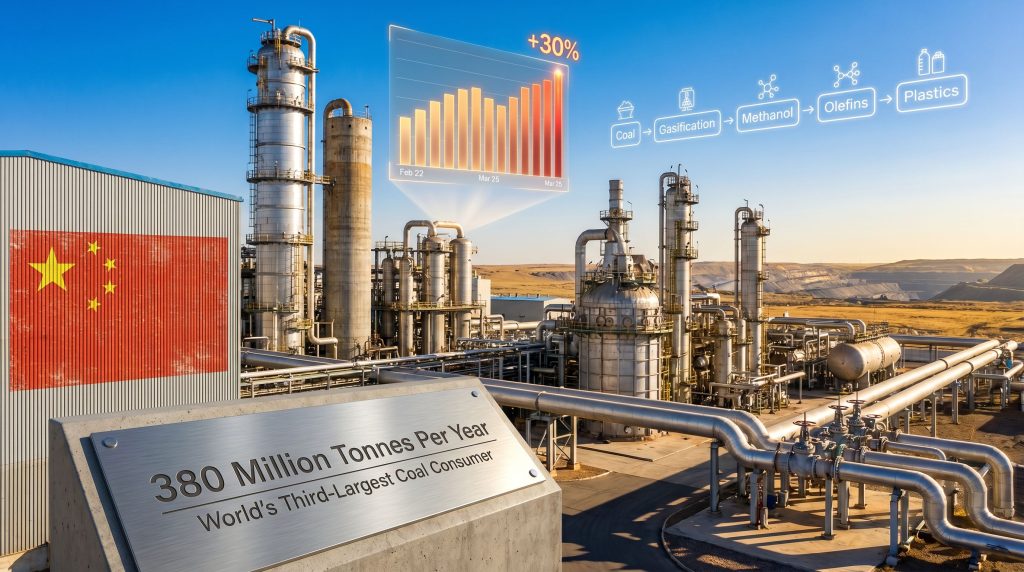
Understanding the scale of the China coal-to-chemicals industry requires a recalibration of reference points. The sector consumes approximately 380 million tonnes of coal per year for chemical production alone. To contextualise that figure: if this single industrial sector were treated as a standalone nation, it would rank as the world's third-largest coal consumer, behind only China as a whole and India. Notably, China consumes almost 400 million tonnes of coal to produce liquid fuels, underscoring the enormous scale of this industrial commitment.
China's total coal production reached approximately 4.74 billion tonnes in recent years, meaning coal-to-chemicals already accounts for a structurally significant and growing share of national coal demand. This is not marginal activity. It represents an industrial base of civilisation-scale consumption.
Geographic concentration of production capacity follows China's coal geology closely.
| Region | Strategic Role |
|---|---|
| Inner Mongolia | Largest coal base; major CTO and CTL production capacity |
| Shaanxi | Integrated coal-chemical industrial parks |
| Ningxia | Methanol and olefins production hub |
| Xinjiang | Emerging capacity expansion zone |
The inland concentration of these facilities creates a distribution challenge for finished products but simultaneously insulates the supply chain from coastal import disruption, which is precisely the point from a strategic planning perspective. This approach also mirrors China's coal strategy of using fossil fuel infrastructure as a long-term industrial backstop.
Market Signals: What Equity Performance Reveals About Sector Sentiment
Coal-to-chemicals equities surged approximately 30% between late February and mid-March 2026 as Middle East supply disruptions elevated the sector's strategic premium in investor portfolios. This kind of sharp re-rating reflects a market beginning to price in a structural shift rather than a temporary arbitrage opportunity.
When investors bid up coal-chemical stocks during an oil supply shock, they are acknowledging that the sector occupies a structurally different risk position than conventional energy equities: its feedstock is domestic, its supply is insulated from the disruption, and its cost base diverges favourably from petroleum-based competitors precisely when macro stress is highest.
Importantly, Chinese coal prices actually fell following the onset of Middle East hostilities, even as oil prices surged. This price divergence directly widened margins across the coal-to-chemicals value chain, creating a positive operating leverage effect that conventional petrochemical producers could not access.
The Economics of Coal-Derived Chemicals: Breakeven Dynamics and Subsidy Questions
The economic viability of the China coal-to-chemicals industry is not uniform across all projects or all price environments. Industry analyses indicate that a meaningful proportion of coal-chemical capacity depends on preferential feedstock pricing and policy support to remain competitive against petroleum-based alternatives during periods of depressed crude oil prices.
Coal-to-chemicals projects typically achieve commercial self-sufficiency when crude oil prices are sustained above approximately $60 to $70 per barrel. At current elevated price levels driven by Middle East disruption, the economics are strongly favourable. The structural risk emerges if oil prices normalise sharply following any conflict resolution.
This breakeven dynamic creates an asymmetric investor profile. The sector generates outsized returns during supply-shock environments while remaining exposed to margin compression when global energy markets normalise. However, sophisticated investors in coal-chemical equities should therefore monitor geopolitical developments in the Middle East not merely as oil price indicators but as direct determinants of coal-chemical sector profitability. The recent oil price rally driven by tariff uncertainty has further amplified this dynamic.
A 2025 industry analysis noted that planned coal-chemical plants had nearly doubled in number globally, with the overwhelming majority located in China. This rapid capacity addition raises legitimate questions about long-run supply discipline and the potential for overcapacity if the current price environment reverses.
India's Attempt to Replicate China's Model: Ambition Versus Structural Reality
India's motivation for building a coal-to-chemicals industry is structurally compelling. The country imports more than 80% of its oil consumption, placing it among the most petroleum-import-dependent major economies on the planet. India holds substantial domestic coal reserves, and the strategic logic of converting locally available resources into chemicals, fertilizers, and fuels rather than importing them on increasingly disrupted international markets is difficult to argue against.
The Indian government has committed approximately $4 billion to catalyse a domestic coal-to-chemicals sector, with a target of converting 75 million tonnes of coal annually into fertilizers, plastics, and other chemicals by 2030. The programme includes infrastructure funding and guarantees of domestic feedstock supply.
However, the structural barriers India faces are considerably more complex than the investment commitment suggests.
| Challenge Factor | India's Position | China's Advantage |
|---|---|---|
| Coal Quality | Lower-rank coals harder to convert efficiently | Higher-quality coals better suited to gasification |
| Technology Maturity | Starting from near-zero industrial base | Approximately 20 years of process development and IP |
| Capital Scale | $4 billion initial commitment may be insufficient | Decades of state-directed capital allocation |
| Post-Conflict Viability | Products may lose competitiveness if gas prices fall | Established cost base and scale efficiencies |
The coal quality dimension is particularly underappreciated in mainstream coverage. Gasification efficiency is significantly affected by coal rank, moisture content, ash composition, and calorific value. Indian coal reserves skew toward lower-rank, higher-ash material that presents greater technical challenges for the gasification processes that underpin chemicals conversion. China's coal-to-chemicals sector was built largely on the higher-quality coals of Inner Mongolia and Shaanxi, providing a thermodynamic and economic advantage that India cannot replicate through investment alone.
The next major ASX story will hit our subscribers first
Environmental Tensions: The Carbon Cost of Industrial Sovereignty
The expansion of the China coal-to-chemicals industry creates a direct tension with the country's stated climate commitments, including carbon peaking before 2030 and carbon neutrality by 2060. The sector is among the most carbon-intensive industrial subsectors in China's economy, and its continued growth adds structurally to national emissions.
The mitigation pathways under exploration remain largely at early or pilot stages.
| Mitigation Approach | Current Status |
|---|---|
| Carbon Capture and Storage (CCS) | Pilot-stage; limited commercial deployment |
| Renewable Energy Integration | Early-stage; green hydrogen co-processing explored |
| Process Efficiency Improvements | Ongoing; incremental gains across major operators |
| Coal Quality Upgrading | Active; reduces per-unit emissions intensity |
The practical reality is that energy security and industrial affordability have consistently overridden emissions reduction timetables during the current supply shock. Decarbonisation timelines are proving politically elastic in ways that energy security imperatives are not. This does not mean climate commitments will be abandoned permanently, but it does indicate that the coal-to-chemicals sector will likely continue expanding for several years before any meaningful emissions-driven constraint takes hold.
Three Scenarios for the Sector's Trajectory to 2035
Scenario 1: Sustained High Energy Prices
Continued geopolitical disruption maintains elevated oil and gas prices through the remainder of the decade. Coal-to-chemicals investment accelerates in both China and India. The sector expands well beyond current capacity projections, and coal becomes entrenched as a core industrial feedstock for at least a generation.
Scenario 2: Price Normalisation After Conflict Resolution
A resolution of Middle East tensions causes petroleum prices to retreat toward pre-crisis levels. Marginal coal-chemical projects face renewed economic pressure. China's established operators maintain viability through accumulated scale and process efficiency; India's nascent industry requires sustained subsidy support to remain operational.
Scenario 3: Technology-Led Integration
Green hydrogen production and carbon capture integration gradually reduce the emissions intensity of coal-to-chemicals processes, allowing the sector to coexist with China's decarbonisation framework. This pathway is the most capital-intensive and least likely to materialise within the current decade.
Key Indicators to Monitor
| Indicator | Significance |
|---|---|
| Brent crude price trajectory | Primary determinant of coal-chemical cost competitiveness |
| China coal-to-chemicals capacity additions | Signals policy commitment and investment momentum |
| India coal-chemical project approvals | Indicator of replication success or failure |
| PetroChina rock gas output vs. 2035 target | Measures progress of coal-bed gas extraction scaling |
| China carbon market pricing | Potential future cost burden on coal-chemical operators |
What the China Coal-to-Chemicals Expansion Reveals About the Real Energy Transition
The growth trajectory of China's coal-to-chemicals sector, and its emerging replication across South Asia, illustrates a structural reality that energy transition narratives consistently underweight: when domestic resources are abundant and imported alternatives are expensive or geopolitically insecure, industrial nations will convert what they have. This is not irrational behaviour. It reflects the foundational hierarchy of energy policy priorities, where reliability and affordability consistently occupy the top two positions, with emissions reduction occupying a subordinate role during periods of supply stress.
The coal-to-chemicals sector's ability to consume 380 million tonnes of coal per year while producing outputs that directly substitute for petroleum-derived products means it creates a structural floor under global coal demand that persists regardless of how rapidly the power generation sector decarbonises. Even if China transitions its electricity grid toward renewables on the timelines it has articulated, the coal-to-chemicals industry will continue generating substantial thermal coal demand for decades. In addition, the global steel outlook and China steel demand trends further reinforce coal's entrenched role within China's broader heavy industrial economy.
For investors, commodity analysts, and energy strategists, the China coal-to-chemicals industry warrants considerably more attention than it typically receives in Western financial media. Its scale is comparable to entire national energy sectors, its strategic rationale is durable across political cycles, and its expansion trajectory is supported by both economics and industrial policy in ways that make near-term contraction unlikely regardless of which geopolitical scenario ultimately unfolds.
Disclaimer: This article is intended for informational and educational purposes only. It does not constitute financial, investment, or trading advice. All figures, forecasts, and scenario analyses are subject to change and should not be relied upon as the sole basis for any investment decision. Readers should conduct independent research and consult qualified financial advisers before making investment decisions.
Want To Track the Next Major Commodity Discovery Before the Market Moves?
Discovery Alert's proprietary Discovery IQ model delivers real-time alerts on significant ASX mineral discoveries across coal, energy commodities, and beyond — transforming complex data into actionable investment insights the moment announcements hit the exchange. Explore historic discoveries and their extraordinary returns, then begin your 14-day free trial at Discovery Alert to position yourself ahead of the broader market.