August 12, 2026
The Geopolitics of Synthetic Molecules: Why China's Coal-to-Gas Ambition Is Reshaping Global Energy
When energy security analysts examine the structural vulnerabilities of import-dependent gas markets, the conversation typically centres on pipeline routes, LNG terminal capacity, and shipping lane exposure. What rarely enters that conversation is a fundamentally different question: what happens when a country decides to manufacture its own gas molecules from scratch, entirely within its own borders, using resources it already controls in abundance? That is precisely the strategic calculation underpinning the China coal-to-gas industry, and the scale of what is now being built demands serious attention from anyone with exposure to global LNG markets.
When big ASX news breaks, our subscribers know first
Understanding the Coal-to-Gas Process and Why It Matters
Synthetic natural gas production through coal gasification is a multi-stage thermochemical process that is considerably more complex than conventional gas extraction. Coal is fed into a high-temperature gasifier along with steam and oxygen, producing a raw synthesis gas, commonly called syngas, composed primarily of hydrogen and carbon monoxide. This syngas then undergoes a catalytic methanation reaction, converting it into methane that meets pipeline-quality specifications.
The resulting synthetic natural gas is chemically indistinguishable from conventionally extracted methane, meaning it can be injected directly into existing gas distribution networks without modification. This is not a niche laboratory technology. China has operated commercial-scale coal-to-gas facilities for over a decade, accumulating engineering expertise, supply chain depth, and operational data that no other country has replicated at comparable industrial scale.
What makes the China coal-to-gas industry categorically different from any historical experiment elsewhere is the combination of:
- Vast domestic coal reserves concentrated in geographically accessible western provinces
- Mine-mouth coal pricing structures that make input costs structurally low compared to global benchmarks
- A domestic gas demand base large enough to absorb significant synthetic gas volumes without market disruption
- A centralised planning system capable of coordinating capital allocation, regulatory approvals, and pipeline infrastructure simultaneously
No other nation has assembled all four of these conditions at scale, which is why CTG remains a uniquely Chinese industrial phenomenon. Furthermore, China commodity demand trends across multiple sectors reinforce the structural importance of ensuring affordable domestic energy inputs.
Xinjiang's Cost Advantage: The Economics Behind the Expansion
The geographical concentration of new CTG capacity in Xinjiang is not accidental. It reflects a deliberate exploitation of one of the most significant regional coal cost differentials in the world. Mine-mouth coal prices in Xinjiang averaged approximately 214 yuan per tonne, equivalent to roughly $30 per tonne, across the period from April 2025 through May 2026. That figure represents less than 40% of equivalent coal costs in Inner Mongolia, which has historically been China's other major CTG hub.
This input cost advantage directly determines the delivered price of synthetic gas reaching eastern Chinese markets. Xinjiang-based CTG facilities are currently producing gas that arrives in eastern China at a delivered cost of $9.1 to $9.6 per MMBtu, a price range that generally sits below China's average LNG import price. In energy economics, a structural cost advantage of even a few dollars per MMBtu is sufficient to drive very high plant utilisation. Current reported utilisation rates at existing CTG facilities are above 90%, confirming that domestic synthetic gas is genuinely competitive with the import alternative.
Regional CTG Geography: Where Capacity Is Concentrated
| Province/Region | Primary Role | Relative Coal Cost |
|---|---|---|
| Xinjiang | Dominant growth hub; fastest approvals | Lowest (~$30/tonne) |
| Inner Mongolia | Established base; slower growth | Higher (>$75/tonne equivalent) |
| Shaanxi | Coal chemical cluster participant | Moderate |
| Ningxia | Existing infrastructure; northwest corridor | Moderate |
Project approval timelines in Xinjiang have compressed dramatically in recent years, with several new CTG developments receiving regulatory clearance in under 12 months, compared to the three-year-plus timelines that were standard in previous cycles. This administrative acceleration reflects the priority that central planning authorities are placing on energy security infrastructure investment in the northwest corridor.
Capacity Scale and the 2030 Growth Trajectory
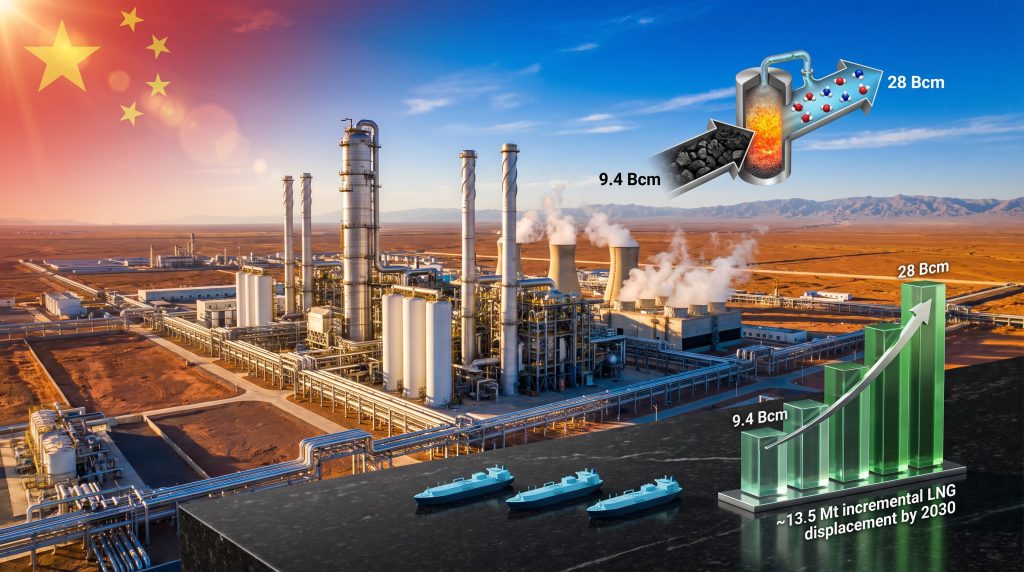
The numbers involved in China's CTG buildout are significant enough to register as a structural force in global gas markets rather than a marginal supply adjustment. According to Rystad Energy analysis, China's CTG capacity is projected to reach 9.4 Bcm per year by end-2026, with growth to 28 Bcm per year by 2030. That represents an approximate tripling of capacity within a four-year window.
To contextualise the scale, 28 Bcm per year exceeds four times Austria's total annual coal-produced gas demand. Approximately 20 Bcm per year of CTG capacity is currently under active construction, a figure that represents roughly four times the cumulative volume built over the entire preceding decade.
| Capacity Metric | Figure |
|---|---|
| CTG capacity by end-2026 | 9.4 Bcm/year |
| Projected CTG capacity by 2030 | 28 Bcm/year |
| Growth multiple (2026 to 2030) | Approximately 3x |
| Capacity currently under construction | ~20 Bcm/year |
| Coal converted to chemicals, oil & gas annually | 276 million tonnes |
The broader context is equally instructive. Data from China's National Petroleum and Chemical Planning Institute indicates that the country is already converting 276 million tonnes of coal into chemicals, oil, and gas annually. As noted by The Coal Hub, coal's role is increasingly expanding well beyond power generation into a wide range of industrial outputs. CTG capacity growth is therefore occurring within a mature industrial ecosystem that has already accumulated the engineering knowledge, logistics infrastructure, and regulatory familiarity to execute large projects efficiently.
CTG Within China's Broader Energy Security Architecture
A critical analytical error made by many Western energy commentators is to evaluate Chinese CTG purely on environmental or economic efficiency grounds. Through that lens, it appears expensive and carbon-intensive relative to LNG imports or domestic conventional gas. That framing misses the point entirely.
China's energy security doctrine is built around supply source diversification, specifically reducing simultaneous exposure to LNG shipping lane disruption, pipeline route geopolitics, and import price volatility. The US-China trade war impacts have, furthermore, accelerated Beijing's determination to reduce its reliance on internationally sourced energy commodities. CTG sits within a layered supply architecture that includes:
- Pipeline imports from Russia via the Power of Siberia system
- Central Asian pipeline volumes through Turkmenistan, Uzbekistan, and Kazakhstan
- LNG terminal capacity across multiple coastal provinces
- Domestic conventional gas from Sichuan, the Tarim Basin, and offshore fields
- Coal-to-gas as a geopolitically insulated domestic molecule supply chain
The strategic value of CTG is not found on a cost-per-MMBtu spreadsheet. It lies in the fact that synthetic gas produced from Xinjiang coal cannot be sanctioned, rerouted by a foreign government, disrupted by a maritime incident, or priced by a seller operating in a tight global market. It is energy autarchy applied to molecules.
The 15th Five-Year Plan, covering 2026 to 2030, formally elevates CTG from a supplemental consideration to an active execution priority within national supply planning. This policy signal matters because it directs capital allocation across state-owned enterprises, shapes financing terms for new projects, and sets the regulatory tone for approval timelines. Broader energy security strategies being pursued across the Asia-Pacific region reflect a similar logic, with nations increasingly prioritising domestic supply resilience over pure cost optimisation.
Environmental Constraints and the Decarbonisation Challenge
The environmental profile of the China coal-to-gas industry represents its most significant long-term challenge. CTG production carries substantially higher carbon intensity per unit of gas output than either conventional gas extraction or LNG importation. Water consumption is a material operational constraint, particularly in Xinjiang and Inner Mongolia, which rank among China's most water-stressed regions.
Agricultural, industrial, and municipal water demands are all intensifying in these areas, creating a potential constraint on future capacity additions that goes beyond regulatory compliance. According to analysis from Energy and Clean Air Research, the rapid expansion of coal-to-chemicals and coal-to-gas facilities poses a measurable risk to China's longer-term climate commitments, particularly given the scale of carbon emissions involved.
China has not yet established a uniform nationwide decarbonisation standard for new CTG projects. Environmental compliance obligations are currently being applied on a project-specific basis, which creates variability across the sector and introduces uncertainty into long-term capital planning.
The CHN Energy Zhundong Project: A Blueprint for Next-Generation CTG
The CHN Energy Zhundong development represents the first generation of CTG facilities designed with decarbonisation infrastructure embedded from the ground up rather than retrofitted. Key design features include:
- Capacity: 2 Bcm per year
- Scheduled production start: 2027
- Electrolytic hydrogen integration to improve carbon balance
- Wastewater recycling systems to reduce water consumption intensity
- Planned carbon capture capacity of 550,000 tonnes per year
The carbon capture dimension raises a nuanced commercial question. China already has an established market for utilisation-based carbon capture, where captured CO2 has a practical industrial end-use such as enhanced oil recovery or chemical feedstock. However, geological storage-based carbon capture, where CO2 is permanently sequestered underground, remains commercially limited within China.
If captured CO2 from CTG operations is directed to geological storage rather than utilisation, the commercial justification for that capital investment weakens considerably. The long-term bankability of decarbonised CTG economics therefore hinges on whether utilisation-based carbon capture can scale proportionally to CTG capacity growth, a question that remains unresolved.
It is also worth noting that reported water consumption figures typically apply to the entire CTG complex rather than specifically to carbon capture systems, making direct comparisons with other clean energy technologies methodologically complex.
The next major ASX story will hit our subscribers first
How CTG Will Affect Global LNG Markets Through 2030
The implications of China's CTG buildout for the global LNG supply outlook are neither immediate nor catastrophic, but they are structural and cumulative. At 28 Bcm per year by 2030, CTG remains a supplemental supply source rather than a wholesale replacement for gas imports. However, every Bcm of domestically produced synthetic gas directly displaces an equivalent volume of LNG import demand.
| Scenario | CTG Volume (Bcm/year) | Approximate LNG Equivalent (million tonnes) |
|---|---|---|
| 2026 baseline | 9.4 | ~6.8 Mt |
| 2030 projection | 28 | ~20.3 Mt |
| Incremental displacement (2026 to 2030) | ~18.6 | ~13.5 Mt |
Note: LNG equivalent calculated at approximately 1.38 Bcm per million tonne of LNG.
The incremental displacement of approximately 13 to 14 million tonnes of LNG demand by 2030 is not a rounding error in global contracting. Rystad Energy's gas and LNG markets analysis frames CTG as one of China's multiple hedges against a world where LNG supply is finite and politically sensitive, positioning it as a structural dampener on demand that every exporter targeting China should incorporate into baseline demand modelling rather than treating it as a downside scenario.
Australia energy export challenges are consequently amplified by this dynamic, given Australia's position as China's largest LNG supplier. Qatari and US exporters competing for long-term contract renewals must similarly account for CTG cost competitiveness when structuring their pricing and volume assumptions. The risk is not a sudden demand cliff but a gradual, predictable erosion of China's marginal import requirements as CTG capacity accumulates across the 2026 to 2030 planning horizon.
Key Risk Factors That Could Slow the CTG Trajectory
| Risk Factor | Nature of Risk | Severity Assessment |
|---|---|---|
| Water scarcity in Xinjiang and Inner Mongolia | Operational ceiling on expansion | High |
| Absence of uniform carbon standards | Regulatory uncertainty; retroactive cost risk | Medium |
| Carbon capture commercialisation gap | Limits decarbonisation credibility | Medium-High |
| Coal input price volatility | Margin compression if mine-mouth prices rise | Medium |
| Environmental approval risk | Periodic policy-driven slowdowns | Low-Medium |
The water constraint deserves particular emphasis because it is frequently underestimated in capacity projections. Large-scale CTG complexes require substantial water inputs across gasification, cooling, and wastewater treatment processes. As competing demand from agriculture and municipal users grows across northwestern China, future project developers may face tighter water allocation constraints that are not currently visible in near-term approval pipelines.
What the 2030 CTG Buildout Signals for the Global Gas Order
A near-tripling of China's coal-to-gas capacity within four years is one of the most consequential structural shifts currently underway in global gas demand geography. Unlike demand-side changes driven by economic cycles or weather patterns, this is a deliberate, capital-intensive infrastructure build with multi-decade operational lifespans. Plants approved today will still be producing synthetic gas in 2050.
For LNG project developers evaluating final investment decisions on new export capacity targeting Chinese buyers, CTG growth is no longer a scenario to be stress-tested. It is a baseline planning variable that belongs in the central case. For policymakers and energy analysts, the China coal-to-gas industry illustrates a broader principle: when energy security objectives are sufficiently compelling, economic and environmental objections become secondary considerations rather than decisive ones.
The molecule China is producing in Xinjiang today is the same molecule buyers in Shanghai will pay for. The difference is that no foreign government, shipping lane disruption, or global price spike can prevent it from arriving.
Disclaimer: This article is intended for informational purposes only and does not constitute financial, investment, or legal advice. Capacity projections, cost figures, and market impact estimates involve forward-looking assumptions and are subject to change. Readers should conduct independent research and consult qualified advisers before making investment decisions.
Want to Track the ASX Discoveries Reshaping Global Commodity Markets?
As China's coal-to-gas expansion reshapes LNG demand and broader energy commodity flows, the ripple effects will increasingly surface in ASX-listed exploration and resource companies — and Discovery Alert's proprietary Discovery IQ model scans ASX announcements in real time, delivering instant alerts on significant mineral discoveries so subscribers can act on actionable opportunities before the broader market catches on. Explore Discovery Alert's dedicated discoveries page to understand how major mineral discoveries have historically generated substantial returns, and begin your 14-day free trial today to position yourself ahead of the market.