August 12, 2026
Africa's Aluminium Chessboard: Why Guinea's State Mining Push Is Rewriting the Rules of a Global Industry
The global aluminium supply chain has long operated on a quietly accepted asymmetry: resource-rich nations in the developing world extract raw ore, while processing margins accumulate in the industrial economies that refine and smelt it. For decades, Guinea sat at the extractive end of this chain, supplying an ever-growing share of global bauxite production while capturing only a fraction of its ultimate value. That arrangement is now being challenged from within, through the rapid construction of a state-owned commercial mining enterprise unlike anything the West African nation has attempted before.
Guinea Nimba Mining Company bauxite production is no longer a footnote in commodity market reporting. Within roughly twelve months of its creation, the company has exported more than five million tonnes of ore, locked in negotiations with one of the world's largest commodity traders, and set its sights on a production target that would have seemed improbable for a brand-new enterprise.
When big ASX news breaks, our subscribers know first
Understanding Nimba Mining Company: A Profile of Guinea's Newest State Enterprise
Nimba Mining Company was formally established in August 2025 as a wholly state-owned Guinean entity. Its creation was not the product of a gradual policy evolution. It emerged from a confrontation: the revocation of the mining concession held by Guinea Alumina Corporation, the local arm of Emirates Global Aluminium, a UAE-based aluminium producer that had invested substantially in mine infrastructure, rail networks, and export facilities in Guinea's Boké region.
Guinea's government accused GAC of failing to meet obligations under the country's mining framework, particularly around domestic processing requirements. The dispute reflected a broader political shift under President Mamadi Doumbouya's administration, which has systematically increased enforcement pressure on foreign operators and pushed for in-country value addition rather than continued raw ore exports.
The standoff was resolved in May 2026 through a tripartite settlement between the Guinean government, GAC, and Emirates Global Aluminium. Under the terms of that agreement:
- GAC's operational assets were transferred to Nimba for development of the Sangarédi bauxite project
- Guinea agreed to make a lump-sum compensation payment to GAC
- A commercial bauxite supply arrangement for EGA was restored through Compagnie des Bauxites de Guinée
That settlement cleared the path for Nimba's accelerated production ramp-up and effectively ended a period of uncertainty that had complicated Guinea's broader mining investment environment.
Key Facts at a Glance: Nimba Mining Company Profile
| Metric | Detail |
|---|---|
| Established | August 2025 |
| Ownership Structure | 100% Guinean state-owned |
| Primary Commodity | Bauxite |
| Operating Mine | Tinguilinta, Boké Region |
| Estimated Reserves | 400-470 million tonnes |
| Export Port | Port of Kamsar |
| 2025 Shipments | ~1,002,400 tonnes |
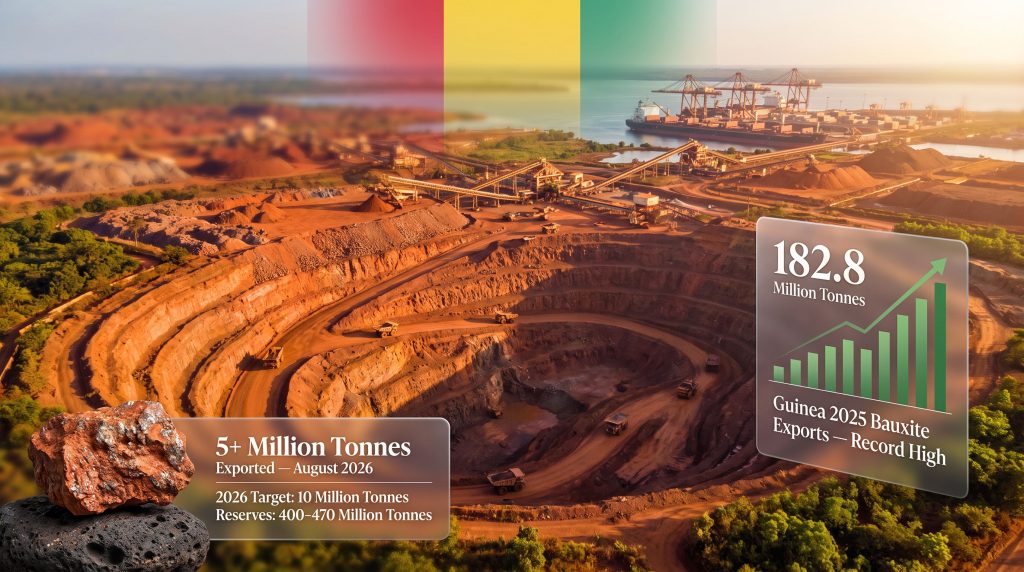
| Cumulative Exports (to Aug 2026) | 5+ million tonnes |
| 2026 Shipment Target | 10 million tonnes |
| 2027 Capacity Target | 12 million tonnes per annum |
| Long-Term Production Target | 14+ million tonnes per annum |
| Diversification Pipeline | Alumina refinery, gold, base metals |
Scale perspective: At its 14-million-tonne annual target, Nimba Mining Company would still represent less than 10% of Guinea's total bauxite export volume, which reached a record 182.8 million tonnes in 2025. This single data point illustrates both the extraordinary scale of Guinea's existing mineral output and the room available for further state-sector expansion without disrupting the broader market.
Guinea's Bauxite Dominance: The Numbers Behind the Nation's Market Power
Guinea's 2025 export figure of 182.8 million tonnes represented a 25% year-on-year increase, an acceleration that has few parallels in the recent history of bulk commodity markets. To contextualise that volume: Australia, historically one of the world's largest bauxite producers, exports roughly 30 to 35 million tonnes annually. Guinea's output now dwarfs that figure by a factor approaching five.
The concentration of destination is equally striking. Approximately 74% of Guinea's bauxite exports in 2025 were directed to China, the world's largest aluminium producer. This bilateral dependency has served both parties: China gains access to high-quality ore at scale, while Guinea benefits from predictable demand that has underpinned sustained production growth.
Yet this arrangement contains a structural tension that Nimba's creation is, in part, designed to address. When a single buyer accounts for nearly three-quarters of a producer nation's export volume, pricing leverage is asymmetric. The buyer's negotiating position is inherently stronger, particularly when the seller has limited downstream processing capability and therefore limited ability to redirect output through alternative value chains.
The Aluminium Supply Chain: Where Guinea Sits and Where Nimba Wants to Go
Understanding Nimba's strategic ambitions requires clarity on how the aluminium supply chain functions from ore to finished metal. Furthermore, examining the role of leading bauxite mines worldwide helps contextualise the scale of Guinea's ambitions.
- Bauxite mining – Raw ore is extracted from the earth. Guinea currently dominates this stage globally, but it captures the lowest margin in the chain.
- Alumina refining – Bauxite is converted into aluminium oxide (alumina) through the Bayer Process, an energy-intensive chemical process. This stage adds substantial value; alumina typically trades at roughly three to four times the per-tonne price of bauxite.
- Aluminium smelting – Alumina is smelted into primary aluminium metal through electrolysis. This is the most energy-intensive stage and tends to locate near cheap electricity sources.
- Downstream fabrication – Aluminium metal is rolled, extruded, and cast into products for automotive, aerospace, packaging, and construction industries.
Guinea currently participates almost exclusively at stage one. An alumina refinery, which Nimba has identified as a core development objective, would shift Guinea into stage two and capture a meaningfully higher share of the value chain. China's commitment to a $1 billion alumina plant investment in Guinea's Boké region, announced by a major Chinese state-owned producer, provides a concrete benchmark for the capital intensity involved in such a transition.
What is the difference between bauxite and alumina? Bauxite is the raw ore from which aluminium is ultimately derived. It must be refined into alumina through the Bayer Process before being smelted into aluminium metal. Nations that export raw bauxite without processing it domestically forfeit the refining margin, which can represent a multiple of the ore's own value.
How Nimba Mining Company Is Built to Compete Commercially
What distinguishes Nimba from a conventional state mining vehicle is its deliberate commercial architecture. Rather than operating through fixed government-to-government offtake arrangements, the company has adopted a hybrid sales model designed to introduce competitive market dynamics into its revenue structure. In addition, the top aluminium mining companies globally are watching this model with considerable interest.
The Dual-Track Sales Model
Nimba's commercial framework rests on two complementary mechanisms:
- Guaranteed minimum-volume offtake: A base-load revenue commitment providing cash flow certainty for operational planning and capital investment. Glencore was selected through an international tender process as Nimba's primary offtaker, with final commercial negotiations still underway as of August 2026.
- Monthly spot tenders: Additional bauxite cargoes beyond the guaranteed offtake volume are offered to competitive bids from international commodity traders and mining companies. Guinea's Mines Minister Bouna Sylla confirmed that companies including Mercuria, Rio Tinto, and Vedanta are among those eligible to participate.
This dual-track structure introduces price discovery into a market that has historically been dominated by bilateral long-term contracts with limited transparency. If Nimba's monthly tender model gains traction at scale, it could influence pricing benchmarks across Guinea's broader bauxite sector, much as iron ore's transition from opaque bilateral pricing to index-linked contracts reshaped that market over the past two decades.
The IBS Group Subcontracting Agreement
Nimba has also executed a five-year mining subcontracting agreement with IBS Group, covering a minimum commitment of 32 million tonnes from the Tinguilinta bauxite mine. This arrangement reflects a strategically sensible division of responsibilities: Nimba retains commercial and resource ownership while outsourcing operational execution to an experienced contractor, accelerating the production ramp-up without requiring the company to build full internal operational capacity from a standing start.
For a company less than two years old, this approach reduces execution risk while preserving strategic control over the asset.
Financing the Expansion: The Self-Funding Discipline Signal
Nimba has stated clearly that its expansion programme will be financed primarily through reinvested operational earnings rather than through proceeds from Guinea's separate $23 billion Simandou iron ore project. This is a commercially significant signal. It implies that Nimba's management believes the cash flows generated at 10 million tonnes per annum are sufficient to fund at least the early stages of its diversification agenda without cross-subsidisation from other state projects.
Whether that arithmetic holds at the scale of a simultaneous alumina refinery construction programme, gold mine development, and base-metals feasibility study is a question that will test Nimba's financial discipline over the next several years.
Nimba's Production Trajectory: A Timeline of Rapid Growth
| Period | Milestone |
|---|---|
| August 2025 | Nimba Mining Company formally established |
| Late 2025 | First shipments commence from Tinguilinta mine |
| End of 2025 | ~1,002,400 tonnes exported |
| April 2026 | Cumulative exports surpass 4 million tonnes |
| May 2026 | GAC/EGA settlement finalised; Sangarédi assets transferred |
| August 2026 | Cumulative exports exceed 5 million tonnes |
| 2026 Full Year Target | 10 million tonnes |
| From 2027 | Annual capacity target of 12 million tonnes |
| 2-5 Year Horizon | 14+ million tonnes per annum |
Scenario Analysis: Three Pathways for Nimba's Future
Guinea Nimba Mining Company bauxite production ambitions unfold against a backdrop of genuine uncertainty. The following scenarios frame the range of plausible outcomes across a five-year horizon. Consequently, understanding each pathway is essential for anyone tracking aluminium sector investment trends in the region.
Scenario 1: Successful Vertical Integration (Base Case)
- Nimba achieves its 14-million-tonne annual production target within the two-to-five-year window
- Monthly tender volumes attract consistent international participation, establishing competitive price benchmarks
- The alumina refinery advances to construction, repositioning Guinea higher in the value chain
- Operational cash flows provide sufficient capital to fund diversification without recourse to external debt or state transfers
- Guinea's share of aluminium supply chain value increases materially
Scenario 2: Operational Bottleneck (Moderate Risk Case)
- Infrastructure constraints at Tinguilinta or the Port of Kamsar create a ceiling on production growth below the 14-million-tonne target
- Financing gaps emerge between operational cash generation and the capital demands of simultaneous alumina, gold, and base-metals development
- International traders adopt a cautious stance on tender participation, limiting the price competition that the model depends on
- Guinea faces pressure to renegotiate terms with foreign technical partners to sustain export volumes
Scenario 3: Geopolitical and Governance Disruption (Tail Risk Case)
- China's outsized share of Guinea's bauxite exports creates leverage risk if bilateral relations deteriorate over trade, diplomacy, or resource pricing disputes
- The GAC concession revocation, while resolved, elevates the sovereign risk premium that international capital markets apply to Guinean mining exposure, constraining Nimba's access to project financing
- Rapid expansion outpaces governance capacity within a company that has existed for fewer than two years
- A softening in global aluminium demand compresses bauxite prices, undermining Nimba's self-funding model
Investor Consideration: The GAC episode demonstrated that Guinea's government is willing to act against established, well-capitalised foreign operators when it believes domestic obligations are not being met. While this reinforces state sovereignty over resources, it simultaneously raises the risk premium that international capital must price into any Guinean mining exposure. This tension between assertive resource nationalism and the need for foreign expertise and capital is one of the defining constraints on Nimba's trajectory.
The next major ASX story will hit our subscribers first
Nimba's Diversification Pipeline: Beyond Bauxite
| Commodity | Development Stage | Key Challenge |
|---|---|---|
| Bauxite | Active production | Scale-up pace and port infrastructure |
| Alumina | Pre-construction planning | Capital intensity and financing structure |
| Gold | Joint evaluation (Resolute Mining) | Exploration risk and project timeline |
| Base Metals | Pre-feasibility | Technical complexity and funding uncertainty |
The Resolute Mining Partnership: Gold as a Strategic Pivot
In March 2026, Australian Securities Exchange-listed Resolute Mining signed an agreement with Nimba to evaluate gold development opportunities across Guinea, with both parties considering potential joint development of identified projects. The partnership is notable for several reasons beyond the transaction itself.
It signals that Nimba is willing to engage international listed mining companies on non-bauxite minerals through collaborative structures rather than asserting exclusive state control. This approach is commercially pragmatic: Resolute brings exploration expertise, technical capability, and access to international capital markets that Nimba, at its current stage of institutional development, cannot replicate internally. According to Mining Weekly's coverage of Nimba Mining Company, Guinea's gold sector has historically attracted exploration activity but lacked the development capital to translate geological potential into producing mines at scale.
Base Metals: The Bankable Feasibility Milestone
Nimba's ambition to advance a base-metals project towards bankable feasibility study represents a technically significant goal. In mining finance, a bankable feasibility study is the document that satisfies lenders and equity investors that a project is technically viable, economically robust, and ready for construction financing.
Reaching that milestone typically requires several years of detailed geological work, metallurgical testing, infrastructure engineering, and environmental assessment. For a company founded in 2025, targeting this milestone across a diversified commodity portfolio simultaneously with a bauxite production ramp-up represents a genuine execution challenge.
How Nimba Compares to Africa's State Mining Enterprises
Placing Nimba in the context of African state-owned mining companies reveals both the scale of its ambition and the difficulty of the path ahead. For instance, a closer look at the mining industry of Guinea highlights how the sector has historically struggled to convert geological wealth into institutional capability.
- Morocco's OCP Group is the most commercially successful African state mining enterprise, controlling a dominant position in global phosphate markets and operating with a governance model that functions closer to a multinational corporation than a government department. OCP's success rests on decades of institutional development and disciplined capital allocation.
- Zambia's ZCCM-IH represents a more cautionary precedent. Zambia's copper sector state vehicle has struggled to balance commercial imperatives with political pressures, and its track record of operational performance has been uneven.
- Société Nationale des Pétroles du Congo illustrates the petroleum sector parallel: resource nationalism can establish state ownership without necessarily delivering operational efficiency or equitable revenue distribution to citizens.
Nimba is far younger than any of these comparators. Its monthly tender mechanism and its willingness to subcontract mining operations to IBS Group suggest a pragmatic commercial instinct. However, the institutional frameworks, governance structures, and management depth required to sustain commercially competitive performance across a diversified mining portfolio take years to build.
The China Dependency Question: Structural Risk in Guinea's Export Mix
China's role in Guinea's bauxite economy deserves careful analysis beyond the headline 74% export share figure. Chinese aluminium smelters depend on Guinean ore because China's own bauxite reserves are of lower grade and increasingly depleted. Guinea's ore quality, particularly from the Boké region, is internationally regarded as among the highest available, with favourable alumina content and relatively low reactive silica.
These characteristics make it particularly well-suited to alumina refinery processing. This quality advantage gives Guinea genuine negotiating leverage, but only if it can develop alternative buyer relationships or downstream processing capacity that reduces its dependence on Chinese demand.
Nimba's monthly tender mechanism, by attracting Mercuria, Rio Tinto, Vedanta, and others into competitive bidding, is a direct attempt to build that optionality. Whether it succeeds in shifting pricing dynamics will depend on the volume of ore available through the tender relative to the total market, and on the willingness of non-Chinese buyers to commit to Guinean supply chains given the sovereign risk environment.
Frequently Asked Questions: Guinea Nimba Mining Company Bauxite Production
What is the Nimba Mining Company?
Nimba Mining Company is a wholly state-owned Guinean mining enterprise established in August 2025. It operates the Tinguilinta bauxite mine in the Boké region and exports through the Port of Kamsar. The company was created following the transfer of assets previously held by Guinea Alumina Corporation, a subsidiary of Emirates Global Aluminium.
How much bauxite has Nimba Mining Company exported?
As of August 2026, Nimba had exported more than five million tonnes since commencing operations in late 2025. The company is targeting ten million tonnes of shipments for the full calendar year 2026, rising to twelve million tonnes annually from 2027 and at least fourteen million tonnes per year over a two-to-five-year horizon.
Who is buying Nimba Mining Company's bauxite?
Glencore was selected through an international tender process as Nimba's primary offtaker, with final commercial negotiations ongoing as of August 2026. Monthly spot tenders will also be open to international traders and mining companies, with Mercuria, Rio Tinto, and Vedanta among the eligible participants identified by Guinea's Mines Minister Bouna Sylla.
What are Nimba Mining Company's reserves?
The Tinguilinta mine is reported to hold between 400 million and 470 million tonnes of bauxite reserves, providing a resource base sufficient to support the company's long-term production ambitions. The bauxite hills production update from comparable operations offers useful context for understanding what such reserve figures mean in practice.
How does Guinea rank globally as a bauxite producer?
Guinea is the world's largest bauxite exporter. Its 2025 exports of 182.8 million tonnes represented a 25% increase on the prior year, with approximately 74% directed to China.
The Bigger Picture: What Nimba Tells Us About Africa's Resource Future
Guinea Nimba Mining Company bauxite production is ultimately a case study in a larger strategic question: can African resource nations transition from passive mineral exporters to active participants in the value chains that their ore enables? The institutional, financial, and governance challenges involved in that transition are substantial and should not be underestimated.
What makes Guinea's experiment distinctive is the platform from which it is launching. A 14-million-tonne production target that would represent a major achievement for most mining companies amounts to less than one-tenth of Guinea's existing annual bauxite export volume. The scale of the country's mineral endowment provides an unusually forgiving margin for error during the learning curve of building a commercially competitive state enterprise.
Three strategic shifts define what Nimba represents for Guinea's mining economy:
- Active commercial ownership replacing passive royalty collection and minority participation
- Value chain integration through the alumina refinery ambition, targeting the processing margin that has historically left Guinea's borders embedded in the ore itself
- Competitive market access through monthly tenders, reducing bilateral dependency and introducing price transparency
Whether Nimba can execute across all three simultaneously, while managing the sovereign risk perceptions created by the GAC concession revocation, will determine whether Guinea's most ambitious state mining experiment becomes a model for African resource nationalism or a cautionary tale about overreach.
Disclaimer: This article is intended for informational purposes only and does not constitute financial or investment advice. All production targets, financial projections, and strategic timelines referenced are forward-looking in nature and subject to material uncertainty. Readers should conduct independent due diligence before making any investment decisions related to commodity markets or mining sector exposures.
Want to Track the Next Major Mineral Discovery Before the Market Moves?
Discovery Alert's proprietary Discovery IQ model delivers real-time alerts on significant ASX mineral discoveries — turning complex commodity data into clear, actionable insights for investors at every level. Explore why historic mineral discoveries have generated extraordinary returns and start your 14-day free trial at Discovery Alert to position yourself ahead of the market.