August 11, 2026
When Crude Prices Lie: The Hidden Mechanics Behind the 2026 Diesel-Gasoline Price Split
There is a deeply embedded assumption in energy markets that crude oil prices and pump prices move in lockstep. When Brent rises, fuel costs follow. When benchmarks fall, relief arrives at the station. This assumption, long treated as a near-certainty by consumers and policymakers alike, is being systematically dismantled by the events of 2026. IEA numbers point to a two-speed recovery in global fuel prices, and the data tell a story far more structurally complex than any single crude benchmark can capture.
When big ASX news breaks, our subscribers know first
The Structural Case for a Two-Speed Fuel Market
Understanding why diesel and gasoline are no longer moving in parallel requires looking beyond the price board at the petrol station. These two fuels share a common feedstock in crude oil, but they are produced through different refining processes, consumed by structurally different end-users, and exposed to distinct supply-chain vulnerabilities. When any of those variables are disrupted simultaneously, the two markets can decouple entirely.
Why Crude Oil Price Movements No Longer Predict Pump Prices Accurately
The IEA's monthly end-use price tracker, updated on August 7, 2026 and covering data through July, measures per-litre pump costs across member and partner economies in U.S. dollar terms. Critically, it captures the full cost to the consumer, including taxes, subsidies, and local distribution margins, rather than simply reflecting the crude input cost.
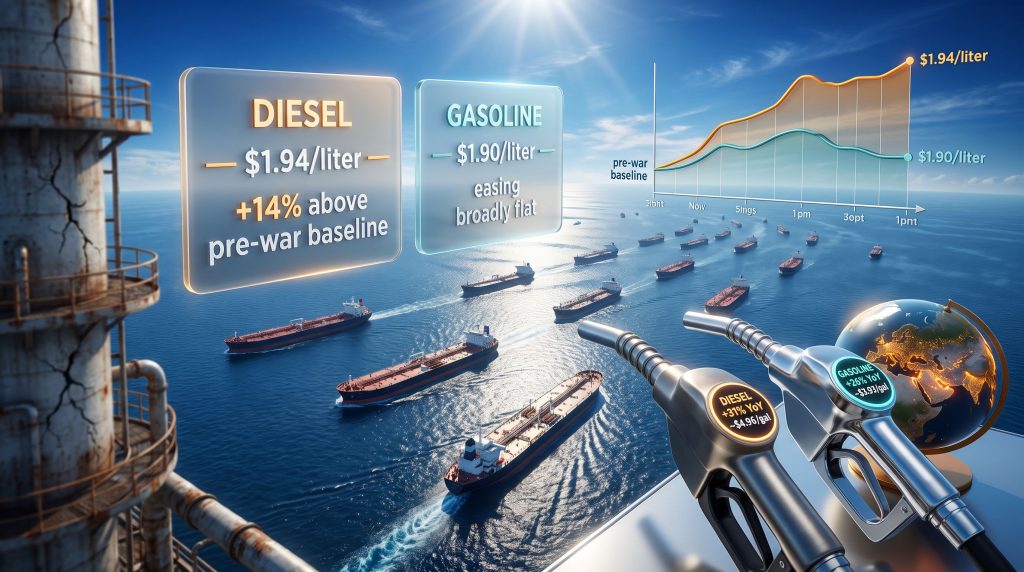
This distinction matters enormously in 2026. Monitoring crude oil price trends reveals that Brent crude has retreated considerably from its spring peak of nearly $120 per barrel, yet the average per-litre diesel price across IEA-tracked economies sits near $1.94, still approximately 14% above its pre-conflict February 2026 baseline. In a world where crude and pump prices moved in lockstep, this divergence would be impossible. In the current environment, it is entirely logical.
Explainer: The IEA's end-use tracker is one of the most reliable real-world affordability indicators available precisely because it captures everything downstream of the crude barrel, including the fiscal choices governments make about fuel taxation. This makes it a more granular diagnostic tool than benchmark crude prices alone when assessing actual consumer exposure to energy market volatility.
The Three Forces That Decouple Diesel From Gasoline in Volatile Markets
Three compounding forces are responsible for the current divergence:
- Distillate-specific supply constraints rooted in the destruction of refining infrastructure in Eastern Europe, removing diesel-heavy output from global trade flows
- Refinery throughput disruptions driven by Ukrainian drone campaigns that have pushed Russian crude-processing rates to a reported 24-year low, with fuel rationing introduced across approximately 90% of Russian regions by mid-2026
- Regional tax and currency dynamics that create a second layer of price volatility entirely independent of crude markets, amplifying or absorbing global signals depending on the jurisdiction
What a Two-Speed Recovery Actually Looks Like in Practice
Defining the Divergence: Diesel vs. Gasoline Price Trajectories in 2026
The contrast between the two fuel types through mid-2026 is stark when placed side by side.
| Fuel Type | Peak Price (Per Litre) | July 2026 Price | Change vs. February Pre-War Level |
|---|---|---|---|
| Diesel | ~$1.97 (est. spring) | ~$1.94 | +14% above pre-war baseline |
| Gasoline | ~$1.99 (May peak) | ~$1.90 | Easing; broadly flat month-on-month |
Gasoline peaked in May near $1.99 per litre and has since pulled back toward $1.90, essentially flat on a month-over-month basis. Diesel, by contrast, actually increased in July even as crude oil continued to slide. These are not minor statistical rounding differences. They reflect fundamentally different supply dynamics at the refinery and trade-flow level.
Why Diesel Is Holding Elevated While Gasoline Softens
The asymmetry between the two products stems from the nature of their respective demand bases:
- Diesel demand is structurally inelastic in freight, agricultural logistics, and industrial operations. When a trucking firm needs to move goods, it does not reduce loadings simply because diesel costs more per litre. Price signals transmit far more slowly through these sectors.
- Gasoline demand is considerably more elastic. Consumers adjust driving behaviour, switch to public transport, or defer discretionary travel when prices rise meaningfully. This responsiveness means that gasoline markets correct faster both on the way up and on the way down.
- Russian refineries are disproportionately configured for diesel and middle distillate output relative to light-end products. When those facilities are damaged or shut, the lost barrels are predominantly diesel barrels, not gasoline barrels. This structural asymmetry is a critical and frequently overlooked dimension of the current price split.
How the Middle East Conflict Restructured Global Energy Supply Chains
The Hormuz Chokepoint: Why One Strait Controls Global Fuel Pricing
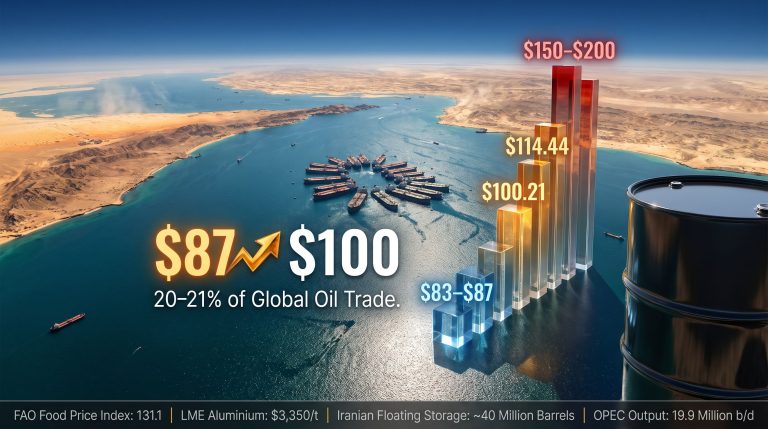
The Strait of Hormuz handles approximately one-fifth of global seaborne oil volumes, making it the single most consequential maritime chokepoint for energy markets. When conflict erupted in late February 2026, tanker traffic through the strait all but halted as insurance markets withdrew coverage and Iran signalled intent to restrict passage.
The resulting crude price shock was swift and severe. Furthermore, Brent surged from approximately $72 per barrel to near $120 within weeks, representing the steepest single-month benchmark move since the 1990 Gulf War. The IEA has previously highlighted options to ease oil price pressures on consumers in response to exactly these kinds of Middle East supply disruptions, underscoring how geopolitical shocks require coordinated policy responses. The transmission into retail pump prices followed over the subsequent four to eight weeks, the typical lag in most markets, though diesel refining margins widened faster than gasoline margins given distillate-specific demand pressures.
The Ongoing Hormuz Negotiation Cycle and Its Market Impact
The diplomatic picture has remained deeply unstable. A memorandum of understanding between the U.S. and Iran reached on June 17, 2026 collapsed within days over disputes regarding shipping-route conditions. Tanker attacks on Saudi refining infrastructure, including the Jazan facility, and continued vessel incidents through early August have sustained a meaningful risk premium in distillate markets even as crude pulled back.
As of early August 2026, Brent has been trading near $88 per barrel, down significantly from its spring highs but still more than 30% above year-ago levels. J.P. Morgan's current base case calls for Brent to average approximately $86 in the third quarter of 2026, drifting toward $78 by year-end, contingent on no renewed escalation in the Gulf.
Risk Callout: The J.P. Morgan year-end Brent forecast of approximately $78 per barrel is explicitly conditional on no further conflict escalation. Given that Hormuz negotiations have already collapsed once and tanker incidents have continued into August 2026, this remains a high-variance assumption that investors and energy-exposed businesses should treat with considerable caution.
Bank of America has separately noted that Hormuz would need approximately ten times more ships operating through the strait to fully stabilise oil markets, underscoring how far the waterway remains from functional normalisation.
The Refinery Destruction Variable: Eastern Europe's Global Diesel Problem
Ukrainian Drone Campaigns and Russian Refinery Capacity
Perhaps the most underappreciated driver of the current diesel-gasoline divergence is the sustained campaign of Ukrainian drone strikes against Russian refining infrastructure. At least 30 drone strikes targeted Russian refinery facilities in July 2026 alone. The cumulative damage pushed Russian crude-processing rates to a 24-year low, with fuel rationing subsequently introduced across approximately 90% of Russian regions.
This is not merely a domestic Russian problem. Russia was a significant exporter of refined middle distillates to global trade flows before the conflict. The removal of that supply from international markets tightens diesel availability globally, even in economies with no direct exposure to the Eastern European conflict. It is a textbook example of how geopolitical oil disruptions can transmit into consumer fuel costs far beyond the zone of direct impact.
Russia has reportedly been approaching South Korea and other external suppliers for fuel as its domestic refinery crisis deepens, a further signal of the severity of the throughput collapse.
Why Refinery Damage Hurts Diesel Markets More Than Gasoline Markets
The selectivity of the impact matters. Russian refineries are historically configured to produce a higher proportion of diesel and middle distillates relative to lighter petroleum products. Consequently, when these facilities are damaged or taken offline, the global market loses diesel barrels at a disproportionate rate compared to gasoline barrels. It is this structural asymmetry, specific to Russian refinery configuration, that explains why diesel held firm in July even as crude oil declined and gasoline eased.
Country-Level Divergence: How National Policy Amplifies or Absorbs Global Signals
Germany: When Tax Policy Becomes a Price Shock Multiplier
Germany's July 2026 fuel price experience offers one of the clearest illustrations available of how domestic fiscal decisions can rival global crude movements in their impact on consumer pump prices. Berlin introduced a temporary per-litre fuel-tax discount of approximately 17 cents per litre in May 2026 to cushion households from the war's price impact. When that discount expired on June 30, the effect was immediate and severe.
Both diesel and gasoline prices in Germany jumped more than 10% in a single month in July. Crude markets were not the primary driver. The tax expiry was. This is a phenomenon that receives far less attention than benchmark crude movements in mainstream energy commentary, yet it can generate consumer price shocks of comparable or greater magnitude in compressed timeframes.
Poland: An Even Sharper Domestic Price Surge
Poland recorded steeper pump price increases than Germany during the same period. Geographic proximity to the Eastern European conflict zone, combined with thinner domestic refining buffers and different tax structures, amplified Poland's sensitivity to the same global price signals that Germany partially absorbed through its now-expired subsidy programme.
The Countries That Bucked the Trend
Four economies saw pump prices actually decline in July despite the broader upward pressure across the IEA-tracked universe:
- United Kingdom
- Ireland
- Sweden
- Cyprus
The drivers in each case include favourable currency movements relative to the U.S. dollar, differentiated domestic tax structures, and local market competition dynamics. This cross-country variance is a powerful reminder that national fiscal architecture and exchange-rate exposure can be as consequential for consumer fuel costs as crude oil benchmarks.
Key Insight: The Germany-versus-UK contrast in July 2026 pump price movements illustrates a principle that energy economists have long understood but that rarely reaches mainstream coverage: the consumer price of fuel is as much a policy variable as it is a commodity variable. Governments have substantial capacity to both dampen and amplify global price signals through tax and subsidy decisions.
The next major ASX story will hit our subscribers first
U.S. Fuel Prices in Context: Where American Consumers Stand
Current U.S. Pump Price Benchmarks
IEA data for July 2026 place U.S. retail fuel costs at levels that remain substantially above year-ago comparisons, with diesel carrying a proportionally larger year-on-year burden than gasoline.
| Fuel Type | July 2026 (Per Gallon) | Year-Ago Level (Per Gallon) | Year-on-Year Change |
|---|---|---|---|
| Diesel | ~$4.96 | ~$3.78 | +$1.18 (+31%) |
| Gasoline | ~$3.93 | ~$3.12 | +$0.81 (+26%) |
The 31% year-on-year increase in U.S. diesel costs is particularly consequential given diesel's role as the primary fuel for freight transportation, agricultural machinery, and construction equipment. When diesel costs rise at this rate, inflationary pressure radiates across the entire goods economy, from supermarket shelves to construction materials to e-commerce logistics costs.
Why OPEC+ Output Decisions Are Secondary Right Now
A common analytical reflex in energy markets is to look at OPEC+ production decisions as the primary near-term price lever. However, understanding OPEC's market influence reveals that, in current conditions, this reflex is likely misplaced. Until distillate supply normalises through Hormuz flow restoration and Russian refinery recovery, incremental crude output increases from OPEC+ members will not translate mechanically into diesel price relief at the consumer level. The bottleneck is downstream, at the refinery and logistics level, not at the wellhead.
Scenario Analysis: Three Pathways for the Fuel Price Gap Through Q4 2026
Forward Scenarios for Diesel and Gasoline Price Convergence or Continued Divergence
| Scenario | Key Assumption | Diesel Price Direction | Gasoline Price Direction |
|---|---|---|---|
| Base Case | Hormuz partially reopens; Russian refining slowly recovers | Gradual easing toward $1.80-$1.85/litre | Continued softening toward $1.82-$1.86/litre |
| Escalation Case | Renewed tanker attacks; Hormuz talks collapse again | Diesel spikes above $2.10/litre; new highs possible | Gasoline re-accelerates above $2.00/litre |
| Resolution Case | Full Hormuz reopening; Russian refinery repairs accelerate | Diesel normalises toward pre-war levels within 60-90 days | Gasoline stabilises; potential modest deflation |
The Long-Horizon Question: Will These Two Fuels Ever Fully Re-Synchronise?
Even in a resolution scenario where Hormuz reopens and Russian refinery throughput recovers, analysts broadly expect the physical repair timeline for damaged Russian refinery infrastructure to extend 12 to 18 months beyond any ceasefire or diplomatic agreement. Refinery reconstruction is not a rapid process, and the configuration of replacement capacity would still need to match the distillate-heavy profile of what was lost.
Beyond the immediate geopolitical horizon, a longer structural dynamic is also worth considering. The energy transition pressures are progressively reducing gasoline demand faster than diesel demand, particularly in road transport, as electric vehicle penetration accelerates in major consumer markets. In addition, the oil market trade war impact has further complicated price normalisation across both fuel types. Diesel demand in freight, marine, and industrial logistics is proving considerably more durable against electrification timelines. This suggests that even after geopolitical normalisation, the structural tendency for diesel and gasoline to price differently may persist and potentially widen over a multi-year horizon. Clean energy investment has, for instance, nearly doubled fossil fuel spending in recent years, reinforcing the longer-term shift in energy market dynamics.
Frequently Asked Questions: Global Fuel Price Dynamics in 2026
Why Are Diesel Prices Holding Higher Than Gasoline Prices Right Now?
Diesel draws from middle distillate refinery streams, which are subject to structurally different supply constraints than light-end gasoline products. Russian refinery disruptions and Hormuz shipping uncertainty have both fallen disproportionately on distillate supply chains, while gasoline supply has proven comparatively more resilient through the current crisis period.
How Much Have Global Fuel Prices Risen Since the Conflict Began?
IEA end-use price data indicate that average diesel costs across tracked economies are approximately 14% above their pre-conflict February 2026 baseline, while gasoline has retreated from its May 2026 peak of approximately $1.99 per litre to around $1.90, broadly flat on a month-over-month basis through July. IEA numbers point to a two-speed recovery in global fuel prices remaining a defining feature of the current market environment.
What Would It Take for Diesel Prices to Return to Pre-War Levels?
A sustained reopening of the Strait of Hormuz, a meaningful recovery in Russian refinery throughput, and a reduction in the geopolitical risk premium embedded in distillate markets would all need to occur simultaneously. Most analysts currently assess this confluence of conditions as unlikely before early 2027 at the earliest.
Why Do Some Countries See Falling Fuel Prices When Global Markets Are Rising?
Currency appreciation against the U.S. dollar, differentiated domestic tax structures, and local market competition can each offset the impact of rising crude prices at the consumer level. The United Kingdom, Ireland, Sweden, and Cyprus each experienced pump price declines in July 2026 despite the broader upward trend across the IEA-tracked universe.
Key Takeaways: Reading the IEA Data Within the Macro Framework
- Diesel is the leading indicator of distillate market stress in 2026, and its divergence from gasoline reflects supply-side structural damage rather than simply a demand fluctuation
- Crude price movements are a lagging and frequently incomplete predictor of end-use fuel costs when refinery capacity disruptions and chokepoint flow restrictions occur simultaneously
- National fiscal policy creates a second layer of consumer price volatility that can amplify or dampen global commodity signals by 10% or more within a single calendar month, as Germany demonstrated in July 2026
- The Hormuz negotiation timeline remains the single most consequential near-term variable for fuel price direction across both diesel and gasoline markets globally
- U.S. diesel costs are approximately 31% higher year-on-year, with limited near-term relief visible under the base case scenario, given the persistence of downstream supply constraints
- The energy transition introduces a longer-term structural dimension to the diesel-gasoline price split that may outlast the immediate geopolitical crisis
This article is intended for informational purposes only and does not constitute financial or investment advice. All price forecasts cited reflect analyst projections at the time of writing and are subject to material revision based on evolving geopolitical and market conditions. Readers are encouraged to consult independent financial advisors before making energy-related investment decisions. For ongoing benchmark data and monthly end-use price tracking, the IEA's Monthly Oil Price Statistics resource, available at iea.org, provides comprehensive per-litre pump price data across member and partner economies.
Want to Capitalise on the Next Major Commodity Discovery Before the Broader Market?
While global energy markets navigate diesel-gasoline divergence and geopolitical supply disruptions, Discovery Alert's proprietary Discovery IQ model delivers real-time alerts on significant ASX mineral discoveries — instantly translating complex commodity data into actionable investment opportunities for both short-term traders and long-term investors. Explore why historic discoveries have generated extraordinary returns on Discovery Alert's dedicated discoveries page, and begin your 14-day free trial today to position yourself ahead of the market.