August 11, 2026
The Structural Fragility Beneath India's Agricultural Powerhouse
When commodity markets convulse, it is rarely the industrialised economies that bear the sharpest pain. Countries sitting at the end of long, concentrated supply chains absorb the most severe consequences of geopolitical disruption. For a nation feeding 1.4 billion people, the architecture of its fertiliser and energy supply chains is not a logistics question. It is a question of sovereign stability.
India's position within global fertiliser markets illustrates this vulnerability with uncomfortable precision. The country's agricultural sector underpins the livelihoods of hundreds of millions of rural households, yet the inputs that sustain crop yields flow through corridors that India does not control, at prices set by dynamics it cannot easily influence. Understanding how this vulnerability compounds across the energy-fertiliser nexus is the starting point for any serious analysis of India energy and fertiliser self-reliance.
When big ASX news breaks, our subscribers know first
Why the Energy-Fertiliser Nexus Creates Compounding Risk
Food Security Begins With Feedstock Security
The connection between energy markets and food production is more direct than most public commentary acknowledges. Urea, India's most widely used nitrogenous fertiliser, is synthesised through the Haber-Bosch process, which combines nitrogen from the atmosphere with hydrogen derived almost entirely from natural gas or liquefied natural gas feedstocks. This means that every tonne of domestically produced urea carries an embedded energy cost tied directly to global gas markets.
When Gulf supply routes face disruption, the impact does not stop at India's fuel pumps. It travels through the gas feedstock pipeline into domestic urea plants, elevating production costs and triggering procurement pressure on the international market simultaneously. The result is a compounding exposure: higher domestic production costs and higher import prices occurring in parallel.
How Geopolitical Shocks Translate Into Agricultural Vulnerability
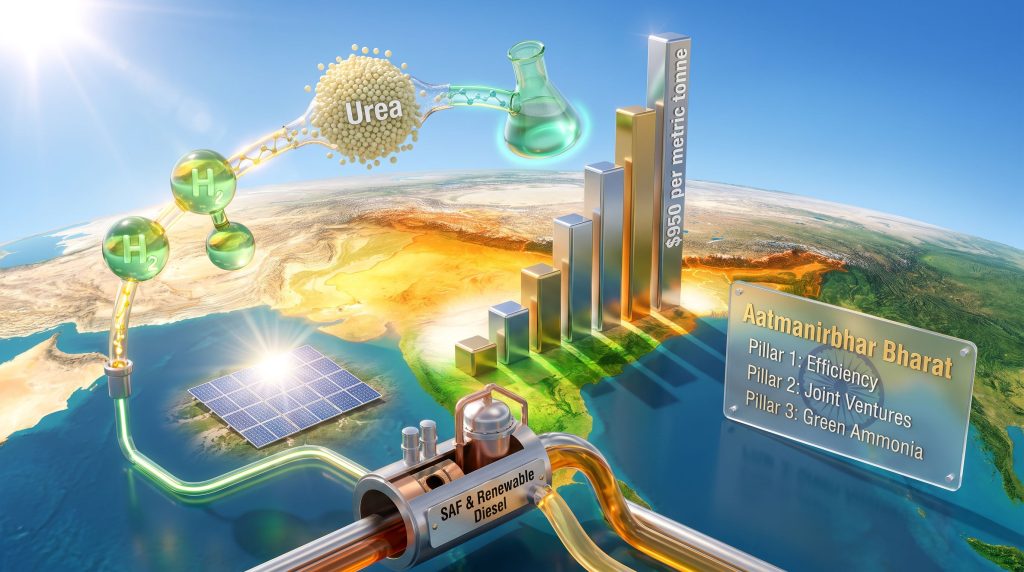
The April 2026 procurement cycle demonstrated this dynamic in real time. Middle East conflict severely disrupted global urea supply, compressing India's procurement window and forcing a single emergency tender covering approximately 2.5 million metric tonnes at prices approaching $950 per metric tonne. That figure represented nearly double the prevailing price recorded just weeks earlier and accounted for roughly a quarter of India's total annual urea import volume in a single transaction.
The April 2026 urea tender exposed a structural reality that periodic import statistics often obscure: India's fertiliser procurement system carries latent price and supply risk that activates rapidly under geopolitical stress, with consequences that flow directly into farm-gate input costs.
This is not an isolated episode. It is a preview of recurring exposure as long as the current import architecture remains unchanged.
Mapping the Full Depth of India's Fertiliser Import Exposure
Beyond Urea: A System-Wide Dependency
Public discourse on India's fertiliser vulnerability tends to anchor on urea, but the structural exposure extends across all three primary fertiliser categories. Each category carries its own import concentration risk, feedstock dependency, and supply route vulnerability. Furthermore, as India's import reliance on fertilisers demonstrates globally, this is a challenge facing multiple major economies simultaneously.
| Fertiliser Type | Primary Import Source | Key Vulnerability |
|---|---|---|
| Urea | Middle East, China, Russia | Natural gas feedstock reliance; Gulf route concentration |
| DAP (Di-Ammonium Phosphate) | Morocco, Jordan, China | Phosphate rock import dependency |
| MOP (Muriate of Potash) | Canada, Belarus, Russia | Near-total import dependence; no domestic reserves |
| Ammonia (feedstock) | Global spot markets | Directly tied to LNG and gas price volatility |
A critical but underappreciated analytical point, highlighted by research from the Indian Council for Research on International Economic Relations (ICRIER), is that headline urea self-sufficiency figures significantly overstate India's actual energy independence. When the imported natural gas and LNG feedstocks consumed by domestic urea manufacturing are incorporated into the calculation, effective self-sufficiency falls sharply. India's urea plants may operate domestically, but their energy inputs are largely sourced internationally, meaning the price risk is not eliminated by domestic production capacity alone.
The DAP and MOP Blind Spot
While urea attracts the majority of policy attention, di-ammonium phosphate and muriate of potash carry arguably more structurally intractable dependencies. India possesses no meaningful domestic potash reserves, making MOP a category where near-total import dependence is a geological reality, not simply a policy failure. DAP dependency, meanwhile, traces back to phosphate rock, a resource concentrated heavily in Morocco, China, and Jordan.
A comprehensive India energy and fertiliser self-reliance strategy must simultaneously address all three fertiliser categories rather than directing policy resources predominantly toward urea, where the domestic production base already exists in partial form.
The Policy Architecture: Aatmanirbhar Bharat and Viksit Bharat as Industrial Frameworks
From Rhetorical Commitment to Industrial Execution
India's self-reliance ambitions operate within a well-articulated policy framework. The Aatmanirbhar Bharat initiative and the Viksit Bharat 2047 vision collectively frame domestic industrial strength and reduced import dependency as core economic objectives. Prime Minister Modi has explicitly linked fertiliser import reduction to national economic resilience and rural household prosperity, positioning it as a structural industrial priority with implications extending well beyond agricultural subsidy reform.
The three foundational pillars of India's fertiliser security transition can be outlined as follows:
-
Modernisation of existing domestic urea manufacturing to reduce energy intensity and improve cost competitiveness without expanding feedstock import exposure.
-
Strategic international partnerships and joint ventures in phosphate and potash-rich regions to build supply security during the medium-term transition period.
-
Long-term domestic green ammonia production anchored to India's rapidly expanding hydrogen economy, targeting a structural break from import dependency.
The critical analytical challenge is the gap between target-setting and execution. Policy frameworks establish ambition; industrial deployment requires capital mobilisation, infrastructure development, and sustained regulatory support to translate into physical production capacity.
Leveraging Existing Infrastructure: The Co-Processing Opportunity
India's Refinery Base as a Renewable Fuels Platform
One of the most immediately actionable pathways for India energy and fertiliser self-reliance does not require the construction of new industrial systems. India's existing refinery infrastructure, one of the largest and most geographically distributed networks in Asia, can be adapted to produce renewable fuels through a technology approach known as co-processing.
Co-processing involves the introduction of bio-based feedstocks, including used cooking oil, agricultural residues, and animal fats, directly into existing refinery hydrotreating units alongside conventional crude. This enables the simultaneous production of sustainable aviation fuel and renewable diesel without requiring wholesale asset replacement or new greenfield construction. The technology is already operating at commercial scale at refineries across Asia and globally.
India's Structural Feedstock Advantage
What makes this pathway particularly compelling for India is a domestic feedstock endowment that receives far less analytical attention than it deserves. India ranks among the world's largest producers of used cooking oil and agricultural residues, two of the primary feedstocks for renewable diesel and SAF production. Converting these waste streams into domestically produced lower-carbon fuels would simultaneously:
-
Strengthen energy security by reducing crude import volumes at the margin.
-
Create economic value from materials currently treated as waste disposal challenges.
-
Generate decentralised rural economic activity through feedstock aggregation and collection networks.
-
Support India's carbon intensity reduction commitments without requiring new infrastructure capital at scale.
This feedstock advantage is a structural resource that competing economies in the region cannot easily replicate, and its monetisation through co-processing represents a near-term opportunity with proven commercial precedent.
Green Hydrogen: Building the Foundation for Long-Term Ammonia Self-Sufficiency
The National Green Hydrogen Mission and the Gap to Close
India's National Green Hydrogen Mission has established an annual production target of 5 million tonnes by 2030, a figure that, if achieved, would position India among the world's largest green hydrogen producers and provide the foundational feedstock for substantially expanded domestic green ammonia manufacturing. The strategic logic connecting renewable energy, green hydrogen, and fertiliser self-reliance forms a coherent industrial pathway that progressively reduces dependence on imported gas and urea simultaneously.
The current readiness profile of India's green hydrogen ecosystem reveals both genuine momentum and material gaps requiring sustained policy attention:
| Green Hydrogen Enabler | Current Status in India | Gap to Close |
|---|---|---|
| Renewable energy capacity | Rapid expansion underway | Electrolysis cost remains elevated |
| Electrolyser manufacturing | Early-stage domestic industry | Scale-up and cost reduction required |
| Demand creation mechanisms | Policy frameworks developing | Industrial offtake agreements needed |
| Infrastructure (pipelines, storage) | Limited | Significant capital investment required |
| Export market development | Nascent | Positioning vs. Australia and Middle East |
Blue Hydrogen as a Near-Term Bridge
A complementary and often underweighted element of India's hydrogen strategy is the role of blue hydrogen as a transitional pathway. Blue hydrogen, produced from natural gas with carbon capture and storage applied to reduce emissions, can be deployed at industrial scale using existing gas infrastructure while green hydrogen production scales toward cost competitiveness. A dual-track strategy pursuing green and blue hydrogen in parallel reduces transition risk and accelerates the growth of a domestic hydrogen economy rather than waiting for green hydrogen alone to reach cost parity.
The next major ASX story will hit our subscribers first
Green Ammonia: The Strategic Endpoint for Fertiliser Independence
Closing the Loop Between Energy and Agriculture
The hydrogen-to-ammonia pathway represents the most strategically significant long-term solution to India's fertiliser vulnerability. Green ammonia is produced by combining green hydrogen with nitrogen through the Haber-Bosch process, replacing the natural gas feedstock that currently ties domestic urea production to imported energy. At sufficient scale, domestic green ammonia production would structurally decouple India's fertiliser supply chain from global gas price volatility and geopolitical supply disruption. In addition, the broader opportunity this creates connects directly to the global critical minerals demand reshaping the energy transition.
The Ramme, Denmark Precedent
A commercially significant proof-of-concept recently crossed the threshold from demonstration to industrial deployment. The commissioning of the world's first commercial-scale dynamic green ammonia facility at Ramme, Denmark, demonstrated that flexible ammonia production powered by variable renewable energy inputs is technically and commercially viable at industrial scale. The facility's ability to operate on intermittent renewable energy rather than requiring continuous baseload power is particularly relevant for India, where solar generation profiles create inherent variability in renewable electricity supply.
For India, with abundant solar irradiation across its northwestern regions, rapidly growing fertiliser demand, and a stated policy commitment to renewable energy leadership, the Ramme facility provides a directly applicable commercial template rather than a distant technological aspiration.
From Import Dependency to Regional Export Potential
With sufficient green hydrogen production capacity and ammonia synthesis infrastructure, India's geographic position, renewable resource endowment, and growing industrial base could eventually support a transition from being a large net importer of ammonia feedstocks to becoming a meaningful regional supplier to neighbouring markets and key Asian importers. This outcome remains medium-to-long-term and is conditional on sustained policy support, infrastructure investment, and industrial scale-up, but the directional opportunity is structurally coherent given India's renewable energy buildout trajectory.
Policy Enablers and Critical Gaps
What the Regulatory Framework Must Deliver
Translating the three-pillar strategy into physical industrial capacity requires a regulatory and policy environment capable of de-risking investment at scale. The key mechanisms include:
-
Production-linked incentive schemes for green hydrogen and renewable fuel production to accelerate cost reduction through volume.
-
Gas procurement reform to improve feedstock access terms for domestic urea manufacturers, reducing the energy cost embedded in domestic production.
-
Demand-side offtake mechanisms that provide green ammonia producers with revenue certainty sufficient to justify long-term capital commitment.
-
Co-processing regulatory frameworks that enable refineries to introduce renewable feedstocks without navigating regulatory ambiguity around product specifications and blending mandates.
-
Phosphatic and potassic capacity programmes that address DAP and MOP dependencies alongside the more politically visible urea focus.
The most significant policy gap in current discourse is the asymmetric attention directed toward urea compared to DAP and MOP. A genuinely comprehensive India energy and fertiliser self-reliance strategy requires simultaneous progress across all fertiliser categories, not sequential reform that addresses the most visible vulnerability first.
The Agricultural Growth Imperative Amplifies the Urgency
A 450 Million Tonne Food Production Target by 2047
India's domestic agricultural ambitions directly amplify the strategic urgency of fertiliser security. Food grain production targets embedded within the Viksit Bharat 2047 framework require a step-change in agricultural productivity, with output rising from approximately 330 million tonnes currently toward 450 million tonnes by 2047. Meeting that trajectory without a corresponding increase in fertiliser availability is not feasible with current yield improvement rates.
A higher food production target without a more secure and affordable fertiliser supply chain does not simply create procurement risk. It creates a structural constraint on India's ability to achieve its own rural development and food sovereignty ambitions. Reliable fertiliser access at competitive prices is a non-negotiable input into the agricultural productivity growth that Viksit Bharat requires. However, India's ambitions extend beyond fertilisers alone, as proposals like the India coal trading exchange further reflect the country's determination to control its own commodity markets.
India Energy and Fertiliser Self-Reliance: Key Questions Answered
Why Does Imported Gas Feedstock Matter for India's Urea Self-Sufficiency?
Even when urea is manufactured domestically, the natural gas or LNG used as the hydrogen feedstock in the production process is frequently imported. ICRIER analysis indicates that when this embedded import dependency is counted, India's effective fertiliser self-sufficiency is meaningfully lower than domestic production volumes suggest.
What Made the April 2026 Urea Tender Unusual?
The combination of Middle East geopolitical disruption, compressed procurement timelines, and the sheer volume secured in a single tender — approximately 2.5 million metric tonnes at prices near $950 per metric tonne — made it the most concentrated and expensive single urea procurement event in India's recent history.
How Does Co-Processing Differ From Building a New Renewable Fuels Refinery?
Co-processing introduces renewable feedstocks into an existing hydrotreating unit, enabling lower-carbon fuel production without constructing new facilities. It dramatically reduces the capital barrier compared to greenfield renewable fuel production infrastructure.
Is Green Ammonia Production Commercially Proven?
The commissioning of the Ramme, Denmark facility demonstrates commercial-scale dynamic green ammonia production from variable renewable energy is now industrially operational. This moves the technology from pilot stage to proven commercial deployment. Furthermore, direct lithium extraction offers a comparable example of how emerging industrial technologies can move rapidly from demonstration to deployment when the policy environment is supportive.
What Is the Difference Between Green and Blue Hydrogen in India's Context?
Green hydrogen uses renewable electricity to split water through electrolysis, generating no direct carbon emissions. Blue hydrogen uses natural gas with carbon capture to reduce emissions. India's optimal near-term strategy involves pursuing both pathways simultaneously, using blue hydrogen to accelerate market development while green hydrogen scales toward cost competitiveness.
Execution Speed Is the Decisive Variable
The technologies underpinning India energy and fertiliser self-reliance are not waiting to be invented. Co-processing is operating at commercial scale across Asian refinery networks. Green hydrogen electrolysis is being deployed at industrial volumes. Dynamic green ammonia production has crossed the commercial threshold at Ramme. The feedstock resources India requires, from used cooking oil to abundant solar irradiation, are already available domestically.
What determines the trajectory is not technological readiness. It is the coherence, speed, and consistency of policy execution; the mobilisation of private and public investment at the scale the opportunity demands; and the willingness to address the full spectrum of fertiliser dependencies rather than concentrating reform exclusively on urea.
India's dual opportunity — reducing structural import vulnerability while building the foundation for regional export competitiveness in hydrogen and ammonia — is available within the current industrial generation. The question is whether policy coherence and execution velocity will match the scale of the strategic prize on offer.
Readers seeking further analysis of India's energy transition and fertiliser security landscape can find regularly updated coverage at ETEnergyWorld (energy.economictimes.indiatimes.com), which publishes reporting on renewable energy policy, hydrogen economy developments, and agricultural input security across the Indian market.
Disclaimer: This article contains forward-looking analysis, projections, and scenario assessments relating to India's energy and fertiliser sectors. Such statements involve inherent uncertainty and should not be construed as investment advice or guarantees of future outcomes. Policy targets, production forecasts, and market projections referenced herein are subject to change based on evolving geopolitical, regulatory, and macroeconomic conditions.
Want to Identify the Next Major Mineral Discovery Before the Market Does?
India's fertiliser and energy transition is driving unprecedented demand for critical minerals — and Discovery Alert's proprietary Discovery IQ model instantly alerts subscribers to significant ASX mineral discoveries the moment they are announced, turning complex data across 30+ commodities into clear, actionable insights. Explore the historic returns major discoveries have delivered and begin your 14-day free trial today to position yourself ahead of the market.