August 11, 2026
The Quiet Revolution in Metal Recovery: Why Waste Is Becoming a Tin Mine
The global metals industry is undergoing a structural recalibration that most investors and policymakers have been slow to fully appreciate. For decades, the dominant logic of commodity supply was straightforward: find an orebody, permit it, mine it, smelt it. Yet for a growing number of critical metals, that linear model is straining under the weight of geopolitical concentration, declining ore grades, and the accelerating pace of downstream demand. Tin sits at the centre of this tension, and the solution being explored is not a new discovery in a remote jungle, but a processing revolution applied to material that already exists in abundance: industrial waste.
Extracting tin from waste is not a fringe concept. It is increasingly a technically credible, economically rational, and policy-aligned strategy for nations that depend on imported refined tin. Understanding why requires a close look at the metal itself, the waste streams it inhabits, and the engineering systems capable of liberating it.
When big ASX news breaks, our subscribers know first
Why Tin Supply Is Under Structural Pressure
Tin's supply landscape is remarkably concentrated for a metal so widely used. More than 70% of the world's refined tin production comes from just three countries: China, Indonesia, and Myanmar. Each of these jurisdictions carries significant geopolitical and operational risk. Myanmar's artisanal and semi-industrial tin mining sector, centred on the Wa region, has faced recurring disruption.
Indonesian production is constrained by environmental regulations and offshore mining complexity. China, the world's largest refined tin producer, applies its own strategic calculus to export volumes. The issue of tin supply volatility is consequently a growing concern for downstream manufacturers and policymakers alike.
Against this backdrop, demand is accelerating. Tin is the foundational material in electronic solder, bonding semiconductor components to printed circuit boards across virtually every electronics category. The proliferation of electric vehicles, renewable energy inverters, and advanced computing infrastructure is compounding demand in ways that primary supply chains are struggling to match.
The International Tin Association has consistently noted that the tin market has experienced structural supply deficits in recent years, a trend that analysts broadly expect to continue. This is the backdrop against which secondary tin recovery from waste streams has graduated from academic curiosity to genuine industrial priority.
What Types of Waste Streams Contain Recoverable Tin?
Not all waste is equally promising as a tin source. The economic viability of any recovery operation depends fundamentally on tin concentration within the feedstock, the complexity of the surrounding matrix, and the presence of penalty elements that complicate purification.
The five principal categories of tin-bearing waste are:
- Electronic waste, particularly printed circuit boards and solder joints: PCBs can carry tin concentrations ranging from 2% to 40% by mass in solder-rich components, making them among the richest secondary tin sources available. Solder is predominantly a tin-silver-copper or tin-lead alloy, with tin typically comprising 60% to 99% of the alloy by weight depending on specification.
- Mineral processing tailings and slags: Conventional flotation and smelting circuits leave behind residual tin at concentrations typically between 0.1% and 1.5% Sn, which is low grade by primary mining standards but represents a recoverable fraction when volumes are large and feedstock costs are minimal.
- Tin-plated steel scrap: Food packaging and industrial tin-coated steel carries coating weights equivalent to approximately 0.5% to 2% Sn by mass. The technical challenge is stripping the tin selectively without dissolving the underlying iron substrate.
- Waste plating solutions: Electroplating bath liquors can carry dissolved tin at concentrations between 5 and 50 grams per litre, making direct electrowinning technically straightforward.
- Spent solder and desoldering waste: High-purity alloys amenable to direct refining with minimal pre-treatment requirements.
| Waste Stream | Typical Tin Content | Primary Recovery Challenge |
|---|---|---|
| PCB/solder waste | 2–40% Sn by mass | Mixed alloy matrix, halogenated materials |
| Mineral processing tailings | 0.1–1.5% Sn | Low grade, fine particle size |
| Tin-plated steel scrap | 0.5–2% Sn by coating weight | Selective stripping without iron dissolution |
| Waste plating solutions | 5–50 g/L Sn in solution | Purification from co-dissolved metals |
| Industrial slag residues | 0.3–3% Sn | High-temperature reprocessing requirements |
Key Insight: The economics of extracting tin from waste are not determined by tin concentration alone. Penalty elements including lead, bismuth, and arsenic can dramatically increase downstream purification costs, sometimes rendering an otherwise attractive feedstock commercially marginal.
How Tin Is Extracted from Waste: The Four-Stage Technical Process
Step 1: Mechanical Preparation and Physical Separation
Before any chemistry begins, physical preparation is critical to process economics. For e-waste streams, automated and manual depopulation of circuit boards isolates tin-rich solder components before bulk chemical treatment. Shredding, screening, and density separation concentrate tin-bearing fractions, while magnetic separation removes ferrous materials that would otherwise consume leaching reagents unnecessarily.
Pre-concentration is not optional; it is the lever that determines whether downstream chemistry operates at viable reagent-to-recovery ratios. Furthermore, the International Tin Association's research on tin recovery from e-waste confirms that physical pre-treatment significantly improves overall process efficiency before chemical stages begin.
Step 2: Chemical Leaching to Dissolve Tin into Solution
Three principal lixiviant systems dominate industrial and pilot-scale tin extraction from waste:
- Hydrochloric acid leaching: The most widely applied approach, typically combined with oxidants such as hydrogen peroxide (H₂O₂) or ferric chloride (FeCl₃) to accelerate tin dissolution kinetics. HCl systems are effective across a range of feedstocks but require careful management of co-dissolution of copper and lead.
- Alkaline leaching with sodium hydroxide (NaOH): These systems exploit tin's amphoteric chemistry to dissolve it selectively while leaving copper and other base metals in the solid residue. This selectivity makes alkaline systems particularly attractive for PCB-derived powders, where copper is the primary co-contaminant. Under optimised conditions, alkaline leaching has demonstrated tin extraction rates exceeding 98%.
- Nitric acid dissolution: Applied specifically to solder-derived waste where the target output is tin oxide (SnO₂) nanoparticles rather than metallic tin. Tin dioxide nanoparticles carry premium commercial value in electronics, sensor manufacturing, and catalysis applications, potentially generating substantially higher margins than refined tin metal.
Step 3: Purification of the Tin-Bearing Leachate
Extracting tin into solution is only half the challenge. Separating it from co-dissolved metals is where many pilot projects encounter difficulty. The principal purification routes include:
- Ion exchange resins: Selective adsorption of tin from complex multi-metal leach solutions, effective for dilute streams.
- Solvent extraction: Organic extractant systems capable of separating tin from lead, copper, and bismuth co-contaminants with high selectivity.
- Selective precipitation: pH-controlled precipitation of tin as hydroxide or oxide intermediates, a relatively capital-light approach suitable for modular plant configurations.
Step 4: Final Metal Recovery
The purified tin-bearing solution is converted to marketable product through one of four routes:
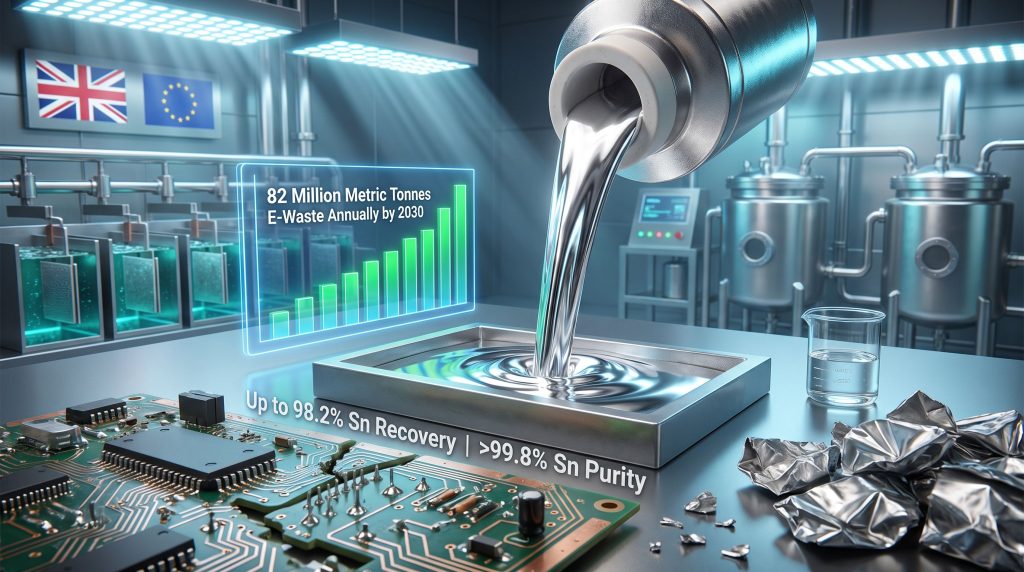
- Electrowinning: Direct electrodeposition of metallic tin from purified leach solution onto cathode substrates. Combined with alkaline leaching, this route has demonstrated cathode purity exceeding 99.8% Sn, meeting or surpassing standard commercial specifications.
- HCl electrorefining: A single-step approach capable of producing high-purity tin directly from crude tin scrap without a separate leaching stage.
- Chemical reduction: Reducing agents convert dissolved tin compounds to metallic tin in controlled solution environments.
- Pyrometallurgical smelting: High-temperature processing of mixed e-waste produces crude tin bullion, which requires subsequent fire refining to reach commercial purity grades.
| Recovery Method | Applicable Waste Type | Reported Tin Recovery Rate | Output Purity |
|---|---|---|---|
| Alkaline leaching + electrowinning | PCB metal powders | Up to 98.2% | >99.8% Sn |
| HCl electrorefining | Tin scrap / solder | High (single-step) | High-purity Sn |
| Nitric acid dissolution + precipitation | PCB solder | Moderate–high | SnO₂ nanoparticles |
| Pyrometallurgical smelting | Mixed e-waste | Variable (scale-dependent) | Crude Sn bullion |
| Chemical stripping + electrowinning | Tin-plated steel | Moderate | Commercial-grade Sn |
Engineering Challenges at the Pilot-to-Commercial Transition
The laboratory performance of tin recovery from waste streams is well-documented. The distance between laboratory results and commercial viability, however, remains one of the most underappreciated risks in secondary metals processing.
Feedstock variability is arguably the most critical barrier. Unlike a mining operation drawing ore from a defined geological formation, a waste processing facility must manage feedstock composition that shifts continuously as collection sources change. A process optimised for one PCB generation may perform poorly against newer board designs with different solder alloy formulations or substrate materials.
Reagent economics present a structural cost challenge. At laboratory scale, reagent costs are manageable. At commercial throughput, the cost of hydrochloric acid, sodium hydroxide, or oxidant additions relative to the value of recovered tin can determine whether an operation generates positive margins. This calculus shifts meaningfully with tin price, which has historically been volatile.
Hazardous by-product management adds operational and regulatory complexity. PCB processing generates halogenated off-gases from brominated flame retardants. Lead-bearing residues from solder waste require controlled disposal or separate recovery. Spent electrolytes from electrowinning operations must be treated before discharge.
Equipment corrosion in aggressive acid environments drives capital cost. Acid-resistant materials of construction add significantly to plant development expenditure, a factor that emerging technology developers must model carefully in their commercial feasibility assessments. Innovations in critical minerals processing are, however, beginning to address some of these material durability challenges through advanced engineering approaches.
Warning: Feedstock inconsistency is consistently cited as the primary reason pilot-scale waste metal recovery projects fail to achieve commercial viability. Securing long-term waste supply agreements with electronics manufacturers, recyclers, or industrial generators is as strategically critical as the processing technology itself.
Comparing Waste-Derived Tin to Primary Mined Production
The environmental and economic case for secondary tin deserves rigorous analysis rather than assumption.
| Metric | Primary Mined Tin | Waste-Derived Tin |
|---|---|---|
| Carbon footprint | High (mining + smelting) | Significantly lower (secondary processing) |
| Capital intensity | Very high (mine development) | Moderate (processing plant) |
| Feedstock cost | Ore grade dependent | Waste tipping fees or collection costs |
| Output purity | Smelter grade (99%+) | Process-dependent (up to 99.8%+) |
| Supply chain risk | Geopolitical concentration | Domestic or regional waste availability |
| Regulatory framework | Established permitting | Evolving circular economy regulations |
One underappreciated dimension of this comparison is the amphoteric chemistry of tin itself. Unlike most base metals, tin dissolves in both acidic and alkaline solutions. This dual solubility is what makes selective alkaline leaching possible and is a property that experienced hydrometallurgists have exploited for decades in tin refining. Translating this chemistry into a robust secondary processing circuit, however, requires engineering competence that is not universally available in the waste management sector.
The next major ASX story will hit our subscribers first
The UK Policy Environment and Waste Tin Recovery
Tin holds critical mineral designation across the UK, EU, and United States, reflecting its concentrated supply geography and irreplaceable role in electronics manufacturing. This classification matters because it shapes where early-stage processing technology can access structured industry partnership frameworks and development support.
The UK's Critical Minerals Accelerator Initiative is designed precisely to bridge the gap between proven technology and commercial deployment. Furthermore, European tin development initiatives demonstrate how cross-border partnership models are being applied to accelerate both primary and secondary tin supply chains.
The EU's Critical Raw Materials Act and various US Defense Production Act investment vehicles are pursuing parallel goals through different mechanisms. What is consistent across jurisdictions is the recognition that domestic secondary processing capacity for critical metals reduces strategic import dependency in ways that primary mining alone cannot address within relevant policy timeframes.
A less commonly discussed dimension is the Basel Convention's influence on feedstock logistics. The treaty, which governs transboundary movement of hazardous waste, creates regulatory constraints on the cross-border shipment of e-waste feedstocks in Europe. This means that UK-based tin recovery operations must largely depend on domestically generated waste streams, reinforcing the importance of robust collection and pre-processing infrastructure as a prerequisite for commercial viability.
Choosing the Right Extraction Method: A Decision Framework
Selecting the appropriate process route for extracting tin from waste requires matching technology to feedstock characteristics, target output, and available capital. The following framework provides a starting point:
- PCB or solder-dominant waste: Mechanical depopulation followed by alkaline leaching and electrowinning delivers the highest tin recovery and purity combination currently demonstrated at pilot scale.
- Tin-plated steel scrap: Chemical stripping or electrorefining offers the most selective and capital-efficient approach.
- Mixed e-waste at industrial volumes: Pyrometallurgical smelting followed by fire refining provides the most proven large-throughput pathway, though it sacrifices some purity and requires downstream refining.
- Waste plating solutions: Direct electrowinning or pH-controlled precipitation represents a technically straightforward, capital-light entry point.
- High-value compound production: Nitric acid dissolution with controlled precipitation to produce SnO₂ nanoparticles may generate margins substantially above those of refined tin metal, appealing to developers willing to target specialty materials markets.
Key selection criteria for process design should be evaluated in this order:
- Tin concentration and chemical speciation in the specific waste feedstock
- Identity and concentration of penalty elements (Pb, Bi, As, Cu)
- Required output form: metallic tin, tin salts, or tin oxide compounds
- Available infrastructure and capital budget
- Regulatory environment governing waste processing and residue disposal
- Target market purity specifications and offtake agreements
The Future Trajectory of Secondary Tin Production
The longer-term outlook for extracting tin from waste is shaped by three converging forces: rising e-waste volumes, technological maturation, and circular economy policy alignment.
Global e-waste generation is projected to reach approximately 82 million metric tonnes annually by 2030, according to the Global E-Waste Monitor, creating an expanding reservoir of tin-bearing secondary material even as primary mine output faces structural constraints. In addition, battery scrap recycling infrastructure being built for lithium-ion materials is establishing collection and pre-processing networks that could similarly support tin recovery from electronic waste streams.
Emerging process innovations are beginning to move beyond the acid-alkaline-electrowinning paradigm. Ionic liquid-based extraction systems offer potentially lower toxicity profiles than conventional organic solvent extraction. Bioleaching research is investigating the role of acidophilic microorganisms in selectively mobilising tin from complex waste matrices, though this remains at an early research stage.
AI-driven feedstock characterisation, enabling real-time adjustment of leaching parameters as waste composition varies, represents a near-term practical application that could substantially improve process stability at commercial scale. The tin recovery partnership model being explored between industrial players further illustrates how collaborative approaches are accelerating the commercialisation of secondary processing technology.
For early-mover technology developers that successfully navigate the pilot-to-commercial transition, the opportunity extends beyond operating a single processing facility. Exportable processing technology, licensed to waste management companies or metals producers across multiple jurisdictions, represents a value creation pathway that could ultimately exceed the returns from any individual plant. Research published in peer-reviewed literature confirms that hydrometallurgical extraction of tin from PCBs is increasingly viable at near-commercial scales when feedstock and reagent economics are carefully managed.
The UK's technically sophisticated processing sector, combined with its policy commitment to critical mineral supply chain development, positions it as a credible incubator for exactly this type of globally scalable innovation. Consequently, companies that invest now in understanding and developing these secondary processing pathways are likely to find themselves well positioned as policy pressure, supply risk, and circular economy mandates converge over the coming decade.
Disclaimer: This article is intended for informational purposes only and does not constitute financial or investment advice. Projections regarding e-waste volumes, tin market dynamics, and technology development timelines involve inherent uncertainty and should not be relied upon as the basis for investment decisions. Readers are encouraged to conduct independent research and consult qualified professional advisers before making any investment or commercial decisions.
Want to Identify the Next Major ASX Mineral Discovery Before the Broader Market?
Discovery Alert's proprietary Discovery IQ model delivers real-time alerts on significant ASX mineral discoveries — including critical metals like tin — instantly translating complex data into actionable investment insights for both short-term traders and long-term investors. Explore historic examples of exceptional discovery returns and begin your 14-day free trial today to position yourself ahead of the market.