August 11, 2026
The Fragmented Mineral Problem America Can No Longer Ignore
For decades, the United States operated under the assumption that global commodity markets would reliably deliver the raw materials needed to power its economy. That assumption has proven costly. The accelerating convergence of clean energy targets, advanced defence requirements, and semiconductor-driven manufacturing has exposed a structural weakness at the heart of American industrial policy: the country lacks coherent domestic control over the minerals that underpin nearly every strategic technology sector.
Critical minerals demand such as lithium, vanadium, and rare earth elements are not simply commodities. They are functional prerequisites for electric vehicle batteries, long-duration grid storage, precision defence systems, and next-generation electronics. When supply chains for these materials run through geopolitically sensitive jurisdictions, the exposure is not merely commercial but existential in terms of national competitiveness.
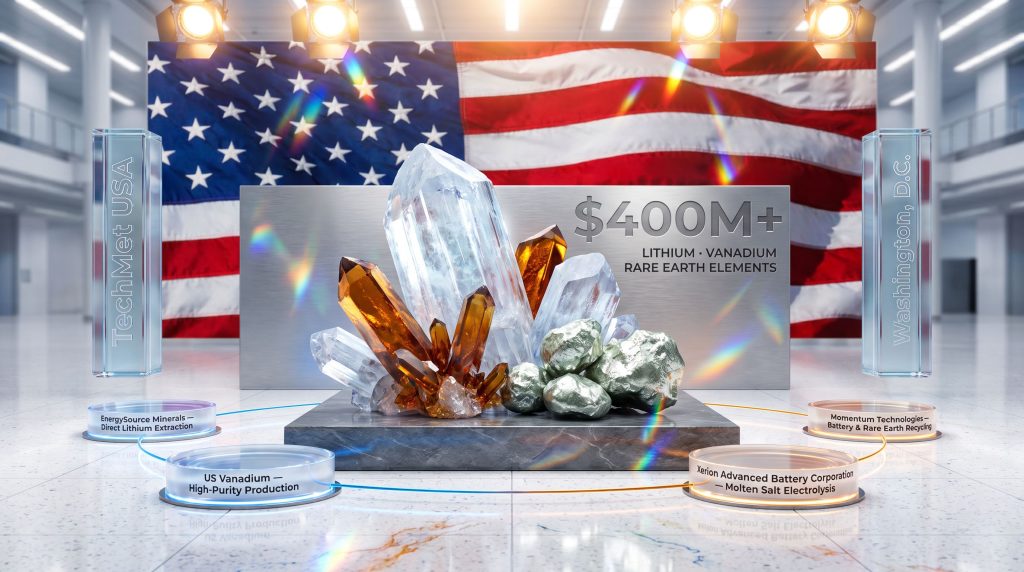
It is within this context that TechMet launches TechMet USA critical minerals platform as a purposeful structural response, consolidating four operating and late-stage development assets into a single domestic entity designed to address the full spectrum of extraction, processing, and recycling needs across America's most strategically sensitive mineral categories.
When big ASX news breaks, our subscribers know first
What TechMet USA Actually Is and Why Consolidation Matters
Announced in August 2026, TechMet USA represents a deliberate departure from the fragmented approach that has historically characterised the US critical minerals landscape. Rather than operating four separate businesses with their own funding structures, stakeholder relationships, and go-to-market strategies, the platform unifies them under a single governance umbrella headquartered in Washington, D.C.
The parent organisation, TechMet, has deployed more than $400 million in capital across the four constituent companies, retaining a majority stake in each. This level of concentrated investment in domestically oriented mineral assets is notable, particularly at a time when institutional capital has been cautious about the long development timelines and commodity price volatility that typically characterise the sector.
The strategic logic behind consolidation is worth examining carefully. Fragmented assets face several structural disadvantages:
- They negotiate separately with government agencies, reducing leverage in procurement conversations
- They often duplicate infrastructure and overhead, compressing margins
- They present a more complex story to institutional investors and OEM partners
- They lack the coordinated supply chain narrative that large-scale government and commercial buyers increasingly require
A unified platform addresses each of these weaknesses simultaneously, creating a more compelling value proposition for partners across both the public and private sectors.
TechMet USA vs. TechMet SCM: Two Platforms, One Ecosystem
TechMet USA does not operate in isolation. It sits alongside TechMet SCM, the parent group's marketing, trading, and logistics arm, which operates across Western-aligned markets globally. Understanding the distinction is important for grasping how TechMet has structured its broader value chain ambitions.
| Platform | Primary Function | Geographic Scope |
|---|---|---|
| TechMet USA | Domestic extraction, processing, and recycling | United States |
| TechMet SCM | Trading, marketing, logistics, and risk management | Western-aligned global markets |
Together, these two entities form a vertically oriented ecosystem spanning from in-ground resource development through to commercial off-take and market delivery.
Leadership Architecture: Experience Across the Full Battery Materials Value Chain
The appointment of Erik Ripple as inaugural CEO of TechMet USA reflects a deliberate choice to lead the platform with an executive whose experience spans both advanced materials and industrial-scale manufacturing. Ripple previously served as CEO of NatureWorks, widely recognised as a pioneer in commercially scaled biopolymers. He also held senior roles at Nexeon, a UK-based company working on advanced battery anode materials using silicon technology.
This cross-sector background is relevant for several reasons. Managing a platform that simultaneously encompasses direct lithium extraction, high-purity vanadium production, rare earth recycling, and novel cathode manufacturing is not a single-industry challenge. It requires fluency across electrochemistry, supply chain logistics, government relations, and capital markets, all domains in which Ripple's career provides meaningful grounding.
Brian Menell, who serves as CEO of the parent TechMet entity and Chairperson of TechMet USA, brings the institutional architecture to the governance layer. As the principal architect of TechMet's Western-aligned critical minerals investment thesis, Menell has spent years positioning the organisation as a bridge between commercially viable mineral assets and the strategic interests of allied-nation governments and industrial buyers.
Ripple has publicly articulated that TechMet USA's mission centres on hardening American critical mineral supply chains against physical, cyber, and economic disruption, with a particular emphasis on building partnerships that extend beyond transactional supply agreements into long-term strategic alignment.
Four Assets, Four Strategic Functions
The portfolio TechMet USA consolidates is notable for covering distinct nodes of the critical minerals value chain rather than clustering around a single commodity or processing stage.
| Company | Mineral Focus | Value Chain Stage | Production Status |
|---|---|---|---|
| EnergySource Minerals | Lithium | Extraction and technology licensing | Shovel-ready and licensing revenue |
| US Vanadium | Vanadium | High-purity production | Currently producing |
| Momentum Technologies | REEs and battery metals | Recycling and processing | Currently producing |
| Xerion Advanced Battery Corporation | Battery cathode materials | Advanced manufacturing | Late-stage development |
EnergySource Minerals: The Dual-Track Lithium Play
EnergySource Minerals operates across two distinct business lines, which is an unusual and underappreciated structural feature of the asset. Most lithium developers pursue a single pathway: mine or extract the resource, process it, and sell the output. EnergySource has layered a technology licensing business on top of its primary production ambition.
Its proprietary direct lithium extraction (DLE) technology is licensed to third-party producers seeking to improve recovery rates and reduce environmental footprint compared to conventional evaporation pond methods. DLE extracts lithium directly from subsurface brines or geothermal fluids, typically achieving recovery rates that can exceed 80 to 90 percent, compared to as low as 40 to 50 percent for traditional solar evaporation processes, according to industry technical assessments.
The licensing stream generates revenue independent of EnergySource's own production ramp, providing a degree of cash flow diversification that is rarely available at this stage of development.
The company's primary production asset is a fully permitted, shovel-ready lithium extraction project targeting battery-grade lithium hydroxide as its end product. This specification matters. Lithium hydroxide, rather than lithium carbonate, is the preferred feedstock for high-nickel cathode chemistries including NMC 811 and NCA formulations, which are increasingly dominant in long-range EV battery packs due to their superior energy density characteristics.
US Vanadium: A Strategic Monopoly in Domestic High-Purity Production
Perhaps the most structurally unique asset in the TechMet USA portfolio is US Vanadium, which holds the distinction of being the only major domestic producer of high-purity vanadium in the United States. This is not a minor competitive advantage. It represents a near-monopoly position in a mineral segment with deepening strategic relevance.
High-purity vanadium serves two overlapping demand streams:
- Vanadium redox flow batteries (VRFBs) for long-duration grid-scale energy storage, where vanadium electrolyte solution enables near-unlimited cycle life and full depth-of-discharge capability without capacity degradation
- Aerospace and structural steel alloying, where vanadium enhances tensile strength and heat resistance in titanium alloys and high-strength steel used in defence and aerospace manufacturing
The absence of competing domestic high-purity vanadium producers means US Vanadium occupies a structurally protected position in negotiations with both government procurement agencies and commercial buyers. This scarcity dynamic is often overlooked in broader critical minerals discussions that tend to focus on lithium and the US rare earth supply chain.
Vanadium redox flow batteries are increasingly considered one of the most viable technologies for multi-hour and multi-day grid storage applications precisely because vanadium electrolyte can be reconditioned and reused indefinitely, unlike lithium-ion systems where capacity fade is cumulative and irreversible.
Momentum Technologies: Modular Recycling Across Two Critical Streams
Momentum Technologies occupies a particularly strategic position within the TechMet USA portfolio because of its ability to process both battery materials and rare earth elements from a single modular technology platform. This flexibility addresses a critical gap in the US secondary supply chain.
The modular design philosophy enables facilities to be scaled proportionally to local feedstock availability. This is commercially significant because rare earth magnet recycling and EV battery recycling are currently constrained not by processing technology but by the geographic concentration and inconsistency of end-of-life feedstock streams.
Momentum has established commercial relationships with major commodity traders and national laboratories, indicating that its technology has achieved credibility beyond the pilot scale. Furthermore, the rare earth supply chains that Momentum feeds into are particularly technically demanding, as rare earth elements in magnets are alloyed and sintered, requiring sophisticated hydrometallurgical or pyrometallurgical separation to recover individual elements like neodymium, praseodymium, and dysprosium at commercially useful purities.
Xerion Advanced Battery Corporation: Rethinking Cathode Manufacturing
Xerion represents TechMet USA's most technically novel asset. Its core technology, molten salt electrolysis, is a fundamentally different approach to producing battery cathode materials compared to the conventional solid-state synthesis and co-precipitation methods that dominate current industrial production.
Molten salt electrolysis operates at elevated temperatures using ionic salt melts as the reaction medium, allowing direct electrochemical refining of metal oxides into cathode-active materials. The process has potential advantages in terms of energy efficiency per unit output and adaptability across multiple cathode chemistries, which broadens its addressable commercial market beyond any single battery formulation.
This positions Xerion at the upstream-to-midstream interface of the battery supply chain, a segment where domestic manufacturing capacity is critically underdeveloped in the United States relative to East Asian competitors.
The Recycling Dimension: Secondary Supply as a Strategic Lever
One of the less-discussed dimensions of TechMet USA's portfolio construction is its deliberate emphasis on secondary supply. Both Momentum Technologies and Xerion address different aspects of the recycling and advanced reprocessing challenge. This is strategically significant for reasons that extend beyond simple resource conservation.
The battery recycling process offers several advantages that primary mining cannot match:
- Geographic concentration is domestic: End-of-life batteries and rare earth magnets are available where products are consumed, reducing import dependency at the feedstock level
- Permitting timelines are typically shorter for processing facilities than for new mines
- Carbon intensity is measurably lower, which increasingly matters for OEM Scope 3 emissions reporting
- Supply response time is faster: Recycling operations can scale within years rather than the decade-plus timelines associated with greenfield mining projects
As EV adoption rates continue to climb, the volume of end-of-life battery packs reaching processing facilities will expand significantly over the coming decade, creating a growing and increasingly predictable secondary feedstock stream that benefits platforms like TechMet USA with established recycling infrastructure already in place.
Frequently Asked Questions About TechMet USA
What is TechMet USA?
TechMet USA is a dedicated domestic US critical minerals platform launched in August 2026, consolidating four operating and development-stage companies focused on lithium, vanadium, rare earth elements, and advanced battery cathode manufacturing under a single Washington, D.C.-based entity.
How much capital has TechMet deployed in its US portfolio?
TechMet has invested more than $400 million across the four businesses now consolidated under TechMet USA, maintaining majority ownership in each.
What makes US Vanadium strategically significant?
US Vanadium is recognised as the sole major domestic producer of high-purity vanadium in the United States, a position that gives it exceptional strategic leverage in both defence-related procurement and the emerging vanadium redox flow battery market for long-duration grid storage.
What is direct lithium extraction and why does it matter?
DLE is an advanced recovery method that extracts lithium from subsurface brines or geothermal fluids without relying on the slow solar evaporation process used in conventional lithium production. It offers meaningfully higher recovery rates, a reduced land footprint, and faster production timelines, making it a preferred technology pathway for new lithium projects targeting battery-grade output.
What is the Western-aligned supply chain positioning about?
TechMet USA explicitly frames its assets as part of a supply chain architecture that excludes exposure to geopolitically sensitive jurisdictions. This positioning aligns with sourcing requirements increasingly embedded in US government procurement frameworks and the procurement preferences of allied-nation industrial buyers seeking supply chain resilience. For further context, Reuters has reported on TechMet's broader strategic intent in the context of Western nations' growing concerns about losing ground in the critical minerals race.
The next major ASX story will hit our subscribers first
Strategic Summary: What the Platform Signals for the Broader Sector
| Dimension | Detail |
|---|---|
| Capital Deployed | $400M+ across four portfolio companies |
| Minerals Addressed | Lithium, vanadium, rare earth elements, cathode materials |
| Value Chain Coverage | Extraction, processing, recycling, advanced manufacturing |
| Unique Asset Position | Only major US domestic high-purity vanadium producer |
| Technology Innovation | DLE licensing, molten salt electrolysis, modular REE recycling |
| Strategic Orientation | Western-aligned, Washington D.C.-headquartered |
The formation of TechMet USA signals something important about where the US critical minerals sector is heading. The era of isolated, single-asset development companies competing independently for government attention and commercial partnerships is giving way to consolidated, platform-based entities capable of speaking to the full supply chain in a single conversation. Whether this model proves replicable across the broader sector remains to be seen, but TechMet launches TechMet USA critical minerals platform as a structural template that others will likely study closely in the years ahead.
This article is intended for informational purposes only and does not constitute financial or investment advice. Forecasts, projections, and strategic assessments involve inherent uncertainty and should not be relied upon as predictions of future outcomes. Readers should conduct independent research and consult qualified advisers before making investment decisions.
Want to Capitalise on the Next Major Critical Minerals Discovery Before the Market Moves?
Discovery Alert's proprietary Discovery IQ model scans ASX announcements in real time, instantly identifying significant mineral discoveries across lithium, vanadium, rare earths, and beyond — turning complex data into actionable investment insights for both short-term traders and long-term investors. Explore historic discoveries and their extraordinary returns, then begin your 14-day free trial at Discovery Alert to position yourself ahead of the market.