
August 21, 2026
The Electrification Imperative Behind China's Copper Import Comeback
Global commodity cycles rarely move in straight lines. Copper, perhaps more than any other industrial metal, has a tendency to confuse analysts who focus on capacity metrics alone while overlooking the behavioural and structural forces that govern physical trade flows. China refined copper imports in Q2 2026 are a textbook example of how demand-side forces can override supply-side expansion narratives, creating import acceleration precisely at the moment when domestic production capacity looks strongest on paper.
Understanding why this matters requires stepping back from the monthly data and examining the layered demand architecture that has quietly been building beneath the surface of Chinese industrial activity. When multiple demand drivers converge simultaneously with a temporary supply constraint, the resulting import surge is neither random nor unsustainable. It reflects deep structural realities about how China's economy is transforming.
When big ASX news breaks, our subscribers know first
The Paradox at the Heart of China's Copper Trade
China expanded its domestic copper smelting capacity significantly through 2024 and 2025, reducing its theoretical dependence on refined metal imports. Nameplate capacity growth was substantial, and for much of 2025, this translated into genuine import substitution, with net import volumes declining to their lowest levels in several years.
Yet the Q2 2026 data tells a very different story. Rather than sustained import compression, the market is now experiencing accelerating cathode demand that is outrunning domestic output. The resolution to this apparent paradox lies in understanding that installed capacity and operational output are entirely different things.
Several dynamics explain the divergence:
- Maintenance-driven output gaps: Even expanded smelter networks require scheduled downtime, and when maintenance cycles coincide with periods of strong downstream demand, the resulting supply gap can only be filled through imports.
- Demand acceleration outpacing capacity gains: China's electrification-driven copper demand is growing faster than even its rapidly expanding refinery network can serve during high-demand periods.
- Behavioural inventory management: Industrial buyers who depleted onshore inventories during strong production cycles must rebuild buffers through accelerated import orders, creating periodic demand surges irrespective of domestic capacity levels.
The distinction between installed capacity and operational output is one of the most underappreciated dynamics in global copper markets. A smelter under maintenance is, functionally, no smelter at all, and China's Q2 2026 experience illustrates this principle with unusual clarity.
China's Copper Demand Engine: What's Actually Driving Q2 2026 Import Growth?
Power Grid Expansion as the Primary Demand Catalyst
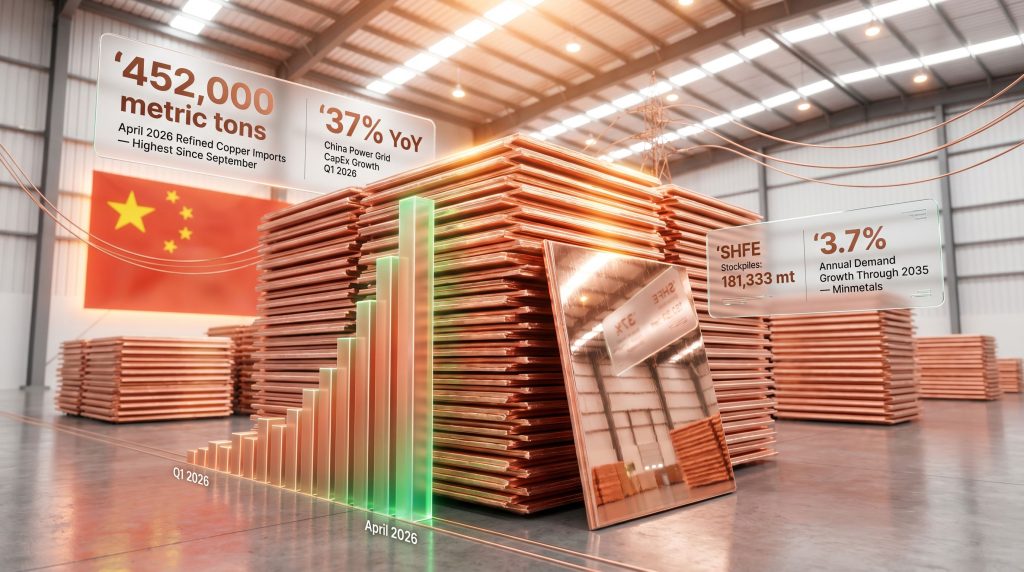
The single most consequential driver of China's current copper import acceleration is the country's aggressive power grid investment programme. Chinese power grid capital expenditure rose 37% year-on-year during the first quarter of 2026, according to state media reporting in April. This figure is not simply a budgetary statistic; it represents a direct pipeline into copper demand.
Grid infrastructure is one of the most copper-intensive categories of capital investment. Transmission lines, transformers, switchgear, and distribution networks all require substantial volumes of high-quality refined copper. A 37% surge in grid capex, at China's scale, translates into procurement volumes that can swing quarterly import figures by hundreds of thousands of metric tons.
Nicholas Snowdon, head of metals and mining research at Mercuria, was explicit about this dynamic at the LME Week conference in Hong Kong, identifying grid investment as the dominant force behind resurgent Chinese copper demand in the electrification sector. His assessment aligns with what physical trade flows are actually showing: grid-related procurement is not discretionary, and buyers in this segment tend to be less sensitive to short-term price movements than traders in other categories. Furthermore, energy transition minerals such as copper are becoming increasingly central to national infrastructure policy across Asia.
Electric Vehicle Sales and the Compounding Demand Effect
Overlapping with grid investment is the ongoing expansion of China's electric vehicle market. EVs require considerably more copper per unit than their internal combustion counterparts, with the metal present in motors, wiring harnesses, charging infrastructure, and battery thermal management systems. As EV penetration continues to rise across China and spreads to adjacent regional markets, the incremental copper demand per unit of industrial output increases structurally.
Regional dynamics have added further momentum to this trend. The geopolitical backdrop created by the Iran conflict has accelerated interest in electric vehicles across China and the broader Asian region, according to Reuters reporting from May 2026. While the precise magnitude of this geopolitical effect on EV adoption is difficult to quantify independently, its directional impact on copper demand is consistent with broader electrification trends.
Post-Holiday Inventory Drawdown and the Restocking Impulse
A third and more cyclical driver is the inventory drawdown that accelerated after China's Lunar New Year period. Shanghai Futures Exchange copper stockpiles declined 5.6% week-on-week to 181,333 metric tons as of the most recent exchange data, representing the lowest inventory level since January 2026.
When onshore inventories fall this sharply while downstream order books are simultaneously expanding, industrial buyers shift into a restocking posture that is characterised by urgency rather than price optimisation. Snowdon's observation that demand post-Lunar New Year was less price-sensitive is a critical behavioural insight: buyers were prioritising supply security over cost minimisation, a dynamic that typically signals genuine physical tightness rather than speculative positioning.
When industrial copper users prioritise supply security over price, it signals that physical availability, not cost, has become the binding constraint. This behavioural shift is one of the most reliable leading indicators of sustained import acceleration in commodity markets.
What Does the Import Data Actually Show?
April 2026: A Breakout Month for China Refined Copper Imports
The April 2026 customs data confirmed what analysts at Mercuria and traders at Eagle Metal had been flagging in the weeks prior. China refined copper imports reached 452,000 metric tons in April, representing a 9% increase from March 2026 and the highest monthly volume since September 2025.
Li Ye, deputy general manager at Eagle Metal, provided context at LME Week in Hong Kong that underscored just how significant this shift was. She indicated that downstream orders had been picking up since March and that April's import volume alone exceeded the combined total for the entire first quarter of 2026. This framing positions April not as a modest recovery but as a structural step-change in procurement behaviour.
Monthly Import Trend Comparison
| Period | Refined Copper Imports | Primary Driver |
|---|---|---|
| January to March 2026 (combined) | Below 452,000 mt total | Post-2025 domestic sufficiency; low base |
| March 2026 | Approx. 203,588 mt | Early seasonal demand recovery |
| April 2026 | 452,000 mt | Inventory drawdown + downstream order surge |
| Q2 2026 Trajectory | Rising | Smelter maintenance + grid capex acceleration |
Why the 2025 Baseline Amplifies the Recovery Narrative
The scale of the Q2 2026 import rebound looks more dramatic partly because 2025 established an unusually low baseline. Total 2025 refined copper imports were estimated at approximately 3.35 to 5.32 million metric tons, representing a year-on-year decline in the range of 6.4% to 10.27%, making it the weakest net import year since approximately 2020.
Several factors converged to compress 2025 imports:
- Expanded domestic smelting capacity reducing reliance on imported cathode.
- A policy-driven export surge following VAT rebate changes for fabricated copper products introduced in late 2024.
- LME-COMEX arbitrage opportunities that incentivised Chinese traders to redirect refined copper toward international markets, particularly the United States.
- The net effect of these dynamics was that approximately 790,000 metric tons of copper were exported from China in 2025, a 73.67% year-on-year increase, fundamentally altering the trade balance.
The partial reversal of these dynamics in 2026 means that some of the Q2 import acceleration reflects normalisation rather than new demand creation. However, the genuine structural demand forces described above confirm that the underlying recovery is not purely statistical.
Why Domestic Copper Supply Is Tightening in Q2 2026
Smelter Maintenance and the Predictable Import Window
One of the more technically interesting aspects of Chinese copper market dynamics is how predictable the seasonal import windows actually are for experienced market participants. Planned maintenance schedules at Chinese copper smelters reduce refined metal output on a recurring quarterly basis, and Q2 2026 is no exception.
Analysts at Shanghai Metals Market (SMM) flagged in a note published in May 2026 that smelter maintenance this quarter is forecast to reduce refined metal output, creating a domestic supply gap that will need to be filled through accelerated cathode imports. This observation is not speculative; it reflects pre-disclosed maintenance calendars and historical production patterns at major Chinese refining facilities.
The implication for market participants is significant. The combination of rising downstream demand and temporarily constrained domestic supply creates a predictable arbitrage window for international copper exporters. In addition, the global copper supply gap is becoming increasingly difficult to ignore as demand accelerates across multiple sectors simultaneously.
The Capacity Expansion Paradox Revisited
It is worth emphasising that even during periods of maximum domestic output, China's copper consumption trajectory means that import dependency cannot be fully eliminated through smelter capacity alone. Capacity expansion reduces the scale of import requirements but does not remove the structural need for refined copper imports when demand growth outpaces production growth rates.
Minmetals projects that Chinese copper consumption will expand at 3.7% annually through 2035, a multi-decade demand trajectory underpinned by grid modernisation, EV adoption, and renewable energy infrastructure. Against this backdrop, even marginal output reductions at China's scale create outsized import demand given the country's sheer consumption volume.
How China's Import Surge Affects Global Copper Prices
The Price Signal from Beijing's Procurement Decisions
Benchmark copper prices climbed to their highest level since January 29, 2026, on the back of rising Chinese import signals, according to Reuters reporting from May 11, 2026. On January 29, copper had reached a record high of $14,527.50 per metric ton, and the May recovery toward that level reflects how directly Chinese import momentum transmits into international pricing.
The mechanism is straightforward. China accounts for more than half of global refined copper consumption. When Chinese import volumes rise sharply against a backdrop of falling onshore inventories, market participants interpret this as a physical tightening signal and price copper accordingly. The LME copper price functions partly as a reflection of Chinese demand expectations, making China's customs data and inventory statistics among the most closely watched leading indicators in the global metals complex.
Global Supply Constraints Amplifying the Effect
The import surge is not occurring in a vacuum. Several global supply-side developments are compressing the available pool of refined copper that China can draw on:
| Supply Factor | Impact on Global Copper Markets |
|---|---|
| Freeport-McMoRan Grasberg restart delayed to early 2028 | Reduces projected global refined supply growth |
| Grasberg interim targets: 65% capacity H2 2026, 80% mid-2027 | Gradual rather than sudden output recovery |
| Chinese smelter maintenance Q2 2026 | Reduces domestic output; increases cathode import demand |
| 2025 Chinese export surge reversal | Removes excess cathode from international markets |
| Rising LME-SHFE spread dynamics | Governs economics of Chinese import decisions |
The Freeport Grasberg delay is particularly notable. Grasberg is one of the world's largest copper mines, and its phased restart timeline through 2028 means that global refined supply growth will remain constrained at precisely the moment when Chinese demand is re-accelerating. Consequently, the copper supply crunch facing the market is intensifying with limited near-term relief in sight.
Arbitrage and the Bonded Warehouse Dynamic
A less visible but commercially important dimension of China's copper import dynamics is the role of bonded warehouses as a buffer between international pricing and domestic demand. Copper held in bonded warehouses in China has not formally entered the domestic market and therefore does not appear in official inventory statistics until cleared through customs.
When the spread between LME and Shanghai Futures Exchange (SHFE) copper prices widens sufficiently to cover import costs, bonded warehouse stocks move rapidly into the domestic market, supplementing cathode imports. Conversely, when the arbitrage is unfavourable, bonded stocks accumulate as a form of price-sensitive inventory buffer. The current period of SHFE inventory depletion and rising LME prices suggests the arbitrage window may be shifting in favour of accelerated bonded stock drawdown alongside fresh import orders.
The next major ASX story will hit our subscribers first
Expert and Industry Perspectives on the Q2 2026 Outlook
Mercuria's Assessment of the Demand Cycle
Nicholas Snowdon of Mercuria provided the most analytically complete framework for understanding Q2 2026 import dynamics at LME Week in Hong Kong. His characterisation of post-Lunar New Year demand as robust and less price-sensitive identified the behavioural shift that precedes import acceleration. His explicit attribution of resurgent demand to electrification sectors, particularly grid investment, establishes a causal chain that connects macro policy to physical commodity procurement.
Snowdon's forward-looking assessment that cathode imports would rise as onshore inventory drawdowns deepened proved accurate ahead of the April customs data release, lending credibility to the broader analytical framework.
Eagle Metal's Ground-Level Confirmation
Li Ye of Eagle Metal provided the kind of ground-level confirmation that is often more valuable than top-down modelling. Her observation that April's import volume exceeded the entire first quarter combined was not derived from forecasting models but from direct market participation, providing independent corroboration that the import acceleration identified in the customs data reflects genuine physical demand rather than statistical noise.
Minmetals' Long-Run Demand Projection
The long-term context provided by Minmetals' projection of 3.7% annual copper consumption growth through 2035 reframes the Q2 2026 import surge as a cyclical episode within a structural demand story. The underlying drivers are not transient: power grid modernisation is a decades-long infrastructure programme, and EV adoption is still in its early growth phase across much of Asia. Furthermore, copper price drivers such as grid investment and electrification are compounding in ways that market participants are only beginning to fully price in.
China's Refined Copper Trade Structure: A Multi-Year Perspective
How Trade Flows Have Evolved Since 2023
China's position in global refined copper trade has undergone a meaningful structural shift since 2023. In 2023, refined copper import value reached approximately $34 billion, with cathodes and sections representing roughly 87% of total volume. By 2025, estimated import values had climbed to approximately $40.5 billion, positioning refined copper as China's 10th most imported product globally despite the volumetric decline in metric tonnage.
This value-volume divergence reflects the impact of rising copper prices on trade statistics: higher prices inflate reported import values even when physical volumes are declining. It also reflects the quality composition of imports shifting toward higher-grade cathode material as downstream industries demand purer inputs for advanced manufacturing applications.
The VAT-Driven Export Cycle and Its Reversal
The December 2024 removal of VAT rebates on fabricated copper products triggered one of the most significant short-term dislocations in China's copper trade history. By eliminating the tax advantage that had made Chinese copper fabrication and re-export economically attractive, the policy change reversed the incentive structure: refined copper that would previously have been retained domestically was instead exported to capture international arbitrage, particularly toward LME and COMEX markets.
The 790,000 metric ton export surge of 2025 was the direct consequence. The partial normalisation of this dynamic in 2026 means some of the Q2 import recovery reflects the unwinding of a one-time policy-driven distortion rather than pure demand growth. Market participants who conflate the two dynamics risk overestimating the sustainability of the current import pace.
The 2026 Import Trajectory: Key Variables
Net imports in 2026 are expected to remain below pre-2023 structural highs, as expanded domestic smelting capacity provides a meaningful floor of domestic supply. Q2 2026 represents a cyclical uptick within this structurally lower baseline. The variables that will determine whether the import trajectory continues to accelerate or plateaus through the second half of 2026 include:
- Domestic smelter maintenance completion schedules: When Chinese refineries return from maintenance at full utilisation, import necessity diminishes.
- LME-SHFE price spread dynamics: Arbitrage economics govern the financial incentive for import decisions at the margin.
- Grid investment disbursement pace: Capex commitments must translate into physical procurement orders to sustain copper demand.
- EV sales momentum through H2 2026: Any slowdown in EV adoption rates would reduce incremental copper demand growth.
- Bonded warehouse inventory levels: Drawdown of bonded stocks can substitute for fresh imports if price spreads permit.
Frequently Asked Questions: China Refined Copper Imports
What Is Driving the Increase in China's Refined Copper Imports in Q2 2026?
The primary drivers are a 37% year-on-year surge in power grid capital expenditure during Q1 2026, accelerating electric vehicle sales, a sharp drawdown in onshore copper inventories to their lowest level since January 2026, and planned smelter maintenance that is reducing domestic refined output during the quarter.
How Much Refined Copper Did China Import in April 2026?
China imported approximately 452,000 metric tons of refined copper in April 2026, the highest monthly volume since September 2025 and roughly 9% above March 2026 levels. According to Eagle Metal, April's volume alone exceeded the combined total for January through March 2026.
Why Were China's 2025 Copper Imports at Multi-Year Lows?
The 2025 decline reflected expanded domestic smelting capacity, a major export surge driven by VAT rebate policy changes introduced in late 2024, and LME-COMEX arbitrage opportunities that redirected refined copper toward international markets rather than domestic consumption.
How Do Chinese Copper Imports Affect Global Prices?
China accounts for the largest share of global refined copper consumption. When Chinese import volumes rise sharply against a backdrop of falling onshore inventories, physical market tightening signals drive LME benchmark price appreciation. The May 2026 price recovery toward January's record high of $14,527.50 per metric ton was directly attributed to rising Chinese import signals. Research into refined copper trade flows confirms how dominant China's role has become in setting the global price direction.
What Is the Long-Term Outlook for China's Copper Demand?
Minmetals projects Chinese copper consumption will grow at 3.7% annually through 2035, driven primarily by power grid modernisation and electric vehicle adoption across China and the broader region. For investors, understanding the right copper investment strategies in this context is becoming increasingly important.
What Role Does Smelter Maintenance Play in Q2 Import Volumes?
Scheduled maintenance at Chinese copper smelters reduces domestic refined output on a predictable seasonal basis. Shanghai Metals Market analysts forecast Q2 2026 maintenance will cut refined metal output, creating a domestic supply gap that accelerates cathode import requirements.
Key Takeaways: What the Q2 2026 China Copper Import Surge Signals
The April 2026 import breakout is best understood as the convergence of three independent forces: structural demand growth driven by electrification investment, cyclical inventory depletion following post-holiday demand recovery, and temporary domestic supply constraints from smelter maintenance schedules. Each of these factors would independently support higher imports; together they produced a step-change in monthly procurement volumes.
Several forward-looking implications deserve emphasis:
- The 2025 low-import baseline amplifies the apparent magnitude of the Q2 2026 recovery, but the underlying demand fundamentals are real and measurable.
- Power grid investment and EV electrification represent multi-year demand drivers that will sustain above-baseline copper import requirements well beyond the current quarter.
- Global supply constraints, particularly the delayed Freeport Grasberg restart, reduce the cushion available to absorb sustained Chinese import acceleration without price consequences.
- Minmetals' projection of 3.7% annual consumption growth through 2035 positions China's current import surge as the opening act of a much longer demand story.
- For market participants, the behavioural signal embedded in the data is arguably more important than the volume figures themselves: when China's industrial buyers shift to price-insensitive procurement, the physical market has entered a phase where supply security outweighs cost optimisation. Academic analysis of copper recycling and supply dynamics further underscores why structural tightness is likely to persist across this decade.
This article is based on publicly available information and analyst commentary as reported. Forward-looking statements regarding import volumes, price trajectories, and demand forecasts reflect analyst projections and industry estimates, not guaranteed outcomes. Readers should not interpret this content as financial or investment advice. Commodity markets are subject to significant volatility and unpredictable geopolitical, policy, and macroeconomic influences.
Want To Position Yourself Ahead of the Next Major Copper Discovery?
Discovery Alert's proprietary Discovery IQ model delivers real-time alerts on significant ASX mineral discoveries — including copper — instantly translating complex market data into actionable opportunities for both traders and long-term investors. Explore historic examples of exceptional discovery returns and begin your 14-day free trial today to ensure you're never the last to know when the next major find is announced.