July 9, 2026
When Factory Prices Decouple From Consumer Demand: What It Means for Australian Miners
Across commodity markets, few relationships carry more predictive weight than the gap between what factories charge and what consumers actually pay. When these two measures drift apart, the signal they send reverberates well beyond the borders of the economy producing the data. The China CPI and PPI data impact on BHP Rio Tinto and Fortescue shares has historically functioned as one of the most reliable leading indicators available, offering a window into the industrial conditions that ultimately determine how much raw material Beijing's steel sector absorbs from global suppliers.
Understanding why this gap matters, how it is currently behaving, and what it implies for BHP Group Ltd (ASX: BHP), Rio Tinto Ltd (ASX: RIO), and Fortescue Ltd (ASX: FMG) requires more than a surface reading of the numbers. It demands an understanding of the transmission mechanism connecting Chinese inflation data to iron ore purchasing decisions, steel mill profitability, and eventually, the share prices of Australia's resource giants.
When big ASX news breaks, our subscribers know first
The Mechanics of the CPI–PPI Spread and Why the Gap Is Widening
Two Indices, One Critical Relationship
China's Consumer Price Index and Producer Price Index are frequently reported together but measure fundamentally different things. The CPI captures what households pay for goods and services at the retail level. The PPI measures price changes at the point of production, before goods travel through distribution chains to reach end consumers.
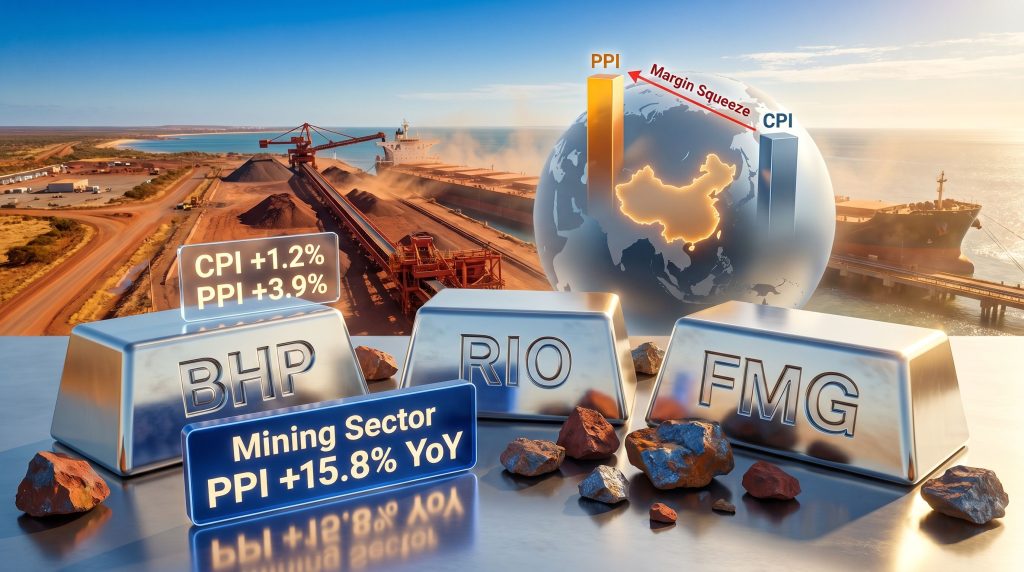
In a healthy, demand-driven economy, both indices tend to move in the same direction because strong consumer spending pulls prices higher across the entire supply chain. The current mid-2026 environment is meaningfully different. May 2026 CPI came in at 1.2% year-on-year, just below the 1.3% market expectation, confirming that Chinese household demand has not yet generated meaningful broad-based price pressure.
Meanwhile, May PPI surged to 3.9% year-on-year, the fastest rate of factory-gate inflation recorded since July 2022. Within that aggregate number, mining sector prices climbed 15.8% year-on-year and raw materials prices rose 9.2% year-on-year — figures that sit at the very core of the revenue environment for Australian iron ore exporters.
| Metric | May 2026 Reading | Market Expectation | Context |
|---|---|---|---|
| CPI (Year-on-Year) | +1.2% | +1.3% | Slightly below expectation |
| PPI (Year-on-Year) | +3.9% | ~+3.5% | Fastest since July 2022 |
| PPI (Month-on-Month) | +0.5% | — | Continued acceleration |
| Mining Sector PPI | +15.8% YoY | — | Directly relevant to iron ore exporters |
| Raw Materials PPI | +9.2% YoY | — | Broad commodity cost pressure |
What Is Driving the Divergence?
The widening gap between CPI and PPI in the current cycle is not a conventional demand-pull story. Three interconnected forces are responsible:
-
Geopolitical energy disruption — Conflict affecting the Strait of Hormuz, a critical transit corridor for global oil flows, generated energy price volatility that fed directly into Chinese manufacturing input costs. China imports roughly 10 million barrels of oil per day, making it acutely sensitive to any disruption in major shipping routes.
-
Commodity price transmission — Elevated global prices for iron ore, copper, and energy-intensive materials flow into PPI well before they affect consumer prices, creating the divergence visible in current data.
-
Structural consumer demand weakness — Chinese household consumption has not recovered sufficiently from post-property sector stress to generate meaningful CPI pressure. This anchors the consumer index even as factory-gate inflation accelerates.
The critical insight for investors is that elevated PPI driven by supply-side cost pressures, rather than strong underlying demand, creates a margin squeeze for Chinese industrial producers, including steel mills, that can eventually reduce their raw material purchasing appetite.
The Steel Mill Margin Squeeze: How Inflation Data Connects to Iron Ore Orders
Understanding the Transmission Mechanism
China's steel industry consumes the overwhelming majority of globally traded seaborne iron ore. Furthermore, when steel mill input costs rise faster than the prices mills can charge for finished steel, profitability contracts. The response to sustained margin pressure typically follows a predictable sequence:
- Initial phase: Mills absorb higher costs and maintain output to preserve market share
- Intermediate phase: Marginal producers begin reducing blast furnace utilisation rates
- Later phase: Procurement teams reduce iron ore order volumes and negotiate harder on price
The speed at which this sequence unfolds depends heavily on whether Beijing responds to weak consumer demand with infrastructure stimulus, which has historically been the primary mechanism through which Chinese governments have sustained steel demand during cyclical soft patches. This dynamic is central to understanding iron ore demand prospects over the near term.
The Four Scenarios: What CPI and PPI Combinations Signal
| CPI Trend | PPI Trend | Signal for Iron Ore Demand | Historical Precedent |
|---|---|---|---|
| Rising | Rising | Strongest demand environment | 2020–2021 infrastructure boom |
| Subdued | Rising | Cost-push squeeze, mixed outlook | Current mid-2026 environment |
| Subdued | Falling | Deflationary risk, most bearish | 2015–2016 commodity downturn |
| Rising | Subdued | Demand recovery outpacing supply | Rare but highly constructive |
The current environment falls squarely into the second category, which is historically associated with near-term demand caution. However, it is not inherently catastrophic for miners if Beijing responds with sufficient fiscal stimulus to sustain construction and industrial activity.
Blast Furnace Utilisation: The Metric Beneath the Headlines
One less commonly tracked but highly informative indicator is Chinese blast furnace utilisation. When steel mill margins compress, the first operational response is typically a reduction in blast furnace run rates rather than a formal production cut announcement. Monitoring weekly utilisation data from independent Chinese steel research providers alongside the headline CPI and PPI figures gives investors a more granular view of actual demand conditions than the monthly government releases alone.
BHP, Rio Tinto, and Fortescue: Differentiated Exposure Profiles
A Framework for Comparing China Sensitivity
The three largest ASX iron ore producers share a common dependence on Chinese industrial activity but differ substantially in how that dependence is structured. Treating them as a homogeneous group is an analytical error that has historically led investors to misjudge relative risk during periods of Chinese demand uncertainty. Consequently, understanding how China steel and iron ore dynamics affect each company individually is essential.
| Factor | BHP (ASX: BHP) | Rio Tinto (ASX: RIO) | Fortescue (ASX: FMG) |
|---|---|---|---|
| Primary Revenue Commodity | Iron ore, copper, potash | Iron ore, copper, aluminium, lithium | Iron ore |
| Commodity Diversification | Moderate to High | High | Very Low |
| China Revenue Concentration | High | High | Very High |
| CPI Sensitivity | Moderate | Moderate | High |
| PPI Sensitivity | High (multi-commodity) | High (multi-commodity) | High (iron ore focused) |
| Current Company-Specific Risk | WA terminal strike threat (16 July 2026) | Sharp June decline of 7.1% | Potential product blacklisting from 15 July 2026 |
BHP: The Copper Factor Changes the Calculus
BHP's earnings base spans iron ore, copper, and potash, with copper increasingly important to the company's long-term growth narrative. This commodity mix means that no single Chinese economic signal uniformly drives BHP's revenue outlook. Copper demand in China is increasingly tied to industrial electrification, data centre construction, and manufacturing modernisation rather than traditional residential property construction, giving BHP exposure to a structurally different demand driver than pure iron ore plays.
The operational complication for BHP in the current period is the announced strike action planned by workers at its Western Australian iron ore terminal on 16 July 2026. This supply-side disruption is independent of Chinese demand conditions but could affect shipment volumes at precisely the moment when the market is scrutinising demand signals from Beijing. Understanding the BHP iron ore strategy in this context helps clarify how the company is positioned to manage these concurrent pressures.
For BHP investors, the June CPI and PPI data represents one risk factor among several concurrent variables rather than the single dominant driver of near-term share price direction.
Rio Tinto: Multi-Commodity Exposure Cuts Both Ways
Rio Tinto's portfolio breadth means that China's inflation data affects its earnings through multiple channels simultaneously. A PPI reading that confirms elevated non-ferrous metal prices benefits Rio's copper and aluminium divisions even if iron ore-specific demand signals are mixed. This is structurally different from the single-commodity sensitivity that characterises Fortescue's position.
Rio Tinto shares declined 7.1% in June 2026, a move partly attributed to the brief easing of commodity price support during the ceasefire window in the Middle East, which temporarily reduced the geopolitical premium embedded in energy and metal prices. The subsequent resumption of hostilities and US military strikes reversed that dynamic, however the episode highlights how directly Rio's near-term share price performance is tied to the same geopolitical forces shaping China's PPI readings. Analysis of miners facing iron ore headwinds confirms these pressures are broadly shared across the sector.
A June PPI print confirming that factory-gate inflation remains elevated would be simultaneously constructive for iron ore, copper, and aluminium revenue assumptions, making it a broader positive catalyst for Rio than for the more narrowly focused Fortescue.
Fortescue: Concentration Risk and a Product-Specific Headwind
Fortescue's business model is structurally the most exposed to Chinese iron ore demand dynamics. With revenue derived almost entirely from a single commodity sold predominantly into the Chinese steel market, every data point from Beijing carries amplified significance for its shareholders.
Beyond the macro data sensitivity, Fortescue carries a company-specific risk that is particularly unusual. Bloomberg has reported that a Chinese state-backed iron ore procurement entity indicated its intention to blacklist Fortescue's Super Special Fines product from 15 July 2026. Super Special Fines is a lower-grade iron ore product that trades at a discount to the benchmark 62% Fe fines price. The product-specific nature of this exclusion is notable because it suggests a targeted purchasing decision rather than a broad reduction in iron ore import appetite.
For Fortescue investors, how ore grade matters is particularly relevant. Lower-grade ores face a structural discount in the Chinese market that widens during periods when steel mills prioritise blast furnace efficiency over raw volume. A margin-compressed steel sector tends to favour higher-grade feedstocks that reduce slag volumes and improve energy efficiency per tonne of steel produced.
Furthermore, understanding why ore grade matters in this environment is essential context for evaluating Fortescue's competitive position within China's purchasing decisions.
Fortescue shares fell 4.2% in June 2026, underperforming both BHP and Rio Tinto over the same period. The combination of higher single-commodity concentration and the product blacklisting risk means that Fortescue's sensitivity to the June inflation data is amplified relative to its peers.
Reading June's Data in Context: The Geopolitical Distortion Problem
Why June Figures May Require Careful Interpretation
Investors approaching the June CPI and PPI release need to account for a significant distortion factor in the data collection period. June covered a window during which the Strait of Hormuz temporarily reopened following a ceasefire, before subsequent US military strikes reversed the situation. This means energy commodity prices may have been temporarily suppressed during part of the month before rebounding.
A softer June PPI print should therefore not be automatically interpreted as evidence of structural Chinese demand deterioration. The more likely explanation for any deceleration from May's 3.9% reading would be a statistical reflection of temporary commodity price relief during the ceasefire window rather than a fundamental shift in industrial activity.
This distinction matters significantly for investment decision-making. Investors who mechanically sell mining stocks on a softer PPI print without accounting for the geopolitical timeline risk reacting to a data artefact rather than genuine demand information. This is particularly relevant given how China iron ore surplus dynamics can complicate price signals during periods of geopolitical volatility.
Three Scenarios for the June Release and Likely Market Responses
Scenario 1: PPI Holds Above 3.5% Year-on-Year
This outcome confirms that commodity and energy price pressures remain embedded in China's industrial cost structure despite the brief ceasefire. For ASX mining shares, this represents the most constructive near-term signal. Rio Tinto, with its multi-commodity exposure, would likely see the broadest earnings support. BHP would benefit across both iron ore and copper divisions. Fortescue would receive a partial offset to its product-specific headwind, though the blacklisting risk remains regardless of the macro data.
Scenario 2: PPI Softens Materially Below 3.0% Year-on-Year
This outcome creates interpretive complexity. Investors must determine whether the deceleration reflects genuine Chinese demand weakness or the statistical impact of mid-month commodity price relief during the ceasefire window. A soft print combined with weak steel production data and falling blast furnace utilisation would be more concerning than a soft print occurring alongside stable or improving steel sector operating rates.
Scenario 3: CPI Moves Higher While PPI Moderates
This scenario represents a narrowing of the CPI–PPI gap, which would be the most structurally positive outcome for Chinese industrial producers. Healthier steel mill margins support sustained or increased iron ore purchasing over subsequent months. For Australian miners, this would function as a medium-term positive signal even if the headline PPI number appears to soften on the surface. Recent reporting on how China's stimulus response has previously lifted BHP, Rio Tinto, and Fortescue illustrates how quickly sentiment can shift when policy conditions improve.
The Industrial Modernisation Wildcard
An Underappreciated Demand Channel for Iron Ore
One dimension of Chinese iron ore demand that is frequently underweighted in conventional analysis is the role of industrial modernisation and advanced infrastructure investment. China's ongoing push into artificial intelligence data infrastructure, electrical grid upgrades, and precision manufacturing facilities drives demand for steel in ways that are structurally less sensitive to residential property cycles than traditional construction activity.
Data centre construction is particularly steel-intensive. A single large-scale facility can consume tens of thousands of tonnes of structural steel in its foundations, support structures, and cooling infrastructure. As China accelerates investment in domestic AI computing capacity, this represents a demand channel for steel that does not correlate with traditional CPI-driven consumer spending cycles.
For miners producing premium-grade iron ore, which is preferred by blast furnaces operating at high efficiency rates, this industrial upgrading dynamic could sustain demand for high-specification feedstocks even during periods of broader construction sector weakness.
The next major ASX story will hit our subscribers first
Key Metrics to Monitor Beyond the Headline Numbers
Investors seeking a complete picture of Chinese iron ore demand conditions should track the following supplementary data points alongside the monthly CPI and PPI releases:
- Steel production volumes published by China's National Bureau of Statistics, which provide a direct measure of iron ore consumption
- Iron ore port inventory levels at major Chinese coastal facilities, which indicate whether mills are drawing down or building stockpiles
- Blast furnace utilisation rates among independent and state-owned Chinese steel producers, providing a real-time operating conditions indicator
- Fiscal policy announcements from Beijing regarding infrastructure spending commitments, which remain the primary mechanism for sustaining steel demand during consumer sector weakness
- Strait of Hormuz shipping status and any further developments in the Middle East conflict that could re-establish or intensify energy price pressure on Chinese manufacturing costs
- Seaborne iron ore spot prices for both 62% Fe benchmark fines and lower-grade products, which reveal whether any grade discount is widening
Understanding the China CPI and PPI data impact on BHP Rio Tinto and Fortescue shares ultimately requires combining the headline monthly releases with these real-time operational indicators. The macro data provides the directional signal; the supplementary metrics confirm whether that signal is translating into actual purchasing behaviour on the ground. Broader market commentary on how ASX miners face pressure from Chinese demand cycles underscores why this multi-layered approach to analysis is essential for informed decision-making.
This article contains general financial analysis only and does not constitute personal investment advice. Investments in ASX-listed securities involve risk, including the potential loss of capital. Past performance is not indicative of future results. Readers should consider their personal financial circumstances and seek independent financial advice before making investment decisions. Forecasts, scenarios, and projections discussed in this article are speculative and subject to significant uncertainty.
Want to Stay Ahead of the Next Major ASX Mineral Discovery?
While macroeconomic signals like China's CPI and PPI data shape the broader commodity landscape, the real wealth-creation moments in Australian resources often come from significant new mineral discoveries — and Discovery Alert's proprietary Discovery IQ model delivers real-time ASX discovery alerts straight to subscribers, transforming complex mineral data into actionable opportunities the moment they are announced. Explore historic examples of discoveries that generated exceptional returns and begin your 14-day free trial today to position yourself ahead of the broader market.