July 15, 2026
The Silent Variable Reshaping Global Crude Markets
Most oil price models are built around a familiar cast of variables: OPEC production quotas, U.S. shale output, Middle East geopolitical risk, and dollar strength. These inputs have anchored energy market analysis for decades. Yet a structural shift has been unfolding that renders these frameworks increasingly incomplete. The world's largest crude importer has transformed from a passive price-taker into something far more consequential: a demand-side force capable of absorbing supply shocks, redirecting trade flows, and setting informal price floors without announcing a single policy change.
Understanding how china crude inventories and oil prices interact has become one of the most analytically demanding challenges in global commodity markets, and one of the most consequential for anyone with exposure to energy assets.
When big ASX news breaks, our subscribers know first
Why China's Inventory Cycle Now Rivals OPEC as a Pricing Force
From Reactive Buyer to Strategic Participant
China's evolution in crude markets did not happen overnight. It was built on decades of infrastructure investment in onshore tank farms, strategic petroleum reserve (SPR) facilities, and independent refinery capacity that collectively gave Beijing the physical ability to absorb enormous quantities of crude when prices were soft and then draw on those reserves when market conditions shifted.
This dynamic is structurally different from Saudi Arabia's influence, which operates through production volume adjustments that take weeks or months to manifest in physical markets. China's mechanism is the timing and pace of its purchases. When Chinese buyers step back, global seaborne crude markets feel the withdrawal immediately through declining tanker bookings, narrowing Asian crude premiums, and falling freight rates.
The analytical implication is significant: traders and investors who focus exclusively on Gulf production signals are now working with only half the information required to anticipate oil price direction. Furthermore, understanding crude price dynamics has become inseparable from understanding Chinese inventory behaviour.
A Two-Variable Framework for Price Discovery
The traditional OPEC-centric model of oil price discovery is no longer sufficient. Global crude prices now respond to two primary demand signals simultaneously: Gulf supply announcements and Chinese inventory drawdown rates.
For energy market participants, this creates an entirely new analytical obligation. Monthly tracking of the gap between Chinese seaborne import volumes and refinery throughput rates has become as strategically important as monitoring OPEC's market influence through production compliance. Platforms such as Kpler and Vortexa, which aggregate tanker-tracking data to estimate Chinese import flows in real time, have moved from supplementary research tools to front-line market intelligence assets.
How China Built 1.47 Billion Barrels of Crude Reserves
The 2025 Accumulation Campaign: Scale and Logic
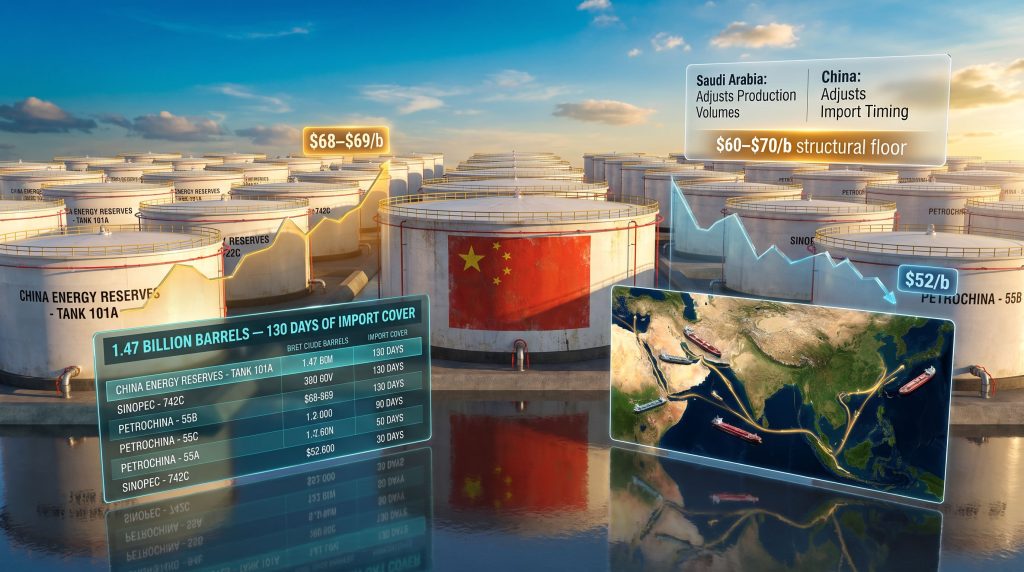
Between January and August 2025, China added an estimated average of 900,000 barrels per day (b/d) to strategic and commercial storage during periods of price softness, according to U.S. Energy Information Administration (EIA) estimates. By April and May 2025, onshore crude inventories reached an all-time high of approximately 1.17 billion barrels. By year-end 2025, total commercial stocks were estimated at 1.47 billion barrels, equating to roughly 130 days of import cover — far exceeding the International Energy Agency's recommended threshold of 90 days.
This was not incidental accumulation. The 2025 stockpiling campaign reflected a deliberate strategy of opportunistic purchasing during periods when discounted Russian and Iranian crude was accessible through alternative payment and delivery channels. Geopolitical sanctions, rather than restricting China's energy access, effectively subsidised its inventory build by making heavily discounted barrels available to independent refiners willing to navigate the operational complexities. In this context, Russian oil sanctions paradoxically created a significant pricing advantage for Chinese buyers.
The Role of Teapot Refiners and Discounted Crude Flows
China's independent refining sector, commonly referred to as teapot refiners, played a central role in absorbing the discounted barrel supply that underpinned the 2025 accumulation cycle. These smaller, privately owned facilities have greater flexibility to process a wide variety of crude grades and are less constrained by the procurement protocols that govern China's state-owned majors.
Key crude sources feeding the 2025 build included:
- Russian crude routed through alternative payment channels following Western sanctions, available at significant discounts to benchmark grades
- Iranian oil priced at steep concessions relative to comparable Middle Eastern grades, processed primarily through teapot facilities
- Opportunistic purchases of other discounted spot cargoes during periods of global oversupply
The cumulative effect was that commercial inventory builds outpaced refinery throughput for extended periods throughout 2025, creating a stockpile buffer of historic scale. According to analysis on China's oil inventory levels, this accumulation represented one of the most aggressive stockpiling episodes in recent history.
Data Snapshot: China's Inventory Build Timeline
| Period | Inventory Status | Estimated Volume | Price Environment |
|---|---|---|---|
| Jan–Aug 2025 | Active Build | +900,000 b/d average | Brent supported at $68–$69/b |
| Apr–May 2025 | Record High | ~1.17 billion barrels onshore | Prevented price collapse amid global builds |
| Nov 2025 | Peak Surplus | ~1 million b/d surplus rate | Price floor held near $60/b |
| End 2025 | Maximum Accumulation | ~1.47 billion barrels commercial | 130 days of import cover |
The 2026 Drawdown: How China Ran Its Refineries Without Buying Crude
Import Collapse to a Decade Low
The strategic logic of accumulation only becomes fully visible when the drawdown phase begins. By late May 2026, Kpler estimated Chinese seaborne crude imports had fallen to approximately 6.78 million b/d, the lowest level in nearly a decade. This represented a decline of roughly 4.4 million b/d below the first-quarter 2026 average and well below the 2025 full-year average of 10.66 million b/d.
Critically, refinery throughput did not fall at anything close to the same rate. Kpler's July 2026 analysis confirmed that refinery runs had declined by only approximately 1.8 million b/d year-over-year to around 13.1 million b/d, confirming that stored crude was systematically substituting for imported barrels. As Reuters reported, China was drawing deeper into its stockpiles as imports hit a decade low.
The Two-Tier Inventory Management Approach
The mechanics of China's inventory management during the 2026 conflict period revealed a level of strategic sophistication that has no direct parallel in Western energy markets. According to IEA estimates, June 2026 alone saw approximately 41 million barrels drawn from Chinese crude inventories, one of the largest single-month stock draws on record.
Simultaneously, a bifurcation emerged between government-controlled and commercial inventories:
- China's strategic petroleum reserves grew by approximately 8 million barrels after the conflict period began
- Commercial refinery inventories fell by approximately 15 million barrels over the same period
- Chinese refiners still held more than 300 million barrels in refinery tank farms at the point of peak import suppression, sufficient to offset the shortfall for an additional 60 to 75 days without new purchases
Beijing effectively allowed commercial refiners to absorb the supply disruption through their own storage capacity, while simultaneously preserving and growing government-controlled strategic reserves. This two-tier approach operates as a sophisticated policy tool with no close equivalent in any Western energy market.
Price Impact of the Drawdown
| Period | Inventory Action | Brent Price Trajectory |
|---|---|---|
| Late 2025 | Peak stockpile surplus (~1M b/d) | Floor held near $60/b |
| Q1 2026 | Global inventory builds at peak | Brent forecast to fall toward $52/b |
| May 2026 | Drawdown accelerates (~1M b/d from reserves) | ~19% price decline recorded in May |
| Jun 2026 | 41 million barrel single-month draw | Downward pressure despite Middle East tensions |
| 2026 Full Year | Moderate build forecast (+266M barrels / +730,000 b/d) | Expected to provide price floor without driving spikes |
How China's Withdrawal Reshaped Global Crude Trade Flows
Saudi Aramco's Unprecedented Discount Sequence
With Chinese buyers stepping back from Middle Eastern crude, a structural surplus of Gulf barrels emerged. Saudi Aramco responded to this demand vacuum with a series of escalating official selling price reductions to Asian customers:
- A $4/barrel reduction for June-loading cargoes
- A further $6/barrel cut for July-loading cargoes
- An additional $11/barrel reduction for August-loading cargoes
- Culminating in Arab Light trading at a $1.50/barrel discount to the Oman-Dubai benchmark
This sequence is extraordinary. The world's largest crude exporter was forced into deep and repeated price concessions not because of oversupply from its own wells, but because its primary customer had temporarily stopped buying. The transmission mechanism between Chinese inventory cycles and Gulf benchmark pricing is now direct and measurable. Consequently, US-China oil tensions added yet another layer of complexity to these already volatile trade dynamics.
Iranian Crude Left Stranded
The impact on Iranian crude was particularly acute. As Chinese teapot refiners shifted purchasing preference toward discounted Gulf grades, Iranian oil lost its primary market. Reuters reported that between mid-June and early July 2026, Iran loaded an estimated 30 to 34.5 million barrels of crude that subsequently remained at sea or in floating storage across Southeast Asian waters.
Chinese imports of Iranian crude were projected to fall to approximately 556,000 b/d in July 2026, the lowest level since early 2023. Notably, this outcome was not driven by new sanctions or enforcement pressure. It was driven entirely by Chinese commercial decisions responding to the relative pricing of available crude grades, representing a previously underappreciated channel through which China influences international sanctions effectiveness.
Gulf Export Recovery and Trade Flow Redistribution
The IEA estimated Gulf crude and condensate exports recovered by approximately 6.5 million b/d in June 2026, reaching 16.1 million b/d. Crude accounted for roughly 85% of that total export recovery, with refined products and LPG remaining well below half of pre-conflict levels. European, Indian, and non-Chinese Asian buyers absorbed the Gulf barrels previously destined for Chinese refineries, creating a rapid and significant redirection of global crude trade flows within a matter of weeks.
China vs. Saudi Arabia: Two Models of Market Influence
Comparing the Mechanisms
| Dimension | Saudi Arabia (OPEC Model) | China (Inventory Model) |
|---|---|---|
| Mechanism | Adjusts production volumes | Adjusts import timing and pace |
| Response Speed | Weeks to months (quota changes) | Immediate (tap or pause purchases) |
| Transparency | Relatively disclosed | No official inventory data published |
| Market Signal | Production quota announcements | Analyst-estimated import/refinery gaps |
| Geographic Reach | Global supply influence | Dominant in Asian crude pricing |
| Historical Role | Decades-established | Emerging since approximately 2022–2025 |
The Opacity Problem and Its Investment Implications
Unlike the U.S. EIA's weekly inventory reports or IEA member-state disclosures, China publishes no official crude inventory statistics. All volume estimates, including those from the IEA, Kpler, and EIA, are derived from the mathematical difference between reported customs import volumes and estimated refinery throughput rates. This creates a structural information asymmetry: Beijing knows its true inventory position precisely; global markets must estimate it from indirect signals.
Investors and traders should treat all Chinese inventory estimates as directional indicators rather than precise measurements. Kpler's revision of its May 2026 import figure from 6.78 million b/d to approximately 6.7 million b/d in a subsequent publication illustrates how significantly these estimates can shift as new tanker-tracking data becomes available.
This article contains forward-looking analysis, price forecasts, and scenario projections sourced from third-party research providers. These figures are subject to revision and do not constitute financial advice. Past inventory cycles do not guarantee future price outcomes.
The next major ASX story will hit our subscribers first
Three Scenarios for Chinese Inventory Behaviour in 2026 and Beyond
Scenario Framework
Analysts forecast China will add approximately 266 million barrels (+730,000 b/d) to inventories across 2026 overall, providing a structural demand floor beneath global oil prices. How that accumulation unfolds, however, will determine whether Brent recovers or continues to test bearish ranges. Furthermore, the broader question of global oil price shocks remains highly relevant to how each scenario plays out for energy producers worldwide.
Scenario 1: Restocking Surge (Bullish)
- China re-enters the market aggressively when Brent falls toward the $52–$60 range
- Gulf producers benefit from restored Chinese demand; Iranian crude discounts narrow
- Brent recovers toward the $68–$75/b range
Scenario 2: Prolonged Drawdown (Bearish)
- Weak domestic fuel demand and high refinery inventories allow China to extend its drawdown cycle
- Import volumes remain suppressed below 7 million b/d; global oversupply intensifies
- Brent tests the $50–$55/b range; OPEC faces pressure to implement deeper cuts
Scenario 3: Selective Opportunistic Buying (Neutral)
- China continues purchasing discounted barrels from specific origins such as Russian, Iraqi, and Abu Dhabi grades, while avoiding premium-priced cargoes
- Inventory levels stabilise rather than grow; the market remains range-bound
- Brent consolidates in the $60–$70/b band, broadly consistent with the structural floor China's 2025 stockpiling helped establish
Key Leading Indicators to Monitor
For energy market participants, the following metrics have emerged as the most reliable leading indicators of Chinese crude demand shifts:
- Chinese seaborne import volumes tracked monthly via Kpler and Vortexa tanker data
- Teapot refiner operating rates as a proxy for commercial inventory pressure
- The spread between Iranian crude discounts and Gulf benchmark grades, which signals when Chinese buyers are likely to return to sanctioned barrels
- Refinery throughput versus import gap, the core calculation underpinning all inventory stock-change estimates
Frequently Asked Questions: China Crude Inventories and Oil Prices
How large are China's crude oil inventories?
Commercial crude inventories were estimated at approximately 1.47 billion barrels by end-2025, representing roughly 130 days of import cover. Additional volumes are held separately in government-controlled strategic petroleum reserves.
Why did China's crude imports fall so sharply in 2026?
A combination of weak domestic fuel demand, elevated existing inventory levels, higher Middle Eastern crude prices during the Iran conflict period, and the availability of discounted Gulf grades caused Chinese refiners to draw down storage rather than purchase new cargoes at elevated prices.
Does China publish official crude inventory data?
No. China does not release official crude inventory statistics. All estimates are produced by third-party analysts using the gap between customs import data and estimated refinery throughput figures, making precision inherently limited.
What price range did China's stockpiling strategy help support?
Analysts credit China's 2025 accumulation programme with maintaining a $60–$70/barrel structural floor for Brent crude during a period of otherwise significant downward price pressure from rising global supply and weakening demand signals.
The New Swing Factor: What the Next Oil Rally Actually Requires
The 2025 to 2026 inventory cycle has demonstrated something that will fundamentally alter how energy markets are analysed going forward. China's crude stockpile strategy has evolved from a passive energy security measure into an active, demand-side market mechanism with consequences that ripple across Gulf pricing, Iranian trade flows, Asian refining economics, and global Brent benchmarks simultaneously.
The structural price range of $60–$70/barrel for Brent in late 2025 was not a coincidence driven by OPEC discipline alone. It reflected the combined effect of Chinese demand-floor buying at scale and the physical absorption of discounted barrels that would otherwise have pressured prices lower. Indeed, understanding china crude inventories and oil prices has become central to any credible framework for energy market analysis.
Looking ahead, the timing and scale of China's return to active purchasing will likely determine whether Brent recovers meaningfully toward the $70–$75/b range or continues testing the lower bound of the $52–$60/b scenario. Until Beijing signals that its stockpiles require replenishment at pace, the demand anchor that supported 2025 prices may remain absent from the market.
For analysts, traders, and investors, monitoring Chinese inventory signals is no longer supplementary to oil market analysis. It has become central to it.
Want to Stay Ahead of the Next Major Commodity Discovery?
While global crude markets are increasingly shaped by China's inventory cycles and strategic purchasing behaviour, commodity investors who act on real-time intelligence consistently hold the advantage — and Discovery Alert's proprietary Discovery IQ model delivers instant notifications on significant ASX mineral discoveries, transforming complex market data into actionable opportunities across more than 30 commodities. Explore how historic mineral discoveries have generated substantial returns and begin your 14-day free trial today to position yourself ahead of the broader market.