July 15, 2026
The Invisible Metal That Powers Modern Warfare and Wireless Networks
Most investors can name the metals driving the energy transition. Lithium, cobalt, nickel, and copper dominate headlines and capital flows. Yet a far smaller, far less visible metal sits at the centre of an equally consequential supply chain battle: gallium. Without it, 5G base stations cannot function, fighter jet radar systems lose their edge, and next-generation electric vehicle inverters remain theoretical. The problem is not scarcity in the geological sense. It is geography. And that geography is changing, with the Alcoa Australia gallium plant at Wagerup positioned to become one of the most strategically significant industrial facilities commissioned this decade.
When big ASX news breaks, our subscribers know first
Understanding Gallium: The Byproduct That Became a Bottleneck
What Makes Gallium Irreplaceable in Semiconductor Manufacturing?
Gallium occupies an unusual position in the periodic table and an even more unusual one in global supply chains. It is not mined directly. No gallium ore body exists in the conventional sense. Instead, gallium is recovered as a trace byproduct of aluminium production, specifically from the Bayer process used to refine bauxite into alumina. During this process, gallium concentrates in the caustic soda liquor stream at levels typically ranging from 50 to 300 milligrams per litre, depending on the bauxite source. Without deliberate extraction infrastructure co-located at an active alumina refinery, this gallium simply cycles back into the process stream and is never recovered.
This physical reality creates a structural moat around gallium production that has nothing to do with resource nationalism or trade policy. You cannot build a standalone gallium mine. You can only extract gallium if you are already operating an alumina refinery at scale, and you are willing to invest in the additional solvent extraction and electrowinning circuits needed to pull gallium out of the liquor before it returns to the process.
The end-use profile of gallium is what elevates it from an industrial curiosity to a strategic imperative. Furthermore, the role of gallium in semiconductors underscores why allied governments are racing to secure supply:
- Gallium nitride (GaN): The compound semiconductor substrate underpinning 5G and emerging 6G power amplifiers, enabling the high-frequency, high-efficiency signal transmission that millimetre-wave networks require
- Gallium arsenide (GaAs): The preferred material for radar, electronic warfare systems, missile guidance, and satellite communications electronics in defence applications
- GaN power electronics: Increasingly adopted in electric vehicle inverters and onboard chargers due to superior switching speed and thermal performance compared to silicon alternatives
- CIGS solar cells: Copper indium gallium selenide photovoltaic cells represent a high-efficiency thin-film technology incorporating gallium compounds
No commercially viable substitute exists for gallium in GaN-based power amplifiers at the frequencies required by 5G infrastructure. That is not a market preference; it is a physics constraint.
The China Concentration Problem: Numbers That Define Strategic Risk
| Metric | Status |
|---|---|
| China's share of global gallium production | More than 90% |
| Significant non-Chinese gallium producers | Fewer than 5 globally |
| Global annual gallium consumption estimate | Approximately 700 to 1,000 tonnes across all applications |
| China's export restriction implementation | August 2023 |
| Gallium's critical mineral classification | Confirmed by the U.S., Australia, Japan, and the EU |
China's export controls on gallium and germanium, implemented in August 2023, sent an immediate signal to Western defence and semiconductor supply chain planners. The restrictions did not halt supply overnight, but they introduced unpredictability into procurement cycles that industrial buyers find deeply uncomfortable. For a metal used in military-grade electronics and telecommunications infrastructure, unpredictability is unacceptable.
The concept of friend-shoring has emerged from this context: the deliberate restructuring of critical mineral supply chains away from geopolitically adversarial producers and toward allied nations. Gallium is now a textbook case study for why friend-shoring is transitioning from policy rhetoric to capital allocation decisions. Consequently, the broader critical minerals demand surge is accelerating this shift with considerable urgency.
What the Alcoa Australia Gallium Plant Actually Involves
Technical Architecture and Processing Scope
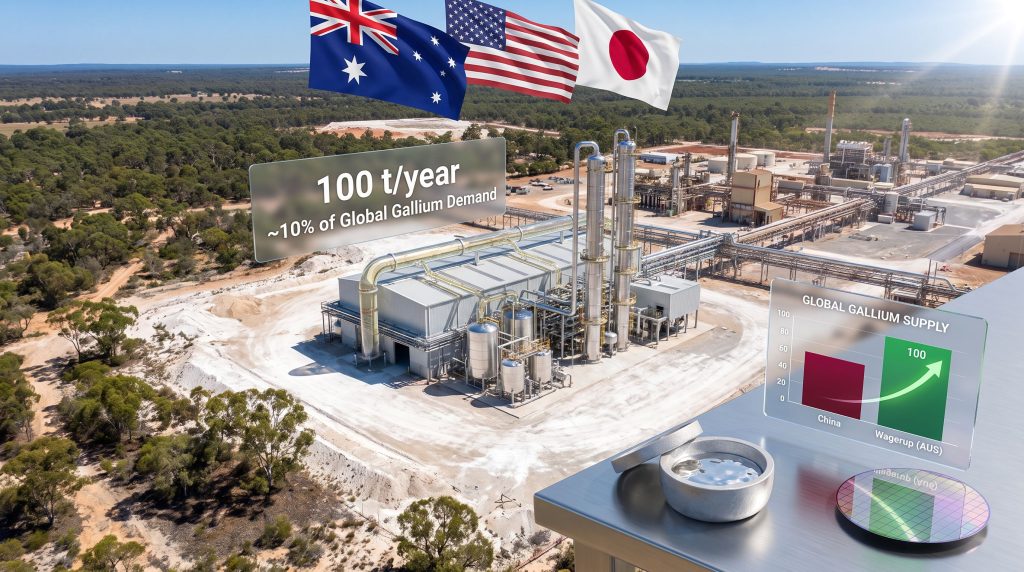
The Alcoa Australia gallium plant is co-located at the Wagerup Alumina Refinery in Western Australia, situated approximately 120 kilometres southeast of Perth. The facility is designed to extract gallium from up to 10% of the refinery's alumina liquor stream, targeting annual production of 100 metric tonnes of gallium, which equates to roughly 10% of current global gallium demand.
The extraction methodology combines two well-established metallurgical techniques adapted to the specific chemistry of Bayer process liquors:
- Solvent extraction: A selective organic solvent is used to strip gallium ions from the alkaline alumina liquor, concentrating them into a smaller volume for further processing
- Electrowinning: The concentrated gallium solution is subjected to electrochemical reduction, depositing high-purity gallium metal at the cathode
These techniques are proven at scale in other metal recovery applications, but adapting them to the specific pH, temperature, and impurity profile of Wagerup's liquor stream represents genuine metallurgical engineering work. Recovery efficiency from the specific liquor chemistry at Wagerup will determine whether the plant achieves nameplate capacity or operates below it, making commissioning performance data a critical indicator to watch.
The plant footprint covers approximately 4 hectares within the refinery's south-eastern precinct, reflecting the relatively compact nature of secondary mineral recovery infrastructure compared to primary processing circuits.
Timeline and Key Decision Points
| Milestone | Date |
|---|---|
| Joint development agreement signed with JAGA | Early 2026 |
| U.S. and Australian government backing announced | October 2025 |
| Works Approval application lodged | December 2025 |
| Final Investment Decision confirmed | July 2026 |
| Construction commencement | Following site preparation completion |
| Target first production | Late 2026 |
The Works Approval application was lodged with the Western Australian Department of Water and Environmental Regulation in December 2025. Environmental considerations associated with solvent extraction chemicals require careful management, and the approval process represents a genuine milestone on the critical path to construction commencement. For further context, Alcoa's project factsheet outlines the technical scope and environmental management approach in detail.
Employment and Regional Economic Contribution
- Approximately 150 construction jobs anticipated during the build phase
- Between 15 and 20 permanent operational roles upon commissioning
- Supply chain engagement across the Western Australian industrial services sector
The relatively modest permanent workforce reflects the capital-intensive, low-labour nature of hydrometallurgical processing, where automation handles much of the ongoing operation.
The Financing Architecture: A Trilateral Government-Industry Structure
Breaking Down the US$307 Million Investment
| Stakeholder | Role |
|---|---|
| Alcoa Corporation (NYSE: AA) | Plant constructor and operator |
| Australian Federal Government | AUD $200 million in financial support |
| Western Australian Government | State Agreement framework |
| U.S. Government | Equity and offtake support |
| Japan Australia Gallium Associates (JAGA) | Joint development partner |
| Sojitz Corporation | Commercial partner within JAGA |
| Japan Organization for Metals and Energy Security (JOGMEC) | Sovereign co-investor within JAGA |
The total estimated project value sits at approximately US$307 million, making this one of the larger critical mineral processing investments confirmed in the Western Australian industrial sector in recent years. The financing structure is notable not for any individual contribution but for the multilateral architecture it represents: three sovereign governments and multiple commercial entities co-investing in a single processing facility targeting a mineral that none of them can currently source domestically at meaningful scale.
Alcoa's President and CEO William F. Oplinger stated that the final investment decision reflects a shared commitment by governments and industry to strengthen critical mineral supply chains among the partners involved in the project.
Strategic Motivations by Nation: Why Each Government Participated
Australia's calculus centres on extracting more value from existing industrial infrastructure. Wagerup already operates as a world-class alumina refinery. Adding gallium recovery capability requires incremental capital against an already-functioning feedstock stream, making the economics structurally more attractive than greenfield critical mineral projects.
The United States is motivated by semiconductor and defence industrial base vulnerability. GaN-based electronics are central to next-generation radar, electronic warfare, and 5G military communications. Dependence on Chinese gallium for these applications represents a supply chain risk that U.S. industrial policy frameworks have explicitly identified as requiring remediation. These energy security risks extend well beyond the energy sector into defence readiness and telecommunications resilience.
Japan imports virtually all of its critical mineral requirements. JOGMEC's participation reflects the same sovereign resource security logic that has driven Japanese government co-investment in energy and mineral projects across multiple continents for decades. Sojitz's commercial role within JAGA provides a structured offtake pathway for Japanese electronics and defence sector end-users.
Alcoa's Dual-Track Strategic Repositioning
The South32 Acquisition: Upstream and Downstream Simultaneously
Earlier in July 2026, Alcoa agreed to acquire the bulk of South32's (ASX: S32) aluminium portfolio for an implied enterprise value of up to US$5.6 billion. The assets span bauxite, alumina, and aluminium operations across Brazil, South Africa, and Western Australia, substantially deepening Alcoa's control over the upstream raw material chain.
Read alongside the Wagerup gallium plant decision, these two transactions reveal a coherent strategic logic: Alcoa is simultaneously expanding its bauxite and alumina feedstock base while building the downstream critical mineral extraction capability to monetise trace elements within that feedstock. This is not incremental portfolio management. It is a structural repositioning from commodity aluminium producer to vertically integrated critical minerals platform.
The Refinery Diversification Model: An Underappreciated Value Creation Mechanism
The broader concept at work here is refinery diversification: the extraction of secondary critical minerals from existing process streams without proportionally scaling capital expenditure. Gallium is the first product in this model at Wagerup, but the underlying logic applies to other trace elements present in bauxite-derived liquors, including vanadium and scandium, both of which carry significant technology sector demand profiles.
Alumina refineries that invest in secondary mineral recovery infrastructure can, in theory, transform fixed-cost processing assets into multi-product extraction platforms. The capital efficiency of this approach — leveraging existing energy infrastructure, water management, and logistics — compares favourably to building new processing facilities from scratch. For investors assessing Alcoa's long-term earnings quality, this dimension of the Wagerup investment deserves attention beyond the headline gallium figures. In addition, the WA resources sector stands to benefit considerably from this model being replicated across the state's refinery base.
Quantifying the Market Impact: A Supply Scenario Analysis
| Scenario | Gallium Supply Implication |
|---|---|
| Baseline (no Wagerup plant) | Western-allied gallium supply remains below 10% of global total |
| Wagerup at full capacity (100 t/year) | Allied supply increases by approximately 10 percentage points of global demand |
| Wagerup plus additional allied projects | Potential for Western bloc to reach 25 to 30% of global supply by 2030 |
| Chinese export restriction escalation | Wagerup output becomes disproportionately strategic for allied semiconductor buyers |
Against a global consumption base estimated at 700 to 1,000 tonnes per year, a single facility producing 100 tonnes annually represents a meaningful supply addition. What makes the arithmetic particularly significant is the concentration of the existing supply base. When more than 90% of production is controlled by a single country, even a 10 percentage point shift in supply geography carries outsized strategic weight for procurement planners operating under security-of-supply mandates.
The next major ASX story will hit our subscribers first
Competitive Landscape: Wagerup in a Global Context
| Project / Initiative | Country | Estimated Capacity | Status |
|---|---|---|---|
| Alcoa Wagerup Gallium Plant | Australia | 100 t/year | FID confirmed July 2026 |
| European gallium recovery initiatives | Germany / Slovakia | Sub-scale | Feasibility / early development |
| North American gallium recovery projects | USA / Canada | Limited | Pre-feasibility |
| Existing non-Chinese producers | Russia, Ukraine, South Korea | Combined less than 50 t/year | Operational but constrained |
At the time of its Final Investment Decision, the Alcoa Australia gallium plant represents the largest single committed gallium production project outside China. The structural barrier to entry for new competitors is significant: without an active, large-scale alumina refinery as a feedstock source, there is no economically viable pathway to primary gallium production. This creates a durable competitive position for facilities like Wagerup that is not replicable through capital spending alone. Stockhead's analysis of the project provides further context on how this positions Western Australia within the broader critical minerals race against China.
Risks Worth Monitoring
Metallurgical, Market, and Execution Considerations
No investment case is complete without an honest assessment of downside scenarios. For the Wagerup gallium plant, three risk categories merit attention:
Metallurgical risk is the most technically specific. Gallium recovery efficiency from Bayer process liquors is sensitive to liquor temperature, caustic concentration, and the presence of organic impurities that can interfere with solvent extraction selectivity. The actual recovery rate achieved at Wagerup will determine whether the facility meets its 100 tonne nameplate capacity or operates at a fraction of it during initial production ramp.
Market price risk is structurally significant. Gallium spot prices are thinly traded, with a small number of transactions capable of moving the market substantially in either direction. Chinese producers retain the capacity to increase export volumes rapidly if export restrictions are relaxed or if strategic pricing pressure is applied to undermine the economics of allied production projects. Offtake arrangements with government-backed entities provide partial insulation, but are unlikely to fully neutralise commodity price exposure.
Execution risk centres on the compressed timeline between FID in July 2026 and targeted first production in late 2026. This window requires simultaneous completion of regulatory approvals, site preparation, equipment procurement, and construction in a regional Western Australian environment where specialist metallurgical tradespeople are in limited supply.
Disclaimer: This article contains forward-looking statements and scenario projections based on publicly available information. It does not constitute financial advice. Readers should conduct their own research and consult a licensed financial adviser before making any investment decisions.
Western Australia's Emerging Position as a Critical Mineral Processing Hub
The Wagerup gallium project does not exist in isolation. It sits within a broader geographic and policy context in which Western Australia is increasingly positioned as the physical location of choice for allied-nation critical mineral processing investment. The state combines world-class mineral endowment, established export infrastructure, a mature industrial workforce, and proximity to Asian end-use markets in a configuration that few other jurisdictions can replicate.
The multilateral co-investment model demonstrated at Wagerup — with Australian, American, and Japanese government and commercial capital flowing into a single processing facility — may prove to be a template rather than a one-off arrangement. As allied governments deepen their coordination on critical mineral supply chain security through frameworks like the Minerals Security Partnership, the logic of co-investing in strategically located processing infrastructure becomes increasingly compelling.
For global gallium markets, the implications extend well beyond 2026. If the Alcoa Australia gallium plant reaches nameplate capacity and demonstrates the commercial viability of allied-nation production at scale, it may catalyse additional investment in similar refinery diversification projects across Australia, Canada, and Europe. The cumulative effect of these initiatives, if they materialise, could meaningfully reshape the supply geography of a metal that modern defence and telecommunications infrastructure cannot function without.
Frequently Asked Questions: Alcoa Australia Gallium Plant
What is the Alcoa gallium plant in Western Australia?
The Alcoa Australia gallium plant is a purpose-built critical mineral extraction facility co-located at the Wagerup Alumina Refinery, approximately 120 kilometres southeast of Perth. It is designed to recover gallium from alumina refinery liquor streams, targeting annual output of 100 metric tonnes, equivalent to roughly 10% of current global gallium demand.
Who is funding the Alcoa Wagerup gallium project?
The project is backed by a multilateral consortium comprising Alcoa Corporation, the Australian Federal Government (contributing approximately AUD $200 million), the Western Australian Government, the U.S. Government, and Japan Australia Gallium Associates (JAGA), a joint venture between Sojitz Corporation and JOGMEC. Total estimated project value is approximately US$307 million.
Why is gallium classified as a critical mineral?
Gallium is essential for producing gallium nitride and gallium arsenide semiconductors, which are foundational to 5G telecommunications, defence electronics, radar systems, and electric vehicle power modules. With more than 90% of global supply currently produced in China, Western governments classify gallium as a critical mineral due to its supply concentration risk.
When will the Alcoa gallium plant start producing?
Following the Final Investment Decision confirmed in July 2026, construction is expected to commence after site preparation activities are completed. The project targets first production in late 2026.
What is JAGA?
Japan Australia Gallium Associates is a joint venture between Sojitz Corporation, a major Japanese trading company, and the Japan Organization for Metals and Energy Security (JOGMEC), a Japanese government agency responsible for securing strategic mineral resources for Japan's industrial economy. JAGA serves as the Japanese government's co-investment vehicle for the Wagerup gallium project.
Want to Know Which ASX Companies Are Positioning in the Critical Minerals Race?
Discovery Alert's proprietary Discovery IQ model scans ASX announcements in real time, instantly identifying significant mineral discoveries across gallium, rare earths, and more than 30 other commodities — turning complex data into actionable investment insights before the broader market reacts. Explore historic discoveries and their extraordinary returns, then begin your 14-day free trial at Discovery Alert to position yourself at the forefront of the next major find.