
August 6, 2026
The Structural Forces Reshaping Global Oil's Most Important Demand Signal
For decades, global oil markets have operated with a simple but powerful assumption: whatever disrupts supply, China's insatiable import appetite will eventually compensate. Refiners from Rotterdam to Singapore priced crude cargoes with one eye perpetually fixed on Chinese buying signals. That assumption is now fracturing in real time, and the consequences extend far beyond any single geopolitical conflict.
Understanding why China crude oil imports fall in June 2026 to their lowest seaborne intake since October 2016 requires examining not one force, but three converging pressures that are simultaneously structural, cyclical, and geopolitical in nature.
When big ASX news breaks, our subscribers know first
Why China Functions as the Oil Market's Demand Anchor
China's position in global crude markets is without parallel. As the world's largest crude importer, the country's purchasing decisions don't merely reflect domestic conditions; they actively set the marginal price signal that ripples through every major trading hub. When China buys aggressively, surplus evaporates. When China pulls back, even genuine supply shocks can be absorbed without triggering price spirals.
This dynamic makes China's import trajectory more than an economic statistic. It functions as a real-time pressure gauge for global oil market health. The extraordinary nature of the current contraction becomes clear when placed in historical context. In June 2024, Chinese imports had already softened approximately 11% year-on-year, which analysts at the time characterised as moderate cyclical weakness.
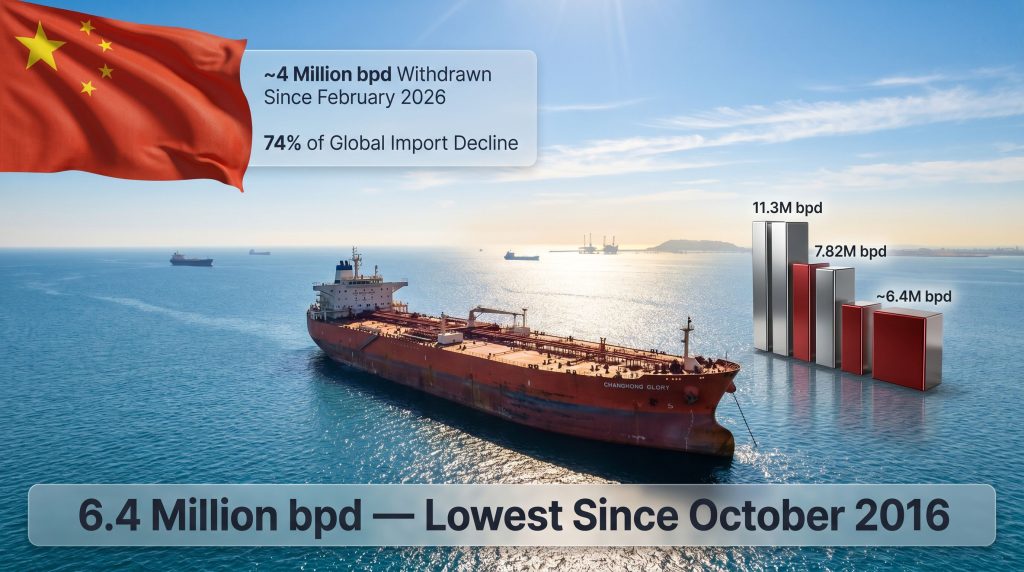
By May 2026, volumes had deteriorated to 7.82 million barrels per day (bpd), representing a 29% year-on-year collapse that marked an eight-year import low. June 2026's projected seaborne arrivals of approximately 6.4 million bpd push that record lower still, as reported by Bloomberg.
| Metric | June 2024 | May 2026 | June 2026 (Projected) |
|---|---|---|---|
| Import Volume | ~11.3 million bpd | 7.82 million bpd | ~6.4 million bpd (seaborne) |
| Year-on-Year Change | -11% vs. June 2023 | -29% vs. May 2025 | Deepening contraction |
| Primary Driver | Cyclical demand softness | Iran war + sanctions tightening | Supply disruption + EV displacement |
| Benchmark Context | Moderate softness | 8-year volume low | Lowest since October 2016 |
What Is Driving the Collapse in China's Crude Oil Import Volumes?
The Iran War Supply Shock: Severing Key Asian Energy Corridors
When the Iran conflict erupted in late February 2026, it didn't just rattle energy markets through headline risk. It surgically removed a critical feedstock source from China's refining sector. Iranian crude had long served as a heavily discounted, sanctions-tolerant supply stream that China's independent refining sector, commonly referred to as teapot refiners, had grown structurally dependent upon.
These independent operators, concentrated in Shandong province, had built their business models around the economics of processing Iranian barrels at a significant discount to mainstream Middle Eastern grades. The war effectively severed those supply lines through a combination of port access restrictions, tightened sanctions enforcement, and maritime insurance constraints that left tanker operators unwilling to risk voyages through contested corridors.
The cumulative result is stark: China has reduced its crude purchases by approximately 4 million bpd below typical volumes since the conflict began, according to vessel tracking data compiled by both Kpler and Vortexa. This is not a rounding error. It represents a supply withdrawal equivalent to roughly four times the output of Libya's entire national production. Furthermore, the trade war oil impact on procurement patterns has compounded the disruption across key Asian energy corridors.
Refinery Economics: When Processing Crude Becomes Unprofitable
A less-discussed but equally important driver is the deterioration of downstream refining margins across both state-owned enterprises and independent operators. Refinery run rates respond directly to crack spreads, the differential between the price paid for crude and the realised value of refined products like gasoline, diesel, and jet fuel.
When those spreads compress, as they have across Asian refining hubs in 2026, the economic incentive to process crude disappears. Teapot refiners, which lack the balance sheet resilience of integrated majors, respond by simply shutting down processing units rather than absorbing losses. The consequence is a cascade: lower run rates reduce crude procurement needs, which directly suppresses import demand. This self-reinforcing cycle has meaningfully amplified the demand signal collapse beyond what the Iran war alone would have produced.
Electric Vehicles and the Permanent Demand Ceiling
Perhaps the most consequential and least reversible driver is China's accelerating transition away from internal combustion engine vehicles. China's EV penetration rate has grown from a niche market share to representing the majority of new passenger vehicle sales in recent years. This matters for oil demand because transportation fuels, particularly gasoline and diesel, account for the largest single component of crude oil end-use.
The EV transport shift across China's passenger vehicle market has introduced a permanent structural ceiling on liquid fuel consumption that prior demand models failed to anticipate adequately.
Critical insight: Unlike the Iran supply shock, which is geopolitical and therefore theoretically reversible, the demand displacement caused by EV adoption is permanent. Each new electric vehicle registered displaces a meaningful volume of liquid fuel consumption across its operational lifetime, and that cumulative displacement compounds annually as fleet turnover accelerates.
Analysts monitoring China's energy consumption patterns have noted that this structural erosion was already visible beneath the headline import figures before the conflict began. The Iran war has simply accelerated and amplified a trajectory that was already pointing lower.
How Beijing Is Managing the Supply Shock
The Three-Lever Absorption Strategy
Rather than allowing the crude supply shortfall to translate into domestic fuel scarcity or price inflation, Beijing has deployed a coordinated operational response built around three concurrent mechanisms:
- Curtailing refined product exports: By redirecting domestically produced gasoline, diesel, and jet fuel away from export markets and toward satisfying internal consumption, Beijing has maintained fuel availability without needing to compensate through higher crude imports.
- Reducing refinery throughput deliberately: State-directed reductions in crude processing volumes have aligned operational requirements with the available feedstock, preventing refineries from running short rather than running hard.
- Drawing down commercial stockpiles: China has maintained significant commercial crude reserves that provide a buffer during periods of seaborne supply disruption. These stockpiles are being actively deployed to bridge the gap between normal import volumes and current intake.
This three-lever response has been effective in the short term, but it carries medium-term limits. Stockpile drawdowns cannot continue indefinitely. Export curtailments reduce foreign exchange earnings. And sustained run rate reductions create operational challenges for refinery equipment and workforce continuity.
Energy Security Implications for China's Diversification Strategy
The current episode has exposed a structural vulnerability in China's crude procurement architecture: an over-reliance on Middle Eastern supply chains that can be disrupted by a single regional conflict. The episode is likely to accelerate Beijing's existing, if gradual, push to diversify crude sourcing toward Russian pipeline volumes, West African grades, and longer-term supply arrangements with Latin American producers.
This strategic recalibration will not resolve the immediate shortfall, but it represents a durable shift in how China structures its energy security planning going forward. In addition, OPEC market influence over alternative supply arrangements will play an increasingly critical role as Beijing seeks to reduce its exposure to any single regional corridor.
China's Contraction as an Accidental Price Stabiliser
One of the more counterintuitive dynamics of the current situation is that China's demand collapse has functioned as an inadvertent stabilising force for global oil prices. The Iran conflict removed a substantial volume of crude from available global supply, a development that would historically have sent Brent crude surging well above $100 per barrel.
Instead, China's simultaneous withdrawal from the market has offset the supply shock from the demand side. Estimates suggest that China's import pullback of approximately 3 to 4 million bpd has absorbed roughly 74% of the total global crude import decline recorded during this period, effectively preventing the supply disruption from generating the price spike that markets initially anticipated. Consequently, as outlined in our crude oil volatility guide, competing demand and supply forces can suppress price movements even during active geopolitical conflicts.
| Importer | Response to Supply Shock | Strategic Posture |
|---|---|---|
| China | Sharply reduced purchases, drawing stockpiles | Passive absorption, EV transition accelerating |
| India | Opportunistic sourcing from alternative suppliers | Active diversification |
| Europe | Managed via strategic reserves and LNG switching | Policy-driven substitution |
| United States | Domestic production buffer, SPR management | Net exporter insulation |
Analyst consensus points to Brent crude stabilising near the $100 per barrel level should the Strait of Hormuz reopen and shipping corridors normalise. Until then, the competing forces of Iran-war supply anxiety and China demand-driven price suppression are holding prices in an uneasy equilibrium below that threshold. However, the oil price rally dynamics of 2025 demonstrate how rapidly sentiment can shift when geopolitical variables realign.
Scenario Analysis: Three Pathways for China's Import Trajectory
Scenario 1: Prolonged Hormuz Disruption
Under this pathway, Iranian crude supply remains constrained through the remainder of 2026. China's seaborne intake stays depressed below 7 million bpd, commercial stockpiles begin to thin materially, and Beijing is eventually forced to source alternative origins at a premium. Brent crude likely trades in a $90 to $100 per barrel range, sustained by supply anxiety but capped by weakened Chinese demand.
Scenario 2: Partial Conflict Resolution
A negotiated or de-escalated reopening of key shipping corridors allows gradual recovery in Chinese import volumes. Teapot refiners resume normal procurement cycles as Iranian barrels become accessible again. Refinery run rates recover incrementally, and Brent crude stabilises near $100 per barrel as supply and demand rebalance. This scenario represents the market's central case but requires geopolitical developments that remain uncertain.
Scenario 3: Structural Demand Permanently Lower
Even with full supply normalisation, China's EV adoption trajectory continues to erode the long-term oil demand ceiling. New vehicle registrations remain overwhelmingly electric. Gasoline demand growth projections are revised materially lower. China's import volumes recover partially but never return to the 11 million bpd-plus peaks of 2023, structurally reshaping global refinery investment economics for the decade ahead. As energy analysts at Reuters note, this contraction reflects economics and structural forces rather than altruism or short-term policy choices.
Speculative consideration: Some energy analysts have raised the possibility that China's current import contraction, while partly forced by geopolitical disruption, is also partly strategic. A buyer of China's scale understands that sustained low import volumes depress global crude benchmarks, improving the terms on which it eventually restocks. If stockpile drawdowns are being managed deliberately to exploit this pricing dynamic, the eventual restocking cycle could produce a sharper-than-expected demand pulse when conflict resolution occurs. This theory remains speculative but is not implausible given China's historical approach to commodity procurement strategy.
The next major ASX story will hit our subscribers first
Frequently Asked Questions: China Crude Oil Imports Fall in June 2026
Why are China's crude oil imports falling in June 2026?
China's import volumes are contracting due to the Iran war severing key supply routes, deteriorating refinery margins suppressing crude processing incentives, subdued domestic economic activity reducing fuel consumption, and accelerating EV adoption permanently displacing liquid fuel demand.
How low have China's crude oil imports fallen?
Seaborne crude arrivals are projected at approximately 6.4 million bpd in June 2026, the lowest recorded since October 2016, and roughly 8% below May 2026's already depressed volumes of 7.82 million bpd.
How is China managing the crude supply shortfall?
Beijing is managing the gap through three primary levers: reducing refined product exports to preserve domestic supply, cutting refinery throughput to match available feedstock, and drawing down commercial crude stockpiles to offset reduced seaborne arrivals.
What impact is China's reduced buying having on global prices?
China's withdrawal of approximately 3 to 4 million bpd from typical purchasing levels has offset the Iran war's supply shock from the demand side, keeping Brent crude below $100 per barrel despite active conflict in a major producing region.
Will China's oil imports recover in the second half of 2026?
Recovery depends heavily on geopolitical developments in the Middle East. However, structural demand erosion from EV adoption means that even a full supply normalisation is unlikely to return China crude oil imports fall trajectories back to prior peak levels.
Key Takeaways
- China's June 2026 seaborne crude intake of approximately 6.4 million bpd marks a decade-low driven by three converging forces: geopolitical supply disruption, economic weakness, and structural EV-led demand erosion
- The Iran war has removed approximately 4 million bpd from China's typical procurement volumes since late February 2026, according to data from Kpler and Vortexa
- Beijing's three-lever absorption strategy has provided short-term insulation but carries meaningful medium-term limits as stockpile buffers thin and export revenue compresses
- China's demand contraction has paradoxically stabilised Brent crude below $100 per barrel by offsetting the Iran war's supply shock with simultaneous demand withdrawal
- Vessel intelligence platforms Kpler and Vortexa both confirm the downward trajectory, providing independent corroboration of the scale of the contraction
- The structural shift toward electric vehicles signals that a meaningful portion of China's demand reduction is permanent, with long-term consequences for global refinery investment and OPEC+ production strategy
This article contains forward-looking analysis and scenario projections that are inherently speculative. Energy market conditions, geopolitical developments, and demand trajectories are subject to rapid and material change. Nothing in this article constitutes financial or investment advice. Readers should conduct independent research and consult qualified advisers before making investment decisions.
Want to Capitalise on the Commodity Shifts Reshaping Global Energy Markets?
As structural forces permanently alter oil demand dynamics and accelerate the transition toward electrification, the mineral discoveries underpinning that shift — from battery metals to critical minerals — are creating significant ASX opportunities. Discovery Alert's proprietary Discovery IQ model delivers real-time alerts on significant ASX mineral discoveries the moment they hit the exchange, turning complex data across 30-plus commodities into actionable insights — explore historic discoveries that have generated substantial returns and begin your 14-day free trial to position yourself ahead of the market.