August 5, 2026
The Anatomy of a Market Held Together by One Buyer
Every decade or so, global oil markets confront a disruption severe enough to expose the fragility beneath their surface stability. The Strait of Hormuz closure of 2026 is shaping up to be one of those defining moments — and China crude oil imports and Strait of Hormuz disruptions sit at the very centre of this unfolding crisis. The more unsettling question analysts are now grappling with is not why prices spiked, but why they did not, and what happens when the mechanism suppressing them disappears.
The answer, increasingly, points to a single actor: China.
When big ASX news breaks, our subscribers know first
Why the Strait of Hormuz Is Unlike Any Other Chokepoint
The Physics of Global Oil Dependency
The Strait of Hormuz is a narrow maritime passage at the mouth of the Persian Gulf, stretching just 21 nautical miles at its tightest navigable point. Despite its modest geography, the strait functions as the arterial valve of global energy supply. Roughly 20% of total world oil consumption transits through it daily, making it the single most consequential chokepoint in the history of energy infrastructure.
For Asian economies, the exposure is even more acute. Between 60% and 75% of crude imports into major Asian buyers — including China, Japan, South Korea, and India — pass through Hormuz. There is no practical short-term alternative at equivalent scale. The East-West Pipeline through Saudi Arabia can handle a fraction of Gulf flows, and alternative routing adds weeks to shipping times while compressing already thin refining margins.
The consequences of disruption therefore cascade unevenly. Western economies, with greater access to Atlantic Basin crude and domestic production, absorb Hormuz shocks differently than Asian refiners whose entire supply architecture runs through a single bottleneck. Furthermore, Asian energy import pressures have been intensifying even before the current crisis emerged.
From 130 Transits to 6: What Tanker Data Reveals
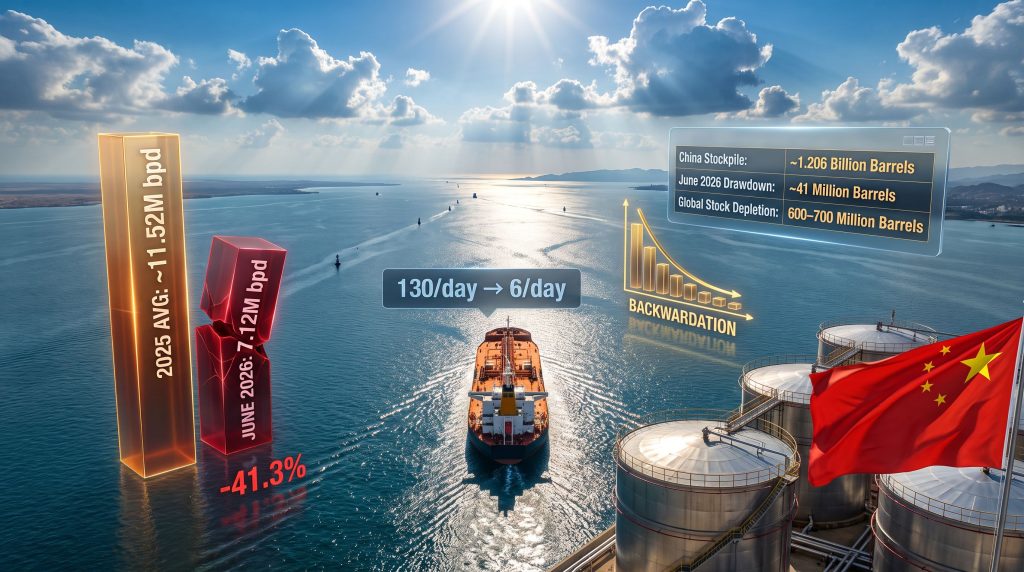
Before hostilities escalated in early 2026, approximately 130 vessels per day transited the Strait of Hormuz carrying crude, refined products, and liquefied natural gas. By March 2026, daily transits had collapsed to an estimated six vessels — a reduction of roughly 95%. The near-total freeze on tanker traffic effectively severed the most direct supply corridor connecting Persian Gulf producers to their largest customers.
This was not a gradual decline. It was an abrupt wall. The operational implications for Asian refiners were immediate, as contracted cargoes went undelivered and spot procurement markets seized up entirely.
China's Crude Oil Imports in 2026: Dissecting a Decade Low
The Numbers That Define the Crisis
China's official customs data for June 2026 revealed the full extent of the import contraction. Total crude oil inflows fell to 29.27 million tons, equivalent to approximately 7.12 million barrels per day. That figure represents a 41.3% year-on-year decline and marks the lowest monthly import volume recorded since October 2016.
| Metric | June 2026 | 2025 Average (Est.) | Year-on-Year Change |
|---|---|---|---|
| Crude imports (million tons) | 29.27 | ~49.8 | -41.3% |
| Crude imports (million bpd) | 7.12 | ~11.52 | -4.4 million bpd |
| Last comparable low | October 2016 | N/A | Decade-low |
| Refinery run rates | 10-year low | Above trend | Significant contraction |
The shortfall versus China's 2025 average import rate equates to roughly 4.4 million barrels per day of absent demand — a figure that dwarfs the voluntary production adjustments typically deployed by OPEC+ during market stabilisation efforts. In addition, OPEC market influence on price recovery has been significantly constrained by the scale of this demand withdrawal.
Refinery Utilisation and the Fuel Export Ban
Lower import volumes translated directly into reduced refinery throughput. Chinese refinery run rates fell to their lowest level in a decade, compressing output across both state-owned refineries and independent processors — known in the industry as teapot refineries — which cluster primarily in Shandong province and account for a meaningful share of China's total refining capacity.
Adding further downward pressure, Beijing imposed restrictions on refined fuel exports during this period. The policy rationale was to prioritise domestic supply adequacy as refinery output contracted, but the consequence was a structural reduction in China's downstream activity precisely when its upstream import volumes were already depleted.
The Middle Eastern Supply Corridors That Went Dark
The granular breakdown of China's import losses by origin illustrates just how concentrated the disruption was within Gulf supply corridors:
| Supplier | February 2026 Shipments | May/June 2026 Shipments | Change |
|---|---|---|---|
| Iraq | ~790,000 bpd | ~60,000 bpd | -92% |
| Kuwait | Significant volumes | Near zero | ~-100% |
| Iran | ~1.3 million bpd (est.) | <800,000 bpd | -40%+ month-on-month |
| Total Middle East to China | Near-record levels | 10-year low | Severe contraction |
Iran's supply disruption carries particular weight for China. Tehran has historically accounted for approximately 13% of China's total seaborne crude imports, delivered at discounted prices reflecting U.S. sanctions risk. The reimposition of U.S. pressure on Iranian oil exports in 2026 created a simultaneous political and logistical supply shock, compressing both the availability and the delivery of Iranian crude to Chinese buyers in a way that was difficult to hedge against quickly. Columbia University's energy policy research has highlighted precisely these structural vulnerabilities in China's Middle Eastern supply dependency.
China's Strategic Stockpile: The Market's Invisible Stabiliser
How 1.2 Billion Barrels Bought Time
In the year preceding the escalation of Middle East hostilities, China systematically accumulated crude reserves at a pace that, in retrospect, appears strategically deliberate. Independent estimates suggest China held approximately 1.206 billion barrels of crude across both commercial and strategic storage facilities as of early January 2026, representing roughly 104 days of import cover at 2025 consumption rates.
These stockpile figures are not officially disclosed by Beijing. China's reserve data remains among the most closely guarded energy datasets anywhere in the world, making independent estimates from shipping analytics firms, satellite imagery analysis, and IEA modelling the primary lens through which markets attempt to gauge China's buffer capacity.
This opacity is itself a market dynamic. Because traders cannot verify Chinese inventory levels with precision, uncertainty about the depth of China's buffer introduces its own form of price volatility — both suppressing panic buying when the buffer is presumed large and amplifying it when depletion signals emerge.
Commercial Drawdowns vs. Strategic Reserve Releases
A distinction worth understanding is the difference between China drawing down commercial inventories held by state-owned enterprises and private refiners versus releasing strategic petroleum reserves held in purpose-built national storage facilities. The former happens continuously as part of routine refinery operations. The latter is a deliberate government decision and carries significant geopolitical signalling value.
Drawdowns confirmed for May and June 2026 appear primarily to reflect commercial inventory consumption rather than coordinated strategic releases. China is estimated to have drawn approximately 41 million barrels from its total inventory holdings in June 2026 alone, according to International Energy Agency monthly report estimates. At that pace, sustained over a multi-month horizon, the buffer narrows materially, and the calculus around returning to the market shifts considerably.
China as the Oil Market's Swing Demand Buyer
What Swing Demand Actually Means
In oil market terminology, a swing producer is a supplier that adjusts output to balance supply and demand — historically a role associated with Saudi Arabia. The 2026 crisis introduced a parallel concept on the demand side: a swing importer whose buying behaviour moderates price movements regardless of what happens to supply.
China has functioned as exactly that since February 2026. By choosing not to bid aggressively in spot markets and drawing down pre-accumulated reserves instead, Beijing effectively removed the world's largest source of incremental crude demand from price-setting activity. The consequence was a market where supply had fallen by more than 10 million barrels per day through Hormuz disruptions, yet benchmark prices remained below the $100 per barrel threshold for an extended period.
No prior disruption of comparable physical magnitude had produced such a muted price outcome. Understanding the trade war oil markets dynamic helps contextualise why China's demand suppression was so strategically timed. The mechanism, ultimately, was China's absence.
Gulf Producers Slash Prices to Attract China Back
Recognising that Chinese buyers hold the decisive influence over price discovery in the current environment, Gulf crude exporters moved to reduce their official selling prices (OSPs) for July and August 2026 cargoes. OSPs are the reference prices set monthly by national oil companies in Saudi Arabia, Iraq, Kuwait, and the UAE for term contract deliveries to different regional markets.
This competitive price reduction signals a structural realignment in bargaining power. When the world's largest buyer withdraws from the market and alternative buyers cannot absorb equivalent volumes, exporters must compete on price to incentivise re-engagement. It is, consequently, a reversal of the dynamics that typically characterise tight supply markets.
When Does China Return, and What Happens When It Does?
The Tipping Point Calculation
Analysts at Goldman Sachs, in commentary reported by the Wall Street Journal, assessed that despite ongoing inventory drawdowns, China retains sufficient stockpile depth to avoid an immediate procurement emergency. The implication is that Beijing retains optionality: it can continue drawing reserves and observe whether Hormuz conditions improve before committing to large-scale spot purchases.
However, Goldman's analysis also flagged that this optionality is time-limited. As drawdowns continue, the strategic buffer erodes, and the cost of waiting begins to outweigh the benefit of avoiding elevated spot prices. Analysts at JPMorgan have anticipated a meaningful recovery in Chinese crude import volumes from August 2026 onward, contingent on partial resumption of Hormuz tanker flows and the domestic fuel export restriction being unwound.
The Three-Shock Convergence Scenario
The scenario that energy analysts consistently identify as the highest-risk price outcome involves three forces arriving simultaneously:
- China re-enters the spot market as an aggressive buyer after months of suppressed procurement, adding several million barrels per day of incremental demand.
- Hormuz disruptions persist at a level that prevents the restoration of Gulf crude flows to pre-crisis volumes, maintaining a structural supply deficit.
- Global commercial inventories remain at critically depleted levels with no meaningful buffer available to absorb the demand surge.
Amrita Sen, founder and director of research at consultancy Energy Aspects, warned in commentary to CNBC that if conditions had not materially improved by late July or early August 2026, the most severe price pressures were likely to materialise in the later parts of Q3 or into Q4. In separate remarks to the Financial Times, Sen noted that the excess commercial inventories which existed at the onset of the crisis had been almost entirely consumed, leaving government-held strategic reserves as the only remaining buffer — a substantially less flexible and politically constrained tool.
| Scenario | Hormuz Status | China Buying | Inventory Level | Likely Price Outcome |
|---|---|---|---|---|
| Base Case | Partial reopening | Gradual rebound | Low but stable | Moderate price rise |
| Adverse Case | Continued disruption | China re-enters aggressively | Critically depleted | Significant price spike |
| Tail Risk | Full closure + escalation | Emergency buying | Near-zero buffer | Extreme price volatility |
The next major ASX story will hit our subscribers first
Brent Backwardation and What Futures Markets Are Saying
Reading the Term Structure as a Stress Signal
Brent crude futures shifted into backwardation during this period — a market structure characterised by near-term delivery contracts trading at a premium to those with later expiry dates. Backwardation typically reflects physical market tightness, where buyers are willing to pay more for immediate access to crude than they are for future delivery commitments.
The shift into backwardation is one of the more reliable signals available to oil market analysts that underlying physical supply is perceived as inadequate relative to current demand. When backwardation steepens, it typically draws inventories out of storage and into the market, accelerating the depletion of commercial buffers. For a broader view of oil price movements in context, the signals emerging from the futures curve are particularly instructive.
The concurrent depletion of approximately 600 to 700 million barrels of global oil stocks since the Hormuz crisis began, combined with a futures curve signalling near-term scarcity, represents a set of conditions with few historical precedents.
How Other Asian Economies Are Responding
India's Dual Response
India responded to the Hormuz disruption along two parallel tracks. Domestically, the government raised export taxes on diesel and jet fuel, seeking to retain refined product volumes within the country as import supply tightened. Operationally, shipping advisories began to reflect security concerns over crew safety on Hormuz-routed voyages, with guidance discouraging the deployment of Indian nationals on vessels transiting the strait.
Japan, South Korea, and the U.S. Crude Pivot
Japan's trade ministry publicly characterised Hormuz as effectively inaccessible for commercial transit during the height of hostilities — an unusually direct acknowledgement from a government that has historically maintained careful diplomatic positioning on Persian Gulf affairs. Both Japan and South Korea accelerated procurement from alternative origins, with U.S. crude grades emerging as the primary Hormuz-independent supply option.
The consequent surge in Asian demand for American crude has materially reshaped transatlantic tanker economics, extending voyage distances and tightening the global fleet of Very Large Crude Carriers (VLCCs) available for rapid redeployment.
China's Long-Term Energy Security Calculus
The Strategic Liability of Hormuz Dependency
The 2026 crisis has exposed a structural vulnerability that Chinese energy planners have long understood intellectually but now face in operational reality. Approximately 40% or more of China's total crude imports transit Hormuz under normal conditions. This concentration creates a supply risk that no amount of stockpiling can permanently insulate against — it can only be deferred. The current crude oil market update confirms how exposed China crude oil imports and Strait of Hormuz disruptions have left the broader Asian supply architecture.
Diversification Pathways: Russia, West Africa, and Overland Routes
China's diversification options are real but constrained:
- Russian pipeline crude via the Eastern Siberia-Pacific Ocean (ESPO) pipeline provides Hormuz-independent supply, but capacity is finite and geopolitical conditions affecting Russian exports introduce their own risks.
- West African grades from Angola and Nigeria require longer voyage times but are entirely Hormuz-independent. China has historically been a major buyer of West African crude, and the 2026 crisis is likely to reinforce that relationship structurally.
- Overland routes including rail and pipeline connections through Central Asia remain limited in throughput capacity compared to seaborne trade volumes.
Does the Crisis Accelerate China's Renewable Energy Transition?
A less frequently examined angle is whether supply shocks of this magnitude alter the economics and political urgency of China's domestic energy transition. China has already committed to peaking carbon emissions before 2030 and achieving neutrality by 2060. A prolonged and severe crude supply crisis creates both economic incentive and political justification for accelerating electric vehicle adoption, expanding domestic renewable generation, and reducing the industrial economy's reliance on imported oil.
The 2026 Hormuz crisis may not resolve the dependency in the near term, but it is likely to sharpen the strategic argument for doing so faster.
Key Data Summary
| Indicator | Value | Significance |
|---|---|---|
| China June 2026 crude imports | 7.12 million bpd | Decade-low; 41.3% year-on-year decline |
| Import shortfall vs. 2025 average | ~4.4 million bpd | Largest voluntary demand withdrawal on record |
| China's estimated stockpile (Jan 2026) | ~1.206 billion barrels | 104 days of import cover |
| June 2026 inventory drawdown | ~41 million barrels | Drawdown phase confirmed by IEA estimates |
| Global stock depletion since crisis | 600-700 million barrels | Near-total exhaustion of commercial buffers |
| Hormuz tanker transits (peak vs. trough) | 130/day to 6/day | 95% reduction in physical throughput |
| Iraq shipments to China (Feb vs. May) | 790,000 bpd to 60,000 bpd | 92% collapse in a single trade corridor |
Frequently Asked Questions
Why Did China's Crude Oil Imports Fall to a Decade Low in 2026?
The collapse in import volumes resulted from the near-total disruption of Strait of Hormuz tanker traffic following the escalation of U.S.-Iran hostilities, combined with weak domestic refinery utilisation and Beijing's deliberate strategy of drawing down pre-accumulated stockpiles rather than purchasing at elevated spot market prices.
How Long Can China Sustain Reduced Imports Before It Must Return to the Market?
With an estimated 1.206 billion barrels in storage as of early 2026, China held approximately 104 days of import cover. At the June 2026 drawdown rate of 41 million barrels per month, that buffer narrows over a multi-month horizon, making a return to active procurement increasingly likely as 2026 progresses.
What Will Happen to Oil Prices When China Resumes Large-Scale Crude Buying?
The convergence of renewed Chinese demand, continued Hormuz constraints, and depleted commercial inventories represents the primary upside risk to global oil prices in the second half of 2026. The severity of any price response will depend on whether Hormuz transit conditions improve before China crude oil imports and Strait of Hormuz disruptions reach a critical inflection point and China re-enters the market at scale.
What Is the Current Status of Strait of Hormuz Tanker Traffic?
Daily tanker transits fell from approximately 130 vessels before the crisis to an estimated six per day by March 2026 — a reduction of roughly 95%. The situation remained highly fluid as of mid-2026, with the collapse of ceasefire negotiations re-intensifying transit risks.
Disclaimer: This article is for informational purposes only and does not constitute financial or investment advice. Forecasts, scenario projections, and analyst commentary referenced herein reflect the views of the cited sources and involve significant uncertainty. Readers should conduct their own research before making investment decisions.
Want to Capitalise on the Next Major Commodity Discovery Before the Broader Market Reacts?
While global oil markets navigate the structural disruptions reshaping energy supply chains, Discovery Alert's proprietary Discovery IQ model delivers real-time alerts on significant ASX mineral discoveries — instantly translating complex commodity data into actionable investment insights for both short-term traders and long-term investors. Explore historic examples of exceptional discovery returns or start your 14-day free trial today to position yourself ahead of the market.