May 19, 2026
The Industrial Foundation Driving Electric Maritime Innovation
Global shipping decarbonisation represents one of the most complex technological challenges facing international trade. While automotive electrification has captured widespread attention, the maritime sector's transformation requires fundamentally different engineering approaches, regulatory frameworks, and capital deployment strategies. The convergence of established battery manufacturing capabilities with advanced shipbuilding expertise creates unique competitive advantages that extend far beyond traditional automotive applications, particularly in the development of china electric-powered vessels.
China's position in this emerging sector stems from systematic industrial development spanning multiple decades. The nation's battery manufacturers have evolved from supplying consumer electronics to dominating electric vehicle markets, accumulating critical knowledge in energy density optimisation, thermal management, and large-scale manufacturing processes. This expertise now translates directly into maritime applications, where space constraints and safety requirements demand sophisticated engineering solutions.
The strategic implications extend beyond individual vessel deployments. As international shipping faces mounting pressure to achieve net-zero emissions by 2050, early technological leadership in electric propulsion systems positions manufacturers to capture substantial market share across multiple vessel categories and trade routes.
When big ASX news breaks, our subscribers know first
Strategic Convergence of Battery Manufacturing and Shipbuilding Excellence
China's dominance in electric-powered maritime technology emerges from the intersection of two industrial strengths: advanced battery manufacturing capabilities and comprehensive shipbuilding infrastructure. Contemporary Amperex Technology holds 38% of the global EV battery market as of 2025, providing the technological foundation for maritime applications. This market leadership translates into substantial research and development resources, manufacturing scale advantages, and deep expertise in battery chemistry optimisation.
Furthermore, the shipbuilding component of this strategy leverages China's established maritime construction capabilities. Chinese shipyards have captured significant market share in traditional vessel construction, creating natural synergies for electric propulsion integration. The proximity of battery manufacturers to shipbuilding facilities enables rapid prototyping, testing, and refinement of electric maritime systems.
Government policy alignment under the Made in China 2025 framework provides additional momentum for electric vessel development. This industrial strategy emphasises green technology advancement across multiple sectors, creating coordinated incentives for battery manufacturers and shipbuilders to collaborate on maritime electrification projects.
Technology Transfer from Automotive Applications
The migration of battery technology from automotive to maritime applications involves significant engineering adaptations. Marine environments present unique challenges including saltwater corrosion resistance, extreme temperature variations, and enhanced safety requirements for large-scale battery installations. Chinese manufacturers leverage their automotive experience while developing marine-specific solutions, including advancements in lithium extraction that support these applications.
Key technical adaptations include:
• Enhanced thermal management systems designed for maritime operating conditions
• Corrosion-resistant battery housing suitable for saltwater exposure
• Redundant safety systems meeting international maritime safety standards
• Modular battery architectures enabling flexible vessel configuration
Market Positioning Through River Operations
China's electric vessel strategy employs a systematic progression from protected waterway operations to oceangoing applications. CATL began developing shipbuilding applications in 2017 and has supplied batteries to over 900 vessels operating in rivers. This extensive operational history provides crucial data for performance optimisation and reliability validation.
River operations serve multiple strategic purposes beyond technology validation. They demonstrate commercial viability at scale, establish maintenance and support infrastructure, and create customer relationships with vessel operators. The Yangtze River system functions as a comprehensive testing environment for electric propulsion technologies before expansion to more demanding oceangoing applications.
Battery Technology Transformation in Maritime Decarbonisation
Contemporary Amperex Technology and Gotion High-tech represent the leading edge of China's maritime electrification initiative. These companies bring distinct technological approaches and market positioning strategies to electric vessel development, collectively advancing the sector's commercial viability while contributing to broader critical minerals and energy security considerations.
CATL's maritime portfolio builds upon eight years of research and development investment since 2017. The company's announcement of self-developed pure electric vessels capable of ocean navigation within three years demonstrates confidence in technological readiness. This timeline suggests commercial deployment by 2028, representing a significant acceleration in electric maritime adoption.
Gotion's approach emphasises immediate commercial applications through certified vessel deployment. The company's battery packs power the Puffer Fish Blue 01, a 132 TEU container vessel certified by the China Classification Society. This certification enables commercial operations and validates the technical specifications required for container shipping applications.
Technical Innovation in Battery Systems
Maritime battery applications require specialised engineering approaches that differ substantially from automotive implementations. The scale of energy requirements, safety considerations, and operational environments demand innovative solutions in battery chemistry, thermal management, and system integration.
Advanced Battery Technologies:
| Technology | Application | Advantages |
|---|---|---|
| CTP (Cell-to-Pack) | High-density energy storage | Maximised energy density for space-constrained vessels |
| CCS (Cell-to-Chassis) | Structural integration | Improved vessel stability through distributed weight |
| Distributed DC Architecture | Power management | Enhanced safety and redundancy for critical systems |
Partnership Models for Commercial Deployment
Gotion's collaboration with Wuhu Shipyard and Sandianshui New Energy Technology demonstrates effective partnership structures for electric vessel development. This three-way collaboration combines battery manufacturing expertise, shipbuilding capabilities, and energy technology integration.
The partnership approach offers several advantages:
• Specialised expertise integration from each participating company
• Risk distribution across multiple organisations
• Accelerated development timelines through parallel engineering
• Enhanced market credibility through established industry relationships
The China Classification Society certification of the Puffer Fish Blue 01 represents a significant milestone in commercial acceptance. This professional maritime classification validates the vessel's technical specifications and safety systems, enabling commercial deployment in container shipping operations.
Operational Capabilities of China's Electric Vessel Fleet
China's electric vessel fleet encompasses diverse vessel types ranging from passenger ships to large cargo carriers. The operational experience gained through 900+ river vessels provides substantial data on performance characteristics, maintenance requirements, and operational economics.
Major Chinese Electric Vessel Specifications:
| Vessel Name | Type | Capacity | Battery System | Range | Annual Impact |
|---|---|---|---|---|---|
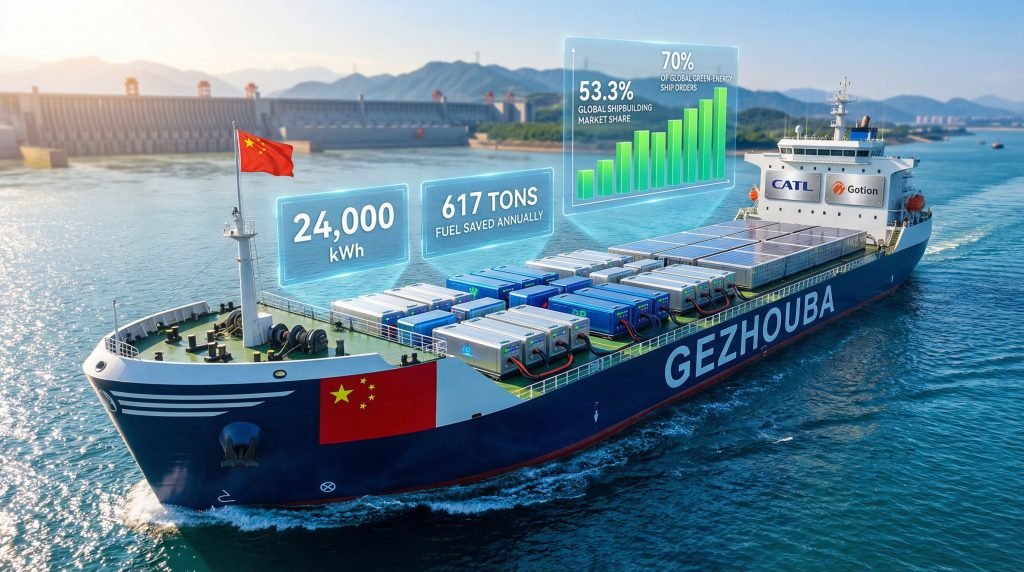
| Gezhouba | Bulk Carrier | 13,740 DWT | 24,000 kWh (12 units) | 500 km | 617 tons fuel savings |
| Yujian 77 | Passenger Ship | 100 passengers | 3,918 kWh CTP | 100 km | Reduced emissions |
| Puffer Fish Blue 01 | Container Ship | 132 TEU | Gotion battery packs | Commercial range | Commercial deployment |
The diversity of vessel types demonstrates the scalability of electric propulsion across different maritime applications. From passenger services to heavy cargo transport, Chinese manufacturers have validated electric systems across operational requirements and vessel configurations.
Performance Characteristics and Efficiency
Electric propulsion offers distinct advantages over traditional marine engines in terms of operational efficiency and environmental impact. The Gezhouba bulk carrier exemplifies large-scale electric cargo operations, achieving 617 tons of annual fuel savings and eliminating 2,052 tons of CO2 emissions annually.
Key Performance Metrics:
• Energy efficiency: Electric motors achieve 90%+ efficiency compared to 40-50% for diesel engines
• Maintenance requirements: Reduced mechanical complexity lowers maintenance costs
• Emissions elimination: Zero local emissions during battery-powered operation
• Noise reduction: Significantly quieter operation improves working conditions
Advanced Maritime Battery Integration
The integration of large-scale battery systems into maritime vessels requires sophisticated engineering solutions. Distributed DC power architectures enable enhanced safety through redundant systems and improved power management capabilities.
Battery system design considerations include:
• Thermal management: Cooling systems designed for marine environments
• Safety systems: Fire suppression and emergency protocols specific to battery installations
• Structural integration: Battery placement optimised for vessel stability and cargo capacity
• Maintenance access: Service protocols for battery replacement and repair
Global Competitive Positioning in Electric Shipping
China's electric shipping strategy leverages systematic advantages in manufacturing, infrastructure, and operational experience. The concentration of shipbuilding capabilities, battery production, and supporting technologies creates competitive moats that extend beyond individual vessel projects.
Recent market data indicates China has captured approximately 70% of global green-energy ship orders in early 2024, though industry experts note this requires validation through global shipping line adoption. Xiong Hao from Shanghai Jump International Shipping observes that while Chinese investment in china electric-powered vessels demonstrates increasing influence in global shipbuilding, widespread acceptance by major container lines remains uncertain.
Regional Infrastructure Advantages
China's geographic and infrastructure positioning provides significant advantages for electric vessel deployment and scaling. The Yangtze River system serves as a comprehensive testing and operational environment, while proximity to the Three Gorges Dam offers abundant hydroelectric power for charging infrastructure.
Strategic Infrastructure Elements:
• Yangtze River Ecosystem: Natural testing ground with 900+ operational electric vessels
• Hydroelectric Integration: Access to renewable power for charging systems
• Manufacturing Proximity: Co-location of battery production and shipbuilding facilities
• Port Infrastructure: Existing facilities adaptable for electric vessel operations
Technology Development Pathway
China's approach emphasises systematic progression from inland waterway operations to oceangoing applications. This risk mitigation strategy validates technology performance in controlled environments before expanding to more challenging open-ocean conditions.
The progression model offers several advantages:
• Performance validation: Extensive operational data from river deployments
• Infrastructure development: Charging and maintenance systems established
• Operator training: Crew familiarity with electric propulsion systems
• Regulatory acceptance: Certification processes refined through operational experience
Economic Analysis of Electric Maritime Adoption
The economic implications of electric vessel adoption extend across capital investment, operational costs, and infrastructure development requirements. Industry analysis suggests additional costs of $125-444 billion for zero-emission ship builds through 2050, though these figures require careful assessment against operational savings and regulatory compliance costs.
Electric propulsion offers compelling operational economics through reduced fuel costs, lower maintenance requirements, and simplified mechanical systems. The elimination of marine diesel fuel represents substantial cost savings, particularly as carbon pricing mechanisms expand globally.
Investment Requirements and Returns
Capital investment in electric vessels typically involves higher upfront costs offset by operational savings over vessel lifecycles. The economic analysis must account for battery replacement costs, charging infrastructure requirements, and potential resale values.
Economic Considerations:
• Capital costs: Higher initial investment for battery systems and electric propulsion
• Operational savings: Reduced fuel and maintenance costs over vessel lifetime
• Infrastructure investment: Shore-based charging and battery swapping facilities
• Regulatory compliance: Potential carbon pricing and emission regulation costs
Competitive Analysis Against Alternative Fuels
Electric propulsion competes with several alternative maritime fuel options including liquefied natural gas, hydrogen fuel cells, and synthetic fuels. Each technology presents distinct advantages and limitations based on route requirements, vessel size, and operational profiles.
Technology Comparison Framework:
| Technology | Advantages | Limitations | Applications |
|---|---|---|---|
| Electric Battery | Zero local emissions, proven technology | Range limitations, charging infrastructure | Short-haul, coastal shipping |
| LNG Hybrid | Reduced emissions, existing infrastructure | Still produces emissions, fuel costs | Medium-range cargo |
| Hydrogen Fuel Cell | Zero emissions, longer range potential | Infrastructure requirements, storage complexity | Long-range applications |
The next major ASX story will hit our subscribers first
Commercial Deployment Challenges and Solutions
The transition from demonstration projects to commercial operations presents several technical and economic challenges. Energy density constraints remain a primary limitation, as battery weight impacts cargo capacity and vessel economics. Current battery technology suits coastal and river operations but requires advancement for trans-oceanic shipping.
Charging infrastructure development represents another significant challenge. Maritime charging networks require substantial investment and coordination across port facilities. Battery swapping systems offer potential solutions for rapid turnaround, though standardisation across vessel types remains complex.
Technical Limitations and Development Priorities
Battery energy density improvements continue advancing, though current technology imposes range limitations on electric vessels. Weight considerations become critical for cargo vessels where battery mass reduces revenue-generating cargo capacity.
Priority Development Areas:
• Energy density enhancement: Higher capacity batteries with reduced weight
• Fast charging systems: Reduced port turnaround times for commercial operations
• Battery standardisation: Interchangeable systems across vessel types
• Safety protocols: Comprehensive emergency procedures for large battery installations
Regulatory and Certification Framework
International maritime regulations require harmonisation to enable global electric vessel operations. Current certification processes vary by jurisdiction, creating potential barriers to international deployment. The International Maritime Organization continues developing standards for electric propulsion systems.
Key regulatory considerations include:
• Safety standards: Battery installation and emergency procedures
• Port compatibility: Charging infrastructure integration
• Insurance frameworks: Risk assessment for electric propulsion technology
• Environmental compliance: Life-cycle assessment of battery systems
Supply Chain Integration and Global Impact
Electric vessels will transform global supply chains through enhanced sustainability and operational characteristics. Short-term applications focus on coastal shipping routes and regional connectivity, while long-term development targets trans-oceanic cargo transportation.
The integration timeline varies by application and route requirements. Container shipping adoption depends on proving commercial viability for major global carriers, while specialised applications may achieve earlier adoption. Regional shipping networks offer immediate deployment opportunities with existing charging infrastructure.
Short-Term Regional Applications
Coastal shipping routes provide optimal conditions for electric vessel deployment with shorter ranges and established port infrastructure. These applications enable commercial validation while supporting infrastructure development for larger-scale adoption.
Priority Deployment Areas:
• Coastal container services: Short-haul routes between major ports
• River transport systems: Expansion of proven inland waterway operations
• Ferry services: Passenger and vehicle transportation across waterways
• Port logistics: Last-mile connectivity within port complexes
Long-Term Transformation Potential
Trans-oceanic electric shipping requires substantial technological advancement and infrastructure development. Battery energy density improvements, charging network expansion, and operational cost reductions must achieve significant progress for wide-scale adoption.
The timeline for major container shipping adoption extends into the 2030s, requiring coordination between technology providers, shipping lines, and port operators. Success in regional applications provides the foundation for broader industry transformation.
Future Development Trajectory for China's Electric Maritime Industry
China's electric maritime industry trajectory emphasises technological advancement, manufacturing scale, and global market expansion. The development roadmap includes ship-shore-cloud integration systems, autonomous navigation capabilities, and comprehensive battery swapping infrastructure.
CATL's announcement of oceangoing china electric-powered vessels within three years represents a significant acceleration in commercial deployment timelines. This aggressive timeline suggests confidence in technological readiness and market demand for electric shipping solutions.
Innovation Pipeline and Technology Roadmap
Comprehensive charging, swapping, and safety management systems represent the next phase of electric maritime development. These integrated platforms enable efficient vessel operations and support rapid scaling of electric shipping networks.
Technology Development Priorities:
• Autonomous systems integration: Smart shipping technology for electric vessels
• Battery swapping networks: Rapid turnaround infrastructure for commercial operations
• Predictive maintenance systems: Data-driven maintenance optimisation
• Grid integration: Shore power systems optimised for renewable energy
Global Market Expansion Strategy
Chinese electric vessel technology positions for international market expansion through technology export, partnership arrangements, and direct investment in overseas shipbuilding facilities. The combination of proven technology and manufacturing capabilities creates competitive advantages in global markets.
Export opportunities include technology licensing to international shipbuilders, direct vessel sales to global shipping companies, and partnership arrangements with foreign port operators for charging infrastructure development. These strategies leverage China's technological leadership while addressing local market requirements and regulatory frameworks.
The strategic implications for global maritime competition suggest that early technological leadership in electric propulsion will influence long-term market positioning as the industry transitions toward decarbonised shipping solutions. Chinese companies' systematic approach to electric vessel development positions them to capture significant market share during this transformation period.
However, this transformation extends beyond vessels themselves. The industry's success depends on supporting infrastructure, including battery recycling breakthrough technologies and the establishment of a battery-grade lithium refinery network to support global production needs. Furthermore, the lessons learned from maritime electrification complement broader electrification in heavy transport initiatives across multiple industrial sectors.
As China's electric vessel technology continues to mature, the integration of these supporting systems will determine the ultimate success of maritime electrification initiatives. The comprehensive approach to electric shipping development, combined with China's manufacturing capabilities and operational experience, positions the nation to lead this critical transition in global shipping.
Meanwhile, competitors must respond to China's comprehensive strategy through their own technological developments and strategic partnerships. The complete solution for battery-electric ships demonstrates the integrated approach necessary for successful market penetration in this emerging sector.
Ready to Navigate the Next Wave of Maritime Investment Opportunities?
China's dominance in electric vessel technology creates compelling investment opportunities across the maritime supply chain, from battery manufacturers to shipbuilders leveraging breakthrough technologies. Discovery Alert's proprietary Discovery IQ model delivers real-time alerts on significant ASX mineral discoveries powering this electrification revolution, instantly empowering subscribers to identify actionable opportunities in critical minerals and emerging technologies ahead of the broader market.