August 20, 2026
The Strategic Logic Behind China's Push for Energy Independence
Few policy imperatives reveal a nation's deepest anxieties quite like the scramble for energy autonomy. Across modern history, countries that depended heavily on imported energy have repeatedly found themselves economically exposed during geopolitical crises, from the 1973 Arab oil embargo to the post-2022 European gas shock. The pattern is consistent: import dependency translates into strategic vulnerability, and strategic vulnerability constrains foreign policy. China's leadership has absorbed this lesson deeply, and the result is one of the most ambitious China energy self-sufficiency strategies ever attempted by a major economy.
When big ASX news breaks, our subscribers know first
Why Import Dependency Became an Unacceptable Risk
For decades, China's extraordinary industrial expansion was fuelled in large part by imported oil and gas. The country's geographic reality is straightforward: it sits on substantial coal reserves but is geologically constrained in terms of conventional oil and gas endowment relative to the scale of its consumption. That structural gap made China permanently susceptible to the kind of price shocks and supply disruptions that cascaded through global markets in recent years.
The closure of the Strait of Hormuz, through which roughly 20% of globally traded oil passes, provided the clearest possible demonstration of this vulnerability. Chinese oil tankers turned back from the strait as risks mounted, supertanker rates from the Gulf to China surged to extraordinary levels, and China's crude import costs spiked. The geopolitical lesson was not lost on Beijing: a single maritime chokepoint, controlled by neither China nor its allies, could threaten the energy supply of the world's second-largest economy.
Critically, Beijing's energy sovereignty agenda is distinct from conventional climate ambition. Reducing carbon emissions may be a downstream benefit of the transition, but the primary driver is supply security. Chinese planners distinguish carefully between strategic resilience and full autarky. The goal is not to seal China off from international energy markets permanently but to build sufficient domestic capacity and diversified supply routes to absorb external shocks without economic disruption.
Furthermore, the broader geopolitical context matters considerably. The US-China trade war impacts have reinforced Beijing's determination to reduce reliance on any supply chain or market where external pressure could be applied.
According to Lin Boqiang, Director of the China Centre for Energy Economics Research at Xiamen University, China recognises its geographic shortfall in oil and gas resources but views its enormous renewable energy capacity in wind and solar as the foundation for confidence in meeting future energy challenges. (Global Times, August 2026)
Four Structural Pillars Driving the Self-Sufficiency Agenda
China's approach to energy resilience is not a single-lever policy. It operates across four reinforcing pillars, each targeting a different dimension of supply security.
Pillar One: Expanding Domestic Fossil Fuel Output
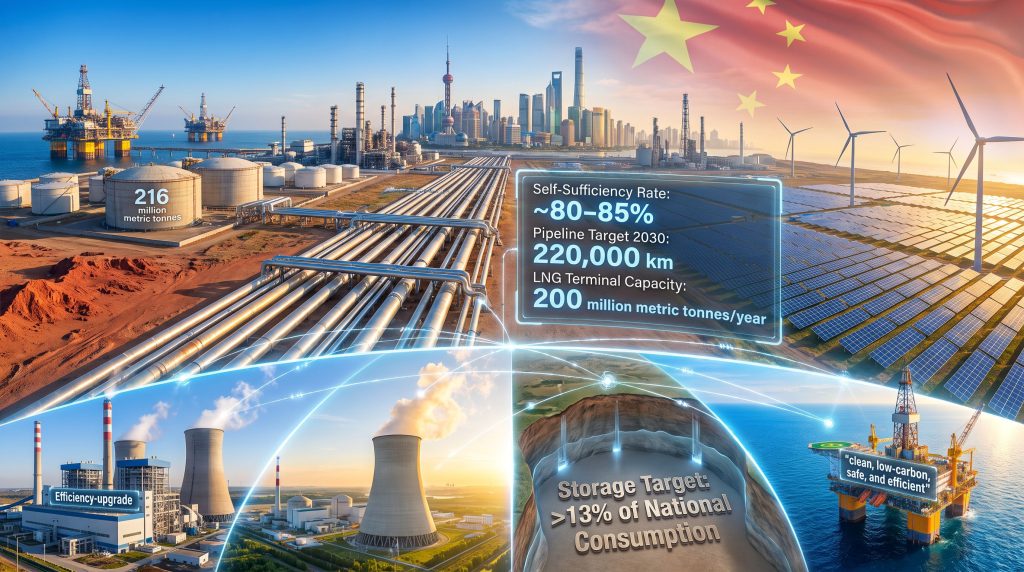
China's domestic crude oil production reached a record 216 million metric tonnes in 2025, according to the National Energy Administration. That milestone is not a ceiling but a launchpad. Between January and July 2026, crude output rose a further 0.9% year-on-year to 4.42 million barrels per day, per National Bureau of Statistics data. Natural gas production added 10 billion cubic metres in a single year, and Chinese oil and gas firms expanded the country's recoverable reserves by 1.32 billion metric tonnes of oil equivalent.
The 15th Five-Year Plan sets the next target: 440 million metric tonnes of oil equivalent in domestic output by 2030, representing a substantial uplift from current levels. Achieving this will require tapping unconventional resources that have historically been either technically difficult or economically marginal, including:
- Continental shale oil formations in sedimentary basins across central China
- Deep shale gas deposits requiring advanced hydraulic fracturing and directional drilling
- Deep coalbed methane, particularly in Shanxi and Xinjiang provinces
- Deepwater offshore reserves in the South China Sea
The comparison to the US shale revolution is instructive but imperfect. America's unconventional boom was enabled by highly permeable geology, a mature service sector, and private land rights that incentivised rapid drilling. China's unconventional geology is generally more complex, with lower permeability and greater drilling depths, meaning the technology breakthroughs the 15th Five-Year Plan specifically targets are not a formality but a genuine technical challenge.
Coal continues to function as a baseload stability anchor within this framework. Rather than pursuing rapid phase-out, Chinese planners are improving efficiency and building strategic reserves of coal capacity to maintain grid reliability during the transition period. The dynamics of the China steel and iron ore market are closely tied to these energy decisions, as coal-intensive industries remain central to China's industrial base.
Pillar Two: Renewable Supremacy and the Curtailment Paradox
China is already the world's largest renewable energy producer. Its decade-long commitment to solar, wind, hydro, and nuclear buildout has created installed capacity that now dwarfs any comparable nation. The 15th Five-Year Plan targets a doubling of non-fossil energy output within the decade, positioning renewables as the long-term replacement for fossil fuel imports.
However, a structural paradox has emerged that is not widely understood outside specialist energy circles: China is simultaneously setting records in renewable capacity installation and records in clean power curtailment. Curtailment occurs when renewable generation capacity exceeds the grid's ability to transmit and absorb that power in real time.
The root cause is geographic. The most productive zones for solar and wind generation are concentrated in western China, specifically Xinjiang, Inner Mongolia, and Gansu, while the largest centres of industrial demand are located in eastern coastal provinces. Without sufficient high-voltage transmission infrastructure connecting these regions, electrons generated in the Gobi Desert cannot reach factories in Guangdong. This mismatch is one of the most consequential bottlenecks in China's entire energy transition.
In addition, the intersection of critical minerals and energy security plays a decisive role here. Scaling renewable capacity at this pace demands vast quantities of lithium, cobalt, copper, and rare earth elements, all of which are subject to their own supply chain risks.
Pillar Three: Infrastructure Hardening
The 15th Five-Year Plan contains some of the most ambitious infrastructure targets in Chinese energy history:
| Infrastructure Category | Current Level | 2030 Target |
|---|---|---|
| Long-distance pipeline network | ~200,000 km | 220,000 km (+20,000 km) |
| Natural gas storage capacity | Below 10% of consumption | Exceeds 13% of consumption |
| LNG terminal annual capacity | Approx. 120 million metric tonnes | 200 million metric tonnes |
| CO₂ injection (CCS) | Early-stage deployment | 10 million metric tonnes/year |
The pipeline expansion has a dual purpose. New pipelines link emerging production zones, particularly unconventional fields in the northwest, to high-demand eastern centres. They also provide overland import corridors that reduce reliance on maritime routes and their associated chokepoint risks. A pipeline through Central Asia or Russia cannot be blockaded by a naval power in the same way the Strait of Hormuz can.
Smart grid modernisation and digitalisation sit beneath all of these physical investments as a force multiplier. Grid management software, demand-response systems, and distributed energy integration tools all improve the efficiency with which China's physical energy infrastructure operates.
Pillar Four: Strategic Reserves and Supplier Diversification
Perhaps the most consequential near-term decision Beijing made was pre-positioning large volumes of discounted crude, sourced from Russia and Iran, into its strategic petroleum reserves over the preceding years. When the Strait of Hormuz situation escalated in 2026, China's buffer meant it could sustain domestic supply without immediately absorbing the full cost of spot market disruption.
The shift in China's crude import mix over just twelve months illustrates the diversification in action:
- Middle East crude's share of Chinese imports fell from 55.4% in H1 2025 to 44.6% in H1 2026, according to calculations by S&P Global Energy
- Replacement volumes came primarily from Russia, West Africa, and Latin America
- China's crude imports touched 7.8 million barrels per day in May 2026, the lowest level since 2017, reflecting the contribution of record domestic output
The shadow tanker fleet and alternative payment mechanisms have also played a role in maintaining access to sanctioned suppliers, though the medium-term objective is to reduce the need for such workarounds through genuine domestic supply growth and legitimate supplier diversification.
The Self-Sufficiency Rate: What the Numbers Actually Mean
China's energy self-sufficiency rate, estimated above 80% currently with some state-linked sources citing figures as high as 85% for 2024, measures the proportion of total domestic energy consumption met by domestic production across all fuels. Government targets aim to sustain or push this figure toward 84.6% to 85% through 2026 to 2030.
| Metric | Estimated Figure |
|---|---|
| Current self-sufficiency rate | Above 80% (up to 85% per some estimates) |
| Domestic crude output, 2025 | 216 million metric tonnes (record) |
| Oil imports, May 2026 low | 7.8 million bpd (lowest since 2017) |
| Middle East share of imports, H1 2026 | 44.6% (down from 55.4%) |
| Pipeline target, 2030 | 220,000 km total |
| LNG terminal capacity target | 200 million metric tonnes/year |
| Gas storage target | Over 13% of national consumption |
| CCS target, 2030 | 10 million metric tonnes CO₂/year |
Critically, the China energy self-sufficiency strategy is a moving target. As China's industrial base continues to expand and its population's energy consumption per capita rises, the denominator in the self-sufficiency calculation grows continuously. Maintaining an 85% ratio requires domestic production to grow in step with total demand, not simply in absolute terms.
Geopolitical Scenarios Beijing Is Engineering Against
The Hormuz Stress Test
The partial closure of the Strait of Hormuz in 2026 was not merely a theoretical risk scenario but a live stress test of China's energy security architecture. Chinese tankers redirected, freight costs spiked, and the strategic petroleum reserve buffer was drawn on to stabilise domestic supply. The residual vulnerability at 7.8 million bpd of imports, even at the low point, confirms that full insulation from maritime chokepoints remains a future objective, not a current reality.
Secondary Sanctions Exposure
Western secondary sanctions targeting Chinese access to Russian or Iranian crude represent a different category of risk. The response embedded within the 15th Five-Year Plan is structural: reduce the volume of imports that could be targeted by growing domestic output, and simultaneously build relationships with suppliers in jurisdictions less susceptible to US or EU sanction regimes, including West African producers and Latin American state oil companies.
Technology Decoupling and Clean Energy Supply Chains
A less-discussed dimension of China's self-sufficiency strategy is its drive for domestic dominance in the manufacturing of clean energy technology. Solar panels, wind turbines, grid batteries, and power electronics are all industries where China has invested aggressively in domestic manufacturing capacity. The 21.4% decline in Chinese solar exports in July 2026 was read by some analysts as a signal that domestic deployment is absorbing production that previously flowed to export markets, prioritising internal energy system buildout over export revenue.
The broader global shift in critical raw materials transition is also shaping how China positions its manufacturing advantage, ensuring that its domestic clean energy buildout is not held hostage to foreign supply chains. Meanwhile, China rare earth export restrictions signal how Beijing is simultaneously leveraging its resource dominance as a strategic tool whilst protecting domestic industrial priorities.
The Tension Between Fossil Fuel Expansion and Climate Commitments
The apparent contradiction between China's record domestic oil and gas output and its headline commitment to peak carbon emissions before 2030 is resolved in Chinese planning through a concept of sequencing. Fossil fuel expansion addresses the near-term supply security imperative, providing the stability buffer that allows renewable energy to scale without causing economic disruption.
Carbon capture and storage, targeted to inject 10 million metric tonnes of CO₂ per year by 2030, provides the mechanism for continuing fossil fuel use while managing emissions intensity. Goldman Sachs scenario modelling suggests that if renewable deployment accelerates faster than the base case trajectory, China could realistically achieve a pathway toward energy self-sufficiency by 2060, though this outcome depends critically on demand trajectory, unconventional resource development success, and grid modernisation timelines.
How China balances these competing priorities is explored in detail by the Columbia University Energy Policy centre, which analyses China's broader ambitions to become a clean energy superpower without sacrificing near-term industrial stability.
Disclaimer: Scenario modelling outputs, including Goldman Sachs projections referenced above, represent analytical estimates under specified assumptions and should not be interpreted as forecasts or guarantees of future outcomes. Energy markets are subject to significant geopolitical, technological, and macroeconomic uncertainty.
The next major ASX story will hit our subscribers first
How China's 15th Five-Year Plan Operationalises the Strategy
The 15th Five-Year Plan translates strategic intent into seven concrete operational mechanisms:
- Launch strategic oil and gas exploration auctions to draw investment into underdeveloped basins and accelerate reserve additions
- Expand the long-distance pipeline network by 20,000 km to connect new production zones with storage and demand centres
- Scale LNG terminal capacity to 200 million metric tonnes per year to diversify gas import sources and reduce overland pipeline dependency
- Increase natural gas storage capacity to exceed 13% of national consumption to buffer against seasonal supply gaps and geopolitical shocks
- Deploy carbon capture and storage infrastructure targeting 10 million metric tonnes of CO₂ injection annually to bridge fossil fuel use and net-zero goals
- Advance deep and unconventional resource extraction technologies to unlock the next layer of domestic supply growth
- Modernise and digitalise grid infrastructure to reduce curtailment, improve efficiency, and integrate distributed renewable generation
Three Scenarios for China's Energy Position by 2035
Optimistic: Technology breakthroughs in deep resource extraction and grid modernisation resolve curtailment bottlenecks. Renewable capacity displaces imports faster than expected. Self-sufficiency climbs toward 88 to 90% by 2035.
Base Case: Domestic oil and gas output meets the 440 million tonne target, but demand growth from continued industrial expansion partially offsets gains. Curtailment improves but remains a drag. Self-sufficiency stabilises in the 84 to 86% range through 2030.
Downside: Secondary sanctions or supply chain disruptions slow clean technology deployment. Demand growth outpaces production gains. Import dependency rises temporarily, increasing exposure to external price shocks.
Resilience, Not Isolation, Is the Actual Goal
The China energy self-sufficiency strategy is fundamentally a risk management architecture rather than a plan for permanent isolation from global energy markets. The dual-track logic of expanding domestic fossil fuel output while simultaneously building the world's largest renewable energy system is internally consistent within a sequencing framework: fossil fuels provide the supply stability floor, renewables provide the long-term trajectory, and infrastructure investment ties the two together.
The 15th Five-Year Plan's pipeline, storage, LNG, and CCS targets give this strategy measurable operational form. As China progressively insulates its economy from energy market volatility, the strategic flexibility that domestic supply security creates extends well beyond energy policy into trade negotiations, foreign policy positioning, and broader geopolitical leverage. The numbers alone tell part of the story. The strategic architecture behind them tells the rest.
Want to Track the Investment Opportunities Emerging From the Global Energy Transition?
Discovery Alert's proprietary Discovery IQ model delivers real-time alerts on significant ASX mineral discoveries — including the critical minerals driving renewable energy and energy security strategies like China's — instantly empowering subscribers to identify actionable opportunities ahead of the broader market. Explore historic discoveries and their returns, then begin your 14-day free trial at Discovery Alert to position yourself at the forefront of the next major find.