August 20, 2026
When Geography Becomes a Liability: Saudi Arabia's DAP Export Crisis
Global fertilizer markets have rarely confronted a scenario where two of the world's most strategically vital maritime corridors become simultaneously inaccessible. For decades, commodity trade flows were stress-tested against single-point failures. The possibility that both the Strait of Hormuz and the Red Sea passage could be compromised at the same time was largely treated as a theoretical extreme. In 2026, that extreme became operational reality.
Diammonium phosphate, known in trade markets as DAP, sits at the intersection of agricultural necessity and geopolitical vulnerability. As one of the most widely traded phosphate fertilizers globally, it underpins crop nutrition cycles from South Asian rice paddies to East African maize fields. When its supply chains fracture, the effects do not stay contained to commodity desks. They ripple outward into food production economics, import tender pricing, and the procurement strategies of state-linked agricultural buyers across emerging markets.
The decision by Saudi phosphate producer Maaden to export DAP via Oman, loading cargoes at Duqm port on the Arabian Sea coast, is the most visible commercial signal yet that the Middle East conflict has permanently altered the logistics architecture of global phosphate trade, at least for the foreseeable future.
When big ASX news breaks, our subscribers know first
The Hormuz Closure and Its Cascading Impact on Phosphate Logistics
Maaden's primary phosphate export hub at Ras Al-Khair sits on Saudi Arabia's Arabian Gulf coastline. For years, this positioning offered a direct and cost-efficient routing advantage: loads would depart Ras Al-Khair, transit the Strait of Hormuz, and reach open ocean heading toward Indian and East African buyers. The infrastructure at Ras Al-Khair was purpose-built around this corridor, meaning the capital intensity of pivoting away from it is substantial.
The Strait of Hormuz effectively closed to normal commercial traffic at the end of February 2026 following military escalation between Iran and the United States. Vessel crossing data tracked by maritime security firm Windward illustrates the severity: only 12 vessels transited the strait on August 16, 2026, comprising eight inbound and four outbound crossings, against a pre-conflict baseline of well over 100 daily crossings.
For context, US Energy Secretary Chris Wright noted that approximately 14 to 15 million barrels per day equivalent of commodity flows were still leaving the Arabian Gulf region through a combination of pipelines and limited tanker movements, compared to 20 million barrels per day prior to the conflict. This left a deficit of roughly 4 to 5 million b/d equivalent — a stark illustration of the geopolitical supply risk now embedded in regional commodity logistics.
Maaden's initial workaround was to truck DAP overland from Ras Al-Khair to Saudi Arabia's Red Sea coast, with Yanbu serving as the primary loading port. This approach was costly but operationally viable until the situation deteriorated further. Houthi militant threats directed at Saudi-linked shipping in the Red Sea, intensifying from late July 2026, elevated war risk insurance premiums and introduced new uncertainty around the Bab El-Mandeb strait.
Eastbound cargoes from Saudi Red Sea ports face a binary and unfavourable choice: transit Bab El-Mandeb under heightened threat conditions, or reroute through the Suez Canal and around the Cape of Good Hope, adding both time and significant freight cost. Neither option offered the commercial predictability that bulk fertilizer procurement requires.
Why Maaden Is Now Exporting DAP via Oman's Duqm Port
Oman's Duqm port, located on the country's southeastern coast facing the Arabian Sea, offers something neither the Hormuz corridor nor the Red Sea route can currently provide: direct ocean access without exposure to either active conflict zone. This geographic positioning is the central rationale behind Maaden to export DAP via Oman, loading cargoes at Duqm for both Indian and East African buyers.
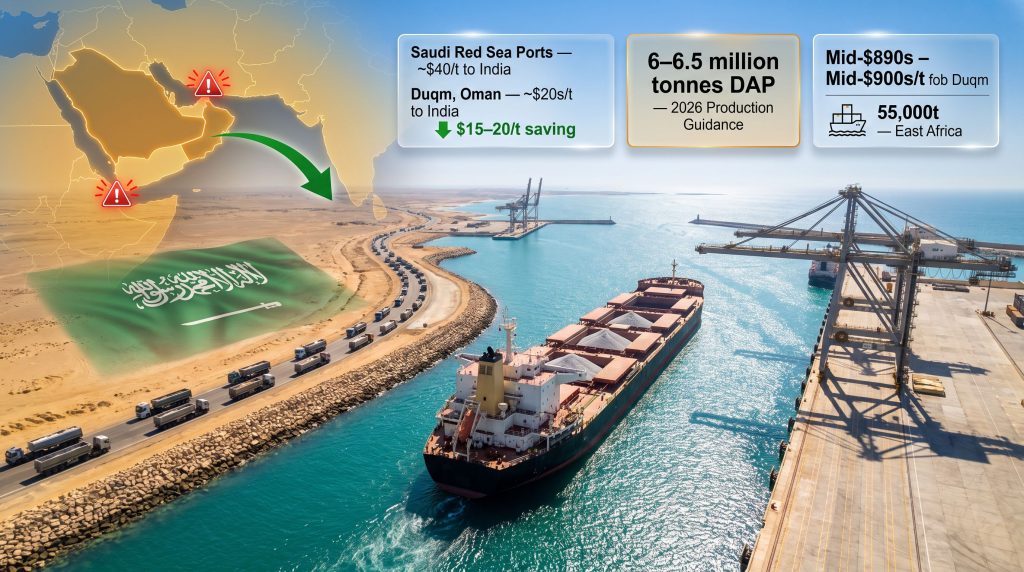
Maaden is loading a 60,000-tonne DAP cargo at Duqm in late August or early September 2026, destined for India and priced on a formula basis. A separate 55,000-tonne cargo sold to East African buyers earlier in August will also load from Duqm in September, with the netback estimated at between the mid-$890s per tonne and mid-$900s per tonne fob.
To reach Duqm, the product must first travel by truck from Ras Al-Khair on the Arabian Gulf coast — a logistically complex and cost-bearing overland leg that partially offsets the maritime freight advantage the Omani port provides.
The Freight Economics: A Critical Commercial Signal
The freight cost differential between routing options is large enough to materially influence pricing decisions and buyer preferences across import markets.
| Export Route | Vessel Size | Estimated Freight to India |
|---|---|---|
| Saudi Red Sea Ports (e.g., Yanbu) | 60,000t bulk | ~$40/t |
| Duqm, Oman | 60,000t bulk | ~$20s/t |
The implied saving of roughly $15 to $20 per tonne on India-bound cargoes represents a meaningful margin recovery opportunity for a producer already absorbing elevated overland trucking costs. However, this advantage is not without its own complications.
Port congestion at Duqm is reported to be significant, with multiple commodity producers and trading flows competing for berth access simultaneously, driving up demurrage costs. Furthermore, war risk insurance premiums, while lower than those applicable to Red Sea routing, still apply to vessels operating in Arabian Sea-adjacent waters. The overland trucking corridor from Ras Al-Khair to Duqm was not a pre-existing fertilizer logistics route, meaning fleet mobilisation, route permitting, and operational scaling are all live constraints.
The Duqm route represents a tactically sound adaptation to an unprecedented dual-chokepoint scenario, but its scalability as a sustained primary export corridor depends on resolution of port congestion, stabilisation of regional war risk premiums, and the long-run economics of overland trucking relative to whatever alternative routing options may emerge.
How Indian and East African Buyers Are Navigating Supply Uncertainty
India remains one of the world's largest importers of DAP, and the India import dynamics reflect both genuine procurement need and strategic behaviour designed to lock in supply before planting season constraints tighten further. State-linked buyers have been actively tendering throughout August 2026 for precisely this reason.
National Fertilizers Limited (NFL) is understood to have awarded approximately 60,000 tonnes of DAP across two 30,000-tonne cargoes to trading firm Midgulf International, priced in the high $920s per tonne cfr with credit terms. On a sight basis, this is equivalent to approximately the mid-$910s per tonne cfr. NFL's tender received four offers from trading firms Ameropa, Oasis Global, Agrifields, and Midgulf, indicating healthy competition among suppliers despite the constrained logistics environment.
Fertilisers and Chemicals Travancore (FACT) ran a concurrent tender for 50,000 tonnes of DAP, receiving offers from a notably diverse set of origins:
- OCP of Morocco offering Moroccan-origin DAP for delivery to New Mangalore or Tuticorin ports
- VB Venture offering US-origin DAP for the same port options
- Oasis Global offering Russian-origin DAP for Tuticorin
- Ameropa offering open-origin DAP for New Mangalore or Tuticorin
The breadth of supplier origins responding to FACT's tender illustrates the degree of active diversification underway among major phosphate buyers. Consequently, when a single logistics corridor disruption creates this level of supply route uncertainty, buyers do not simply wait for prices to normalise — they build redundancy into their procurement architecture, which structurally expands the competitive opportunity for non-Saudi DAP producers, including Morocco's OCP and Russian exporters. This supply chain disruption is reshaping long-standing trade relationships that took years to establish.
Comparative DAP Pricing Landscape: August 2026
| Cargo / Seller | Volume | Price Reference | Route / Origin |
|---|---|---|---|
| NFL Award (India) | ~60,000t | High $920s/t cfr (credit) | Undisclosed / trading firm |
| Maaden to East Africa | 55,000t | Mid-$890s to mid-$900s/t fob Duqm | Saudi Arabia via Oman |
| Maaden to India | 60,000t | Formula-priced | Saudi Arabia via Duqm |
| NCIC Egypt Tender | 21,000t | $915 to $920/t fob | Egypt |
The NCIC Egypt tender result is particularly instructive. Egyptian DAP awarded at $915 to $920 per tonne fob in mid-August 2026 represented a substantial increase from the same producer's $890 to $900 per tonne fob awards just weeks earlier in late July, signalling that the broader pricing environment is tightening as logistics stress compounds supply constraints.
The East Africa cargo represents more than a single commercial transaction. It signals Maaden's intent to maintain and actively develop non-Indian market share under logistical duress. East African agricultural markets, including Ethiopia and neighbouring import-dependent economies, are increasingly important destination channels for Middle Eastern phosphate producers. The Duqm-to-East-Africa routing, while longer than a direct Red Sea path, avoids the Bab El-Mandeb risk corridor entirely, which carries its own risk-adjusted commercial logic.
Production Under Pressure: More Than a Shipping Problem
A detail that warrants more attention than it typically receives in shipping-focused coverage of this story is that Maaden's difficulties are not confined to export logistics. The company revised its 2026 phosphate production guidance to the equivalent of 6 to 6.5 million tonnes of DAP, down from prior targets, citing two distinct upstream pressures:
- Sulphur supply shortfalls: Sulphuric acid is an essential processing input in DAP manufacturing. Phosphate rock must be reacted with sulphuric acid to produce phosphoric acid, which is then combined with ammonia to produce DAP. Disruptions to sulphur import logistics, themselves a consequence of the same conflict-driven shipping constraints, are directly limiting how much DAP Maaden can physically produce.
- Elevated logistics costs: The multi-layered routing complexity is eroding operational margins at the production level, not merely at the export and freight level.
This production guidance downgrade is a leading indicator worth monitoring carefully. It suggests that the market's supply-side stress is structural rather than purely logistical, and that even if export routing normalises, output recovery may lag due to upstream input constraints. For comparison, projects such as the Ammaroo phosphate project in Australia and the Toolse phosphate project in Estonia highlight how global developers are increasingly looking beyond traditional phosphate supply hubs to build resilient, conflict-insulated supply chains.
The SABIC-Maaden Collaboration: Defensive Consolidation or Strategic Repositioning?
On August 18, 2026, Saudi fertilizer producers SABIC AN and Maaden Integrated Fertilizer Company (MIFC) signed a non-binding three-year collaboration framework to explore joint opportunities across the fertilizer value chain. MIFC, incorporated in September 2023, functions as a holding company for Maaden's stakes in its phosphate businesses and key subsidiaries. The relationship between SABIC and Maaden predates this agreement, with SABIC having held minority shareholdings in Maaden's Wa'ad Al-Shamal and Maaden Phosphate operations since their inception.
SABIC has also received Saudi energy ministry approval to expand its urea capacity by 2.6 million tonnes per year, which would bring its total urea production capacity to approximately 7.4 million tonnes per year upon completion.
Whether SABIC also plans to route cargoes through Duqm has not been confirmed. However, the timing of the collaboration framework, signed during a period of acute logistics stress for both producers, raises the possibility that coordinated routing, shared port access negotiations, and joint pricing strategy could become operational outcomes of what began as an exploratory agreement.
If the Hormuz closure extends beyond Q4 2026, the SABIC-Maaden collaboration framework could accelerate from exploratory to operational, effectively creating a coordinated Saudi phosphate and nitrogen export structure that manages routing, port relationships, and market positioning across both Duqm and Red Sea corridors simultaneously.
The next major ASX story will hit our subscribers first
Three Scenarios for Global DAP Markets
Scenario 1: Hormuz Reopens Within Three to Six Months
Under this pathway, Maaden reverts to primary loading at Ras Al-Khair. Duqm transitions from an active primary hub to a contingency corridor. Freight costs normalise, reducing delivered DAP prices in India by an estimated $15 to $20 per tonne. Sulphur supply chains stabilise, allowing production guidance to be revised upward. Market impact would be moderate short-term price relief without any structural shift in global DAP trade flows.
Scenario 2: Prolonged Closure With Duqm as a Semi-Permanent Hub
If disruptions extend for six to eighteen months, both Maaden and potentially SABIC move toward formalising the Duqm trucking corridor and investing in dedicated port handling infrastructure. Duqm congestion becomes a sustained operational constraint requiring Omani port authority investment to expand capacity. DAP prices in India remain structurally elevated in the $900 to $940 per tonne cfr range as logistics premiums become embedded in delivered pricing. Competing suppliers from Morocco, Russia, and the United States consolidate market share in price-sensitive import markets.
Scenario 3: Escalation and Extended Dual-Corridor Closure
Under the most severe scenario, both Hormuz and Bab El-Mandeb remain effectively inaccessible or high-risk for eighteen months or more. Saudi phosphate production contracts further as sulphur import logistics deteriorate. Global DAP supply tightens materially. Delivered prices for Indian buyers could breach $1,000 per tonne cfr. Food security implications emerge for import-dependent agricultural economies across South Asia and Sub-Saharan Africa, where fertilizer affordability directly determines crop yield outcomes.
The Geopolitical Timeline Shaping All Three Scenarios
Understanding which of the three scenarios is most likely requires tracking the geopolitical timeline with precision:
- Late February 2026: Strait of Hormuz effectively closes following military escalation
- June 18, 2026: A 60-day ceasefire MoU is signed, including provisions for Hormuz safe passage and US sanctions relief
- Mid-July 2026: The MoU collapses amid disputes over strait administration; Iran resumes vessel targeting; the US reinstates its naval blockade
- August 14, 2026: US President Trump threatens an indefinite blockade and raises the prospect of a US territorial claim over the Strait of Hormuz
- August 18, 2026: Iran's parliament speaker confirms Hormuz will remain closed until the US fulfils MoU commitments, including lifting the blockade, releasing frozen assets, and ending military operations
Iranian parliament speaker Mohammad Bagher Ghalibaf stated on August 18 that the strait would not reopen until all US commitments under the now-expired agreement were fulfilled. US Defense Secretary Pete Hegseth indicated the naval blockade could be maintained indefinitely. With both sides publicly entrenched, no confirmed reopening timeline exists as of mid-August 2026.
Key Takeaways for Market Participants
The Maaden-Duqm development carries implications that extend well beyond a single routing adjustment. Several structural signals deserve close attention:
- Logistics corridors have become a primary pricing variable, not merely a cost input. The $15 to $20 per tonne freight differential between Red Sea and Duqm routing is large enough to determine which suppliers win tender awards in price-sensitive markets.
- The production guidance downgrade to 6 to 6.5 million tonnes DAP equivalent is a supply-side warning signal, indicating that upstream input constraints are compounding export-side pressures.
- India's buyer diversification, visible in FACT's multi-origin tender response, signals a structural shift in procurement strategy that may outlast the immediate crisis.
- The SABIC-Maaden collaboration framework represents the most significant potential structural development in Saudi fertilizer export strategy in recent years, with outcomes that could reshape how the Kingdom manages phosphate and nitrogen export logistics under sustained conflict conditions.
- East Africa's emergence as a deliberate strategic market for Maaden, evidenced by the 55,000-tonne cargo loaded at Duqm, reflects a long-term demand diversification logic that operates independently of the current crisis.
- Procurement risk managers at fertilizer importers and agricultural input distributors should stress-test supply strategies against all three scenarios outlined above, given that the reopening timeline for Hormuz carries no current certainty.
This article is based on publicly available market intelligence and commodity pricing data current as of August 2026. Pricing figures, freight rates, and production estimates are subject to change as market conditions evolve. Nothing in this article constitutes financial or investment advice. Forward-looking scenarios are analytical projections only and do not represent confirmed commercial outcomes.
Want to Stay Ahead of the Commodity Disruptions Reshaping Global Markets?
Discovery Alert's proprietary Discovery IQ model delivers real-time alerts on significant ASX mineral discoveries — including those in the phosphate and fertiliser sectors being reshaped by today's geopolitical supply shocks — instantly translating complex data into actionable investment insights for both short-term traders and long-term investors. Explore how historic mineral discoveries have generated substantial market returns and begin your 14-day free trial today to position yourself ahead of the market.