
June 30, 2026
Understanding China's Strategic Export Control Framework
Global supply chains for critical materials have entered an era where geopolitical leverage matters more than traditional market forces. At the center of this transformation lies China export controls sophisticated apparatus, which has evolved from bureaucratic trade management into a strategic weapon capable of disrupting entire industrial sectors worldwide.
Furthermore, China rare earth export controls have become a defining feature of modern resource geopolitics, affecting everything from electric vehicle production to defense systems manufacturing.
What Makes China's Export Control System So Powerful?
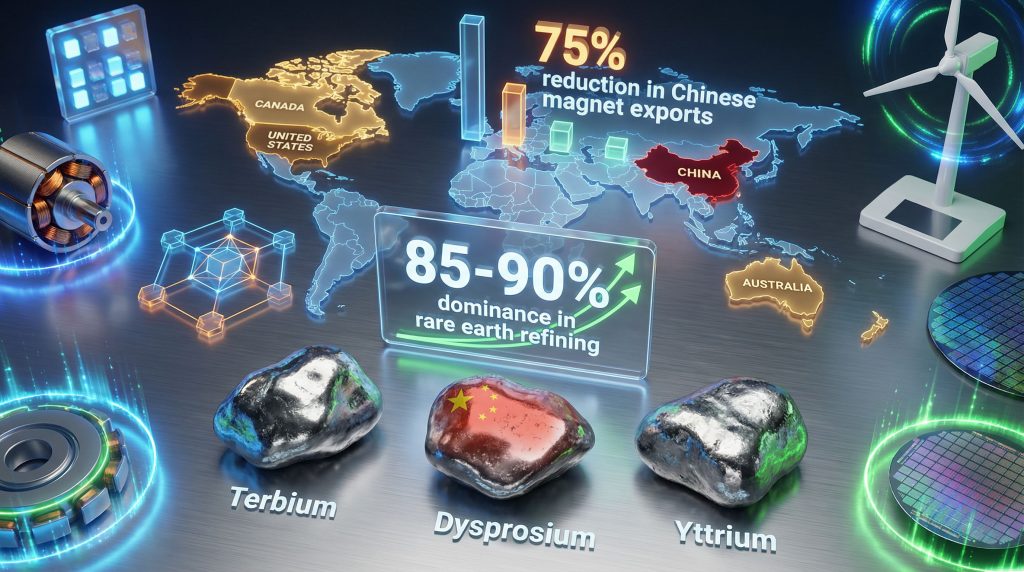
China's dominance over rare earth processing creates an unparalleled chokepoint in global manufacturing. With approximately 85-90% of worldwide rare earth refining and processing capacity under Chinese control, Beijing possesses leverage that extends far beyond its raw material production, which accounts for only 65-70% of global mining output.
However, the 2020 Export Control Law modernized China's regulatory framework, transforming previously ad-hoc administrative restrictions into a systematic bureaucratic apparatus. This legislation established comprehensive licensing requirements for dual-use technologies and critical materials, creating legal foundations for strategic trade restrictions that appear transparent while maintaining administrative discretion.
Key elements of China's processing dominance include:
• Separation Technology Control: China controls proprietary methods for separating individual rare earth elements from mixed concentrates
• Metallization Capacity: Converting separated oxides into usable metals and alloys requires specialized facilities concentrated in Chinese industrial zones
• Supply Chain Integration: Chinese facilities handle multiple processing stages, from initial concentration through final product manufacturing
• Technology Transfer Restrictions: Licensing requirements effectively prevent foreign competitors from accessing separation and metallization expertise
Consequently, the licensing regime operates through a dual-layer architecture combining formal regulatory procedures with informal administrative delays. Companies must submit detailed end-use documentation, customer verification, and technical specifications before receiving export approval. Processing timelines remain discretionary, extending from weeks to months based on geopolitical considerations and policy priorities.
How Do Export Controls Function as Geopolitical Tools?
Export controls represent a fundamentally different instrument compared to traditional trade restrictions. While tariffs create price signals that markets can eventually overcome through alternative sourcing or substitution, export controls create absolute availability constraints that cannot be resolved through economic mechanisms alone.
China demonstrated this distinction during the 2023-2025 period through restrictions on gallium and germanium, two critical semiconductors where China controls approximately 95% and 65% of global processing capacity respectively. These restrictions targeted high-power transistors, integrated circuits, and optoelectronic devices essential for advanced manufacturing across allied nations.
Moreover, the extraterritorial reach of China's export controls extends Beijing's regulatory authority beyond its borders. Foreign-manufactured products containing Chinese-origin rare earths now require Chinese export licenses when destined for restricted end-uses or specific countries. This creates a de facto secondary sovereignty claim over manufactured goods based solely on the presence of Chinese-origin materials.
Recent examples of China's strategic leverage include:
• Semiconductor Supply Disruption: Gallium-germanium restrictions following U.S. technology export controls created 6-12 month supply shortages across allied semiconductor manufacturers
• Defense Industry Targeting: Automatic denial policies for military-linked applications force Western defense contractors to seek alternative suppliers or face production delays
• Technology Transfer Barriers: Restrictions on separation and metallization technology exports prevent foreign competitors from developing independent processing capabilities
• Supply Chain Visibility Requirements: Manufacturers must trace rare earth origins through complex supply chains or face export license denials
When big ASX news breaks, our subscribers know first
The 2025 Rare Earth Export Control Escalation
The escalation of China rare earth export controls during 2025 represents a systematic expansion of Beijing's strategic leverage over global technology supply chains. This timeline demonstrates how administrative restrictions can rapidly transform from targeted measures into comprehensive supply chain disruptions.
Additionally, critical minerals energy security has become increasingly dependent on stable access to Chinese processing facilities.
What Changed in China's 2025 Export Control Strategy?
The 2025 escalation followed a deliberate pattern of expanding coverage across critical rare earth elements while maintaining diplomatic language around nonproliferation and responsible governance. Each phase targeted specific industrial applications while creating cumulative supply chain pressures.
| Timeline | Restricted Elements | Primary Applications | Documented Impact |
|---|---|---|---|
| April 2025 | Samarium, gadolinium, terbium, dysprosium, lutetium, scandium, yttrium | High-temperature magnets, defense systems | Initial manufacturing delays |
| October 2025 | Added holmium, erbium, thulium, europium, ytterbium | Optical systems, specialised alloys | 75% reduction in Chinese magnet exports |
| December 2025 | Automatic denial for military applications | Defence procurement | Global defence sector supply reassessment |
| November 2025 | One-year suspension following trade agreement | Temporary relief across sectors | Continued uncertainty over long-term policy |
The 75% reduction in Chinese magnet exports following October 2025 restrictions particularly impacted neodymium-iron-boron (NdFeB) permanent magnets, which require dysprosium and terbium for high-temperature performance. These magnets are essential for electric vehicle motors, wind turbine generators, and defence applications where performance cannot be compromised.
How Do Extraterritorial Controls Extend China's Reach?
China's extraterritorial control framework asserts regulatory authority over products manufactured entirely outside Chinese territory, based solely on the presence of Chinese-origin rare earth inputs. This approach fundamentally challenges traditional concepts of commercial sovereignty and supply chain independence.
The mechanism operates through several enforcement layers:
• Supply Chain Tracing Requirements: Manufacturers must document the origin of all rare earth inputs or face potential licence restrictions when exporting finished products
• End-Use Monitoring: Chinese authorities track how rare earth materials are incorporated into final products, even after sale to foreign companies
• Technology Transfer Prohibitions: Licensing restrictions prevent Chinese companies from sharing separation and metallization expertise with foreign competitors
• Third-Party Compliance: Foreign companies using Chinese-origin rare earths must comply with Chinese licensing requirements for their own exports
This framework effectively creates supply chain dependencies that extend beyond direct commercial relationships. Electric vehicle manufacturers sourcing rare earth magnets from third-party suppliers may discover their finished vehicles require Chinese export licences if the magnets contain restricted Chinese-origin elements. Similarly, aerospace companies face licensing requirements for any exports containing Chinese rare earth components, even when selling to allied nations.
Industry Impact Assessment by Sector
Different industrial sectors face varying levels of vulnerability to China rare earth export controls based on their technical requirements, supply chain structure, and ability to implement alternative materials or suppliers. Understanding these sectoral differences reveals where strategic dependencies create the greatest economic and security risks.
Which Industries Face the Greatest Vulnerability?
Electric Vehicle Manufacturing
The electric vehicle sector faces perhaps the most severe exposure to China rare earth export controls due to the technical requirements of modern EV traction motors. Nearly all contemporary EV designs rely on synchronous permanent magnet motors containing rare earth elements, particularly dysprosium and terbium for high-temperature performance.
Critical dependencies include:
• Motor Design Constraints: Modern EV traction motors require 0.5-2.5 kg of NdFeB permanent magnets per vehicle, with dysprosium content typically 5-10% by weight for thermal stability
• Performance Requirements: Induction motors (which avoid rare earth elements) are less efficient and require larger cooling systems, making them unsuitable for modern EV packaging and range requirements
• Supply Chain Concentration: Approximately 90-95% of rare earth magnet production for EVs originates from China or Chinese-controlled facilities in Southeast Asia
• Development Timeline Constraints: Redesigning motor architectures to eliminate rare earth dependencies requires 2-4 year development cycles plus regulatory testing and certification
The global EV market produced approximately 14 million units in 2024, with China manufacturing roughly 60% of global production. Chinese EV manufacturers benefit from preferential access to restricted rare earth supplies, creating competitive asymmetries that Western automakers cannot rapidly overcome through market mechanisms alone.
Major automaker exposure varies significantly:
• Tesla: 2024 production exceeded 1.8 million units globally, with 70-80% of rare earth magnet supply sourced from Chinese-controlled suppliers
• Chinese Manufacturers: BYD, NIO, and Li Auto collectively produced over 12 million units in 2024, all requiring rare earth magnets with preferential domestic supply access
• European Automakers: BMW, Mercedes-Benz, and Volkswagen face supply chain disruptions that cannot be resolved through traditional supplier diversification due to Chinese processing dominance
Defence and Aerospace Systems
Defence applications present unique vulnerabilities because military systems require high-performance materials that often cannot be substituted without compromising operational capabilities. Rare earth elements appear in approximately 15-20% of advanced defence systems, with particularly critical applications in radar, electronic warfare, missile guidance, and propulsion technologies.
Heavy rare earth elements like dysprosium and terbium are essential for:
• High-Temperature Permanent Magnets: Fighter jet propulsion systems and missile guidance mechanisms requiring operation above 150°C
• Radar and Electronic Warfare Systems: Advanced electronics requiring stable magnetic properties under extreme conditions
• Precision Guidance Systems: Miniaturised motors and actuators in advanced munitions
• Naval Applications: Submarine propulsion systems and shipboard defence electronics
The December 2025 automatic denial policy for military-linked applications creates particularly severe constraints for Western defence contractors. Unlike commercial applications where some performance trade-offs might be acceptable, military systems cannot compromise on reliability or performance specifications that depend on rare earth materials.
Renewable Energy Infrastructure
Wind turbine manufacturing represents another sector with concentrated exposure to China rare earth export controls. Modern offshore wind turbines require substantial quantities of rare earth permanent magnets for direct-drive generators that eliminate gearbox maintenance requirements in marine environments.
Key vulnerabilities include:
• Magnet Requirements: A single 10-15 MW offshore wind turbine requires 500+ kg of rare earth permanent magnets containing restricted elements
• Performance Dependencies: Direct-drive generators using permanent magnets achieve higher efficiency and reliability compared to alternatives, making them standard for offshore applications
• Manufacturing Concentration: China produces approximately 70% of global wind turbines, with domestic manufacturers having preferential access to rare earth supplies
• Grid-Scale Impact: Large wind farms may contain hundreds of turbines, creating aggregate rare earth requirements that cannot be substituted through alternative technologies
Solar panel manufacturing faces less direct exposure but remains vulnerable through component supply chains, particularly for tracking systems and power electronics that require rare earth elements for optimal performance.
Global Response Strategies and Diversification Efforts
Western nations and allied countries have implemented various strategies to reduce dependency on China rare earth export controls, but these efforts face significant technical, economic, and timeline constraints. Understanding the scope and limitations of these diversification initiatives reveals the complexity of building alternative supply chains for critical materials transition.
What Alternative Supply Sources Are Emerging?
Despite widespread recognition of supply chain risks, developing alternative rare earth processing capacity outside China requires substantial time and capital investment. Current non-Chinese initiatives represent a small fraction of global requirements and face significant scaling challenges.
| Region | Key Projects | Development Timeline | Estimated Capacity vs. China |
|---|---|---|---|
| Australia | Lynas Rare Earths expansion | 2025-2027 | 5-8% of global refining capacity |
| United States | MP Materials scaling | 2024-2026 | 3-5% of global refining capacity |
| Canada | Saskatchewan REE initiatives | 2026-2028 | 2-4% of global refining capacity |
| Europe | Northern European processing projects | 2027-2030 | 2-3% of global refining capacity |
Australian Developments: Lynas Rare Earths operates the only significant rare earth processing facility outside China, but expansion faces environmental regulatory challenges and community opposition. The company's Malaysian processing facility handles light rare earth elements but lacks heavy rare earth processing capabilities essential for defence and high-performance applications.
United States Initiatives: MP Materials has restored production at the Mountain Pass mine in California but still ships concentrate to China for processing. Developing domestic separation and metallization capabilities requires overcoming environmental permitting challenges and technology transfer restrictions that limit access to Chinese processing expertise.
Canadian Projects: Saskatchewan's uranium mining infrastructure provides potential synergies for rare earth development, but projects remain in early development phases. Canadian initiatives focus primarily on heavy rare earth elements, which offer higher strategic value but lower production volumes.
How Are Western Nations Building Strategic Resilience?
Allied nations have implemented coordinated frameworks to reduce collective vulnerability to China rare earth export controls, though these efforts require sustained political commitment and substantial financial resources across multiple election cycles.
Critical minerals partnerships include:
• AUKUS Framework: Australia, United Kingdom, and United States cooperation on critical minerals security, including rare earth processing technology sharing
• Quad Initiatives: Australia, India, Japan, and United States coordination on supply chain resilience, with particular focus on clean energy mineral requirements
• EU Critical Raw Materials Act: European Union legislation establishing domestic processing targets and strategic partnerships with resource-rich nations
• Canada-US Cooperation: Bilateral agreements on critical minerals development leveraging Canadian resources and US market access
Government funding mechanisms support private sector investment through:
• Production Tax Credits: Financial incentives for domestic rare earth processing facilities
• Research and Development Grants: Support for alternative processing technologies and material substitution research
• Strategic Reserve Funding: Government purchases to guarantee market demand for non-Chinese rare earth production
• Infrastructure Investment: Development of specialised industrial facilities, transportation networks, and environmental management systems
However, these initiatives face several structural limitations:
• Technology Gaps: Chinese processing expertise developed over decades cannot be quickly replicated
• Environmental Challenges: Rare earth processing involves complex chemical separation requiring environmental permits that may take years to obtain
• Economic Viability: Non-Chinese facilities must compete with established Chinese operations that benefit from economies of scale and lower environmental costs
• Timeline Constraints: Developing alternative supply chains requires 5-10 year investment horizons that may not align with political or business planning cycles
Investment and Market Implications
China rare earth export controls create both risks and opportunities for investors across multiple asset classes and geographic regions. Understanding how these restrictions affect different types of investments requires analysis of direct exposure, indirect dependencies, and long-term strategic positioning.
What Does This Mean for Rare Earth Mining Equities?
Non-Chinese rare earth companies have experienced significant valuation premiums as investors seek exposure to alternative supply chains. However, these premiums often overlook the distinction between mining operations and the more critical processing and refining capabilities where China maintains dominance.
Key investment considerations include:
• Processing vs. Mining Premium: Companies with separation and metallization capabilities command higher valuations than raw material producers
• Heavy vs. Light Rare Earth Focus: Heavy rare earth projects (dysprosium, terbium, europium) trade at significant premiums due to Chinese processing concentration
• Government Partnership Value: Companies with strategic partnerships or government contracts receive valuation support beyond pure commercial metrics
• Technology Access Constraints: Firms lacking access to Chinese processing expertise face higher development risks and longer timelines
Notable publicly traded companies positioned for China rare earth export control scenarios:
• Lynas Rare Earths (ASX: LYC): The only significant non-Chinese rare earth processor, with expansion plans in Texas and Australia
• MP Materials (NYSE: MP): California-based mining operation developing domestic processing capabilities
• Energy Fuels (NYSE Arca: UUUU): Uranium producer diversifying into rare earth processing using existing facilities
• Appia Rare Earths (CSE: API): Canadian exploration company with heavy rare earth focus
How Should Investors Evaluate Supply Chain Risk?
Investment analysis must incorporate geopolitical risk factors that traditional financial metrics cannot capture. China rare earth export controls create discontinuous risks that may not appear in historical performance data but can dramatically affect future cash flows.
Due diligence frameworks should assess:
• Direct Rare Earth Exposure: Percentage of input costs dependent on Chinese-origin materials
• Indirect Supply Chain Dependencies: Upstream supplier exposure to Chinese rare earth processing
• Alternative Sourcing Capabilities: Availability and cost of non-Chinese supply sources
• Technology Substitution Options: Ability to redesign products using alternative materials
• Customer Base Vulnerability: End-user exposure to defence, EV, or renewable energy sectors
Risk assessment methodologies include:
• Scenario Analysis: Modelling cash flow impacts under different restriction scenarios
• Supply Chain Mapping: Identifying all rare earth dependencies across multi-tier supplier networks
• Regulatory Monitoring: Tracking policy developments that might trigger additional restrictions
• Technology Roadmap Review: Understanding long-term material requirements for product development
Portfolio construction strategies for managing rare earth supply chain risks:
• Diversification Across Geographies: Balancing exposure between China-dependent and alternative supply chain companies
• Hedging Through Alternatives: Investing in rare earth alternatives, recycling technologies, and material substitution research
• Strategic Reserve Exposure: Companies with government contracts or strategic stockpiling agreements
• Integration Premium: Vertically integrated companies that control multiple supply chain stages
Future Scenario Analysis
The evolution of China rare earth export controls will depend on complex interactions between geopolitical tensions, technological developments, and economic incentives that create multiple possible futures. Understanding these scenarios helps investors and policymakers prepare for different strategic environments.
What Are the Possible Long-Term Outcomes?
Scenario 1: Permanent Fragmentation
This scenario envisions separate supply chains developing for Western and Chinese markets, similar to how technology sectors have diverged in semiconductors and telecommunications. Key characteristics include:
Supply Chain Structure:
• Parallel Processing Capacity: Non-Chinese rare earth processing facilities scale to serve allied nation requirements independently
• Technology Divergence: Different processing technologies and quality standards develop for Western vs. Chinese markets
• Higher Cost Structure: Western rare earth supply chains operate at 30-50% price premiums due to smaller scale and higher environmental costs
• Strategic Stockpiling: Government reserves buffer supply disruptions but require ongoing funding and management
Investment Implications:
• Sustained Premium Valuations: Non-Chinese rare earth companies maintain elevated valuations due to strategic importance
• Government Support Mechanisms: Continued subsidies and contracts support alternative supply chain development
• Technology Innovation Acceleration: Substantial investment in material substitution and recycling technologies
• Market Segmentation: Clear price differentials between Chinese and non-Chinese rare earth materials
Scenario 2: Managed Interdependence
This scenario assumes negotiated frameworks emerge that allow controlled trade in rare earth materials while managing security concerns. Elements include:
Regulatory Framework:
• Bilateral Trade Agreements: Specific provisions for rare earth trade with transparency and monitoring mechanisms
• Emergency Protocols: Predetermined procedures for maintaining supply during crisis periods
• Technology Sharing Safeguards: Limited cooperation on processing technology with intellectual property protections
• Strategic Reserve Coordination: Coordinated stockpiling among allied nations to manage supply volatility
Commercial Structure:
• Quota-Based Trade: Negotiated annual volumes for different rare earth categories and end-uses
• Price Stabilisation Mechanisms: Agreements to limit dramatic price swings that could destabilise supply chains
• Transparency Requirements: Enhanced reporting on production, exports, and inventory levels
• Dispute Resolution Procedures: Structured mechanisms for addressing trade disagreements
Scenario 3: Chinese Strategic Retreat
This scenario considers the possibility that economic incentives eventually outweigh geopolitical leverage considerations, leading to reduced use of export controls. Factors supporting this outcome:
Economic Pressures:
• Revenue Loss: Sustained loss of market share to alternative suppliers reduces Chinese rare earth industry profits
• Industrial Competitiveness: Chinese manufacturers face higher input costs if domestic rare earth prices rise due to export restrictions
• Technology Development: Alternative processing capacity outside China reduces leverage value of export controls
• International Isolation: Continued restrictions damage China's reputation as a reliable trade partner
Policy Recalibration:
• Market-Based Trade Return: Gradual relaxation of licensing requirements and administrative restrictions
• Competitive Pricing: Chinese rare earth exports compete on price and quality rather than strategic leverage
• Technology Transfer Resumption: Limited cooperation on processing technology in exchange for market access
• Multilateral Framework Participation: China rejoins international commodity trading frameworks with transparency obligations
The next major ASX story will hit our subscribers first
Regulatory and Policy Outlook
Western governments have implemented various policy responses to China rare earth export controls, but the effectiveness of these measures depends on sustained political commitment, adequate funding, and international coordination. Understanding the policy landscape helps predict future regulatory developments and their market impacts.
Furthermore, policy initiatives like the Trump executive order on critical minerals demonstrate the bipartisan nature of supply chain security concerns.
How Are Western Governments Responding?
Critical minerals legislation has emerged as a key policy tool across allied nations, though implementation varies significantly based on domestic political priorities and resource availability. These frameworks typically combine supply chain security objectives with industrial policy goals.
United States Initiatives:
• Critical Materials Strategy: Department of Energy roadmap for reducing import dependencies through domestic production incentives
• Defence Production Act: Presidential authorities to prioritise domestic rare earth processing for national security applications
• Infrastructure Investment: Funding for rare earth separation facilities and recycling technologies through climate and industrial policy legislation
• Research Partnerships: Collaboration between national laboratories and private companies on alternative processing technologies
European Union Framework:
• Critical Raw Materials Act: Legislation establishing domestic processing targets and strategic partnership requirements with resource-rich nations
• Green Deal Alignment: Integration of critical minerals security with renewable energy and electric vehicle deployment goals
• Strategic Autonomy Objectives: Reduced dependency on single-source suppliers across multiple critical material categories
• Technology Innovation Funding: Support for materials research and alternative processing methods through Horizon Europe programmes
Australia and Canada Coordination:
• Resource Partnership Framework: Bilateral cooperation on critical minerals development leveraging Canadian resources and Australian processing expertise
• Indigenous Community Engagement: Consultation processes for rare earth projects affecting traditional territories
• Environmental Assessment Streamlining: Accelerated permitting for strategic mineral projects while maintaining environmental standards
• Export Credit Facilities: Government financing support for rare earth infrastructure development
However, nations like Australia have also implemented their own strategic planning, including the Australia strategic reserve for critical minerals.
What Policy Tools Can Counter Export Controls?
Responding to China rare earth export controls requires policy instruments that address both immediate supply security and long-term strategic independence. Different tools offer varying effectiveness and implementation timelines.
Reciprocal Restrictions:
• Technology Export Controls: Restrictions on advanced manufacturing equipment and software exports to Chinese rare earth processors
• Financial Services Limitations: Banking and insurance restrictions for Chinese companies involved in strategic export control decisions
• Investment Screening: Enhanced review of Chinese acquisitions in critical minerals and processing technology companies
• Intellectual Property Protection: Stronger enforcement against technology transfer requirements in Chinese joint ventures
Strategic Stockpiling Programmes:
• Government Reserves: Direct government purchases to guarantee demand for non-Chinese rare earth production
• Industry Consortiums: Collaborative stockpiling among companies in vulnerable industries to share costs and risks
• Allied Coordination: Shared strategic reserves among partner nations to improve collective supply security
• Rotation Mechanisms: Regular inventory cycling to maintain material quality while supporting ongoing production
Market Development Incentives:
• Production Tax Credits: Financial incentives for domestic rare earth processing facilities based on output volumes
• Research and Development Grants: Direct funding for alternative processing technologies and material substitution research
• Loan Guarantees: Government backing for private sector investment in rare earth infrastructure
• Procurement Preferences: Government purchasing requirements favouring non-Chinese rare earth sources
However, policy responses face several implementation challenges:
• WTO Compliance: Export restrictions may violate international trade agreements, limiting retaliatory options
• Economic Efficiency: Government intervention in rare earth markets may distort price signals and reduce overall economic efficiency
• Timeline Misalignment: Policy electoral cycles often conflict with 5-10 year timelines required for rare earth supply chain development
• International Coordination: Effective responses require sustained cooperation among allies with different economic priorities and political systems
Navigating the New Reality
China rare earth export controls represent a structural shift in how critical materials function within global supply chains. Rather than operating as commodities subject to market forces, rare earth elements have become strategic assets where access depends on geopolitical relationships and regulatory frameworks controlled by a single dominant supplier.
Key Takeaways for Stakeholders
The November 2025 suspension of China's expanded rare earth export controls provides temporary relief but should not be interpreted as a fundamental policy reversal. The underlying regulatory framework and demonstrated willingness to use export controls as geopolitical leverage remain intact, creating ongoing uncertainty for global supply chains.
For Corporate Decision Makers:
• Supply Chain Vulnerability Assessment: Companies must evaluate their direct and indirect exposure to Chinese rare earth processing through comprehensive supply chain mapping
• Alternative Sourcing Development: Relationships with non-Chinese suppliers require development now, even if current costs are higher or availability is limited
• Technology Roadmap Planning: Product development must consider material substitution options and supply security factors alongside traditional performance metrics
• Risk Management Integration: Geopolitical risk assessment becomes essential for technology companies previously focused only on commercial considerations
For Investors:
• Valuation Framework Updates: Traditional financial analysis must incorporate discontinuous geopolitical risks that may not appear in historical data
• Portfolio Diversification: Exposure to China-dependent supply chains should be balanced with investments in alternative rare earth processing capabilities
• Timeline Expectations: Alternative supply chain development requires 5-10 year investment horizons that may not align with typical investment planning cycles
• Government Partnership Value: Companies with strategic partnerships or government contracts may outperform purely commercial operations in this environment
For Policymakers:
• Strategic Patience Requirements: Developing alternative supply chains requires sustained commitment across multiple political cycles
• International Coordination: Effective responses require cooperation among allies with different economic priorities and resource endowments
• Market Mechanism Limitations: Pure market solutions may not address national security requirements for supply chain security
• Technology Innovation Investment: Long-term supply security depends on developing alternative processing technologies and material substitution options
Strategic Recommendations
Immediate Actions (0-2 years):
• Supply Chain Audit: Document all rare earth dependencies across product lines and supplier networks
• Alternative Supplier Qualification: Begin technical qualification processes for non-Chinese rare earth sources
• Strategic Inventory Management: Build buffer stocks of critical rare earth materials where economically feasible
• Technology Substitution Research: Invest in R&D for alternative materials and design approaches that reduce rare earth requirements
Medium-term Strategies (2-5 years):
• Supply Chain Diversification: Develop commercial relationships with alternative suppliers even if cost premiums exist
• Processing Capacity Investment: Support domestic or allied rare earth processing capability through direct investment or long-term contracts
• Technology Licensing: Secure access to non-Chinese processing technology through licensing agreements or joint ventures
• Regulatory Engagement: Participate in policy development processes that affect critical minerals security
Long-term Positioning (5-10 years):
• Vertical Integration: Consider controlling multiple supply chain stages to reduce dependency on external suppliers
• Technology Leadership: Develop proprietary processing technologies or alternative materials that provide competitive advantages
• Strategic Partnerships: Build long-term relationships with allied governments and companies committed to supply chain security
• Market Development: Support alternative supply chain ecosystems through purchasing commitments and technical cooperation
Additionally, according to the IEA's analysis of export controls, "With new export controls on critical minerals, supply concentration risks become reality," highlighting the urgent need for diversification strategies.
Furthermore, as Reuters reports on China's streamlined licensing, the bureaucratic mechanisms for controlling exports continue to evolve.
The suspension of China's 2025 export controls provides temporary relief, but companies must plan for a world where critical mineral access is increasingly politicised. Success requires balancing commercial efficiency with supply chain security in ways that previous generations of business leaders never faced.
Understanding China rare earth export controls as part of a broader strategic framework rather than isolated trade policy helps stakeholders prepare for continued volatility and uncertainty. The goal is not necessarily complete independence from Chinese supply chains, but rather sufficient diversification and alternative capacity to maintain operations during periods of restricted access.
This new reality requires fundamental changes in how companies evaluate suppliers, how investors assess risks, and how policymakers balance commercial interests with national security considerations. The temporary suspension of export controls offers an opportunity to implement these changes before the next escalation occurs.
Looking to Position Yourself Ahead of Critical Minerals Market Developments?
Discovery Alert's proprietary Discovery IQ model delivers real-time alerts on significant ASX mineral discoveries, instantly empowering subscribers to identify actionable opportunities ahead of the broader market. Understand why major mineral discoveries can lead to significant market returns by exploring Discovery Alert's dedicated discoveries page, showcasing historic examples of exceptional outcomes, and begin your 30-day free trial today to position yourself ahead of the market.