May 16, 2026
China grain oriented electrical steel pricing operates within a complex global manufacturing ecosystem where technological advancement meets infrastructure modernisation demands. Furthermore, the market has evolved beyond traditional commodity trading to encompass sophisticated quality specifications and application-specific performance requirements that directly influence pricing strategies across multiple industry sectors.
What Drives China's Grain-Oriented Electrical Steel Pricing Structure?
China grain oriented electrical steel pricing operates through a sophisticated framework that balances technical specifications, regional distribution economics, and transaction volume requirements. The market has evolved beyond simple commodity pricing to reflect the complex manufacturing processes required for high-performance transformer core materials.
Core Manufacturing Specifications and Quality Standards
The B23R085 grade specification represents the cornerstone of China's standardised GOES pricing framework, featuring precisely controlled magnetic properties essential for transformer efficiency. This specification requires 0.23mm thickness tolerance maintained within strict manufacturing parameters, ensuring consistent magnetic flux density characteristics across production batches. The 1,000mm width standardisation enables efficient utilisation by coil winding equipment in transformer manufacturing facilities, while specialised surface coating applications provide corrosion resistance and insulation properties that directly influence final pricing.
Manufacturing complexity extends beyond dimensional control to encompass magnetic performance characteristics. Core loss parameters must meet exacting standards measured in watts per kilogram, with premium grades achieving ultra-low loss specifications that command significant pricing premiums. Surface coating variations include organic and inorganic options, each requiring different application processes and curing temperatures that affect production costs and final delivered pricing.
Quality control measures throughout the production process involve sophisticated magnetic testing equipment capable of measuring core loss characteristics at multiple frequency ranges. These quality assurance protocols ensure consistency across production runs but add operational overhead that influences the final pricing structure for B23R085 grade materials.
Regional Production Hub Cost Differentials
Eastern China's manufacturing cluster provides significant cost advantages through economies of scale, specialised workforce concentration, and integrated supply chain networks. The region benefits from proximity to silicon steel substrate suppliers, reducing transportation costs for primary raw materials. Shanghai warehouse distribution serves as the central pricing reference point, reflecting the region's advanced logistics infrastructure and established trading networks serving both domestic and international markets.
Transportation cost factors from mill to end-user vary significantly across China's vast geography, with coastal regions enjoying lower logistics expenses compared to interior provinces. The ex-warehouse Shanghai pricing model incorporates these distribution economics while providing a standardised reference point for contract negotiations. VAT inclusion methodology at 13% creates transparent, all-in pricing that eliminates uncertainty about final delivered costs for domestic purchasers.
Regional variations in energy costs, labour rates, and environmental compliance expenses create subtle pricing differentials across production hubs. Eastern China's mature industrial infrastructure provides cost efficiencies that smaller regional producers cannot match, contributing to the region's pricing leadership in national markets.
When big ASX news breaks, our subscribers know first
How Do Industrial Applications Shape GOES Pricing Dynamics?
Industrial applications create distinct demand patterns that directly influence China grain oriented electrical steel pricing through varying technical requirements and volume commitments. In addition, the evolution from traditional power transmission applications toward emerging technology sectors has fundamentally altered market dynamics and pricing strategies, creating connections to broader iron ore price trends in the steel supply chain.
Power Transmission Infrastructure Demand
Transformer core efficiency requirements drive premium pricing for GOES grades meeting stringent magnetic performance specifications. Grid modernisation projects across China require substantial quantities of high-efficiency transformer cores, with specifications demanding core loss characteristics below 1.0 watts per kilogram at standard operating frequencies. These technical requirements support pricing premiums for ultra-low loss grades compared to standard commercial specifications.
High-voltage transmission expansion projects create sustained demand for large transformer cores requiring consistent magnetic properties across substantial cross-sectional areas. The technical specifications for grid-scale transformers exceed typical industrial applications, necessitating premium GOES grades with exceptional magnetic uniformity and minimal core loss variability.
Energy loss reduction mandates implemented by regulatory authorities have elevated the importance of transformer efficiency, directly influencing demand patterns for premium GOES grades. Utilities increasingly specify ultra-low loss transformer cores to minimise grid losses and improve overall system efficiency, supporting continued pricing strength for high-performance materials.
Bulk procurement patterns from major utility companies create volume-based pricing negotiations that differ substantially from spot market transactions. Long-term supply agreements often include quality guarantees and technical support services that influence the total cost structure beyond basic material pricing.
Emerging Technology Sector Consumption
AI data centre transformer requirements represent a rapidly growing application segment demanding specialised GOES grades optimised for high-frequency switching operations. Data centre power supply transformers require materials with specific frequency response characteristics that exceed traditional power transmission specifications, creating demand for premium grades commanding significant price premiums.
Electric vehicle charging station infrastructure growth has created new demand patterns for medium-voltage transformers utilising specialised GOES grades. These applications require materials optimised for frequent load cycling and rapid power fluctuations inherent in EV charging operations, influencing both technical specifications and pricing strategies.
Renewable energy grid integration projects require transformer capacity significantly larger than traditional fossil fuel generation facilities. Wind and solar power integration demands GOES grades optimised for variable load conditions and frequent transients, creating technical requirements that support premium pricing for specialised materials.
Energy storage system applications utilise converter transformers requiring GOES grades with specific magnetic properties optimised for power electronics applications. These emerging applications contribute disproportionately to market growth despite representing smaller volume segments compared to traditional power transmission uses.
What Production Metrics Define China's GOES Market Position?
China's production capabilities have established the country as the dominant global supplier of grain-oriented electrical steel, with manufacturing metrics that demonstrate both scale advantages and growing technical sophistication. Furthermore, these developments reflect broader industry innovation trends reshaping the global steel manufacturing landscape.
Manufacturing Capacity and Output Analysis
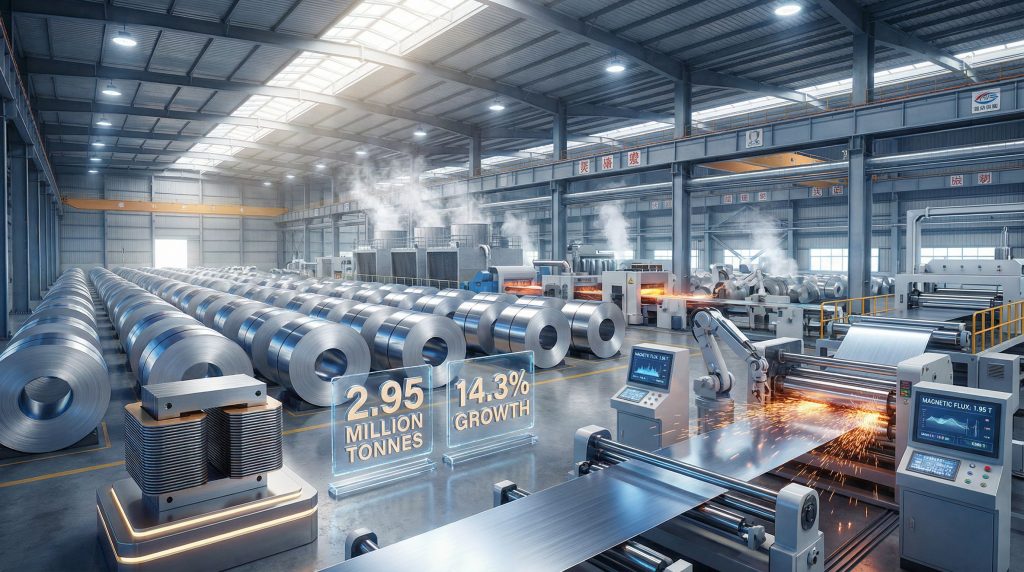
China's GOES production reached 3.37 million tonnes in 2025, representing a 14.3% increase from 2.95 million tonnes in 2024, according to the Chinese Society for Metals. This growth trajectory substantially exceeds typical steel industry expansion rates, indicating market share gains within the broader electrical steel category and successful substitution of lower-specification materials.
Export volume expansion reached 757,717 tonnes in 2025, compared to 642,077 tonnes in 2024, representing an 18% year-over-year increase. This accelerating export growth indicates expanding international recognition of Chinese GOES quality improvements and cost competitiveness relative to established Japanese and European suppliers.
| Year | Production Volume | Growth Rate | Export Volume | Domestic Consumption |
|---|---|---|---|---|
| 2024 | 2.95 million tonnes | – | 642,077 tonnes | 2.31 million tonnes |
| 2025 | 3.37 million tonnes | +14.3% | 757,717 tonnes | 2.61 million tonnes |
Domestic consumption increased from 2.31 million tonnes in 2024 to approximately 2.61 million tonnes in 2025, representing 12.9% growth that slightly trails total production expansion. This pattern suggests export market penetration is accelerating as Chinese producers expand international market share through competitive pricing and improved technical capabilities.
Global market position reflects China's dominant production role, representing approximately 45% of global GOES output. This market share creates significant pricing influence across international markets, establishing China as a price setter rather than price taker in global transactions.
Quality Grade Distribution and Pricing Tiers
Premium grades featuring ultra-low loss characteristics command significant pricing premiums over standard commercial specifications. These materials typically achieve core loss values below 0.8 watts per kilogram, requiring sophisticated manufacturing processes that justify price premiums of 15-25% above standard grades.
Standard commercial grades represent the largest volume segment, providing reliable magnetic properties suitable for typical power transmission applications. These materials balance performance requirements with cost considerations, establishing baseline pricing for commodity-grade GOES transactions.
Secondary quality materials offer cost-effective alternatives for applications with relaxed magnetic performance requirements. These grades typically feature slightly higher core loss characteristics or dimensional variations that remain acceptable for many industrial applications while providing 10-15% cost savings compared to prime materials.
Import substitution effects have become increasingly significant as Chinese mills achieve technical competence matching established Japanese and European suppliers. This development reduces reliance on high-priced imports while establishing competitive reference pricing based on lower-cost Chinese production capabilities.
Which Factors Influence Spot Market Pricing Mechanisms?
Spot market operations in China grain oriented electrical steel reflect sophisticated trading mechanisms that balance accessibility, liquidity, and transaction efficiency requirements across diverse market participants. However, these mechanisms remain sensitive to global economic conditions and trade war impact on international steel markets.
Transaction Volume Requirements and Market Access
Minimum order quantities of 10 tonnes establish accessible entry levels for mid-sized transformer manufacturers while enabling volume aggregation for larger industrial buyers. This threshold significantly influences market accessibility by allowing smaller participants to engage in spot market pricing while maintaining economic transaction sizes for distributors and mills.
Spot market liquidity operates alongside long-term contract relationships, with approximately 20-30% of total transactions conducted through spot mechanisms. The balance between spot and contract pricing reflects buyers' needs for supply security versus pricing flexibility, with smaller manufacturers typically relying more heavily on spot purchases.
Prompt payment terms requiring cash-on-delivery create transaction efficiency while favouring buyers with substantial working capital resources. This payment structure influences participation patterns, with larger industrial buyers maintaining advantages over smaller manufacturers requiring extended payment terms.
Ex-warehouse pricing structure eliminates mill-direct transportation variables while providing standardised reference points for contract negotiations. The Shanghai warehouse location serves multiple regional markets through established logistics networks, supporting price transparency across Eastern China's industrial corridors.
Supply Chain Cost Components
Raw material input costs centre on silicon steel substrate pricing, which typically represents 60-70% of total GOES manufacturing expenses. Substrate quality directly influences final product magnetic properties, creating tight correlations between input material specifications and finished goods pricing.
Energy-intensive processing requirements encompass multiple heating and cooling cycles necessary for grain orientation development. These processes consume substantial electricity and natural gas forecast, making GOES production sensitive to regional energy cost variations and environmental compliance requirements.
Specialised coating application expenses include organic and inorganic surface treatments that provide insulation properties and corrosion resistance. The coating processes require precise application parameters and curing temperatures that add complexity and cost to the manufacturing sequence.
Quality testing and certification overhead encompasses magnetic property verification, dimensional inspection, and surface quality assessment. These quality assurance procedures ensure specification compliance but add operational costs that influence final delivered pricing.
How Does China's GOES Market Compare Globally?
China's position in global grain-oriented electrical steel markets reflects both competitive advantages and ongoing technical development relative to established international suppliers. Consequently, these developments occur alongside broader considerations about tariff market impact on international steel trade relationships.
International Pricing Benchmarks
Japanese premium grade suppliers including Nippon Steel and JFE maintain pricing premiums of 20-40% above Chinese equivalents for ultra-low loss specifications. These premiums reflect superior magnetic properties, dimensional consistency, and established quality reputations in demanding applications such as high-efficiency power transformers.
European specialty steel producers focus on niche applications requiring exceptional magnetic uniformity and custom specifications. Their pricing strategies emphasise technical service and application engineering support, commanding premiums through value-added services rather than commodity-based competition.
South Korean technological advancement has positioned suppliers as intermediate alternatives between Chinese cost competitiveness and Japanese premium positioning. Korean producers achieve magnetic performance approaching Japanese standards while maintaining price points 10-15% below premium suppliers.
According to the Asian Metal Shanghai Electrical Steel Price Index, Chinese GOES pricing has demonstrated increasing stability relative to international benchmarks over the past 24 months.
Key Insight: China's GOES production represents approximately 45% of global output, creating significant pricing influence across international markets while driving industry-wide cost reductions through manufacturing efficiency improvements.
Competitive Positioning Analysis
Domestic Chinese mill consolidation has created larger production entities capable of substantial capital investment in advanced manufacturing technology. This consolidation trend enables Chinese producers to achieve economies of scale while improving technical capabilities through equipment modernisation and process optimisation.
Technology licensing arrangements with established international suppliers have accelerated Chinese technical development, enabling rapid advancement in magnetic property optimisation and surface treatment capabilities. These partnerships reduce development timelines while improving product consistency.
Quality certification achievement by major Chinese producers has enabled participation in international markets previously dominated by Japanese and European suppliers. Certifications from recognised testing laboratories provide credibility for export market penetration and premium pricing opportunities.
What Market Forces Drive Future Pricing Trends?
Future pricing dynamics for China grain oriented electrical steel will reflect the interplay of technological advancement, regulatory requirements, and evolving application demands across traditional and emerging market segments. Moreover, these trends will influence how China grain oriented electrical steel pricing adapts to changing global conditions.
Regulatory Environment Impact
Energy efficiency standards continue tightening across global markets, creating sustained demand for premium GOES grades that enable transformer efficiency improvements. These regulatory trends support pricing strength for ultra-low loss materials while potentially reducing demand for standard commercial grades.
Environmental compliance costs in manufacturing encompass emissions controls, waste treatment, and energy efficiency improvements that add operational expenses. These regulatory requirements favour larger producers capable of substantial environmental investment while creating barriers for smaller regional mills.
Export policy changes affecting domestic material availability could influence pricing relationships between domestic and international markets. Potential export restrictions during supply shortages would strengthen domestic pricing while reducing competitive pressure from international suppliers.
Quality certification requirements evolution toward more stringent magnetic property specifications could create additional compliance costs while supporting price premiums for materials exceeding standard requirements.
Technology Development Influence
Advanced grain orientation techniques utilising improved processing parameters and magnetic field application enable superior magnetic properties while potentially reducing manufacturing costs. These technological improvements could support pricing competitiveness while enhancing product performance characteristics.
Automated manufacturing improvements through digital process control and artificial intelligence applications enhance production consistency while reducing labour requirements. These efficiency gains enable cost reductions that support competitive pricing strategies without compromising quality standards.
New coating technologies enhance corrosion resistance and insulation properties while simplifying application processes. These developments reduce manufacturing complexity while potentially improving product performance, supporting value-based pricing strategies.
Digital quality control systems utilising advanced magnetic testing equipment enable real-time process optimisation and defect reduction. These technological improvements enhance yield rates while ensuring consistent magnetic properties across production batches.
The next major ASX story will hit our subscribers first
Which Investment Considerations Affect GOES Market Dynamics?
Investment requirements in grain-oriented electrical steel production create substantial barriers to entry while influencing competitive dynamics and pricing strategies across established market participants. Furthermore, current market analysis from the IMARC Group electrical steel pricing report indicates sustained capital investment requirements across the sector.
Capital Expenditure Requirements
Specialised rolling mill equipment investments typically require $200-400 million for complete production lines capable of producing premium GOES grades. These substantial capital requirements create barriers to entry while ensuring established producers maintain competitive advantages through economies of scale.
Annealing furnace technology upgrades enable improved grain orientation development and magnetic property optimisation. The specialised furnace systems require precise temperature control and atmospheric management capabilities that represent significant ongoing operational expenses.
Quality control laboratory establishment costs encompass magnetic testing equipment, dimensional measurement systems, and surface quality assessment capabilities. These facilities require substantial initial investment while generating ongoing operational expenses for personnel and equipment maintenance.
Workforce training and certification expenses reflect the specialised technical knowledge required for GOES production optimisation. The complex manufacturing processes demand skilled operators capable of managing sophisticated equipment and quality control procedures.
Market Consolidation Trends
Major steel producer expansion strategies focus on vertical integration and production capacity increases to achieve economies of scale. These expansion initiatives often involve technology licensing from established international suppliers to accelerate technical capability development.
Smaller mill acquisition patterns enable larger producers to consolidate market share while eliminating excess capacity. These acquisitions typically involve technology upgrades and workforce integration that temporarily reduce production efficiency while improving long-term competitiveness.
Technology licensing arrangements provide access to proven manufacturing processes while reducing development risks and timelines. These partnerships enable rapid technical advancement but require substantial licensing fees and ongoing royalty payments that influence cost structures.
Joint venture formation in specialised grades enables risk sharing for advanced product development while combining technical expertise from multiple partners. These arrangements facilitate entry into premium market segments while spreading substantial development costs across multiple participants.
How Do End-User Industries Influence Pricing Strategies?
End-user industries create distinct demand patterns and pricing requirements that shape China grain oriented electrical steel market dynamics through varying technical specifications and procurement approaches. In addition, these industry demands directly affect overall pricing stability and market development trajectories.
Power Generation Sector Requirements
Utility company procurement cycles typically involve annual contracting processes with volume commitments ranging from hundreds to thousands of tonnes. These substantial commitments enable negotiated pricing that often provides discounts from spot market levels while ensuring supply security for critical infrastructure projects.
Renewable energy project specifications increasingly demand premium GOES grades optimised for variable load conditions and frequent transients inherent in wind and solar power generation. These technical requirements support pricing premiums for specialised materials while creating sustained demand growth.
Grid upgrade programmes drive consistent demand patterns that enable long-term planning and capacity investment by GOES producers. The predictable nature of infrastructure replacement cycles provides market stability while supporting volume-based pricing negotiations.
International power infrastructure export opportunities create demand for GOES materials meeting diverse national standards and certification requirements. These export projects often require premium grades with exceptional quality documentation, supporting higher pricing levels.
Industrial Manufacturing Applications
Motor manufacturing quality requirements vary significantly across application segments, from basic industrial motors utilising standard commercial grades to precision servo motors requiring premium specifications. This application diversity creates multiple pricing tiers reflecting varying performance requirements.
Appliance industry cost-performance balance emphasises efficient transformer designs utilising standard GOES grades that provide reliable magnetic properties at competitive pricing. The high-volume nature of appliance applications creates substantial demand for commercial-grade materials while supporting economies of scale in production.
Automotive industry lightweight transformer needs drive demand for thin-gauge GOES materials optimised for compact packaging and minimal weight. These specialised applications often require custom specifications that command pricing premiums above standard commercial grades.
Electronics sector miniaturisation demands create requirements for precision-cut GOES materials with exceptional dimensional consistency and surface quality. These niche applications represent smaller volumes but support significant pricing premiums through specialised processing and quality requirements.
What Risk Factors Impact GOES Pricing Stability?
Multiple risk factors create pricing volatility in China grain oriented electrical steel markets, requiring sophisticated risk management approaches by both producers and consumers. Consequently, understanding these risks becomes essential for maintaining stable China grain oriented electrical steel pricing strategies.
Raw Material Cost Volatility
Silicon steel substrate price fluctuations directly impact GOES manufacturing costs, with substrate typically representing 60-70% of total production expenses. Volatile iron ore and metallurgical coal pricing creates uncertainty in input costs that influences final pricing strategies and contract negotiations.
Energy cost variations in production regions affect the substantial electricity and natural gas consumption required for GOES manufacturing processes. Regional energy pricing differences can create competitive advantages or disadvantages for producers in different geographic locations.
Specialty coating material availability encompasses organic and inorganic compounds used for surface treatment applications. Supply disruptions or price volatility in these specialised chemicals can impact production costs and delivery schedules, influencing overall market dynamics.
Transportation fuel cost impacts affect both raw material delivery expenses and finished goods distribution costs. Fluctuating logistics expenses create additional uncertainty in delivered pricing, particularly for customers located distant from production centres.
Market Demand Fluctuation Scenarios
Economic cycle impact on infrastructure investment creates cyclical demand patterns that influence capacity utilisation and pricing strategies. Economic downturns typically reduce power grid expansion while affecting industrial equipment demand, creating excess supply conditions that pressure pricing levels.
Technology transition effects on traditional applications could reduce demand for standard GOES grades while increasing requirements for specialised materials. The evolution toward smart grid technologies and renewable energy integration creates uncertainty about future application mix and specification requirements.
International trade policy changes including tariffs, export restrictions, or currency controls could substantially alter competitive dynamics and pricing relationships between domestic and international markets. These policy risks require ongoing monitoring and contingency planning by market participants.
Currency exchange rate influences affect export competitiveness and import costs, creating additional volatility in international market pricing. Fluctuating exchange rates can rapidly alter competitive positioning between Chinese and international suppliers.
The information presented represents market analysis based on publicly available industry data and should not be considered investment advice. Readers should consult qualified professionals before making investment decisions related to electrical steel markets or associated industries.
Looking to Capitalise on China's Booming Electrical Steel Market?
Discovery Alert's proprietary Discovery IQ model delivers real-time alerts on significant ASX mining and materials discoveries, instantly empowering subscribers to identify actionable opportunities as commodity markets like steel evolve. Explore how major mineral discoveries can generate exceptional returns and begin your 14-day free trial today to position yourself ahead of the market.