July 16, 2026
The Geography of Vulnerability: Why Energy Chokepoints Still Define Geopolitical Power
Every decade or so, a single waterway reminds the world just how fragile the global energy system remains. The Strait of Hormuz, a narrow passage barely 33 kilometres wide at its tightest point, has performed that role repeatedly throughout modern history. What makes the current moment different is not the crisis itself, but the degree to which one nation has spent twenty years quietly engineering its way out of maximum exposure.
Understanding how China shielding itself from Hormuz oil shock has been achieved requires looking well beyond the headlines. The architecture that allowed Beijing to absorb a seismic supply disruption without rationing fuel or triggering domestic economic chaos was not assembled in response to the February 2026 outbreak of hostilities. It was built before the first strike, layer by layer, across two decades of deliberate strategic investment.
When big ASX news breaks, our subscribers know first
Why the Strait Remains the World's Most Consequential Energy Corridor
Approximately 17 to 21 million barrels of crude oil and petroleum products transit the Strait of Hormuz every single day, representing roughly one-fifth of all seaborne oil traded globally. The waterway serves as the primary export channel for Saudi Arabia, Iraq, the United Arab Emirates, Kuwait, and Iran. There is no alternative maritime route capable of handling equivalent volumes, and overland bypass pipelines from the Gulf region remain limited in capacity.
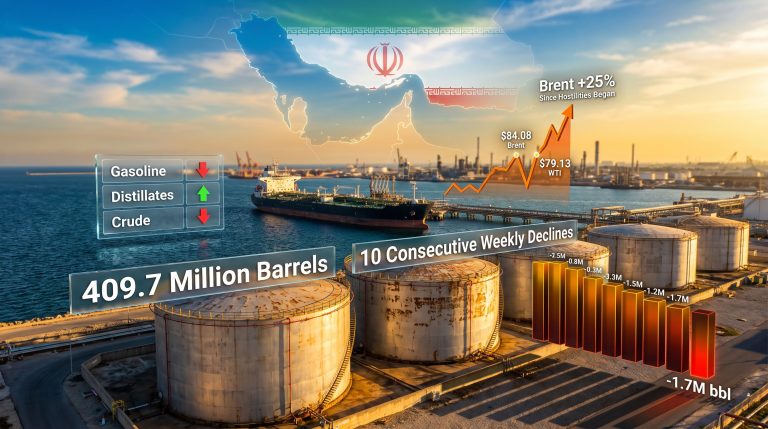
When the June 2026 ceasefire between the United States and Iran collapsed, the market needed no reminder of what was at stake. Brent crude climbed back above $85 per barrel within days, recovering from the mid-$70s that had prevailed during the brief truce. The International Energy Agency had already warned that a prolonged disruption risked unwinding its projected global oil surplus for the year, and that warning suddenly looked prescient again.
How Does This Crisis Differ from Previous Hormuz Tensions?
What distinguishes the 2026 episode from earlier Hormuz tension cycles — including the 2011 to 2012 period and the 2019 tanker incidents — is the operational severity involved. Active tanker strikes, a reimposed U.S. naval blockade, and Iranian retaliatory targeting of vessels created a qualitatively different risk environment. Oil prices surged more than 12% in the immediate aftermath of the ceasefire breakdown, reflecting a genuine reassessment of transit security across the Gulf.
Furthermore, the oil market disruption of this scale has compounded existing pressures already building from the US-China trade war, adding another layer of complexity to Beijing's strategic calculations.
Mapping China's Hormuz Exposure: Less Than Assumed
The conventional assumption that a Hormuz shutdown would devastate China rests on an outdated map of its import supply chains. China is the world's largest crude oil importer, historically drawing between 10 and 12 million barrels per day from global markets. At peak pre-crisis levels in early 2026, that figure reached approximately 11.99 million barrels per day.
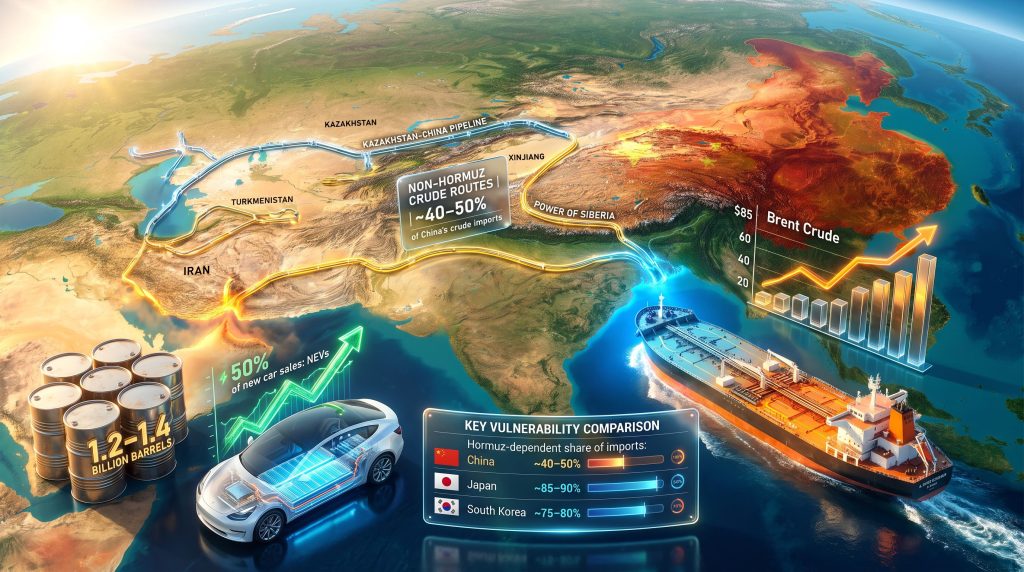
Yet by 2026, the Hormuz-dependent share of China's seaborne crude imports had fallen to somewhere between 40% and 50% of total supply — a figure that contrasts sharply with the near-total maritime dependency that Japan and South Korea face. The table below illustrates the divergence in structural exposure across the three largest Asian importers:
| Metric | China | Japan | South Korea |
|---|---|---|---|
| Hormuz-dependent share of imports | ~40-50% | ~85-90% | ~75-80% |
| Overland pipeline supply available | Yes (significant) | No | No |
| Strategic reserve days of cover | ~120-130 days | ~150+ days (IEA mandated) | ~90-100 days |
| EV fleet as % of new car sales | ~50% | ~5% | ~10% |
Japan's trade ministry explicitly characterised the strait as effectively off-limits as hostilities reignited in July 2026 — a declaration that reflects a vulnerability profile fundamentally different from Beijing's. Pakistan, meanwhile, moved into emergency LNG procurement mode as Hormuz tanker traffic stalled, a crisis-mode response that stands in sharp contrast to China's managed drawdown from pre-positioned reserves.
This structural divergence is not accidental. It is the product of five distinct defensive layers that China assembled well before the first shots were fired.
Layer One: The Billion-Barrel Buffer
In the twelve to eighteen months preceding the February 2026 outbreak of hostilities, Chinese state refiners and independent operators systematically acquired crude at a scale that goes well beyond normal commercial inventory management. They exploited deeply discounted sanctioned oil from Russia and Iran that Western-aligned buyers were unwilling or unable to purchase, accumulating what analysts estimated to be between 1.2 billion and 1.4 billion barrels of combined strategic and commercial reserves — equivalent to roughly 120 to 130 days of net import cover.
When conflict arrived, the logic of that pre-positioning became immediately apparent. Chinese crude imports fell from 11.39 million barrels per day in February 2026 to just 6.36 million barrels per day by May — a collapse of more than 44%. Refineries maintained near-normal operating rates throughout. The IEA estimated China drew down approximately 41 million barrels from inventories in June 2026 alone, absorbed entirely from pre-built stocks rather than through fuel rationing.
Rystad Energy analysts characterised the pre-built inventory position as having placed a stabilising floor under global crude prices, functioning as a genuine macro shock absorber during a period when alternative demand centres were scrambling to secure supply.
The limits of this buffer deserve equal attention. Strategic reserves are a finite resource. Drawdowns do not self-replenish, and rebuilding a billion-barrel cushion requires sustained periods of below-capacity refinery utilisation, favourable pricing conditions, and geopolitical stability. Goldman Sachs analysts went further, estimating that as much as 10% of China's import collapse may represent permanent demand destruction rather than temporary substitution — a distinction with profound long-run implications.
J.P. Morgan analysts began raising the same question in mid-2026, framing the oil market as undergoing something resembling a systemic reset rather than a temporary contraction, and questioning whether China's demand trajectory had fundamentally recalibrated rather than simply paused.
Layer Two: The Overland Pipeline Network
China's pipeline diversification strategy predates the current crisis by approximately two decades, reflecting a long-standing doctrine of reducing exposure to maritime energy transit routes. Rush Doshi, director of the China Strategy Initiative at the Council on Foreign Relations, has noted that Beijing has spent the past two decades deliberately constructing overland supply alternatives to reduce its dependence on seaborne oil routes.
The network draws crude and gas from multiple directions:
- Russia: Power of Siberia pipeline delivering natural gas, with crude moving via both pipeline and rail
- Kazakhstan: Kazakhstan-China oil pipeline providing Central Asian crude
- Turkmenistan: Central Asia-China gas pipeline, one of the world's longest
- Myanmar: Myanmar-China oil and gas pipeline offering a non-Malacca maritime bypass
Pipeline-sourced volumes offer a qualitatively different security profile from seaborne supply. They cannot be intercepted by naval forces, are not subject to war-risk insurance surcharges that have spiked dramatically during the Hormuz crisis, and are entirely indifferent to whether contested waters are safe for tanker transit. During the 2026 crisis, this stable terrestrial baseline insulated Chinese refiners from the full magnitude of Gulf shipping disruptions.
According to analysis of China's Strait of Hormuz oil security playbook by the Baker Institute, this overland infrastructure advantage has long been central to Beijing's energy security doctrine. OCBC analysts argued in March 2026 that this infrastructure advantage would leave China materially less exposed than regional peers to a prolonged strait shutdown — a thesis that received real-world validation as the ceasefire collapsed in July.
The ceiling on this strategy is real, however. Existing overland pipelines are operating near capacity. Russia lacks sufficient tanker tonnage to compensate by sea for any shortfall that pipelines cannot cover. The terrestrial network reduces vulnerability without eliminating it, functioning as a critical partial hedge rather than a complete substitute.
Layer Three: Electrified Transport at National Scale
Perhaps the least appreciated dimension of China's Hormuz insulation is the structural demand erosion that electrification of the transport sector has already delivered. The numbers involved are large enough to materially alter the national crude import calculus.
Approximately 50% of all new passenger vehicles sold in China in 2026 are new energy vehicles — a share that continues to accelerate. The country's total EV fleet is now comparable in aggregate size to the rest of the world's combined electric vehicle stock. Within the taxi and ride-hailing segment, the transition is even more advanced: roughly half of China's 1.3 million-strong taxi fleet operates on battery power, and in the largest metropolitan areas that share approaches 100%.
Didi's non-fossil fuel fleet reached 8 million vehicles in 2025, covering approximately 75% of total platform mileage. The fare dynamics amplify the fuel displacement effect in ways that operate largely independently of oil prices. A structural oversupply of ride-hailing drivers has compressed fares to the point where urban commuters frequently find ride-hailing cheaper than fuelling and parking a privately owned vehicle.
What Do the Transport Figures Actually Reveal?
The result, as Daizong Liu of the Institute for Transportation and Development Policy has observed, is that aggregate travel demand in China continues to expand, but the energy vector carrying that demand is migrating from liquid fuels to electricity. China recorded 3.05 billion taxi and ride-share trips in May 2026 — a year-on-year increase of 6% — whilst simultaneously consuming 10% less gasoline and 14% less diesel than in the same month of 2025. Road freight volumes rose 2% over the same period.
This combination — rising mobility, rising freight, falling fuel consumption — is the statistical signature of structural demand displacement rather than economic contraction.
The next major ASX story will hit our subscribers first
Layer Four: Monopsony Leverage Over Global Suppliers
When the world's single largest crude importer can afford to walk away from the market and force competing exporters into a price war for its attention, the conventional oil market power dynamic inverts. That is precisely what occurred during the 2026 crisis.
Iran exports approximately 90% of its crude to China, making Beijing the singular destination for sanctioned Iranian barrels. During the June ceasefire, Chinese buyers declined to compete aggressively for Iranian cargoes even as those cargoes accumulated in floating storage. Iranian imports into China were projected to fall to approximately 556,000 barrels per day in July 2026 — the lowest level since early 2023 — with an estimated 30 to 34.5 million barrels of Iranian crude sitting in floating storage with no committed buyer.
J.P. Morgan's Natasha Kaneva characterised the dynamic in a July 2026 client note, observing that barrels transiting Hormuz were increasingly finding only one viable destination whilst that destination was actively choosing not to buy.
When Iranian volumes became logistically and politically inconvenient, independent Chinese refiners pivoted to Gulf alternatives on their own terms. Shenghong Petrochemical purchased approximately 12 million barrels of Iraqi, Emirati, and Saudi crude for July 2026 delivery after Gulf producers discounted their official selling prices sufficiently to make the switch commercially attractive. China had effectively forced a price competition among its own suppliers.
This monopsony dynamic is amplified precisely during supply disruptions, when alternative buyers are scarce and Chinese demand becomes the marginal determinant of global clearing prices. Saudi Arabia's experience during the period illustrates the consequence: China reduced Saudi crude orders as Hormuz risks intensified, obliging Riyadh to respond with pricing adjustments to retain market share.
Layer Five: The Long-Duration Energy Transition Hedge
The structural layers described above all operate within a larger directional shift in China's energy economy that the Hormuz crisis did not create but may have accelerated. Beijing's official policy target calls for non-fossil fuels to reach 25% of total primary energy consumption by 2030, up from approximately 22% in 2025.
In addition, the growing critical minerals demand underpinning China's clean technology supply chains has reinforced this energy transition push, providing both domestic and export-facing momentum. Clean technology exports — including solar panels, battery systems, and electric vehicles — reached a record high in March 2026, coinciding with the peak of the initial Hormuz disruption.
China's coal strategy of maintaining coal capacity as a backup provides an ultimate industrial backstop through coal-to-liquids and petrochemical production pathways, functioning as energy security insurance that operates entirely independently of global crude markets. The country's dual-track refining structure — combining state-owned refiners with the large cluster of independent teapot refineries concentrated in Shandong province — provides additional sourcing flexibility.
Teapot refiners have historically sourced discounted crude from Iran, Russia, and Venezuela, operating a parallel supply channel that gives China the ability to pivot between supply sources with relative commercial agility. J.P. Morgan analysts noted in July 2026 that the conflict may have functionally advanced behavioural and structural changes in Chinese energy consumption that were already embedded in the system's trajectory.
What China's Resilience Means for the Oil Market's Future
The strategic implications of China shielding itself from Hormuz oil shock extend well beyond the current episode. If Goldman Sachs analysts are correct that roughly 10% of China's import collapse represents permanent structural demand destruction, then the global oil market's single largest demand growth engine has entered a phase of deceleration that will not reverse when the strait reopens.
Furthermore, the oil price shock dynamics playing out in 2026 are forcing a wider reassessment of how dependent any single nation should remain on maritime energy chokepoints. The following summary table captures the architecture of China's five-layer insulation strategy and its inherent limitations:
| Strategic Layer | Mechanism | Current Scale | Key Limitation |
|---|---|---|---|
| Strategic stockpiling | Pre-positioned reserves absorb import shortfalls | 1.2-1.4 billion barrels (~120-130 days cover) | Non-renewable; drawdowns require time and stable conditions to rebuild |
| Overland pipelines | Bypass maritime chokepoints entirely | ~40-50% of imports via non-Hormuz routes | Operating near capacity; cannot fully replace sea routes |
| EV and transport electrification | Reduces structural liquid fuel demand | ~50% of new car sales; ~50% of taxi fleet electric | Adoption rate-dependent; large legacy petrol fleet persists |
| Supplier substitution leverage | Monopsony power forces price competition | No single supplier exceeds 20% of import mix | Requires active management; political sensitivities with key partners |
| Domestic energy transition | Renewables, coal-to-liquids, and efficiency reduce import dependency | Non-fossil target: 25% of energy by 2030 | Long-run structural shift; near-term coal dependency persists |
As Reuters graphics analysis of the Iran crisis and China's oil positioning illustrates, the structural gap between China and its regional peers has widened considerably over the past decade. For Japan and South Korea, the Hormuz crisis is a supply emergency. For China, it has functioned as a stress test of a system deliberately engineered to absorb exactly this kind of shock. That divergence will shape not only how the current disruption resolves, but how the next one is priced.
China shielding itself from Hormuz oil shock is not merely a story about one nation's energy security — it is a lens through which the entire future architecture of global oil demand must be reconsidered.
Disclaimer: This article is intended for informational and educational purposes only. It does not constitute financial, investment, or trading advice. Forecasts, analyst estimates, and price projections referenced throughout reflect views expressed by third-party analysts and institutions at the time of publication and are subject to change. Readers should conduct their own due diligence before making any investment decisions.
Want to Stay Ahead of the Next Major Resource Shift?
As energy geopolitics reshape commodity markets and mineral supply chains, Discovery Alert's proprietary Discovery IQ model instantly identifies significant ASX mineral discoveries — translating complex data across 30+ commodities into clear, actionable opportunities for both traders and long-term investors. Explore how historic mineral discoveries have generated substantial returns and begin your 14-day free trial today to position yourself ahead of the market.