July 16, 2026
The Architecture of Restriction: How the EU's New Steel Import Quota System Is Redrawing Global Trade Maps
When trade policy shifts from reactive to structural, the consequences ripple far beyond the borders of the regulating bloc. For decades, the global steel industry has operated within a patchwork of tariffs, safeguards, and bilateral agreements that, while imperfect, offered exporters some degree of predictability. The EU steel import quotas mark a qualitatively different kind of intervention, one that demands exporters, traders, and downstream buyers fundamentally reassess their market strategies rather than simply waiting for conditions to normalise.
When big ASX news breaks, our subscribers know first
From Temporary Shield to Permanent Infrastructure: Understanding the Policy Shift
The EU steel safeguard mechanism, first activated in 2018 in response to global overcapacity pressures and the knock-on effects of US steel tariffs, was always framed as a temporary instrument. Its purpose was to prevent trade diversion from flooding European markets as exporters sought alternative destinations after the US tightened its own import restrictions.
That transitional logic expired on 30 June 2026. Regulation (EU) 2026/1384, which came into force on 1 July 2026, does not extend the safeguard — it replaces it with a purpose-built permanent framework designed to run through 2031. This is not an incremental adjustment. It represents a categorical change in how the EU positions trade defence as a tool of industrial strategy.
The numerical differences alone illustrate the scale of the transformation:
| Parameter | Previous Safeguard (2018–2026) | New Regime (2026–2031) |
|---|---|---|
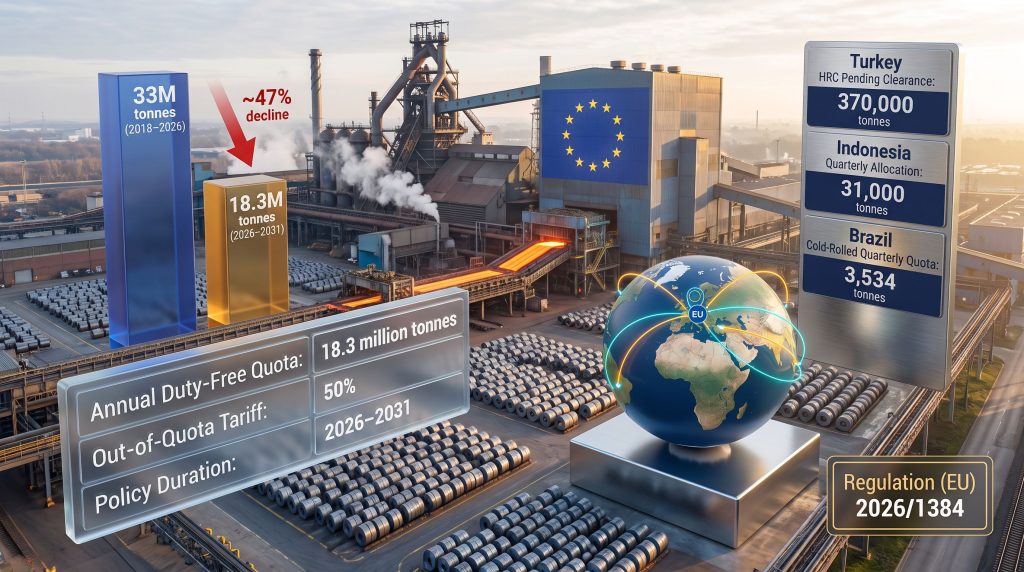
| Annual Duty-Free Quota | ~33 million tonnes | 18.3 million tonnes |
| Reduction in Free Access | — | ~47% decline |
| Out-of-Quota Tariff | 25% | 50% |
| Product Categories Covered | 28 | 30 |
| Policy Duration | Temporary | 5 years (to 2031) |
| EEA Exemptions | Yes | Yes (maintained) |
The near-halving of duty-free import volumes, combined with a doubling of the out-of-quota tariff rate, signals that the EU intends to use trade policy as an active industrial reindustrialisation instrument, not merely a defensive buffer against import surges.
Key Insight: One of the least-discussed aspects of the transition is that the technical details of the new quota allocations were only published on 30 June 2026, the final day before implementation. This gave market participants zero lead time to adjust contracts, reroute cargoes, or renegotiate terms. The resulting dislocation was not incidental; it was structurally embedded in the announcement timeline.
How EU Steel Import Quotas Are Structured Under the New Framework
The 50/50 Quota Split: FTA Partners vs. the Rest of the World
Of the 18.3 million tonne annual duty-free ceiling, exactly 9.15 million tonnes is ring-fenced exclusively for countries that hold Free Trade Agreements with the EU. Qualifying partners include the UK, India, Switzerland, and other nations with established bilateral trade arrangements. The remaining 9.15 million tonnes constitutes a residual allocation accessible to all WTO members, including non-FTA exporters such as Indonesia, Vietnam, Brazil, and others.
This architecture creates a two-tier access system that rewards pre-existing diplomatic and trade relationships. Furthermore, for exporters that lack FTA status, access to the EU market is structurally constrained regardless of price competitiveness or product quality. According to EU customs factsheet details, this framework represents a fundamental restructuring of market access conditions for steel exporters globally.
Country-Specific Allocations: The 5% Threshold Rule
Nations that demonstrated an historical import share of 5% or greater during the 2022–2024 reference period receive individually assigned country-specific quotas. This threshold-based methodology effectively rewards established trade relationships while penalising emerging exporters whose market presence grew most rapidly in 2024 and 2025, precisely the period excluded from the reference window.
Countries falling below the 5% threshold are directed into the residual quota pool, where allocations are dispensed on a first-come, first-served basis across quarterly windows. This creates a competitive scramble for quota access that disadvantages exporters with longer transit times or less sophisticated logistics infrastructure.
The Melt and Pour Rule: Closing the Origin Arbitrage Loophole
Perhaps the most technically consequential provision in the new framework is the melt and pour origin requirement. Under this rule, a steel product's country of origin is determined by where it was first melted and cast, not where it was subsequently processed, rolled, coated, or shipped.
This provision directly targets a well-established circumvention practice: routing semi-finished steel through third-country processing hubs in Southeast Asia, North Africa, or the Middle East to claim preferential origin status for customs purposes. By anchoring origin at the point of primary steelmaking, the EU eliminates processing-based origin arbitrage as a viable commercial strategy.
The practical implications extend throughout global supply chains:
- Steel produced in China but processed in Vietnam cannot claim Vietnamese origin under the new rules
- Semi-finished slabs converted to hot-rolled coil in third countries retain the origin of the slab's first cast, not the rolling mill's location
- Documentation requirements for customs clearance will become substantially more complex, requiring traceability back to the original steelmaking facility
Quarterly Administration and the Carry-Forward Constraint
Quotas are administered on a quarterly basis, with each quarter representing a discrete allocation window. During the initial 2026–2027 period, unused quarterly volumes may be carried forward to the following quarter within the same annual cycle. However, this carry-over mechanism provides only limited commercial flexibility. Importers holding annual supply contracts face a fundamental mismatch between their contractual commitments and the quarterly availability of quota entitlements.
When Quota Exhaustion Becomes a Commercial Crisis: The Turkish HRC Case
The 50% Out-of-Quota Tariff as a Hard Commercial Ceiling
Steel imports exceeding allocated quotas face an additional 50% ad valorem tariff on top of existing Most Favoured Nation duties. At prevailing hot-rolled coil prices, this renders the vast majority of over-quota imports commercially unviable without extraordinary price concessions from the exporting party. The doubling of this rate from the previous 25% transforms what was once a manageable cost premium into a binary decision point: secure quota access or redirect the cargo.
Turkey's HRC Oversubscription: A Case Study in Structural Mismatch
No single market participant illustrates the severity of the new framework's disruption more acutely than Turkey. As of 14 July 2026, EU customs data showed over 370,000 tonnes of Turkish hot-rolled coil pending customs clearance, a figure representing more than double the actual quarterly quota of approximately 160,000 tonnes.
A significant contributing factor is a reclassification of certain Turkish plate products. Higher-thickness flat products that were previously cleared under separate plate quota classifications have been brought within the scope of the HRC quota category. This reclassification compresses quota availability further and has concentrated the disruption at the Port of Antwerp, historically the primary EU entry point for Turkish flat steel products.
The commercial consequence for importers holding pre-cleared or in-transit Turkish material is stark:
- Paying the 50% over-quota tariff renders the cargo economically unviable at prevailing HRC prices
- Delaying customs clearance to the following quarter defers, rather than resolves, the cost exposure, and requires port warehouse capacity that is already saturated
- Selling cargoes to non-EU customers requires finding buyers willing to absorb redirected volumes at compressed margins
How Traders Are Responding: Rerouting, Cancellation, and Renegotiation
Cargo Rerouting as the Primary Short-Term Response
The most immediate market response to the new EU steel import quota regime has been the physical rerouting of cargoes originally destined for EU ports. Indonesian and Thai hot-rolled coil shipments have been among the most actively redirected volumes, with North Africa emerging as the primary alternative destination given geographic proximity and relatively open import conditions in the region.
Indonesia's situation is particularly illustrative of the structural mismatch created by the new framework:
| Metric | Figure |
|---|---|
| Indonesian HRC imports to EU (April 2026 alone) | 200,000+ tonnes |
| Indonesian country-specific quarterly quota | 31,000 tonnes |
| Implied reduction in monthly access | ~84% |
Indonesia had established itself as a significant EU flat product supplier over the preceding year. However, the new framework's country quota, calculated from 2022–2024 historical data, captures none of that recent growth, effectively excluding Indonesia from meaningful EU market participation under standard commercial conditions.
Brazil's Micro-Quota Problem: When a Single Vessel Exceeds an Entire Quarter
Brazil's situation in cold-rolled coil illustrates an extreme version of the same dynamic. Brazil's quarterly cold-rolled coil allocation within the EU stands at approximately 3,534 tonnes, a volume so limited that a single standard vessel cargo can exhaust the entire quarterly entitlement in a single customs clearance event.
At least one Brazilian cold-rolled coil shipment has been redirected to the UK market, which operates its own independent steel safeguard framework and applies no EU quota restrictions as a result of post-Brexit regulatory divergence. This dynamic is already making the UK an overflow destination for cargoes displaced from the EU — a trend that is likely to intensify as quota exhaustion becomes more systematic across product categories.
Contract Renegotiation and the Liability Transfer Problem
Traders holding supply contracts signed prior to the 30 June 2026 announcement face a legally and commercially difficult position. Contracts that specified EU delivery were written against an assumption of quota conditions that no longer exist. The absence of any lead time between the publication of technical quota details and their entry into force means that renegotiation is occurring under duress rather than through orderly commercial processes.
The primary renegotiation dynamic involves traders attempting to transfer a portion of over-quota tariff liability to downstream buyers — an outcome that buyers with their own margin pressures are naturally resistant to accepting. The feasibility of the delay-to-next-quarter strategy is constrained by two compounding factors:
- Port warehouse saturation: Key EU entry points, particularly Antwerp, are already operating at or near storage capacity for affected steel grades
- Forward quota uncertainty: The following quarter's quota may face equivalent or greater oversubscription, meaning deferral resolves nothing and adds storage costs and potential product deterioration risk, particularly for material stored uncovered outdoors over a three-month period
Downstream Effects: EU Mills Capitalise, but Structural Constraints Remain
Short-Term Demand Uplift for Domestic Producers
The displacement of imported steel from the EU market has generated immediate demand support for domestic EU steelmakers. EU mills moved quickly to capitalise on the reduced import competition, raising offer prices by approximately €50 per tonne within the first week following quota implementation. This pricing response reflects opportunistic positioning rather than any fundamental improvement in underlying consumption trends.
Why the Price Recovery May Have Limited Durability
Analytical Caution: Several structural conditions constrain the magnitude and longevity of any EU mill price recovery driven by import restriction alone.
- Seasonal demand weakness: The summer period is typically characterised by slowdowns in construction and industrial manufacturing activity across major EU economies
- Subdued macroeconomic conditions: Structural weakness in key EU industrial sectors, including automotive and construction, limits end-user appetite for restocking at elevated prices
- Adequate existing inventory: Steel-consuming industries entered the quota implementation period with sufficient stock levels, reducing urgency to replenish at higher prices
- Capacity utilisation gap: The EU's stated policy objective of lifting domestic steelmaker utilisation to 80% remains aspirational; achieving it requires genuine demand recovery, not simply import restriction
Furthermore, the green steel pricing dynamics add another layer of complexity, as mills pursuing low-carbon transition investments must balance short-term pricing opportunities against longer-term capital expenditure requirements.
The next major ASX story will hit our subscribers first
Comparative Frameworks: The EU Quota System in Global Context
EU vs. US Steel Trade Measures
| Dimension | EU 2026 Quota System | US Section 232 Tariffs |
|---|---|---|
| Mechanism | Volume-based quota + 50% over-quota tariff | Flat 25% tariff on all imports |
| Country Differentiation | Yes — FTA preference, country-specific allocations | Yes — country exemptions and product quotas |
| Origin Rules | Melt and pour requirement | Standard country of origin |
| Duration | 5 years (2026–2031) | Indefinite |
| Exemption Pathway | EEA countries fully exempt | Product exclusion process |
The EU framework is arguably more architecturally sophisticated than the US approach, using volume controls rather than flat tariffs to calibrate import access. However, the combination of volume caps and a prohibitive over-quota tariff achieves a similar practical outcome: making non-preferred imports commercially unviable beyond a defined ceiling. The broader consequences of tariffs and supply chains continue to reverberate across global manufacturing networks as a result.
Post-Brexit UK as a Safety Valve
The UK's independent steel safeguard framework, which operates entirely separately from EU quota administration, is emerging as an unintended relief valve for cargoes displaced from the EU. According to recent reporting on EU quota allocations, this dynamic is already visible in the redirection of Brazilian cold-rolled coil and will likely extend to other product categories and exporting nations as EU quota exhaustion becomes a recurring quarterly phenomenon rather than a one-time transition shock.
Long-Term Strategic Implications for Exporters and Supply Chains
Permanent Structural Disadvantage for Non-FTA Exporters
The five-year duration of the new framework through 2031 means that exporters without FTA status face a structural, not cyclical, disadvantage in EU market access. Price competitiveness alone cannot overcome a hard volume ceiling enforced by a 50% over-quota tariff. Nations in this position must evaluate market diversification strategies, investment in value-added processing within FTA-qualifying jurisdictions, or the longer-term pathway of pursuing bilateral FTA negotiations with the EU.
The EU steel action plan signals that this structural preference for domestic and FTA-partner production is unlikely to soften over the medium term, reinforcing the case for strategic market repositioning rather than passive adaptation.
Circumvention Risk and Enforcement Complexity
Despite the rigour of the melt and pour rule, enforcing steel origin requirements across multi-stage global supply chains presents genuine operational challenges for EU customs authorities. Third-country processing hubs in Southeast Asia and the Middle East will face heightened scrutiny, and traders should anticipate increased documentation requirements, potential customs investigations, and longer clearance timelines as the EU develops its enforcement capabilities under the new framework.
Consequently, the China steel market faces particular pressure, as Chinese producers that previously routed material through third-country processors will find this pathway substantially closed under the new origin rules.
Steel Trade as Industrial Policy
The explicit linkage between the new quota framework and broader EU industrial reindustrialisation objectives — including strategic autonomy goals and the European Green Deal — signals that import restriction is now a permanent feature of EU steel market architecture. The 2031 horizon aligns with EU industrial policy planning cycles and suggests that the framework will either be renewed or succeeded by an equally restrictive successor instrument. Exporters that treat the current framework as temporary do so at commercial risk.
Frequently Asked Questions: EU Steel Import Quotas 2026
What is the total annual duty-free steel import quota for the EU under the new framework?
The new regime caps annual duty-free steel imports at 18.3 million tonnes across 30 product categories, representing an approximately 47% reduction from the previous safeguard allocation of around 33 million tonnes.
What tariff applies to steel imports that exceed EU quotas?
Steel imports exceeding allocated quotas are subject to a 50% out-of-quota tariff, double the 25% rate applied under the prior safeguard.
Which countries are exempt from EU steel import quotas?
Iceland, Liechtenstein, and Norway — as European Economic Area members — are fully exempt from EU steel import quotas and the associated 50% out-of-quota tariff.
How are EU steel quotas split between FTA and non-FTA countries?
Exactly 50% of the total annual quota (9.15 million tonnes) is reserved for countries holding Free Trade Agreements with the EU. The remaining 50% is available to all WTO members on a residual first-come, first-served basis.
What is the melt and pour rule in EU steel trade?
The melt and pour rule requires that a steel product's country of origin be determined by where it was first melted and cast. This prevents circumvention through minimal processing or transshipment via third countries with preferential trade access.
How long does the new EU steel import quota framework remain in force?
Regulation (EU) 2026/1384 is structured to remain in effect for five years, through to 2031.
This article is intended for informational purposes only and does not constitute financial, legal, or trade compliance advice. Quota figures, tariff rates, and trade flow data reflect conditions as reported in publicly available sources as of mid-July 2026 and are subject to change. Market participants should seek independent professional advice before making commercial or investment decisions based on the information contained herein.
Want To Stay Ahead of Commodity Market Shifts Driving ASX Opportunities?
As global steel trade barriers reshape mineral and metals supply chains, Discovery Alert's proprietary Discovery IQ model scans ASX announcements in real time, instantly identifying significant mineral discoveries before the broader market reacts — explore historic discoveries and their returns to understand the scale of opportunity, then begin your 14-day free trial at Discovery Alert to position yourself ahead of the next major find.