June 20, 2026
When State Power Meets Supply Chains: Understanding China's Iron Ore Procurement Architecture
The global iron ore trade has never been a purely commercial enterprise. For decades, the pricing and allocation of seaborne iron ore between Australian miners and Chinese steelmakers has operated within a web of geopolitical tensions, national industrial policy, and strategic resource calculations. When a state-controlled buying entity can restrict access to hundreds of millions of dollars worth of ore products simply through administrative directive, the boundary between commerce and economic statecraft dissolves entirely.
That is the underlying reality that the China lifts ban on BHP iron ore cargoes story illuminates. Beneath the headlines about futures prices and port stockpiles lies a much deeper structural question: what happens when the world's largest buyer of a commodity decides to weaponise its purchasing power against one of the world's most significant suppliers? Furthermore, understanding the institutional mechanics behind this episode is essential for anyone tracking the long-term trajectory of China iron ore demand.
When big ASX news breaks, our subscribers know first
How China's Centralised Iron Ore Buying Machine Works
To understand what unfolded between BHP and China's state procurement apparatus, it helps to first understand the institutional architecture that made the ban possible. China Mineral Resources Group, known as CMRG, was established to consolidate what had historically been a fragmented and competitively disadvantaged buying process. Prior to CMRG's centralisation role, hundreds of independent Chinese steelmakers each negotiated separately with major miners, giving suppliers like BHP, Rio Tinto, and Fortescue significant pricing leverage.
CMRG fundamentally altered that dynamic. By aggregating purchasing power into a single state-controlled entity, China effectively created a monopsony buyer on the demand side of the seaborne iron ore market. This matters enormously in commodity economics: when a single buyer controls access to the largest market for a given product, that buyer gains the ability to set terms, restrict access, and apply targeted pressure to specific suppliers without disrupting the broader market.
The purchasing decisions that flow from CMRG cascade downward through hundreds of downstream Chinese steelmakers. When CMRG restricts a product, no individual steelmaker can simply circumvent the directive and buy independently. That institutional architecture is what transformed what might otherwise have been a commercial dispute into a six-month supply disruption that accumulated nearly 9 million tonnes of stranded inventory at Chinese ports.
Why Centralisation Changes Everything
The consolidation of purchasing power under CMRG represents a structural shift in how China steel and iron ore relationships are managed at the highest levels. Consequently, individual miners can no longer rely on the competitive fragmentation of Chinese demand to protect their market access. The era of negotiating with hundreds of independent buyers is, for all practical purposes, over.
The Three-Stage Embargo: A Deliberate and Sequential Strategy
The restrictions imposed on BHP's Pilbara products did not arrive as a single sweeping ban. Instead, they unfolded across three distinct phases spanning approximately six months, with each phase targeting a different BHP ore product.
| BHP Product Restricted | Month Restriction Imposed | Ore Classification |
|---|---|---|
| Jimblebar Fines | September (prior year) | Medium-grade iron ore fines |
| Jinbao Fines | November (prior year) | Pilbara blend fines |
| Newman Fines | March (current year) | High-volume Pilbara standard fines |
Each of these products serves a specific function in Chinese blast furnace steelmaking. Iron ore fines are the feedstock for the sintering process, where fine ore particles are agglomerated into a porous material called sinter before being fed into a blast furnace. Different fines grades carry different iron content levels, silica profiles, and alumina concentrations, all of which affect how efficiently a blast furnace operates and what quality of hot metal it produces.
Jimblebar fines, sourced from BHP's Jimblebar mine in Western Australia's Pilbara region, are classified as a medium-grade iron ore. They play a role in steelmakers' blending strategies, where different ore grades are mixed to achieve target chemistry in the sinter feed blend. Removing access to a specific medium-grade product does not halt steelmaking entirely, but it forces procurement teams to source alternative blending materials, often at higher cost or with inferior logistics.
The sequential nature of the restrictions, each wave targeting a different BHP product at roughly two-month intervals, strongly suggests a deliberate procurement pressure strategy rather than a product quality dispute. No credible public statement from CMRG or BHP has confirmed the underlying commercial trigger, and both organisations declined to comment when approached by Reuters. What the pattern reveals is a measured, escalating approach designed to create maximum leverage while preserving CMRG's ability to negotiate a resolution on its own terms.
The Anatomy of an 8.69-Million-Tonne Problem
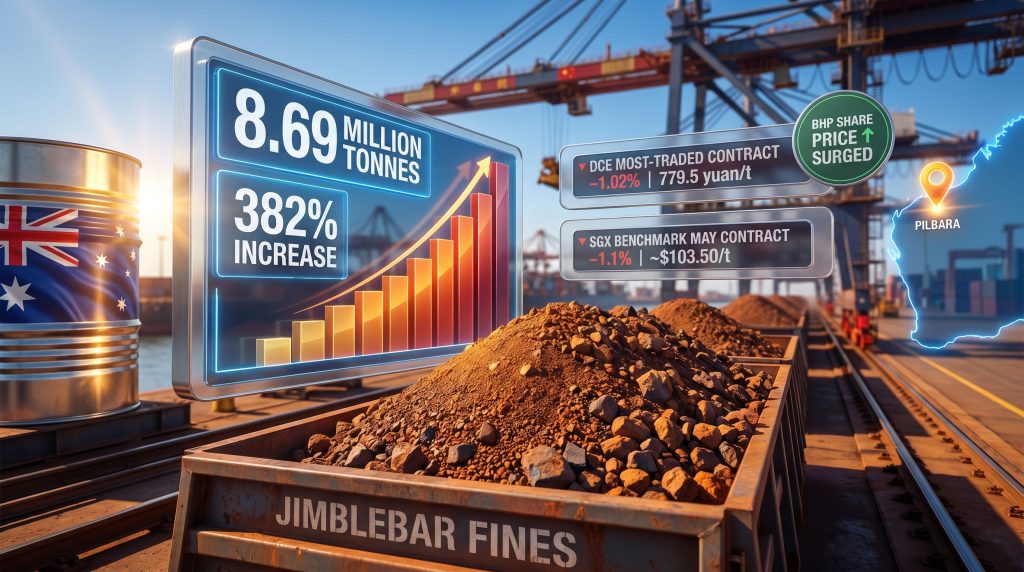
The most striking quantitative consequence of the embargo was the accumulation of Jimblebar fines at Chinese ports. According to two traders with direct knowledge of the situation, Jimblebar fines stocks across 15 major Chinese ports reached 8.69 million tonnes as of April 22, 2026. That figure represents a 382% increase compared to the inventory levels recorded in late September, when the first restriction was imposed.
To put this in perspective: 8.69 million tonnes of iron ore is roughly equivalent to approximately 87 capesize vessel cargoes, given that a typical capesize bulk carrier loads around 100,000 tonnes per voyage. This is not a rounding error in supply chain calculations. It represents a massive, immovable inventory overhang that created several simultaneous problems. In addition, the scale of this accumulation underscores the broader iron ore surplus risks that have been building across the market.
For traders holding portside inventory:
- Financing costs accumulate daily on unsold cargo, as iron ore held at port is typically funded through commodity trade finance arrangements with interest charges running continuously.
- Port storage fees apply to ore sitting in stockyards, adding ongoing operational cost to inventory that cannot be liquidated.
- Price exposure during the ban meant that any softening in broader iron ore markets eroded the notional value of held inventory without any corresponding ability to sell.
For the broader market:
- The stockpile created an artificial overhang that suppressed the effective price discovery for BHP's Pilbara products, as buyers understood that large volumes of frozen material would re-enter the market once restrictions lifted.
- Port capacity tied up by stranded BHP cargoes reduced the throughput capacity available for other iron ore products, creating secondary logistical friction across Chinese port operations.
What the Resolution Actually Required
The conclusion of contract negotiations between BHP and CMRG that ended the embargo followed direct engagement at the executive level. According to Reuters, the ban's removal came after a visit to China by BHP executives, underscoring a dynamic that observers of commodity trade diplomacy recognise well: when procurement disputes become intertwined with state-level institutions, commercial negotiation alone is rarely sufficient to resolve them.
This is a lesser-understood feature of how major iron ore trade relationships actually function at their highest levels. The negotiation is never purely about price or product specifications. It involves relationship capital between senior executives and their counterparts at Chinese industrial conglomerates, the timing of visits relative to broader bilateral diplomatic signals, and the signalling value of who travels, at what level, and under what framing.
The practical outcome of the resolution involved a specific operational mechanism: steelmakers were permitted to resume purchasing and taking delivery of previously frozen BHP portside cargoes, including Jimblebar fines, but only after submitting a formal report to CMRG. Traders holding Jimblebar fines at port were simultaneously notified that they could proceed with sales.
Does the Architecture of Control Remain Intact?
This procedural requirement, the mandatory CMRG report before delivery, is significant. It is not simply administrative housekeeping. It preserves CMRG's visibility and oversight over every transaction, maintaining the institutional architecture of centralised procurement control even as individual restrictions are lifted. The ban ends, but the architecture that enabled it remains fully intact.
How Markets Processed the News
The market response to China lifts ban on BHP iron ore cargoes followed a logic that may seem counterintuitive to casual observers but is well understood by commodity traders: the resolution was price-negative for iron ore futures, at least in the short term.
The most-traded iron ore contract on China's Dalian Commodity Exchange (DCE) fell 1.02% to 779.5 yuan per tonne (approximately $114.18 per tonne) on the day the news broke, April 28, 2026. The mechanics behind this are straightforward: the market had been pricing in the scarcity premium created by restricted BHP supply. When that restriction lifts and nearly 8.69 million tonnes of portside inventory suddenly becomes available for trade, the effective supply available to steelmakers increases significantly, pushing prices lower.
This creates an important distinction between how equity investors and commodity traders interpreted the same news. BHP's share price responded positively, because the resolution removes a significant commercial headwind for the company and restores access to its largest market. Iron ore futures moved in the opposite direction, because the commodity market is pricing the forward supply picture, where additional tonnes available from clearing portside inventory weigh on near-term price support.
The near-term price outlook is shaped by several factors that traders will be monitoring closely:
- Portside clearance pace: How quickly the 8.69-million-tonne overhang is absorbed will determine how long the downward supply pressure persists. Steelmakers are likely to prioritise cheaper port-sourced material over new seaborne procurement in the immediate term, reducing demand for fresh shipments.
- Seasonal steel demand: Chinese construction and infrastructure activity follows seasonal patterns, with demand typically rising through spring and summer. Strong seasonal demand could accelerate the absorption of portside inventory.
- CMRG's procurement posture: Whether CMRG resumes normal seaborne purchasing from BHP or continues to manage volumes carefully will shape how quickly the supply picture normalises.
Forward-looking assessments of iron ore pricing carry inherent uncertainty. The observations above reflect market dynamics at the time of the embargo's resolution and should not be interpreted as investment guidance or price forecasts.
The next major ASX story will hit our subscribers first
BHP's Pilbara Operations and the Limits of Procurement Leverage
BHP holds the position of the world's third-largest iron ore supplier, with its Western Australian Pilbara operations forming the backbone of its export volumes. The Pilbara is one of the world's most significant iron ore provinces, hosting multiple large-scale operations including the Jimblebar hub, Newman operations, and associated infrastructure that feeds into Port Hedland, the world's largest bulk export terminal by tonnage.
The diversity of BHP's Pilbara product suite matters for understanding both the scope of the ban and its inherent limits. Chinese blast furnace operators use multiple ore grades in their sinter blends because no single ore provides the optimal chemistry in isolation. Different products contribute different iron grades, gangue mineral profiles, and physical characteristics that affect sintering efficiency.
| BHP Ore Product | Origin | Primary Role in Steelmaking |
|---|---|---|
| Jimblebar Fines | Jimblebar Mine, Pilbara WA | Medium-grade fines for sinter blend |
| Jinbao Fines | Pilbara blend product | Mid-range blending component |
| Newman Fines | Newman Hub, Pilbara WA | Core high-volume blast furnace feed |
The fact that all three banned products originate from the Pilbara reflects CMRG's targeting of BHP's core export stream specifically. However, it also reveals the structural constraint on how far such restrictions can be pushed. Australia's iron ore advantage — encompassing volume, logistics efficiency, and product diversity — cannot be replicated by any alternative supply source at anything approaching current cost structures.
Guinea's Simandou project, often cited as a long-term alternative to Australian supply, remains years away from reaching meaningful export volumes. Brazilian supply from Vale, while significant, is logistically disadvantaged relative to Australia due to substantially longer shipping distances to Chinese ports. These structural realities function as a natural ceiling on how extensively CMRG-imposed restrictions can be sustained without damaging the operational efficiency of Chinese steel production itself.
The Broader Lesson for Global Iron Ore Trade
The six-month embargo and its resolution offers a case study in the limits and conditions of resource procurement as economic statecraft. CMRG demonstrated that its centralised architecture gives China genuine leverage over individual miners' market access in ways that were not fully tested before this episode. The escalating sequence of product-specific restrictions showed sophisticated calibration, applying pressure without triggering a full supply crisis.
At the same time, the resolution required CEO-level diplomatic engagement, a signal that the quasi-political dimensions of major iron ore trade relationships cannot be managed at arm's length through commercial teams alone. The precedent set by this episode will be carefully studied by every significant iron ore producer with material exposure to global iron ore trade impacts and Chinese demand dynamics.
For other major Pilbara producers, the episode raises an important strategic question: how should individual miners manage their institutional relationships with CMRG in an era where that body has demonstrated both the willingness and the capability to apply targeted procurement pressure? The answer almost certainly involves more proactive executive engagement, not just periodic commercial negotiation.
The underlying asymmetric dependency between Chinese steelmakers and Australian iron ore suppliers has not changed. China needs Pilbara ore to keep its blast furnaces running efficiently. Australia needs China to absorb its export volumes. What has changed is the institutional sophistication with which China is now managing that dependency. Consequently, the commercial and diplomatic tools that major miners will need to deploy in response must evolve accordingly. As Bloomberg reported, the China lifts ban on BHP iron ore cargoes development signals a new chapter in how resource trade relationships will be contested and negotiated going forward.
This article is based on publicly reported information available as of April 28, 2026. All price figures, stockpile volumes, and market data are sourced from Reuters reporting. Forward-looking statements regarding pricing, demand, and trade relationship dynamics are observational in nature and do not constitute financial or investment advice. Readers should seek independent professional guidance before making investment decisions related to the iron ore sector or any securities mentioned.
Want To Stay Ahead of Major ASX Mineral Discoveries Before the Broader Market Reacts?
While geopolitical forces reshape global iron ore trade, Discovery Alert's proprietary Discovery IQ model delivers real-time alerts on significant ASX mineral discoveries — transforming complex resource data into actionable investment insights for traders and investors at every level. Explore how historic discoveries have generated substantial returns and begin your 14-day free trial today to secure a market-leading edge.