June 13, 2026
Global commodity markets operate under relentless cycles of scarcity and abundance, where structural imbalances can persist for years before market forces restore equilibrium. China's lithium sector exemplifies this phenomenon, having endured three years of destructive pricing dynamics that pushed one-third of energy storage system integrators below break-even operations. The convergence of supply disruptions, regulatory intervention, and unprecedented demand from artificial intelligence infrastructure development now signals a fundamental shift in market mechanics that could reshape competitive dynamics across the entire energy storage value chain. Moreover, rising lithium costs in China are fundamentally altering the economic landscape for battery manufacturers and energy storage companies.
Understanding China's Lithium Price Surge: Market Fundamentals and Economic Drivers
The Perfect Storm: Supply Constraints Meet Explosive Demand
China's lithium market confronts an unprecedented convergence of supply-side restrictions and demand acceleration that has fundamentally altered pricing dynamics. Mining operations in Yichun, Jiangxi Province face potential license revocations affecting 27 facilities by January 2026, creating immediate supply bottlenecks in a region critical to domestic production capacity. Simultaneously, CATL's Jianxiawo mining project experiences operational delays that compound near-term supply constraints across vertically integrated producers.
The demand equation has transformed dramatically through artificial intelligence infrastructure expansion requiring massive energy storage installations. Data centers supporting machine learning workloads demand reliable backup power systems with significantly higher capacity requirements than traditional computing facilities. This AI-driven demand surge coincides with China's new energy vehicle market maintaining robust momentum, recording 20.6% year-over-year growth in November 2025 despite broader economic headwinds and evolving regulatory frameworks.
Furthermore, the lithium industry innovations emerging globally are creating additional demand pressures on raw materials. Companies are racing to secure supplies for their battery-grade lithium refinery projects, intensifying competition for available lithium resources.
Price Trajectory Analysis: From Trough to Peak
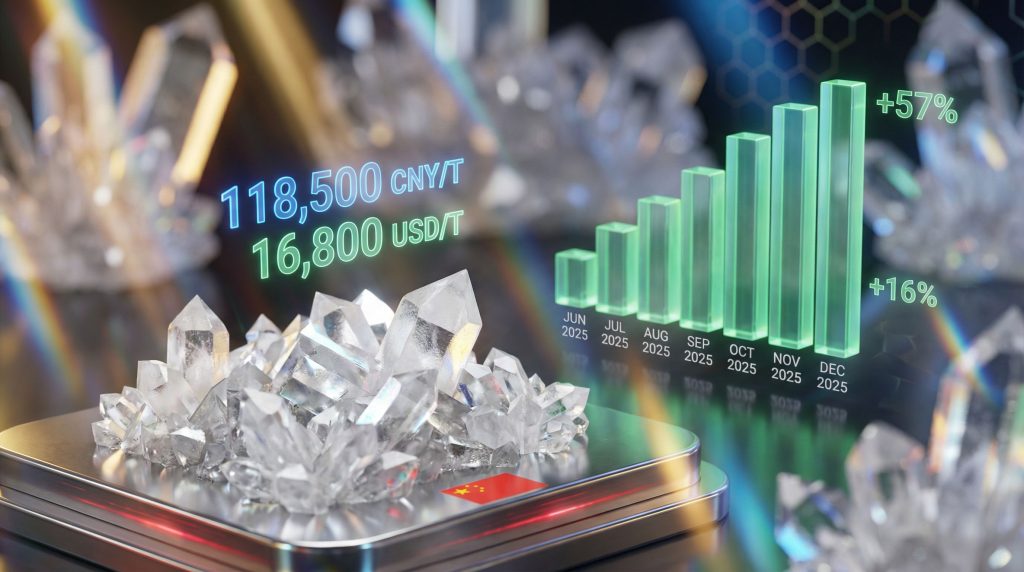
Lithium carbonate pricing demonstrates the severity of market rebalancing forces currently reshaping China's battery supply chain economics. According to Trading Economics, lithium prices have shown remarkable volatility throughout 2025. The commodity's journey from June 2025 baseline levels reveals the magnitude of structural shifts occurring across the lithium value chain.
Lithium Carbonate Price Evolution (2025)
| Period | Price (CNY/T) | Price (USD/T) | Monthly Change |
|---|---|---|---|
| June 2025 | 58,000 | 8,259 | Baseline |
| November 2025 | 94,000+ | 13,003 | +57% |
| December 2025 | 118,500 | 16,800 | +16% |
This approximately 70% rebound from yearly lows reflects more than typical commodity volatility. The sustained upward trajectory indicates fundamental supply-demand rebalancing rather than speculative positioning, particularly given the coordinated nature of downstream price increases across multiple battery manufacturers. Exchange rate fluctuations provide minimal explanation for yuan-denominated price movements, confirming domestic market dynamics drive the current cycle.
Futures Market Dynamics and Forward-Looking Indicators
Forward curve analysis reveals market expectations for sustained elevated pricing through 2026, with Ganfeng Lithium projecting potential ranges between 150,000-200,000 CNY per tonne during peak demand periods. These projections reflect anticipated global demand growth of 30-40% as electric vehicle adoption accelerates across major automotive markets while energy storage deployment scales to support renewable power integration.
The 18-month price highs achieved in December 2025 signal structural rather than cyclical market shifts. Speculative positioning remains secondary to fundamental supply constraints, as evidenced by coordinated industry responses including strategic inventory accumulation and supply chain diversification initiatives across major battery manufacturers. Additionally, projects like the Thacker Pass lithium mine are being accelerated to meet this growing demand.
When big ASX news breaks, our subscribers know first
What Does Beijing's Anti-Involution Campaign Mean for Battery Manufacturers?
Government Intervention Strategy and Industry Response
Beijing's regulatory apparatus has mobilised comprehensive measures targeting destructive competitive practices that characterised China's battery manufacturing sector over the previous three years. The Ministry of Industry and Information Technology convened emergency meetings with 12 industry leaders in late November 2025, including BYD Chairman Wang Chuanfu, signalling high-level government concern over market sustainability and industry consolidation risks.
The "anti-involution" campaign represents deliberate policy intervention designed to transition market competition from pure price-based dynamics toward value-driven differentiation. This regulatory approach acknowledges that sustained below-cost selling undermines research and development investment capacity while threatening long-term technological leadership in critical energy storage technologies.
Industry participants now operate under implicit government expectations for coordinated pricing discipline and capacity rationalisation. The ministry pledged accelerated implementation of measures curbing "irrational competition," creating regulatory framework supporting margin recovery across battery manufacturers and system integrators.
The Economics of Below-Cost Selling: A Three-Year Price War Analysis
Envision Group's August 2025 market analysis revealed the devastating impact of prolonged price competition, documenting that approximately one-third of system integrators operated below production costs throughout the preceding period. This unsustainable market structure contributed to an aggregate 80% decline in selling prices over three years, destroying industry profitability and constraining innovation investment.
The destructive competition cycle created multiple negative feedback loops:
• Margin compression eliminated research and development funding for next-generation technologies
• Quality degradation occurred as manufacturers reduced input costs to maintain competitiveness
• Market consolidation pressure threatened smaller players with bankruptcy or forced asset sales
• Employment instability emerged across manufacturing regions dependent on battery production
Pierre Lau of Citigroup Global Markets maintains scepticism regarding rapid market improvement, noting that domestic supply capacity remains elevated despite coordinated price increase announcements across multiple manufacturers.
This assessment highlights the fundamental challenge facing industry restructuring efforts: achieving sustainable competitive dynamics requires either significant demand growth to absorb excess capacity or permanent facility closures to restore supply-demand balance. However, innovative battery recycling breakthrough technologies could help alleviate some supply pressures.
How Are Energy Storage Companies Adapting to Higher Input Costs?
Strategic Price Adjustments Across the Value Chain
Battery manufacturers demonstrate unprecedented coordination in implementing price increases throughout December 2025 and early 2026, marking the first synchronised pricing action since oversupply conditions emerged in 2022. Deegares initiated this trend with a 15% lithium battery price increase announcement in December, quickly followed by similar moves from other major producers seeking margin recovery.
Hunan Yuneng targeted lithium iron phosphate cathode materials specifically, implementing 3,000 CNY per tonne fee increases effective January 2026. This targeted approach reflects the company's focus on LFP chemistry applications where price elasticity remains favourable given performance advantages in large-scale energy storage applications.
Dejia Energy adopted comprehensive pricing adjustments with 15% increases across its entire product portfolio, indicating confidence in sustained demand growth and reduced competitive pressure to maintain artificially low pricing levels.
Supply Chain Ripple Effects and Material Cost Inflation
Raw material cost pressures extend beyond lithium carbonate to encompass critical battery components throughout the supply chain. Material cost inflation creates cascading effects requiring strategic inventory management and supply contract renegotiation across the industry. In addition to domestic challenges, international lithium brine insights suggest global supply constraints will persist.
Key Battery Material Price Changes
| Material | Price Increase | Impact Timeline |
|---|---|---|
| Lithium Hexafluorophosphate | +118% to 120,000 CNY/T | Q4 2025 |
| Battery-Grade Lithium Carbonate | +16% monthly | November 2025 |
| Lithium Iron Phosphate | +3,000 CNY/T | January 2026 |
Lithium hexafluorophosphate represents the most severe input cost pressure, with 118% price increases reflecting acute supply constraints for this critical electrolyte component. The specialised manufacturing requirements and limited global production capacity create particular vulnerability to supply disruption compared to more commoditised materials.
Battery manufacturers face 30-90 day lag periods between raw material price increases and ability to implement downstream pricing adjustments due to existing supply contracts and customer negotiation timelines. This temporal mismatch between input cost inflation and revenue adjustments creates working capital pressure requiring strategic financial management.
Will Rising Costs Break China's Energy Storage "Involution" Cycle?
Market Structure Transformation Indicators
The coordinated price increases announced throughout December 2025 represent the first synchronised industry response to restore profitability since destructive competition began in 2022. This coordination suggests market participants recognise mutual benefits from transitioning away from pure price competition toward value-based differentiation strategies. Consequently, rising lithium costs in China may serve as a catalyst for this transformation.
Several indicators support potential structural market transformation:
• Pricing discipline emerges across previously fragmented competitive landscape
• Government regulatory support provides political cover for margin recovery initiatives
• Demand growth acceleration creates favourable conditions for sustainable price increases
• Industry consolidation momentum reduces marginal producer competitive pressure
The sustainability of this transition depends critically on continued demand growth absorption of existing production capacity. Without sustained volume expansion, temporary pricing coordination may collapse under competitive pressure from manufacturers with excess capacity seeking market share recovery.
Alternative Technology Acceleration
Rising lithium costs accelerate research and development investment in alternative battery chemistries that reduce dependence on lithium carbonate inputs. CATL's sodium-ion battery technology deployment represents the most advanced commercial alternative, offering cost advantages when lithium pricing exceeds critical threshold levels.
Sodium-ion batteries provide several strategic advantages during periods of lithium cost inflation:
• Raw material abundance eliminates supply constraint risks associated with lithium mining
• Manufacturing compatibility with existing lithium-ion production equipment reduces capital investment requirements
• Performance adequacy for stationary energy storage applications where energy density requirements are less stringent
• Geographic diversification reduces dependence on concentrated lithium supply chains
Major battery manufacturers accelerate sodium-ion research programmes while implementing supply chain diversification strategies beyond Chinese lithium sources. These technological hedging strategies provide insurance against sustained lithium price elevation while maintaining competitive positioning across multiple battery chemistry platforms.
What Are the Broader Economic Implications for China's Green Transition?
NEV Market Dynamics and Consumer Impact
China's new energy vehicle market faces potential demand headwinds as battery cost increases translate into higher consumer pricing for electric vehicles. Industry forecasts suggest potential 30% demand decline during early 2026 as manufacturers pass through input cost increases while government tax exemption programmes phase out simultaneously.
The convergence of rising lithium costs and reduced policy support creates challenging market conditions for sustained EV adoption growth. Consumer price sensitivity becomes more pronounced when purchase incentives diminish while vehicle costs increase, potentially slowing China's transportation electrification timeline.
Export market restrictions, particularly regarding US market access, limit Chinese manufacturers' ability to offset domestic demand softness through international expansion. This geographic constraint intensifies focus on cost management and technological differentiation to maintain competitive positioning in accessible global markets.
Global Competitive Positioning Analysis
Chinese battery manufacturers face strategic decisions regarding margin recovery versus market share preservation during the current commodity cost cycle. Sustained input cost pressure tests the viability of export-focused strategies built on cost leadership rather than technological differentiation.
Rising lithium costs create opportunities for international competitors utilising alternative supply chains or battery chemistries less dependent on Chinese mineral processing capacity. Japanese and South Korean manufacturers may gain competitive advantages if they successfully diversify supply sources or develop superior alternative technologies.
China's response involves strategic stockpiling initiatives and long-term supply contract negotiations designed to insulate domestic manufacturers from spot market volatility. State-sponsored resource acquisition programmes target international lithium assets while domestic recycling capacity expansion reduces primary material dependence over time.
How Should Investors Navigate This Commodity Cycle Shift?
Equity Market Response and Valuation Implications
Ganfeng Lithium's 7.48% rally following demand growth projections demonstrates investor recognition of the fundamental supply-demand rebalancing occurring across lithium markets. As reported by Reuters, this surge follows the chairman's prediction of a 2026 demand boom. Equity valuations reflect expectations for sustained pricing power restoration rather than temporary cyclical improvement.
Sector rotation patterns favour upstream lithium producers and mining companies over downstream battery manufacturers during periods of input cost inflation. Investors recognise that raw material suppliers capture disproportionate value during commodity up-cycles while manufacturers face margin compression until successful price pass-through completion.
Valuation methodologies must incorporate geopolitical supply chain security considerations as traditional cost-based competitive advantages become secondary to resource access reliability. Companies with diversified supply sources or vertical integration strategies command premium valuations reflecting reduced operational risk exposure.
Forward-Looking Investment Considerations
Global lithium demand projections supporting 27% growth to 1.8 million tonnes lithium carbonate equivalent in 2026 provide fundamental support for sustained pricing strength. These growth rates exceed historical expansion patterns, indicating structural demand acceleration rather than cyclical recovery.
Production capacity utilisation rates across Chinese lithium processing facilities approach maximum levels, constraining near-term supply response capability. New capacity development requires 24-36 month lead times, ensuring supply constraints persist through 2027 regardless of commodity price incentives.
Investment strategies must account for technological disruption risks as rising lithium costs in China accelerate alternative battery chemistry development. Sodium-ion, lithium iron phosphate, and recycling technologies represent potential competitive threats to primary lithium demand over medium-term investment horizons.
Investment decisions involving commodity exposure carry significant risks including price volatility, regulatory changes, and technological disruption. Past performance does not guarantee future results, and investors should conduct thorough due diligence before making investment commitments.
The next major ASX story will hit our subscribers first
Frequently Asked Questions About China's Lithium Cost Surge
Why are lithium prices rising so rapidly in China?
Multiple factors converge to drive unprecedented lithium cost inflation throughout 2025. Supply disruptions from mining licence complications in key production regions create immediate capacity constraints while explosive growth in artificial intelligence data centre energy storage requirements generates unexpected demand acceleration.
Coordinated industry efforts to eliminate destructive price competition represent equally important demand-side factors. Government intervention targeting "involution" dynamics enables manufacturers to restore rational pricing rather than continuing unsustainable below-cost selling practices that characterised the previous three years.
How long will elevated lithium costs persist?
Structural demand growth patterns suggest sustained higher pricing through 2026 and potentially beyond, depending on alternative technology deployment success and supply capacity expansion timing. New lithium production sources require 24-36 month development timelines, constraining near-term supply response capability regardless of price incentives.
Government intervention may moderate extreme volatility while supporting general price level elevation. Regulatory coordination provides industry stability that encourages long-term investment in capacity expansion and technological development rather than short-term competitive positioning.
What does this mean for global EV adoption?
Short-term price increases may slow adoption rates in price-sensitive markets where consumers exhibit high elasticity of demand for electric vehicles. However, long-term technology development trends accelerate toward cost reduction through alternative chemistries, improved manufacturing efficiency, and recycling capacity expansion.
Regional supply chain strategies become critical for automakers seeking to minimise exposure to Chinese lithium market volatility. Diversification initiatives including North American and Australian supply development provide hedging strategies against concentrated supply chain risks.
A New Era for China's Energy Storage Economics
The convergence of supply constraints, demand acceleration, and government intervention marks a potential inflection point for China's energy storage sector that extends far beyond temporary commodity price fluctuations. Rising lithium costs in China create immediate challenges for manufacturers and consumers while simultaneously forcing long-overdue industry rationalisation that may ultimately restore sustainable competitive dynamics.
The success of this market transformation will determine whether China maintains global leadership in clean energy technologies while building economically viable domestic industry structure. Coordinated pricing discipline, technological diversification, and supply chain resilience represent critical factors supporting this transition from destructive competition toward value-based market dynamics.
As artificial intelligence infrastructure deployment accelerates and renewable energy integration demands expand, China's energy storage industry faces unprecedented growth opportunities alongside significant operational challenges. The ability to balance margin recovery with technological advancement will define competitive positioning throughout the next commodity cycle phase.
Investment in alternative technologies, supply chain diversification, and manufacturing efficiency improvements provides strategic hedging against future lithium cost volatility while supporting China's broader green transition objectives. The current market restructuring creates foundation for sustainable industry development that balances profitability with continued innovation leadership.
Looking for the Next Mineral Discovery Before Market Impact Occurs?
Discovery Alert's proprietary Discovery IQ model delivers real-time alerts on significant ASX mineral discoveries, instantly empowering subscribers to identify actionable opportunities ahead of the broader market. Begin your 30-day free trial today and secure your market-leading advantage whilst positioning yourself for the next major breakthrough.