
August 23, 2026
Africa's Most Consequential Resource Partnership Is Being Built From the Ground Up
When external powers compete for access to frontier resource territories, the decisive advantage rarely belongs to whoever arrives first with capital. It belongs to whoever arrives with the most complete understanding of what lies beneath the surface. Geological intelligence — the granular subsurface data that maps what exists, at what depth, in what concentration, and at what extraction cost — is the foundational asset in any resource competition. Before a single tonne is mined or a cubic metre of gas is piped, the party that controls the survey data controls the negotiating table.
This principle sits at the core of the recently announced China Mozambique gas and minerals deal, a sweeping bilateral agreement signed following direct presidential-level talks in Beijing between Chinese President Xi Jinping and Mozambican President Daniel Chapo. The arrangement is structurally unlike any previous Sino-African resource pact and represents something considerably more ambitious than a commodity access agreement. It is, in analytical terms, a long-cycle sovereign integration strategy.
When big ASX news breaks, our subscribers know first
What Separates This Deal From Every Previous Sino-African Resource Agreement?
Most historical resource agreements between China and African nations followed a recognisable template: Chinese state-backed capital finances infrastructure, typically roads, ports, or railways, in exchange for preferential access to extractive assets. The infrastructure-for-resources model delivered tangible outcomes in both directions but left the host nation structurally positioned as a raw material exporter rather than an industrial participant.
The China-Mozambique framework, however, departs from this template across four interlocking dimensions that together constitute a qualitatively different form of engagement:
- Geoscientific intelligence gathering through comprehensive geological surveys of Mozambique's largely unmapped northern mineral deposits
- Industrial infrastructure investment, with Chinese financing directed toward domestic processing plants designed to shift Mozambique from raw commodity export toward value-added manufacturing
- Energy system development encompassing LNG infrastructure, power generation capacity, and renewable energy frameworks
- Security architecture, including counterterrorism training, military equipment transfers, and joint exercises targeting insurgency-affected zones in Cabo Delgado province
The simultaneous deployment of all four dimensions within a single bilateral framework is what gives this deal its strategic weight. Each pillar reinforces the others: security stabilisation unlocks geological access, geological data enables informed industrial investment, and industrial investment creates the export infrastructure that monetises the energy assets.
Mozambique's Resource Endowment: Scale, Composition, and Strategic Value
Understanding why this deal matters requires a clear picture of what Mozambique actually holds in the ground, and why those resources carry outsized significance in the current global energy and manufacturing transition.
| Resource Category | Estimated Scale | Primary Location | Global Significance |
|---|---|---|---|
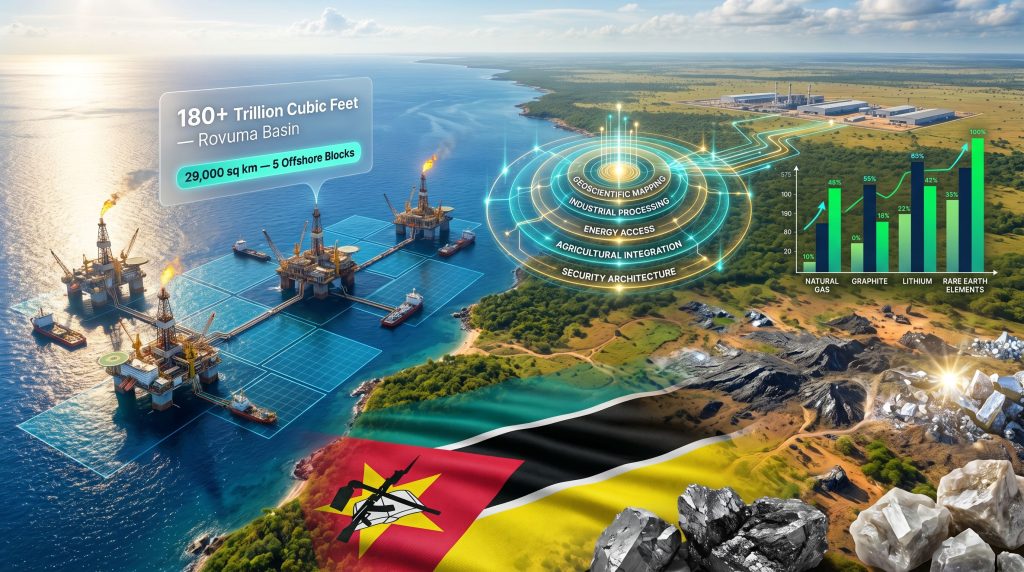
| Natural Gas | 180+ trillion cubic feet (5 trillion cubic metres) | Rovuma Basin | Top-tier LNG export potential |
| Graphite | Significant untapped reserves | Cabo Delgado (north) | Battery anode supply chain |
| Lithium | Underexplored deposits | Northern provinces | EV battery manufacturing |
| Rare Earth Elements | Largely unmapped | Northern provinces | Advanced technology inputs |
| Offshore Oil and Gas | 29,000 sq km across five blocks | Offshore (500-2,500m depth) | New hydrocarbon frontier |
The Rovuma Basin's more than 180 trillion cubic feet of proven natural gas places Mozambique among the top tier of gas-endowed nations globally, comparable in reserve scale to major LNG exporters. The basin's deepwater pre-salt architecture, with hydrocarbon-bearing formations at significant depth, is technically analogous to Brazilian pre-sal fields that transformed that country's energy export profile over two decades. Furthermore, the broader implications for global LNG supply dynamics are considerable, given Mozambique's proximity to high-demand Asian markets.
But it is the critical minerals dimension that generates the most strategic interest in the current global environment. Graphite, lithium, and rare earth elements in Mozambique's northern provinces are simultaneously in high demand globally and largely unquantified due to the convergence of security disruption and infrastructure deficits that have prevented systematic geological surveying. According to the International Energy Agency's projections on critical minerals demand and the clean energy transition, graphite demand alone is expected to increase several times over by the mid-2030s as electric vehicle production scales globally, with the mineral serving as the primary anode material in lithium-ion battery cells.
"The combination of a world-class natural gas basin and an unmapped critical minerals frontier in the same country is genuinely rare. Mozambique holds the dual role of energy supplier and materials supplier for the global green energy transition, and the China Mozambique gas and minerals deal positions Beijing to shape both dimensions simultaneously."
For offshore hydrocarbons, CNOOC subsidiaries have signed exploration and production contracts covering five blocks totalling approximately 29,000 square kilometres at operational depths ranging from 500 to 2,500 metres. The initial exploration mandate spans four years. This commitment extends a relationship that predates the current agreement; CNOOC signed a gas purchase agreement with Mozambique's state energy company ENH as early as 2019, demonstrating a sustained strategic orientation toward the Rovuma Basin rather than an opportunistic entry.
The Geoscience Advantage: Why Data Is the Real Prize
The geological survey component of the agreement is delivered through two institutional vehicles: the China-Africa Geoscience Cooperation Centre and the Belt and Road International Geoscience Education and Training Centre. These platforms provide the organisational framework for conducting systematic mineral mapping across Mozambique's northern provinces.
What makes this dimension strategically significant is a dynamic that is rarely discussed in mainstream coverage of resource agreements. Subsurface geological data — the detailed survey intelligence that quantifies what minerals exist, at what ore grades, in what deposit geometries, and at what extraction economics — is not simply technical information. It functions as a strategic asset that creates durable informational asymmetry.
Whoever holds the survey data understands:
- Which deposits warrant development investment and which do not
- What ore grades and tonnages are commercially viable at current commodity prices
- Which areas should be prioritised in future licensing rounds
- What processing infrastructure will be required and at what capital cost
- How competing mineral projects in adjacent regions compare on economic merit
"China's geological survey investment operates as a data-acquisition strategy. Early-mover access to subsurface intelligence creates an informational advantage over future licensing rounds that no amount of capital commitment can easily replicate once that asymmetry is established."
Mozambique's northern mineral deposits remain largely unsurveyed because the Cabo Delgado insurgency, active since 2017, has made systematic field survey work logistically and physically dangerous. Infrastructure deficits compound the problem: limited analytical laboratory capacity, inadequate road access to survey sites, and restricted equipment mobility have collectively frozen the geological knowledge base for an entire mineral-rich corridor.
This is precisely why the geological survey component of the deal is sequenced first. Without a quantified subsurface picture, no rational investment decision can be made about processing infrastructure. China is effectively offering to bear the cost and risk of mapping a resource frontier that will subsequently anchor all downstream industrial decisions.
China's Five-Layer Integration Model Explained
The full architecture of China's engagement in Mozambique operates across five functional layers that work in sequence and reinforce each other:
- Geoscientific intelligence: Systematic mapping of mineral deposits before commercial extraction to establish the informational foundation for all subsequent decisions
- Industrial infrastructure: Construction of domestic processing facilities to enable value-added manufacturing rather than raw commodity export
- Energy system development: Natural gas monetisation through LNG infrastructure, combined with power generation and renewables development
- Agricultural and logistics integration: Zero-tariff import channels for Mozambican agricultural products, irrigation system development, seed technology transfer, and logistics corridor investment
- Security stabilisation: Counterterrorism training programmes, military equipment provision, and joint exercises targeting Cabo Delgado
This layered model contrasts fundamentally with Western institutional approaches that typically seek targeted financial exposure to individual operations rather than shaping the broader industrial and security environment. The distinction matters because it determines what each partner can extract from the relationship over time, and what obligations each partner accepts. In addition, the broader context of metals and mining geopolitics in 2025 makes this framework all the more consequential for competing global powers.
The Cabo Delgado Insurgency: Is Security the Key Variable?
No analysis of the China Mozambique gas and minerals deal is complete without examining the insurgency that has defined the investment environment in northern Mozambique since 2017. An Islamist insurgency in Cabo Delgado province has displaced more than one million people, disrupted multiple major energy and mining projects, and created a security environment that has historically deterred Western institutional capital from making long-term commitments to the region.
The strategic logic of including security cooperation in the bilateral framework is direct: Cabo Delgado is not merely one of Mozambique's northern provinces. It is the geographic location of the most significant graphite deposits, the primary zone for unmapped critical mineral potential, and the corridor through which LNG infrastructure must operate. Stabilising it is not a humanitarian objective separate from the resource agenda; it is a prerequisite for the entire investment thesis.
What Does China's Security Commitment Actually Include?
China's security cooperation commitments embedded in the agreement include:
- Military training programmes for Mozambican counterterrorism forces
- Equipment provision to build operational capacity
- Joint military exercises designed to enhance interoperability
This represents a meaningful evolution in China's Africa engagement doctrine. Previous frameworks emphasised economic partnership and infrastructure investment while avoiding direct security entanglement. The Mozambique agreement signals a willingness to accept the role of security guarantor when strategic resource interests are sufficiently large. According to recent reporting on the agreement, Beijing and Maputo have moved quickly to formalise the mineral mapping arrangements despite the ongoing instability.
| Dimension | China's Approach | Western Approach (e.g., US DFC) |
|---|---|---|
| Security involvement | Direct military training and equipment provision | Indirect, relying on regional multilateral partners |
| Investment structure | State-led, integrated multi-sector package | Targeted equity stakes in existing operations |
| Geological intelligence | Comprehensive sovereign surveys prior to licensing | Commercially driven, project-specific data |
| Risk tolerance | High, accepts frontier instability as manageable | Low, prefers established jurisdictions |
| Value chain positioning | Full-spectrum from mapping through to processing | Primarily extraction and offtake arrangements |
"A scenario worth serious consideration: if Chinese security assistance achieves meaningful stabilisation of Cabo Delgado, the informational, infrastructural, and political positioning Beijing accumulates across the entire northern resource corridor could translate into durable influence over global graphite supply dynamics and rare earth element pricing well beyond what any financial stake in a single mine could deliver."
The next major ASX story will hit our subscribers first
The United States' Contrasting Approach: Financial Exposure Without Industrial Control
The contrast between China's integrated model and the US approach is instructive for understanding the long-term strategic implications of each framework. The US International Development Finance Corporation (DFC) has pursued a targeted supply chain security strategy in Mozambique centred on existing operational assets.
The DFC's plan involves converting a $31 million loan into approximately a 20% equity stake in Syrah Resources, the Australian-listed operator of the Balama graphite mine in Cabo Delgado. An additional $15 million investment is directed toward Twigg Exploration and Mining Limitada, the local operating entity at the Balama site. The Balama mine is one of the world's largest graphite operations by designed production capacity, at approximately 350,000 tonnes per annum of graphite concentrate, representing a substantial share of non-Chinese global supply capacity.
This approach secures American financial exposure to a critical mineral asset but does not shape the geological knowledge base, the security environment, the processing infrastructure, or the industrial policy framework surrounding that asset. It is a supply chain security play executed through financial instruments rather than a sovereign industrial partnership.
The structural gap between the two models produces materially different long-term outcomes:
- China builds infrastructure, controls subsurface data, provides security, and shapes industrial development, creating multi-decade institutional dependencies
- The US secures financial participation in one established operation without influencing the broader environment that determines how that operation will perform
"Mozambique's capacity to negotiate favourable terms with either partner depends on its ability to sustain genuine strategic optionality — engaging both without becoming structurally captured by either. That optionality narrows progressively as geological survey data concentrates in Chinese institutions and as security relationships deepen."
Three Scenarios for Where the China-Mozambique Partnership Goes From Here
Scenario 1: Full Integration Success
Chinese security assistance achieves meaningful stabilisation of Cabo Delgado over a three to five year horizon. Geological surveys across the northern provinces identify commercially viable graphite, lithium, and rare earth element deposits. Processing infrastructure is constructed, LNG exports expand significantly, and Mozambique transitions from raw material supplier to industrial participant within a decade. Outcome: China secures preferential upstream positioning across one of Africa's most significant resource corridors while Mozambique achieves industrial diversification, albeit with deep structural dependency on a single dominant partner.
Scenario 2: Partial Execution
Security cooperation achieves limited stabilisation, reducing insurgency intensity but not eliminating it. Geological surveys proceed in accessible areas but processing investment lags behind schedule. LNG development advances while critical minerals remain a contested and underinvested frontier. Outcome: China consolidates its position in Mozambique's gas sector while critical minerals development creates an opening for Western capital to re-enter on competitive terms.
Scenario 3: Strategic Disruption
The insurgency intensifies or adapts in ways that neutralise Chinese security assistance. Infrastructure investment timelines extend significantly. Western partners leverage instability to introduce multilateral security frameworks that complicate Chinese positioning. Outcome: Mozambique's resource development is substantially delayed across all categories, geopolitical competition over Cabo Delgado intensifies, and the bilateral framework's credibility is stress-tested in ways that affect China's broader Africa strategy.
The Moamba Industrial Park and the Agricultural Dimension
Beyond hydrocarbons and critical minerals, the agreement encompasses two strategic complements that extend Beijing's influence beyond the resource sector. The Moamba Industrial Park and Special Economic Zone functions as a controlled environment for establishing manufacturing footholds linked to Mozambique's mineral and agricultural output. Special economic zones have historically served as the entry points through which China has established processing and light manufacturing capacity in host nations, creating industrial dependencies that outlast any individual commodity agreement.
The agricultural cooperation components carry an additional strategic logic that is easy to underestimate. Zero-tariff access for Mozambican exports to China, a dedicated green channel for agricultural trade, irrigation infrastructure investment, and seed technology transfers all serve an indirect stabilisation function. Food insecurity in conflict-affected northern communities has historically contributed to the social conditions that sustain insurgent recruitment. Agricultural investment that reduces that insecurity builds popular legitimacy for Chinese economic engagement at the community level, independent of any security assistance directed at military counterterrorism operations.
What the Deal Signals for Africa's Resource Future
The China Mozambique gas and minerals deal is significant not only for what it delivers within Mozambique but for the precedent it establishes across the continent. The structural template it deploys — bundling geological intelligence, industrial investment, energy infrastructure, agricultural trade, and security cooperation into a single sovereign package — represents a form of external partnership that Western institutional frameworks have so far been unable to match in either scope or delivery speed.
Resource-rich African nations observing this arrangement are presented with a compelling offer: access to capital, technology, security, and market access in a single integrated package from a partner willing to operate in frontier risk environments that Western investors systematically avoid. The trade-off — the progressive concentration of informational, infrastructural, and political leverage in a single dominant external partner — is real but long-dated enough to feel abstract against the immediate development imperatives facing governments in these nations.
Consequently, rare earth supply chains globally could be materially reshaped if Mozambique's unmapped northern deposits prove commercially significant. Furthermore, China's rare earth strategy — already a defining factor in global technology supply chains — stands to gain another strategic node through this agreement. As analysis of President Chapo's Beijing visit confirms, Mozambique is actively courting Chinese investment as the foundation of a new strategic era.
Xi Jinping's stated intent to explore new pathways for cooperation in infrastructure and comprehensive energy and mineral development signals that Mozambique is intended as a replicable model rather than a one-off arrangement. The implications for the global critical minerals supply chain, for LNG market dynamics, and for the broader geopolitical competition over Africa's resource endowment are substantial.
Disclaimer: This article contains forward-looking analysis, scenario modelling, and projections based on publicly available information. It does not constitute financial or investment advice. Readers should conduct independent due diligence before making any investment decisions related to the companies, sectors, or geographies discussed.
Want to Track the Next Major Mineral Discovery Before the Market Does?
The critical minerals and resource dynamics reshaping global supply chains — from graphite to rare earth elements — create real opportunities for investors who act on significant ASX discoveries the moment they are announced. Discovery Alert's proprietary Discovery IQ model delivers real-time alerts on major ASX mineral discoveries, turning complex geological and commodity data into actionable insights across more than 30 commodities. Explore historic examples of exceptional discovery returns and start your 14-day free trial today to position yourself ahead of the broader market.